
What an Albanian wedding is
An Albanian wedding is not a ceremony. It is a multi-day, multi-event production — sometimes a full week, sometimes a long weekend in the diaspora — with the wedding day itself as the public peak of a much longer family negotiation. The structure is older than any of the modern Albanian states, and it survives in roughly the same shape whether the family is from Albania, Kosovo, North Macedonia, Montenegro, the Italian Arbëresh communities, or the US diaspora.
For most Albanian families, the wedding is the most important social event of the year. The guest list often runs into the hundreds, spread across multiple celebrations — extended family from three or four countries, parish or mosque communities, regional associations, neighbors, coworkers, and the friend networks of every adult sibling. Weddings are when the diaspora reassembles. Cousins fly in from Detroit and Pristina. Grandparents arrive a week early and stay a month.
The traditions are layered. Ottoman-era betrothal customs sit underneath; Catholic, Orthodox, Sunni, and Bektashi religious overlays sit on top; mid-20th-century communist-era simplifications shaped what got compressed; and the post-1991 diaspora has done its own adaptation. What survives is what gets practiced — the valle line dance, the engagement candy, the threshold rituals, the food.
This guide covers what those traditions are, what to expect as a guest, and which elements travel intact to the Albanian-American wedding. We’ve kept it neutral on the regional and religious variations — every Albanian wedding is a little different, and arguments about whose version is “the real” version are arguments we are not interested in winning.
The wedding week: jav’ e nuses
The traditional cycle is jav’ e nuses — “the week of the bride” — a sequence of pre-wedding events that begin roughly a week before the ceremony and build in intensity through the wedding day itself.
The week is organized around movement between two households. The groom’s family visits the bride’s. The bride’s family visits the groom’s. Food is prepared in both kitchens and shared across both. Gifts move in both directions. By the wedding day, every member of both families has seen every other member multiple times, and the “two families becoming one” framing has been rehearsed in practice rather than only in toast.
A typical week sequence looks something like this. Early in the week, the formal fejesa commitments are reaffirmed and the kufeta (sugared almonds — the Albanian word comes from the Italian confetti) are distributed publicly. Mid-week, the gift exchanges intensify: the bride’s family receives sweets, fruit, and raki from the groom’s; the groom’s family receives the paja items the bride is bringing. In some traditions, especially in northern Albania, Kosovo, and North Macedonia, a pre-wedding henna night is held — a women-only gathering at the bride’s home, with henna applied to her hands as a symbol of fertility and protection.
Through the week, food preparation runs continuously in both kitchens. Whole sheep are slaughtered for the wedding day. Trays of byrek are layered, the dessert pans are filled with bakllava and trilece, and the raki bottles are distributed across both households for toasting throughout the week. In rural Albania this preparation is communal — neighbors arrive with their own trays and contributions — and the kitchen runs on women working in shifts.
The day immediately before the wedding is the heaviest. The bride is dressed by women of her family, the groom’s vellam (best man) prepares for his ceremonial role the next day, and both households finalize the seating, the music, and the religious arrangements. By the time the wedding morning arrives, the families have been at full event pace for six or seven days.
In the diaspora, the full week is rare. Most Albanian-American weddings compress the cycle into a Friday-Saturday-Sunday weekend, with the engagement separately observed weeks or months earlier. The kitchen prep is outsourced to caterers. The henna night, when held, is a single evening rather than an embedded part of a longer week. But the structural logic — events building across multiple days, both families visibly involved — survives even in compressed form.
The engagement: fejesa
The fejesa is the formal engagement ceremony, often held weeks or months before the wedding itself. The mechanics are old. The groom’s family — typically led by his father, with his mother and a small delegation of close relatives — travels to the bride’s family home, bringing gifts and a formal request for her hand.
The gifts are specific. Sweets and fruit are standard. In northern Albanian and Kosovar traditions, raki is exchanged between the fathers as a sealing gesture. The bride traditionally receives a gold coin (flori) — a tradition that traces to Ottoman-era betrothal practices, where the gold piece served as a public marker of the family’s commitment and the bride’s secured status. In some families the flori is a single coin; in others it is a small set of gold pieces or jewelry.
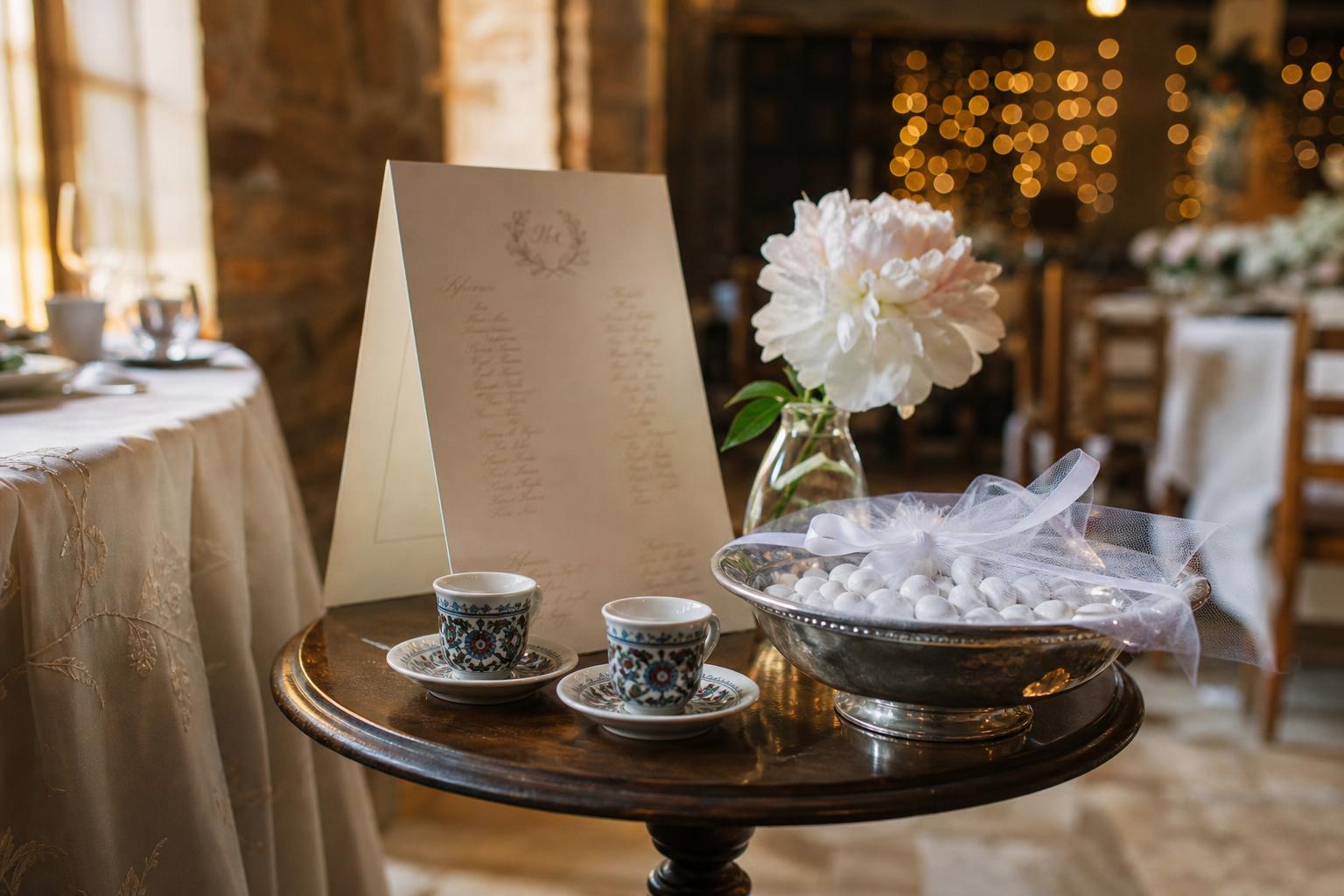
Once the families are agreed and the gifts are presented, the kufeta are shared — sugared almonds passed around the room, then distributed to absent relatives and neighbors as a public announcement. In some regions the kufeta are wrapped in small tulle bundles tied with ribbon; in others they are scattered openly. Either way, the kufeta moving outward through the family network is the engagement equivalent of a wedding announcement in the newspaper. Once you’ve received kufeta, you know.
The fejesa is a public commitment binding both families, not only the couple. Historically, breaking an engagement after the fejesa was a serious matter — closer to a contractual rupture than a relationship update — because the besa (the Albanian code of honor) of both households had been given. In the diaspora, the fejesa has softened into something closer to an American engagement party in feel, but the structure is the same: an event held at the bride’s family’s home or a small venue, both families present, gifts exchanged, kufeta distributed.
The interval between the fejesa and the wedding varies. In Albania and Kosovo, three to twelve months is typical. In the US diaspora, where venue calendars and travel logistics drive the schedule, the interval often stretches to a year or more.
The dowry: paja
Traditionally, the bride’s family prepared a paja — a trousseau of household items, embroidered linens, clothing, and sometimes furniture — for the new household she would join. The paja was both a practical contribution and a public display of the bride’s family’s care. A grandmother’s hand-embroidered pillowcase, passed from mother to daughter to daughter again, is a paja item.
In rural Albania, the paja is sometimes still presented at the wedding itself, with the items displayed for guests to see before being carried to the new home. The display is celebratory rather than transactional — pride in craft, not a price tag.
In the diaspora, the paja tradition has largely faded. Modern Albanian-American families substitute money gifts at the wedding, and the registry is the cash envelope rather than a furniture set. What survives most reliably is the embroidered textile element: a single hand-stitched pillowcase, tablecloth, or set of linens, presented as a paja token rather than a full trousseau. The gesture is preserved; the scale has shrunk.
This is one of the cleaner examples of how Albanian wedding tradition adapts to the diaspora. The economic logic that produced the paja — pre-industrial households needing material setup — does not apply to a couple who already has an apartment and an Amazon registry. The symbolic logic survives in a single embroidered piece rather than a wagon-load.
The bride’s preparation
The night before the wedding, the bride is dressed by women of her family — her mother, sisters, aunts, grandmothers, and close family friends. The dressing is itself a ritual. Wine or raki is offered. Final wishes are spoken from the mother to the daughter, often with the grandmother present. Photos are taken throughout. The mood is celebratory but heavy, because the dressing marks the practical end of the bride’s status as a member of her birth household.
The vellam — sometimes spelled vëllam, literally “blood-brother” — has his own role to play. The vellam is the groom’s best man, but the term carries more weight than “best man” does in English. He is often a male relative, a long-standing family friend, or in some traditions a godfather figure. The role is for life, not just for the wedding day.
The vellam traditionally brings the bride’s shoes — filled with rice and almond candies, wrapped in a silk handkerchief. The rice and candies symbolize fertility and sweetness; the silk wrapping signals respect. As part of the ritual, coins are thrown three times, and everyone present tries to catch them. The catching is lighthearted — a scramble of cousins and children — but the symbolism is serious: the coins represent prosperity flowing into the new household, and catching them is a small share of that abundance.
In the diaspora, the bride’s preparation has often migrated to a hotel suite or salon rather than the family home, but the women-of-the-family element survives. A second-generation Albanian-American bride being dressed at a Westchester hotel by her mother, two aunts, and three cousins is observing the same ritual her grandmother observed in a village living room — different room, same shape.
The water tradition
A more rural Albanian tradition, observed less frequently in the diaspora and now mostly in specific regions of Albania: a midnight water-collecting ritual on the night before or the morning of the wedding. The bride, groom, and family travel to three bodies of water in three different directions — typically a spring, a river, and a well or fountain — fill containers at each, and throw coins into the water for anyone to collect.
The symbolism is plural. Three directions: blessings arriving from multiple sides. Three water sources: continuity with the land and with the historical importance of water rights in highland communities. Coins thrown openly: prosperity shared with the broader community rather than hoarded by the new household.
In modern Albania the water tradition is now largely a rural-village practice rather than a city one. In Kosovo and North Macedonia it survives in specific communities. In the US diaspora it has effectively disappeared as a literal practice — three directional water sources are not easy to arrange in a New Jersey suburb — but the underlying logic shows up in modified form: coins scattered at the threshold of the new home, or at the entrance to the reception hall.
The wedding day
The wedding day itself runs long. In a traditional sequence, the day involves five distinct phases.
Religious ceremony. Depending on the family’s confession: Catholic Mass, Orthodox liturgy, Muslim nikah, or civil ceremony at a town hall or registry office. Mixed-confession Albanian weddings are common — Catholic-Orthodox, Catholic-Muslim, Orthodox-Muslim — and many families hold a religious element from one tradition alongside a civil ceremony, or invite officiants from both backgrounds. The Albanian world has lived with confessional pluralism for centuries; weddings are where it shows up most visibly.
Photo session. Between the religious ceremony and the reception, the couple and the wedding party take formal photos — often at a scenic location: a city square, a waterfront, a national monument, a church or mosque facade. In the diaspora the photo locations have an Albanian-American character: the Brooklyn Bridge, the Detroit riverfront, a Boston harbor view.
Procession to the reception hall. This is one of the loudest moments of the day. Cars travel in convoy, horns blaring continuously, Albanian flags waving from windows, and Albanian music — çifteli recordings, modern pop-folk — playing at full volume from the lead vehicles. In some traditions the lead car carries the vellam and the groom; in others the bride and groom travel together. The procession is announcement and celebration in one. Neighbors hear it coming for blocks.
Welcome at the door. When the couple arrives at the reception hall, the groom’s mother traditionally meets them at the entrance and breaks bread — sometimes a round loaf split over the bride’s head, sometimes a piece each handed to bride and groom. The bread-breaking is ancient: a marker of the new household’s first shared meal, with the mother-in-law as host. The bride and groom then step over the threshold together, often with coins or candies scattered at their feet, and enter the reception hall as a married couple.
The reception itself, which runs four to eight hours and absorbs the rest of the day. Everything from the procession onward is structured around the reception. Once you are in the hall, you are in for the long form.
The reception
The reception is where the Albanian wedding does most of its visible work.
Music. A traditional Albanian wedding reception runs a sazi ensemble for the traditional segments: clarinet, violin, accordion, and def (frame drum), playing regional folk music for the valle and the more formal moments. Once the traditional segments are done — usually after the cake and the first round of speeches — the room transitions to a DJ playing modern Albanian pop, Balkan dance, and international hits. Many Albanian-American weddings now run hybrid setups where the sazi musicians and the DJ alternate through the night.
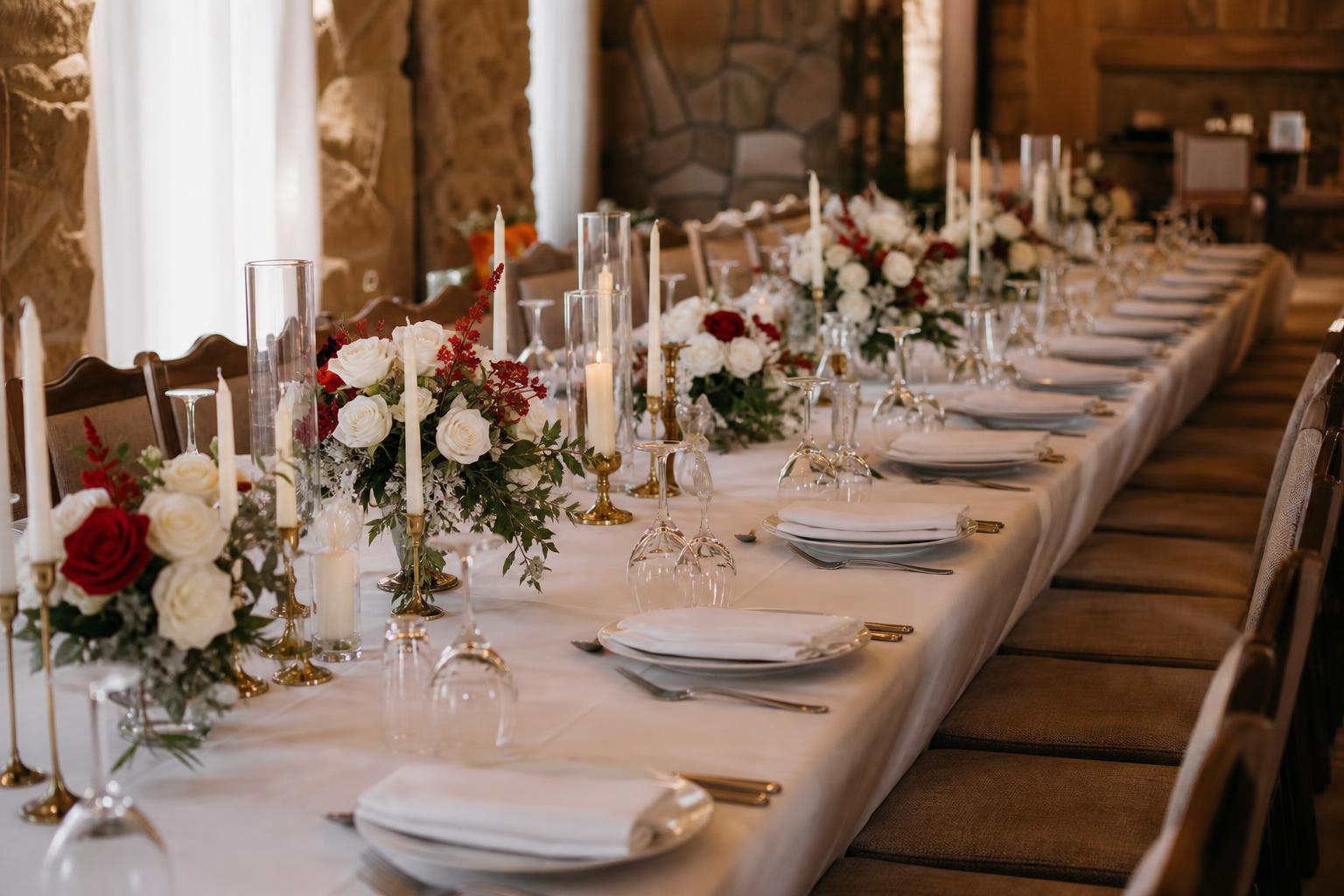
Food. The Albanian wedding menu is heavy and abundant. Byrek leads off as the appetizer — savory layered filo pastry, often filled with cheese, spinach, leek, or meat. The main course is typically tavë kosi (baked lamb in a yogurt-egg sauce) or whole roasted lamb served family-style. Salads, grilled vegetables, rice pilafs, and seasonal fruit fill the table. For dessert: trilece (three-milk cake) and bakllava, often served together. The drinks are raki — usually grape, sometimes plum or mulberry, distilled at home or by a family friend — for toasts, and red wine for the meal. Coffee comes after.
Dance. The valle is the structural center of the reception. The line dance forms early, led by the bride and groom and the eldest male family members from both sides, and runs continuously for hours. The line snakes around the entire reception hall. Children join. Grandparents join. Cousins who have never met before join, holding the same handkerchief between them. Regional variations show up depending on the family’s roots: valle e Tropojës from the north, valle e Lunxhërisë from the southern Gjirokastër region, valle e Devollit from the southeast. A wedding with families from multiple regions will cycle through several valle across the night.
Money throwing. During the valle and at intervals through the reception, guests pin paper bills to the bride and groom — sometimes directly to clothes, sometimes onto a sash worn for the purpose, sometimes attached with clothes pins to a specific area. The tradition is called qebze in some regions, “the money dance” in plain English. The money is the couple’s to keep. At a well-attended wedding it can run into thousands of dollars, and the pinning runs through the night with guests rotating in and out of the gesture as they take the floor.
Speeches. Brief speeches from family elders — usually the fathers, sometimes the grandfathers, occasionally an uncle or vellam — punctuate the reception. The tone is blessing and pride rather than roast. Speeches in Albanian are common, with translations offered for non-Albanian-speaking guests at mixed weddings. The toast is Gëzuar — “let it be joyful” — and the response is Faleminderit, “thank you.”
The cake. Cut by bride and groom together, usually toward the end of the night, often paired with a final valle and a last round of money-pinning. The cake is the visual close, but the dancing typically continues for another hour or two after.
Diaspora variations
The Albanian-American wedding is recognizably the same event, with predictable adaptations.
Time. Compressed. Most diaspora weddings run a single weekend rather than a full week, with the reception itself the main event. The pre-wedding week’s events are either spread out over the previous months or skipped entirely.
Size. Still large. Albanian-American weddings often run into the hundreds of guests, held at hotels, country clubs, banquet halls, or rented Albanian community centers. New York metro, Detroit metro, Boston, Worcester, Waterbury, and Chicago all have venues that have hosted Albanian weddings for decades and know the rhythm.
The valle. Survives intact. Many Albanian-American DJs maintain extensive Albanian-music playlists specifically for weddings, and the çifteli is still in the room — sometimes as live ensemble, sometimes as recorded music when a sazi group isn’t bookable. Children of the third generation learn the basic valle from cousins at family weddings.
Religious mix. Increasingly common. Catholic-Orthodox, Catholic-Muslim, Orthodox-secular — the Albanian diaspora marries across confessional lines as a default rather than an exception, and weddings often combine elements: a civil ceremony plus a religious blessing, two officiants, or a single ceremony with readings from multiple traditions.
Money-pinning. Very much alive. Qebze, “the money dance,” “pinning the bride” — whatever a given family calls it — is one of the most durable wedding traditions in the diaspora. Bring small bills. Clip-on cash sashes are sold at Albanian-American specialty stores in the New York and Detroit metros for exactly this purpose.
Dessert. Trilece and bakllava on the same dessert table is a near-universal diaspora marker. If you’re at an event with both, you’re at an Albanian wedding (or a wedding-adjacent celebration), with very high probability.
Mixed marriages. Albanian + non-Albanian weddings are now common in the second and third generations. The blend tends to keep the valle, the money-pinning, and the dessert table on the Albanian side, and adapts the rest. The family will make a point of explaining the valle to the non-Albanian guests — a brief tutorial, then everyone is in the line within ten minutes.
What to know as a guest
If you’re attending an Albanian wedding for the first time:
Dress formally. Closer to black-tie than business-casual. Suits and gowns. Albanian weddings are dressy events across all generations. Avoid white (the bride’s color) and avoid all-black at celebratory events — a touch of color signals you’re celebrating, not mourning.
Bring cash. There’s no fixed amount — envelopes typically scale with how close you are to the family, with close relatives and multi-income households giving more. Present it in an envelope at the door, or pin it to the bride and groom during the valle. Cash is preferred over physical gifts; the family rarely sets up a registry.
Don’t refuse the valle. If invited to join the line dance, accept. Imperfect dancing is welcome — the line will carry you. Watching the foot patterns of the person in front of you is enough to fake your way through the basic step. Refusing to join is more awkward than joining badly.
Plan for a long night. Arrive on the late side of the start time (Albanian weddings typically run later than the invitation suggests), and plan for the reception to run hours past the announced end. The dancing continues until the room empties.
Toast in Albanian. Gëzuar — pronounced roughly guh-zoo-AR — is the universal toast, used at every glass-clink. The response is Faleminderit, “thank you.” Both work in any Albanian setting; nobody minds the accent.
Respect the money-pinning. If you don’t want to pin, that’s fine — nobody will pressure you. But if you do, small bills are welcome. The gesture matters more than the amount.
Why this matters in the diaspora
Albanian weddings are one of the most reliable mechanisms by which Albanian identity transmits across generations in the United States. A second-generation kid who barely speaks Albanian still learns the valle at her cousin’s wedding. A third-generation teenager still hears the çifteli in the family hall. A non-Albanian fiancé learns the language of a community by being walked into the line dance on the first night.
Tradition does not preserve itself. It is preserved by the families who keep doing it — in this case, by hosting weddings that look recognizably the same as the ones their grandparents held in Shkodër or Gjirokastër or Pristina. The compression is real, the venue is different, the dessert table has more options. But the core event, recognized by every Albanian who walks in: still here.
If you’re Albanian — by ancestry, by family, by any of the routes that brought our community to the United States — the National Albanian Registry is building a community-led count of Albanian Americans, and your name belongs in it. Add yourself at albanianregistry.org/register. It takes about a minute. The certificate is free.
Then we’ll see you at the next wedding.