
There was no Albania on the map when the first Albanians reached America.
The founding wave, young men from the Korçë region, mostly Orthodox, arriving in New England mill towns between the 1880s and the 1910s, came from a place that existed as a language and a people but not as a state. Ottoman Albania would not declare independence until November 28, 1912. For an immigrant, that absence is not an abstraction. It means there is no consulate to register with, no passport that names you, no country on the census form. Christian Albanians were routinely filed as “Greek” by American enumerators who had no other box for them.
So the community did the only thing that works when there is no state to inherit an identity from: it built the identity by hand.
This is the story of how, and it is the answer to a question we get constantly: what actually held the Albanian-American community together for a hundred years? The short answer is three institutions, one city, and four years. The longer answer is the best-documented case of identity-preservation in the diaspora, and the historian who documented it lived inside it.
The three institutions, Boston, 1908–1912
Between 1908 and 1912, in and around Boston, Albanian immigrants founded three institutions in rapid succession. Each did a different job. Together they were an identity infrastructure.
- The Albanian Orthodox Church in America (1908). Founded by Fan Noli, who was ordained specifically so that Albanians could worship in Albanian rather than Greek. This was not only a religious act. It was a national one. A church in your own language tells a scattered people that they are a people.
- The newspaper Dielli, “The Sun” (1909). Dielli gave the community a shared voice, a standard written Albanian, and a weekly reason to think of itself as one thing. Faik Konica later served as its editor. It is still published today, more than a century later.
- The Pan-Albanian Federation of America, Vatra, “the hearth” (1912). The civic federation that tied the mill-town chapters into a single body. It grew into a national network of local chapters and became the authoritative voice of the community at home and abroad.
Read the dates again: 1908, 1909, 1912. All three were built before Albania became a country. The diaspora did not import its institutions from a homeland state. It invented them, and in some ways the homeland borrowed back: Vatra lobbied Washington and the 1919 Paris Peace Conference to keep an independent Albania on the map at all.
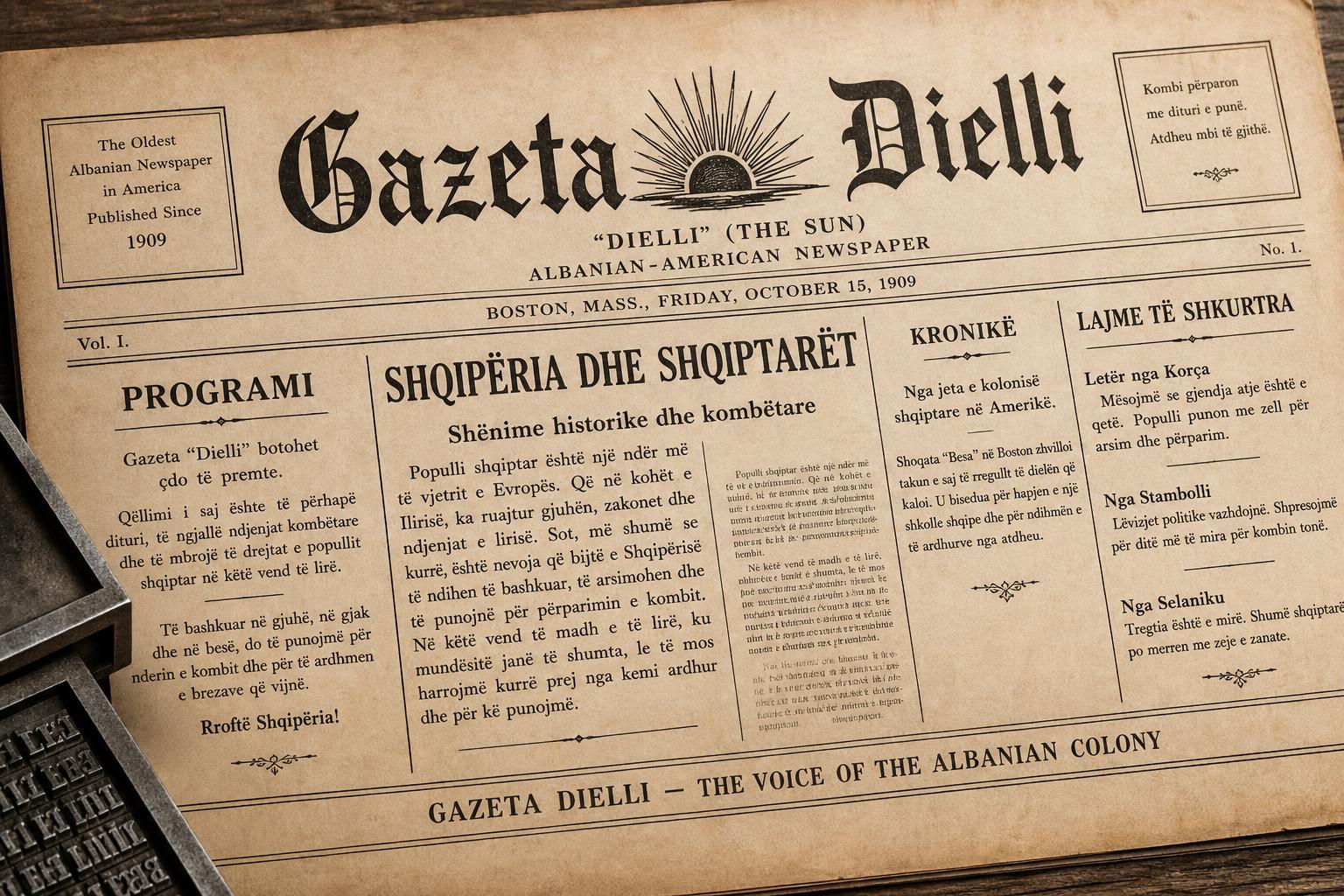 Dielli (“The Sun”), founded 1909. The newspaper gave the scattered community a shared voice and a standard written Albanian. It is still published today.
Photo: Wikimedia Commons / public domain
Dielli (“The Sun”), founded 1909. The newspaper gave the scattered community a shared voice and a standard written Albanian. It is still published today.
Photo: Wikimedia Commons / public domain
The historian whose family was the story: Nicholas Pano
Most communities that preserve their identity do not also produce the scholar who explains how they did it. Albanian America did.
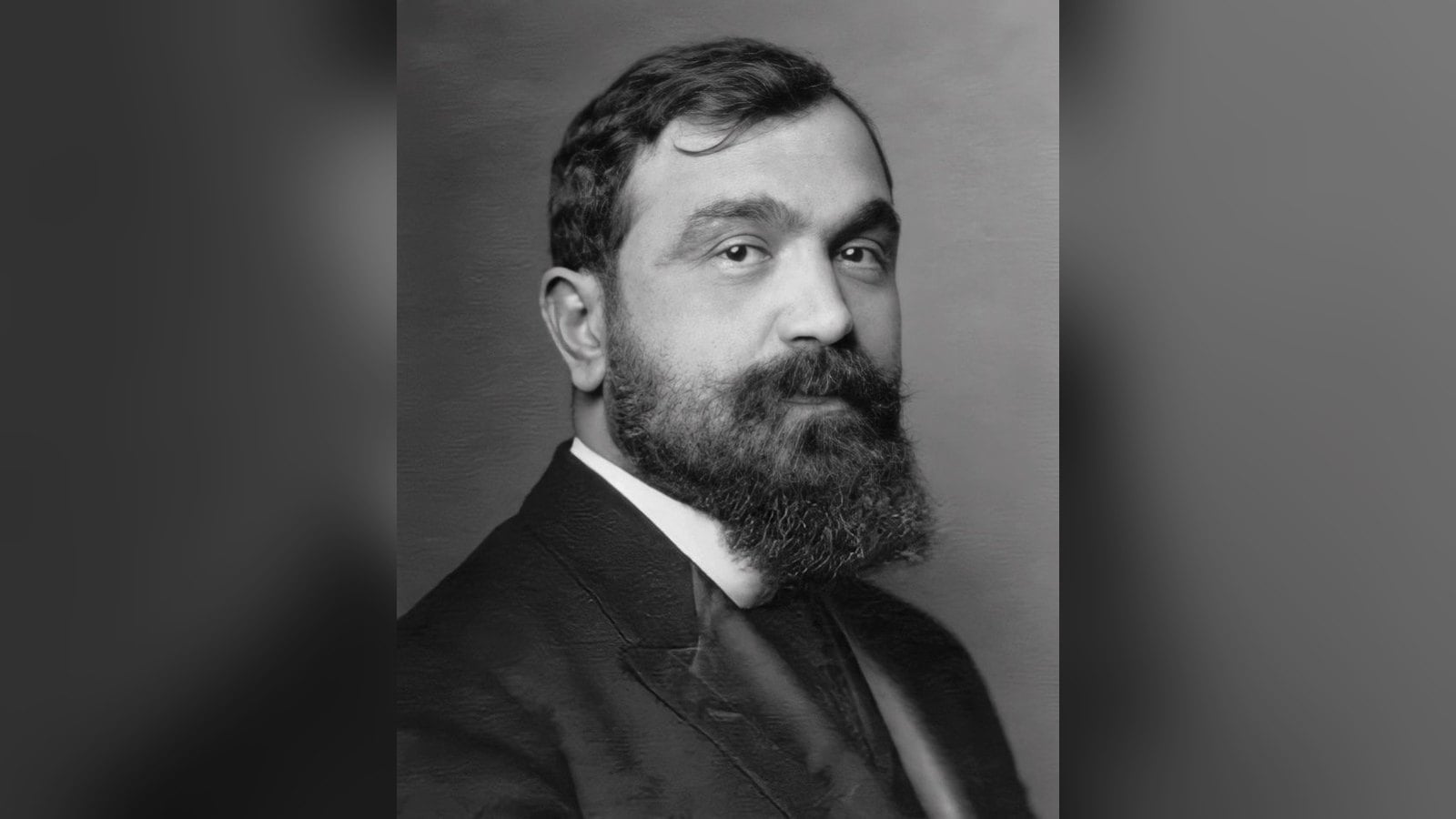
Nicholas C. Pano is a son of the same Korçë-region immigration that built the community. He grew up inside the exact institutions this article is about. Family and church kept him Albanian, shaped by what Dielli and Vatra had built.
He became a professional historian of it. Pano taught at Western Illinois University for over three decades and retired as Professor Emeritus of History, and wrote The People’s Republic of Albania (Johns Hopkins Press, 1968), long a standard English-language reference on the country.
Pano’s contribution to this story is specific: he identified and documented the church (1908), Dielli (1909), and Vatra (1912) as the three institutions that “served to reinforce the national identity of the Albanians of America.” That framing, identity held by institutions rather than by a state, is the spine of everything above. And Pano is its proof as much as its author: an American-born third-culture kid who stayed Albanian because three institutions in Boston made it possible, and who then spent a career making sure the mechanism was written down.
The deliberate choice: nation over sect
The single most important design decision the founders made was to organize around national identity, not religion.
The Albanian-American community was multi-confessional from the first boat: Orthodox, Catholic, Sunni Muslim, and Bektashi. A community that small (tens of thousands, scattered across a dozen mill towns) could not afford to split along sectarian lines. So when Vatra was founded in 1912, it named Albanian national identity, not religious affiliation, as the basis of membership. Catholics, Orthodox, and Muslims sat in the same federation.
The 19th-century poet Pashko Vasa had put the principle into a line: “the religion of the Albanian is Albanianism.” It was a political slogan aimed at Ottoman-era sectarian division, not a literal claim that Albanians are indifferent to faith; plenty hold their religion close. But as an operating rule for a diaspora, it aged extraordinarily well. A wedding in Sterling Heights or a Dielli subscription list still pulls Catholic, Orthodox, and Muslim families together without anyone needing to explain it. That inclusive definition, Albanian first, denomination second, is the one the whole modern diaspora inherited.
The Cold War test: preservation when the homeland went dark
An identity built on institutions gets tested when the homeland disappears. Albanian America’s test lasted 45 years.
When Enver Hoxha’s communist government sealed Albania after 1945, the country became the most isolated regime in Europe. Letters went unanswered. Travel was nearly impossible. Family members in Albania could be persecuted for having relatives in America. For the diaspora, the homeland effectively went dark for two generations.
The institutions held anyway. The church kept its doors open. Dielli kept publishing. Vatra kept its Boston headquarters, kept awarding scholarships, kept holding conventions. For the American-born second and third generations (Pano’s generation), these institutions were the entire available connection to being Albanian, because the actual country was inaccessible. When communism fell in 1991 and Albania reopened, Vatra was the diaspora body best positioned to rebuild the relationship, for one blunt reason: it had never stopped existing.
That is what an identity infrastructure is for. It carries a people across the decades when the homeland can’t. That’s the whole point of building it in good times.
The modern bookend: identity as an ongoing act
If Pano is the historian of how the identity was built, Gazmend Kapllani is a contemporary voice for what it means to keep it.
Kapllani, a writer and scholar who since 2019 has directed the endowed program in Albanian Studies at DePaul University in Chicago, works precisely on the themes this community lives: migration, borders, memory, and the identity of people who belong to more than one place. His best-known book, A Short Border Handbook, is about exactly the condition the first Boston wave invented institutions to survive: being from a place that the map keeps redrawing.
The through-line from 1912 to now is that Albanian-American identity has never been a fixed inheritance you receive once. It gets renewed, not inherited: in a church service, in Dielli’s next issue, in a kid who learns three more words of Albanian this year.
Why this matters now, and where the count comes in
The community that built three institutions before it had a country is now in its third and fourth American-born generations. The immigration waves have slowed; the growth is generational. And a community that grows generationally survives only if its identity infrastructure survives with it.
That is the same problem the founders faced in 1908, in a new form. In 1912 the answer was: get counted, get organized, become visible as one people. Signing a Vatra chapter roll was how you did it.
The National Albanian Registry is the current-generation version of that instinct. The U.S. Census counts about 230,000 Albanian Americans; the real community (counting ethnic Albanians from Kosovo, North Macedonia, and Montenegro, plus the American-born who don’t always check the box) is closer to a million. A community-led count is how you close that gap and make the whole community visible, the way Dielli and Vatra made it visible a century ago.
If you are Albanian-American, first generation or fourth, fluent or rusty, Orthodox or Catholic or Muslim or none of the above, being counted is the most concrete way to keep the identity that three institutions in Boston built for you. Get counted: add your name to a community-led count of Albanian Americans →
For the institutions in depth, read Vatra, Dielli, Fan Noli, Faik Konica, and the Albanian Orthodox Archdiocese in America. For the demographic picture, see Albanian Americans: Population, History, and US Geography.
Sources
- Nicholas C. Pano, The People’s Republic of Albania (Baltimore: Johns Hopkins Press, 1968); Western Illinois University, Department of History faculty records.
- Profile of Nikolla Pano, BalkanWeb (Albanian-American community history).
- Vatra, the Pan-Albanian Federation of America (Wikipedia).
- Fan Noli (Wikipedia); Faik Konica (Wikipedia).
- Gazmend Kapllani, DePaul University, Albanian Studies Program.