
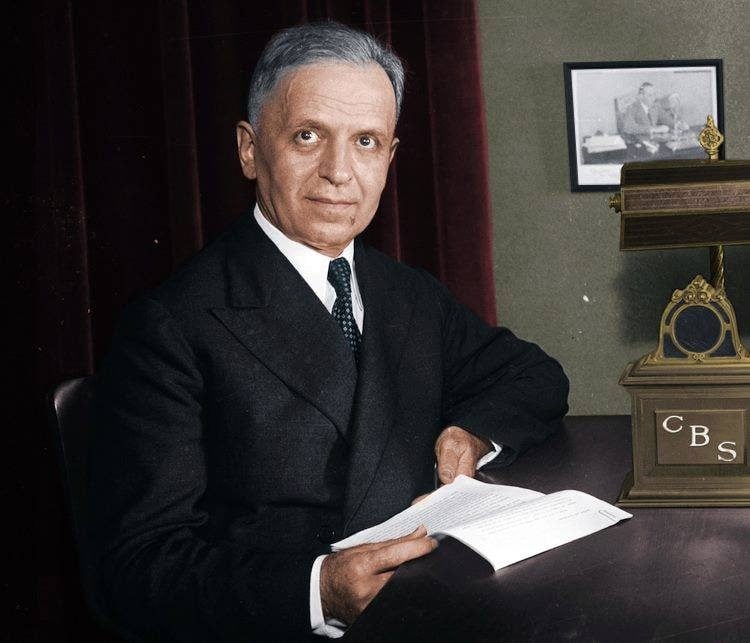
Faïk Dominik Konitza — known almost everywhere as Faik Konica — was the writer and editor who built the modern Albanian-American diaspora’s institutional voice. Born on 15 March 1875 in Konitsa, a town in the Pindus mountains then under Ottoman rule and now in northwestern Greece, he spent his twenties editing a French-and-Albanian magazine out of Brussels and London. He arrived in the United States in 1909, settled in Boston, and within three years had co-founded the Pan-Albanian Federation Vatra, taken over editing of Dielli (the Sun, the Boston-based diaspora newspaper that still publishes today at gazetadielli.com), and earned a Master’s degree from Harvard.
He stayed in America for the rest of his life. From 1926 until 1939, he served as Albania’s first Minister Plenipotentiary to the United States — the senior diplomatic rank, equivalent to ambassador — until the Italian invasion of Albania closed the legation; he remained in Washington until his death there in 1942.
For Albanian Americans, Konica’s place is unusual. He never founded a church. He was not a national orator. He held political office only as a diplomat. His influence ran through print: a twelve-year magazine, a Boston newspaper, a satirical novel published in installments, and the editorial register that shaped modern Albanian literary prose. The diaspora press as an institution begins with him.
What follows is his life and his place in the Albanian-American story — the Konitsa years, the Brussels-and-London magazine, the move to Boston, the founding of Vatra, the collaboration and friction with Fan Noli, the diplomatic post, and the long road of his remains.
Who Faik Konica was
Konica lived from 15 March 1875 to 15 December 1942 — sixty-seven years that ran from the late Ottoman Empire through the Albanian National Awakening, the founding of the Albanian state in 1912, the interwar Zog monarchy, the Italian invasion of April 1939, and the first years of the Second World War.
Across that span he held a stack of identities that don’t fit any single profession. He was a literary critic and prose stylist; the founding editor of the most consequential Albanian-language periodical of the pre-war period; a co-founder and, from 1921, president of the Pan-Albanian Federation Vatra; a long-time editor of the diaspora newspaper Dielli; a satirical novelist (Doktor Gjilpëra); and Albania’s first envoy to Washington.
He published in Albanian, French, and English, and worked across Italian, German, Greek, Latin, and Turkish. He sometimes wrote under the pseudonym Trank Spiro Beg. He never married.
The pattern across his career is consistent. Konica was a one-man editorial institution. Where Noli built churches and federations, Konica built periodicals, prose registers, and the diplomatic post. The two together built the Albanian-American twentieth century.
From Konitsa to Brussels: education and the magazine Albania
Konica was born in Konitsa — known in Albanian as Konica — a small Ottoman town in the Pindus mountains, in what is today the Ioannina regional unit of northwestern Greece. The town sat at the southern edge of the Albanian-speaking lands and held a mixed Greek and Albanian population, with a local Muslim Albanian elite to which Konica’s family belonged. The honorific bey in his name reflects that standing under Ottoman administration.
His early schooling ran through Ottoman institutions and a Jesuit college in Shkodër in the Albanian north. In 1890, at age fifteen, he was sent to France. He attended secondary school at Lisieux in 1890 and Carcassonne in 1892, then enrolled at the University of Dijon, from which he graduated in 1895 with a degree in Romance languages and philology. He spent the next two years in Paris at the Collège de France, studying medieval French literature, Latin, and Greek.
In 1897, at age twenty-two, he founded the periodical Albania in Brussels. The magazine was dual-language — French and Albanian — and Konica edited it almost single-handedly. He moved publication to London around 1902 and kept the magazine running there until 1909, a twelve-year continuous run.
Albania was the most consequential Albanian-language periodical of the pre-war period. It published folklore, historical essays, original poetry, French translations, language-reform polemics, and political writing aimed at the European chanceries. It carried early work by Thimi Mitko, Andon Zako Çajupi, and Gjergj Fishta. The magazine was financed in part — at various points — by Albanian patriotic networks and by Konica’s own resources, and it operated outside the Ottoman censorship that would have shut down anything comparable inside the Ottoman Balkans.
The magazine’s first issue carried Konica’s argument for a unified Albanian literary language drawing on both Tosk and Geg dialects. That argument did not win immediately, but the register Konica set — dry, precise, ironic, classical in its references, allergic to nineteenth-century sentimentality — became the foundation of modern Albanian critical prose.
Boston, 1909: arrival and the editing of Dielli
Konica arrived in the United States in 1909. The immediate purpose, according to his own correspondence and later biographical sketches, was threefold: to campaign for Albanian autonomy within the still-standing Ottoman Empire, to help organize relief for Albanian refugees displaced by Ottoman political upheaval, and to pursue a Master’s degree at Harvard.
He settled in Boston and took over as chief editor of the Albanian-language newspaper Dielli in the autumn of 1909. Dielli — the word means “the Sun” in Albanian — had been founded earlier that year, on 15 February 1909, by the Besa-Besën society, a Boston-based Albanian-American patriotic organization. Some accounts credit Sotir Peci as the editor of an immediate predecessor weekly that ran briefly before Konica took the masthead.
Konica’s editing was the institutional move. Dielli under his hand became a paper of record rather than an occasional bulletin. He used it to argue for Albanian independence, to standardize Albanian-language usage for an immigrant readership scattered across the Massachusetts mill belt, and — after April 1912 — to serve as the official organ of the new federation he was about to co-found.
He completed his Harvard Master’s degree in Romance philology in 1912. The combination — Brussels-and-London magazine editor, Harvard-trained philologist, Boston newspaper editor — made him, by his late thirties, the most editorially equipped Albanian intellectual in the diaspora.
For the early Albanian-American mill workers in Worcester, Lowell, Pontiac, and the Pennsylvania coal country, Dielli under Konica was the paper that arrived in the mail and told them what was happening in the homeland, what their community in Boston was doing about it, and how Albanian was being written and spelled. The cultural-transmission chain runs from that 1909 newsroom forward, more or less unbroken, to gazetadielli.com in 2026.
April 1912: co-founding Vatra
In April 1912, Konica and Fan Noli — the other towering figure of early Albanian-American intellectual life — co-founded the Pan-Albanian Federation of America, Vatra. The word vatra literally means “the hearth” in Albanian; the name was a deliberate choice, signaling a gathering place for a scattered immigrant community.
Konica served as Vatra’s founding general secretary; he would not become the federation’s president until September 1921, when he returned from Naples to Boston at Vatra’s invitation. The federation consolidated the scattered Albanian-American patriotic societies — Besa-Besën in Boston, smaller mutual-aid associations in Worcester and across the mill belt — into a single federated structure. Dielli was adopted as Vatra’s official organ within months and has held that status continuously since (Wikipedia: Vatra).
The timing was not accidental. The Balkan Wars opened in October 1912. Albania declared independence from the Ottoman Empire on 28 November 1912. The young state was immediately under pressure from Italian, Greek, Serbian, and Montenegrin claims to Albanian-inhabited territories. Vatra became, within months of its founding, the diaspora institution best placed to argue Albania’s case to American policymakers and to the European powers.
Konica did that work directly. On 17 November 1912 — eleven days before the Vlorë declaration — he chaired a Vatra mass meeting in Boston opposing any partition of Albania. He traveled to London to represent the Albanian-American diaspora at the Conference of Ambassadors that was redrawing post-Ottoman Balkan borders. He participated in the Congress of Trieste in March 1913, organized in collaboration with Noli.
The institutional architecture Konica and Noli built at Vatra’s 1912 founding has held for more than a century. Vatra is the oldest continuously operating Albanian-American organization and the longest-running federated civic body the diaspora has produced. The case Konica argued for it in November 1912 — that the Albanian-American community had a right and a duty to speak to American policy about Albania — is the same case the federation still operates under.
Konica and Fan Noli: collaboration and friction
The two men most associated with early Albanian-American intellectual life are Konica and Fan Noli. They were collaborators across most of three decades and rivals during one decisive crisis.
Noli — born in Ottoman Thrace in 1882, ordained an Orthodox priest in 1908, founder of the Albanian Orthodox Church in America that same year, briefly prime minister of Albania in 1924, and the canonical Albanian translator of Shakespeare — was the orator and the institutional organizer. Konica was the prose stylist and the polemicist. Their temperaments were different. The institutional work depended on both.
They co-founded Vatra in April 1912, with Konica serving as the federation’s general secretary. Konica did not become Vatra’s president until September 1921, and Noli would later serve multiple non-consecutive terms in the same role. They jointly anchored Dielli’s editorial line through the 1910s and 1920s — support for Albanian independence and territorial integrity, language standardization, ecclesial autonomy for Albanian Orthodox Christians, and a civic, inter-confessional Albanian nationalism that included Albanian Catholics, Sunni Muslims, Bektashi, Orthodox, and secular readers under one editorial roof.
The friction came in 1924. Noli served as prime minister of Albania for about six months that year, after the June Revolution drove the conservative government and its strongman Ahmet Zogu out of the country. The Noli government was the most ambitious reform program interwar Albania attempted — land reform, judicial reform, a westward foreign-policy orientation. It was overthrown in December 1924 when Zogu re-entered the country with armed support from outside.
Konica’s relationship to the 1924 government has been argued over since. Vatra under Konica’s editorial direction backed Noli’s government politically and financially, in contrast to Zogu, who drew on foreign backing. After the government’s fall, Konica criticized aspects of Noli’s program and political method, and the two men’s personal correspondence cooled. Later communist-era Albanian historiography painted Konica as Noli’s opponent and a Zogist; that framing is now generally regarded as a Cold-War distortion of a more complicated relationship.
What is not in dispute is that Konica continued editing Dielli across the 1924 crisis and after, that Noli returned to the United States after his exile, and that both men remained the central editorial voices of the Albanian-American diaspora through the 1930s. The institutional partnership held even when the political partnership frayed.
Doktor Gjilpëra and the literary work
Konica’s literary output is small in volume and large in influence. He wrote few finished books. He worked instead in essays, criticism, periodical journalism, and a single substantial work of prose fiction.
That fiction is Doktor Gjilpëra zbulon rrënjët e dramës së Mamurrasit — “Doctor Needle reveals the roots of the Mamurras drama” — an unfinished satirical novel he serialized in Dielli in 1924, at the height of the June Revolution year. The novel’s hero, Doktor Gjilpëra, is a young Albanian intellectual studying medicine in Russia and Sweden who has to choose between a foreign career and a return to help rebuild Albania. Around that choice Konica builds a satirical anatomy of Albanian provincial mentality, political opportunism, and social hypocrisy.
The book matters less as plot than as register. Doktor Gjilpëra is the most sustained example of the prose style Konica had been refining for a quarter-century — ironic, classically referenced, surgically precise, deliberately allergic to the nationalist sentimental mode of the late Albanian Awakening. It moved Albanian prose from romantic affirmation to satirical criticism.
Alongside the novel, Konica’s permanent literary contribution is in the essays and criticism he published in Albania (1897-1909) and Dielli (1909-1942), and in his prose-style essays — most consequentially Albania: The Rock Garden of Southeastern Europe, an English-language overview of Albanian history and culture for American readers, published posthumously in 1957 from his Washington papers.
The Albanologist Robert Elsie, who edited and translated several of Konica’s works into English in the 1990s and 2000s, called him the founding voice of Albanian critical prose. Modern Albanian literary historians generally treat Albania the magazine as the bridge between the nineteenth-century Albanian National Awakening (Rilindja Kombëtare) and the twentieth-century Albanian literary tradition. Both judgments rest on Konica’s editorial work, not on his finished books.
Minister to the United States, 1926-1939
In 1926, Prime Minister Ahmet Zogu appointed Konica as Albania’s first Minister Plenipotentiary to the United States. The post was the senior Albanian diplomatic rank in Washington — functionally equivalent to an ambassadorship in modern usage — and Konica was the first person to hold it.
The appointment is, in retrospect, surprising and revealing. Konica had been associated with the 1924 reform faction and with Vatra’s funding of the Noli government. Zogu, who had just declared the Albanian Republic in January 1925 and would crown himself King Zog I in September 1928, was nonetheless willing to send Konica to Washington. The most likely reading is institutional: Konica was the most prominent and credentialed Albanian in the United States, he had operational command of English, French, and the American political class, and the alternative candidates were thin.
Konica based the legation in Washington, D.C. He held the post through the entirety of Zog’s reign and up to the Italian invasion of Albania on 7 April 1939. The invasion ended both the post and the legation: Albania ceased to exist as an independent state — the country was annexed to Italy and Zog went into exile in Britain — and the Albanian legation in Washington was officially closed. Konica remained in Washington for the rest of his life, no longer a serving diplomat but still close to the diaspora’s anti-Italian, anti-occupation organizing through Vatra and Dielli.
The thirteen years he held the post made Konica a fixture of Albanian-American institutional life. He kept the editorial relationship with Dielli throughout, continued writing, and corresponded with American academics and policymakers on Albanian questions. By the time he died in 1942, the Albanian state he had represented in Washington had not formally existed for more than three years, and the legation itself had been closed for nearly as long.
Death in Washington and the long road of his remains
Konica died in Washington, D.C., on 15 December 1942, at age 67 — three years after the Italian invasion had ended his tenure as Minister Plenipotentiary and closed the Albanian legation in Washington. Albania itself was still under Italian military occupation at the time of his death; German forces would not occupy the country until after Italy’s surrender in September 1943.
His funeral was held in Boston, and he was buried at Forest Hills Cemetery in the Jamaica Plain neighborhood. Forest Hills, founded in 1848, is one of the older rural-cemetery-movement cemeteries in the United States and the resting place of e.e. cummings, Eugene O’Neill, and Anne Sexton, among others. For more than fifty years, the Albanian Minister to Washington lay in a Boston cemetery alongside American poets.
The political conditions for repatriation did not exist for most of that period. Albania entered communist rule in November 1944 under Enver Hoxha, and the regime spent four decades demonizing Konica as a class enemy, an opponent of the 1924 revolution, and a collaborator with Zogu. Communist-era textbooks treated him as a footnote at best. His books were restricted or unavailable in Albania. The notion of bringing his remains home was political poison.
That changed after the 1991-92 collapse of Albania’s communist regime. In the mid-1990s, with the post-communist government re-evaluating the pre-war Albanian-American diaspora, Konica’s remains were repatriated to Tirana and reinterred in the Tirana Park cemetery on the Artificial Lake (Liqeni Artificial). Sources disagree on the exact year — some accounts cite 1995, others 1998 — and the matter has not been definitively settled in the English-language record.
The reinterment was, more than anything, a political and cultural rehabilitation. Konica’s diplomatic post, his collaboration with Noli, his magazine, and his prose work were reintegrated into Albania’s official memory after the communist suppression. A statue of him now stands in the Grand Park of Tirana.
Why Konica matters to Albanian Americans today
The case for Konica’s centrality to the Albanian-American story is institutional, not sentimental.
In an eight-year window from 1909 to 1916, working primarily out of Boston, Konica consolidated the editorial and civic infrastructure that would carry the diaspora through the twentieth century. He took over Dielli in 1909 and turned it into a paper of record. He co-founded Vatra in April 1912, serving as its general secretary at the founding and, from 1921, as its president. He represented the diaspora to the European powers at the London Conference of Ambassadors and at the Congress of Trieste in 1912-1913. He edited Dielli for most of the next three decades, intermittently across the diplomatic years.
The institutional inheritance is direct. Vatra — the federation Konica co-founded — is the oldest continuously operating Albanian-American organization. Dielli — the newspaper he edited — is the longest-running Albanian-language newspaper in the United States and remains Vatra’s organ today at gazetadielli.com. The diaspora press that includes Illyria (New York), ACTV Michigan, and a growing list of online and regional Albanian-American outlets traces its genealogy back to the editorial register Konica set.
The diplomatic post mattered too. From 1926 to 1939, Konica was the formal Albanian voice in Washington, until the Italian invasion closed the legation; diplomatic relations between Albania and the United States did not resume until 1990-91, after the fall of communism. The Albanian embassy that operates today in Washington — under the Republic of Albania — is the institutional descendant of the legation Konica opened in 1926, even with that half-century gap. Konica was its first occupant.
The literary inheritance is the hardest to measure but in some ways the most consequential. Modern Albanian prose, in its critical and satirical mode, runs through Konica. The register he set in Albania the magazine — dry, exact, ironic — became the default for Albanian critical writing in the twentieth century and remains the default for Albanian editorial prose in the diaspora press. The argument he made in Albania’s first issue for a unified literary language drawing on both Tosk and Geg dialects was eventually realized, in modified form, by the 1972 Tirana orthography congress.
For Albanian Americans in 2026, the practical reach of Konica’s work is this: the federation that argued for Albanian independence in 1912 is the same federation operating from Boston today; the newspaper that announced Albania’s independence in 1912 is the same newspaper publishing online today; the literary register Albanian-American writers default to when they write essays in English about the diaspora was set in a London editorial office in 1898. None of that is a metaphor. The institutions are continuous and the line runs through one man.
Konica spent four decades building the institutions that let Albanian Americans recognize each other across mill towns, generations, and political crises. The National Albanian Registry continues that work in a different format — a community-led count of who is here and where. Get counted at /register and add your name to the modern census of Albanian America.