

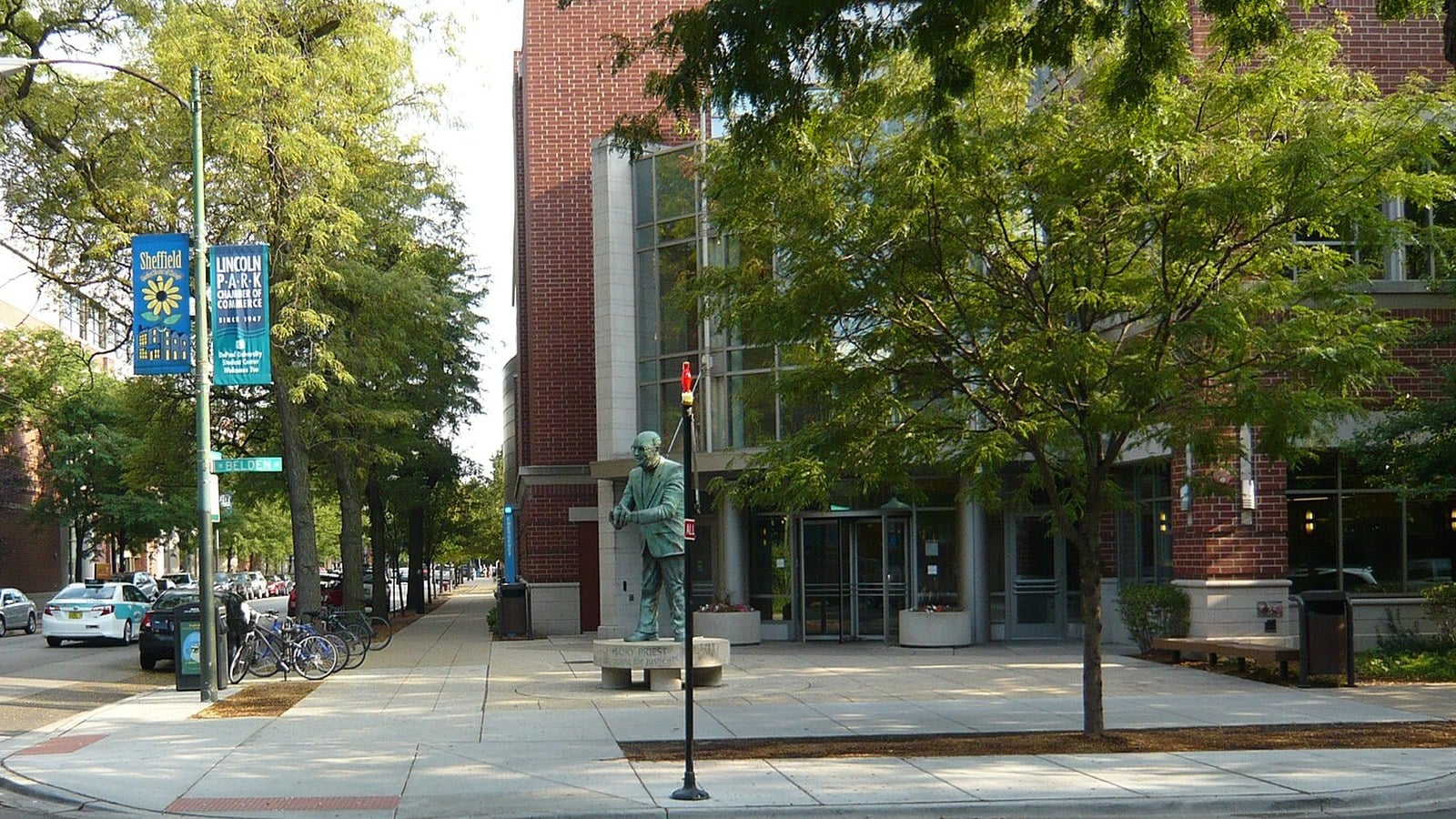
In 2019, DePaul University in Chicago created what it describes as the first endowed chair of Albanian Studies in American academia. It is called the Hidai “Eddie” Bregu Endowment in Albanian Studies, funded by the Albanian-American donor whose name it carries, and it has been held since it began by the writer and scholar Gazmend Kapllani (DePaul: Gazmend Kapllani).
That sentence is easy to skim past. It shouldn’t be. For more than a century, the Albanian-American story has been kept alive almost entirely by volunteers: church committees, newspaper editors, federation secretaries, families who held onto the language one more generation. An endowed university chair is a different kind of thing. It is permanent. It has a budget, a syllabus, students, and a place in the catalog of a major American university. It does not depend on whether any one person keeps showing up.
This is the account of how that program came to exist, who holds it, and why a registry built to count Albanian Americans pays attention to it.
The program: an endowment, a certificate, a scholarship
The chair sits inside DePaul’s Department of Modern Languages, in the College of Liberal Arts and Social Sciences. It began with the fall academic term of 2019 and was widely reported in the Albanian-American press as the first program of its kind, Albanological studies established at the level of an endowed chair, in the history of American universities (Dielli / OCNAL).
Around the chair, DePaul built the connected pieces a durable program needs:
- An Albanian and Southeastern European Studies undergraduate certificate, so students can formally study Albanian language, history, and culture as part of a degree (DePaul catalog).
- The Hidai “Eddie” Bregu Scholarship in Albanian and Southeastern European Studies, which helps fund students in the field (DePaul: Bregu Scholarship).
- A public-facing program that hosts Albanian and Balkan speakers and events on campus.
The endowment itself came from Hidai “Eddie” Bregu, an Albanian-American whose gift made the chair possible and whose name it carries. That detail matters: the money came from an Albanian-American donor, not a government or foreign ministry. Diaspora money, given to an American university, made Albanian studies a permanent part of the American academy. The community funded its own visibility.
Who holds the chair
The chair is held by Gazmend Kapllani, a writer and scholar whose subject fits it almost exactly. He was born in Lushnjë, in central Albania, in 1967, left the country in 1991, and spent years as an Albanian migrant in Greece while building an academic life there: a BA in philosophy from the University of Athens and a PhD in political science and history from Panteion University, where his thesis examined how the Greek and Albanian presses portrayed each other (Wikipedia: Gazmend Kapllani).
His best-known book, A Short Border Handbook, came out of that experience. It is about borders, migration, and what he called “border syndrome”, the condition of belonging to a place the map keeps redrawing; it has been translated into four languages and was shortlisted for the John D. Criticos Prize. Before DePaul he was a 2012 Radcliffe Fellow at Harvard and a 2013 visiting scholar at Brown. When the Bregu chair was created in 2019, a scholar whose subject is people who come from more than one place at once was the natural person to lead it.
Why the count pays attention
The subject the chair studies, migration, borders, memory, the identity of people who belong to more than one country, is not an abstraction to the Albanian-American community. It is its biography.
For most of the last century, that biography survived only because volunteers refused to let it disappear. The Pan-Albanian Federation Vatra, founded in Boston in 1912, kept minutes. Albanian-language newspapers kept printing. Orthodox and Catholic parishes kept services in Albanian. But volunteer memory is fragile: it lives and dies with the people who carry it.
An endowed chair outlasts any one volunteer. It converts a community’s memory into an institution that keeps working after the founders are gone, with students who did not live the story learning to carry it anyway. That is the same reason a community-led count exists. Both the chair and the count exist because the community was afraid of being erased, and both respond the same way, with a permanent record instead of good intentions.
DePaul built the academic version; we built the count. Both were funded by the community, not handed to it by outsiders.
We go deeper on that continuous thread, from the 1908–1912 Boston institutions to the present, in our Albanian-American identity piece.
Get counted
You do not need an endowed chair to keep the Albanian-American story on the record. You need 2 minutes.
Get counted at /register: free, encrypted, community-led. We mint a recognition certificate. We do not sell anything. We never share your data.
The community-led count of Albanian Americans starts with you adding your name.