
Theofan Stylian Noli, known almost universally as Fan S. Noli, was the central figure in the institutional history of the Albanian-American diaspora. Born on January 6, 1882, in an Ottoman Albanian-speaking village in Eastern Thrace, he arrived in the United States in 1906 and within six years had founded a church, a civic federation, a newspaper, and the first nationalist organization of Albanians in America. He served as prime minister of Albania in 1924, was driven into exile, returned to the US, earned a doctorate from Boston University at age 63, and translated Shakespeare and Cervantes into Albanian alongside his liturgical and musical work.
He is one of those rare biographies in which the parts that would each define a career (priest, politician, scholar, translator, composer) were the same person.
For Albanian Americans, Noli’s place is not in dispute. The Boston parish he founded on March 22, 1908 is the institutional starting point of organized Albanian-American religious life. Vatra, the Pan-Albanian Federation he co-founded in 1912, is still the oldest continuously operating Albanian-American civic body. The newspaper Dielli he edited still publishes. He has been called the patron saint of the American Albanian diaspora in our listing of famous Albanians; the language is unusually direct, but the institutional record makes the case.
What follows is his life and his place in the Albanian-American story. The community is multi-confessional (Sunni Muslim, Bektashi, Catholic, Orthodox, secular), and Noli’s institutional reach extends across all of it, even though his ecclesial work was specifically Orthodox.
Who Fan Noli was
Theofan Stylian Noli lived from January 6, 1882 to March 13, 1965, eighty-three years that ran from the late Ottoman Empire through two world wars, the founding of the Albanian state, the dictatorship of Ahmet Zogu, the Italian occupation, the rise of communist Albania under Enver Hoxha, and most of the Cold War.
Across that span he held an unusual stack of identities: Orthodox priest, archbishop, and metropolitan; journalist and editor; politician and head of government; literary translator; composer; scholar with a doctorate from Boston University. He published in Albanian, English, and Greek, and could work in Italian, French, German, Latin, and Old Church Slavonic.
Most accounts identify three central institutions of his life: the Albanian Orthodox Church in America, which he founded; the Pan-Albanian Federation Vatra, which he co-founded; and the brief 1924 Albanian government, which he led. The translations and the academic work run alongside. He is buried at Forest Hills Cemetery in Boston’s Jamaica Plain neighborhood (Wikipedia: Fan Noli).
From Ottoman Thrace to Boston
Noli was born in Ibrik Tepe (known in Albanian as Qyteza), a small village in Eastern Thrace, in what was then Ottoman territory and is today the European part of Turkey. The village was one of a constellation of Albanian-speaking Orthodox settlements that had been established across Thrace and the southern Balkans during the Ottoman centuries.
His family was modest. His father, Stilian Noli, served as a psaltis (an Orthodox church chanter) and gave the boy his first exposure to Byzantine liturgical music. The family spoke Albanian at home. Noli received his early schooling in Greek, the language of Orthodox education in the Ottoman south, and never lost his fluency in either language.
He left Thrace as a young man for Athens, then Cairo, where there was a long-established and prosperous Albanian Orthodox merchant community. In Egypt he taught Greek, worked as a church chanter, and began publishing articles on Albanian national questions. The Albanian National Awakening (Rilindja Kombëtare) was at full pitch in the first years of the twentieth century, and diaspora intellectuals in Cairo, Bucharest, Istanbul, and the United States were arguing in print about language reform, alphabet standardization, ecclesial autonomy, and independence from the Ottoman Empire.
He arrived in the United States in 1906, settling in Boston, where there was already a small but active Albanian-immigrant community drawn from the same southern Albanian and Thracian villages. Most early Albanian Americans worked in the textile mills of Worcester, Lowell, and the Massachusetts mill belt, and in the iron and steel mills of the Great Lakes, almost entirely young men intending to send money home, an immigration pattern shared with Greek, Italian, and Lebanese arrivals of the same period.
Noli stepped into that community as a 24-year-old who could write, edit, chant, organize, and argue. Within two years he was a priest. Within four he was running a national federation.
Founding the Albanian Orthodox Church in America (1908)
The act for which Noli’s name is most directly remembered happened in March 1908.
The political context matters. Before 1908, Orthodox Albanian Christians worldwide worshipped under the Ecumenical Patriarchate of Constantinople, the senior see of Eastern Orthodoxy, headquartered in Istanbul. In Ottoman-era ecclesial administration, Patriarchate parishes used Greek as the liturgical language, kept their parish records in Greek, and classified all of their faithful (Albanian-speaking, Arvanite, and others) under the official ethnic category Greek Orthodox. For Albanian-speaking communities in the southern Albanian lands and across the diaspora, this meant their language was excluded from worship and their ethnic identity was administratively absorbed.
The Albanian National Awakening generation considered this an open wound. Liturgy in one’s own language was a precondition for being recognized, ecclesially and politically, as a distinct people.
The Patriarchate of Constantinople was not going to ordain an Albanian-speaking priest for Albanian-language liturgy in 1908. Noli took the only available canonical path: he sought ordination through the Russian Orthodox Greek Catholic Church in America, the Russian-jurisdiction North American mission that would, decades later, become the autocephalous Orthodox Church in America (OCA).
On March 18, 1908, Noli was ordained a priest in New York City by Archbishop Platon (Rozhdestvensky), then the senior Russian Orthodox hierarch in North America. Four days later, on March 22, 1908, he traveled to Boston and celebrated the first Divine Liturgy in the Albanian language ever held in the United States (Wikipedia: Albanian Orthodox Archdiocese in America).
The act was as much political as religious, a public declaration that Albanian Orthodox Christians had their own language, their own ecclesial standing, and their own identity. Within months, Albanian Orthodox parishes were organizing in Worcester (1911) and across the Massachusetts mill belt, then in the Great Lakes industrial cities. The institutional structure that grew out of that morning in Boston is the Albanian Orthodox Archdiocese in America, now part of the OCA, headquartered today at St. George Albanian Orthodox Cathedral in South Boston.
The Patriarchate / Albanian-language split is sometimes told as a partisan grievance against the Greek church. We don’t read it that way. It is institutional history: a multi-ethnic patriarchate worked in a single liturgical language for centuries, and the linguistic-nationalist movements of the late nineteenth century (Romanian, Bulgarian, Serbian, Albanian) all required new ecclesial arrangements to use their own languages in worship.
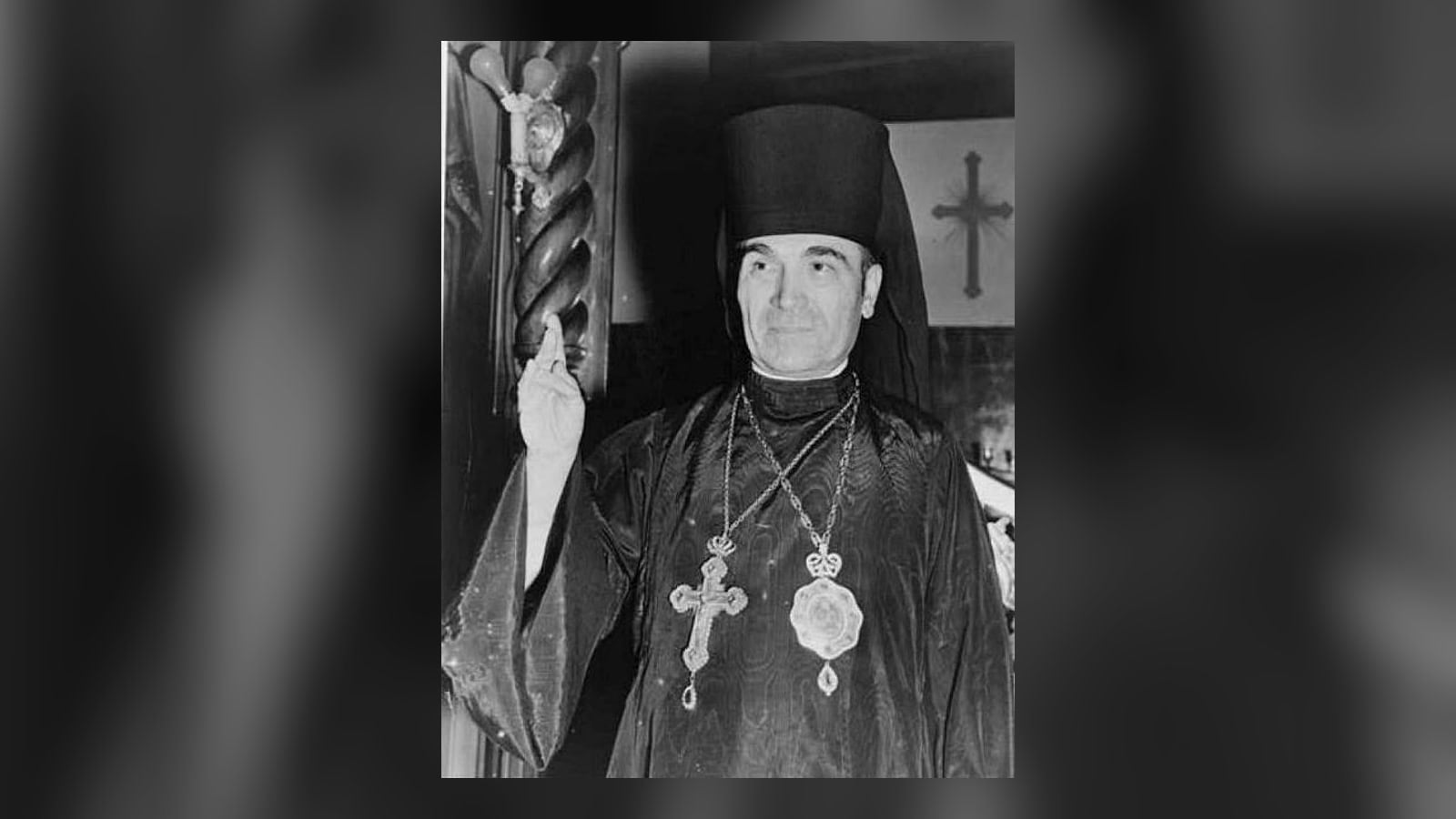
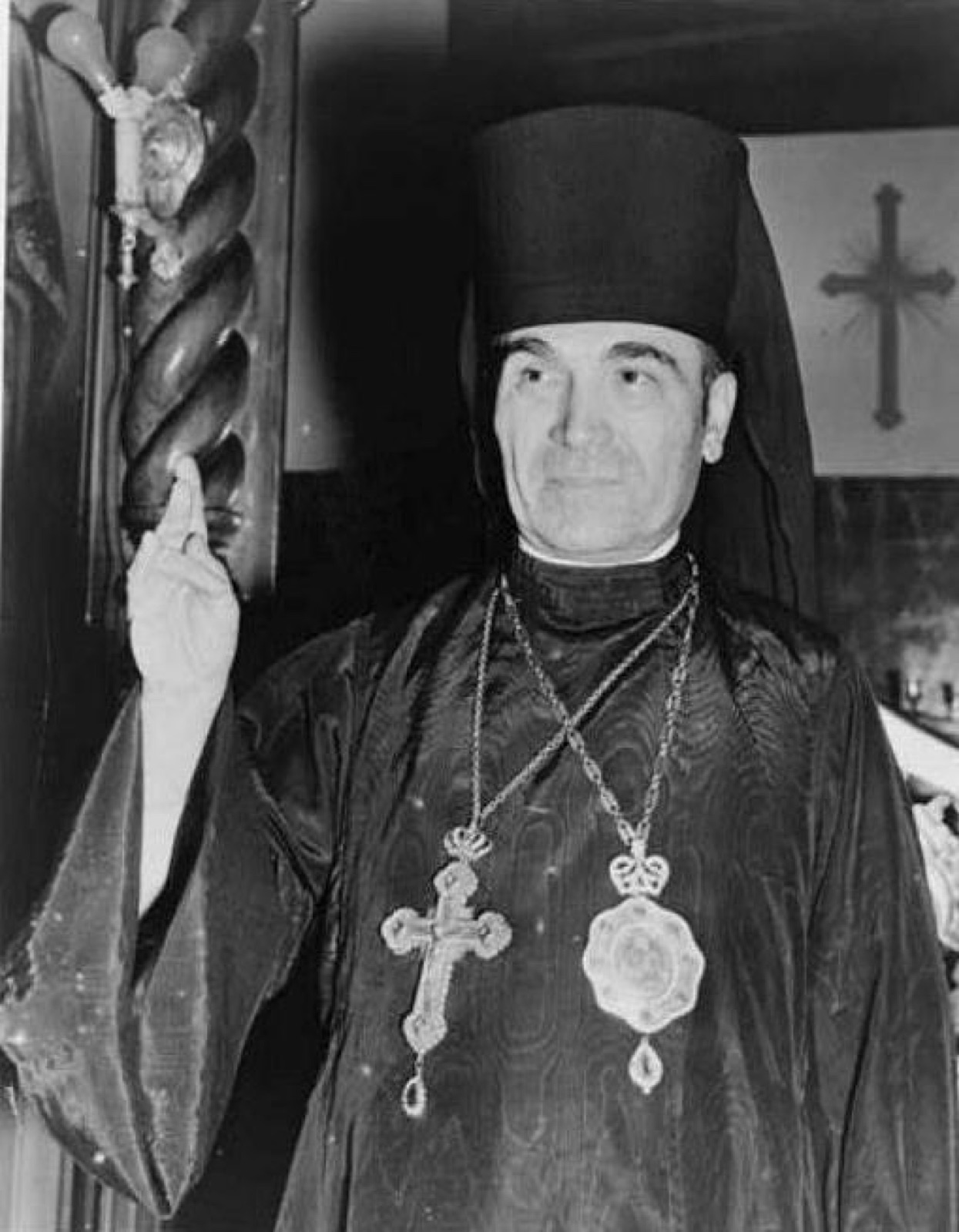 Bishop Theofan Stilian (Fan) Noli in Boston, 1939. By then he was head of the Albanian Orthodox Archdiocese in America and a generation removed from his 1924 prime ministership of Albania.
Photo: Wikimedia Commons / public domain
Bishop Theofan Stilian (Fan) Noli in Boston, 1939. By then he was head of the Albanian Orthodox Archdiocese in America and a generation removed from his 1924 prime ministership of Albania.
Photo: Wikimedia Commons / public domain
Champion of Albanian independence (1908-1920)
The four years after the Boston founding were dense with institution-building.
In 1907, before the ordination, Noli had already founded Besa-Besën (the name doubles besa, the Albanian code of honor, the bond of one’s word), the first Albanian nationalist organization in America. In 1909, he founded Dielli (“The Sun”), the Albanian-American newspaper that still publishes today, more than 115 years later, and remains one of the longest continuously operating Albanian-language newspapers anywhere in the world.
In April 1912, he co-founded the Pan-Albanian Federation of America (Vatra) with Faik Konitza, the other towering early Albanian-American intellectual. Vatra (literally “the hearth” in Albanian) consolidated the existing scattered Albanian-American mutual-aid societies into a single national federation. By 1919 it had roughly 70 chapters across the United States and was, in practical terms, the most important Albanian organization anywhere, including inside Albania, which was still emerging from Ottoman rule with little functioning state apparatus.
When Albania declared independence on November 28, 1912, Vatra was the diaspora institution that argued the new state’s case to American policymakers, raised funds for Albanian famine relief, and organized political pressure during the territorial crises of 1913-1920. After the First World War, Noli traveled to the 1919 Paris Peace Conference as part of the Albanian delegation, lobbying the great powers to preserve Albania’s territorial integrity against partition proposals from the Italian, Greek, Yugoslav, and French sides. He served as Albania’s representative to the League of Nations when Albania was admitted in December 1920, delivering the address that secured Albania’s seat. His diplomatic work in 1919-1920 helped keep the Albanian state on the European map at a moment when it could easily have been carved up among neighbors.
He was holding three identities simultaneously in this period: Orthodox priest leading a young American diocese, leading civic figure of the Albanian-American community, and working diplomat for a struggling new European state.
Prime minister of Albania, 1924
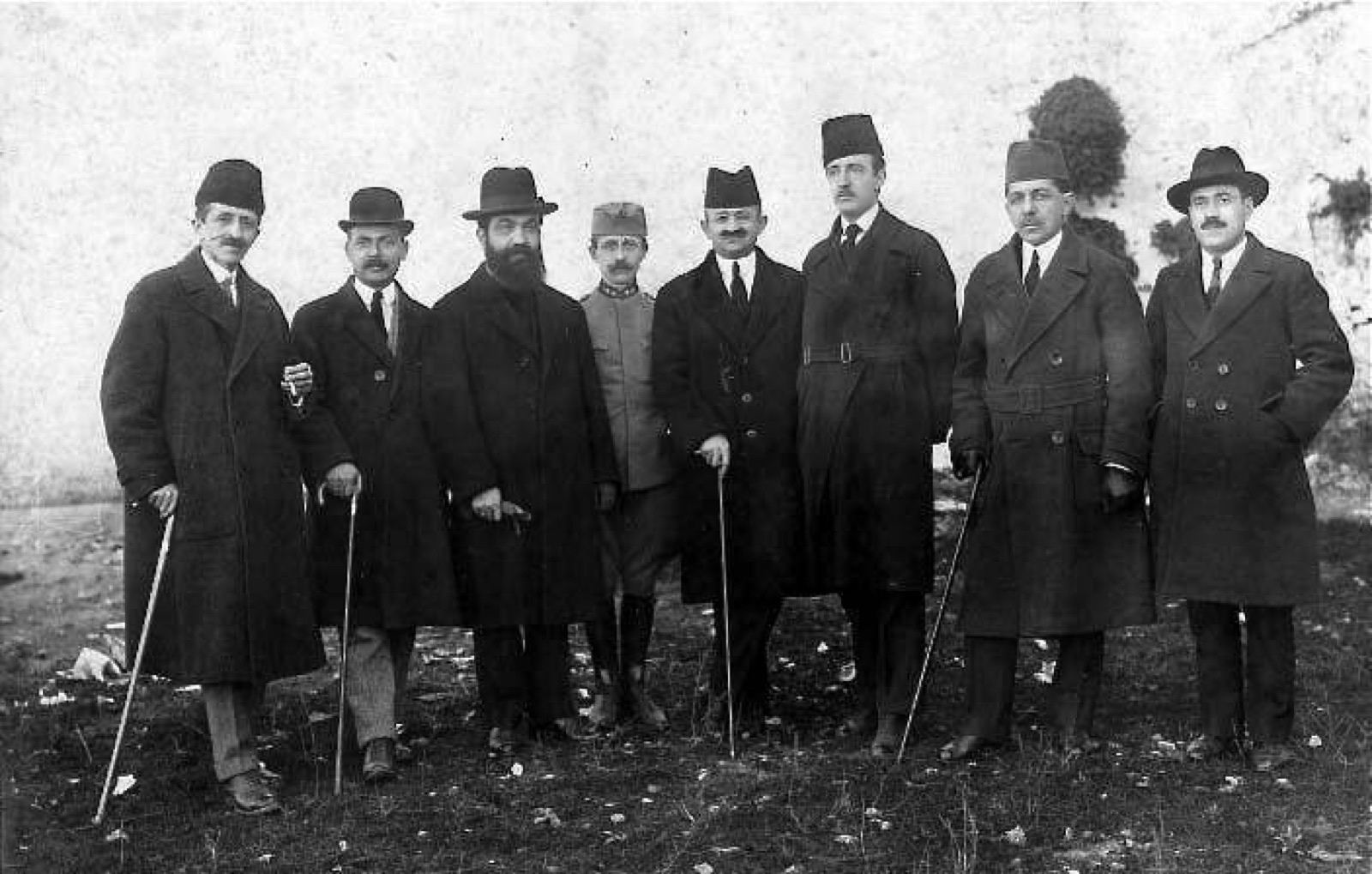 The Xhafer Ypi cabinet of December 1921, in which Noli served as Foreign Minister: Mehmed Konica, Spiro Koleka, Fan Noli, Ismail Haki Tatzati, Xhafer Ypi, Ahmet Zogu, Hysen Vrioni, Kolë Thaçi.
Photo: Wikimedia Commons / public domain
The Xhafer Ypi cabinet of December 1921, in which Noli served as Foreign Minister: Mehmed Konica, Spiro Koleka, Fan Noli, Ismail Haki Tatzati, Xhafer Ypi, Ahmet Zogu, Hysen Vrioni, Kolë Thaçi.
Photo: Wikimedia Commons / public domain
By the early 1920s, Noli had been consecrated bishop (at the 1922 Congress of Berat, as Bishop of Korçë and primate of the newly organized Albanian Orthodox Church) and was beginning to shift his center of gravity from Boston to Tirana. The young Albanian state was politically unstable, with coups, assassinations, and shifting cabinets the norm, and a reform-minded faction associated with Noli and other Albanian intellectuals saw an opening.
The opening came in June 1924. After the assassination of an opposition deputy, Avni Rustemi, a popular uprising (usually called the June Revolution or the Democratic Revolution) drove the conservative government and its strongman, Ahmet Zogu, out of the country. The revolutionary forces installed Noli as prime minister on June 16, 1924.
Noli’s six-month government was the most ambitious reform program Albania had attempted to that point. The published platform included land reform (redistribution of large estates to peasant smallholders), judicial reform, administrative modernization, educational expansion in Albanian, and a western foreign-policy orientation, opening to the United States, the United Kingdom, and the League of Nations rather than to Italy or Yugoslavia.
The program ran into the obstacles that defeated most interwar Balkan reform governments: the landowning class resisted redistribution, the foreign powers were ambivalent, the treasury was empty, and the state apparatus was thin.
In December 1924, Zogu, backed by Yugoslav military support, White Russian mercenary units, and a faction of the Albanian gendarmerie, re-entered the country from across the northern border and overthrew the Noli government. Noli fled abroad. Zogu would consolidate power, declare himself King Zog I in 1928, and rule Albania until the Italian invasion of April 1939.
The 1924 government has been argued about by Albanian historians ever since. Critics call it idealistic and politically inexperienced; defenders call it the only serious attempt at democratic reform in interwar Albania, defeated by external intervention rather than internal rejection. What is not in dispute is that Noli never held political office again.
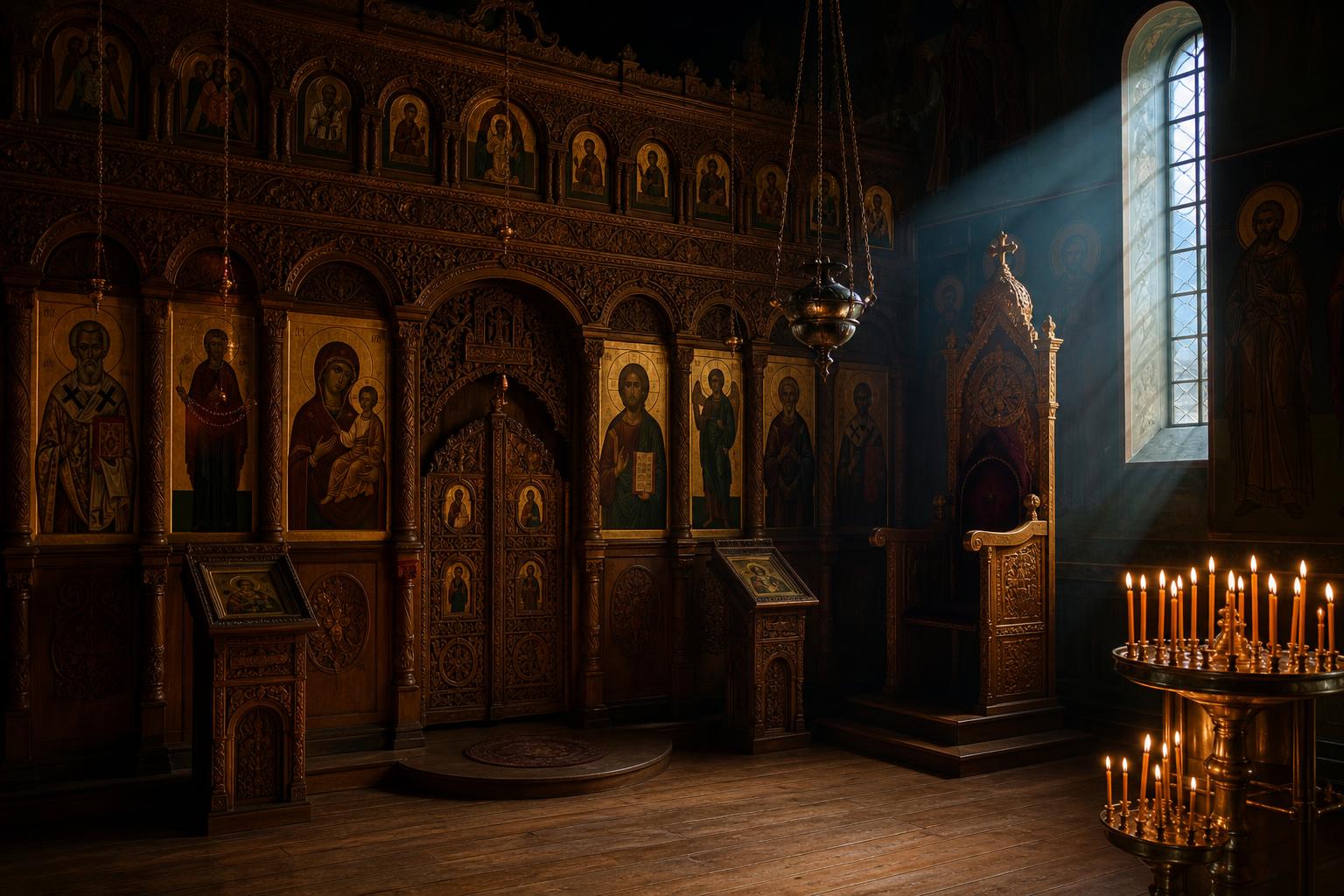 Albanian Orthodox church interior evoking the Boston-and-Massachusetts parishes Noli built from 1908 onward, the institutional spine of the early Albanian-American community.
Graphic by NAR
Albanian Orthodox church interior evoking the Boston-and-Massachusetts parishes Noli built from 1908 onward, the institutional spine of the early Albanian-American community.
Graphic by NAR
Return to the US and the second life
Noli spent the late 1920s and early 1930s in exile in Western Europe (primarily Germany and Austria), writing, lecturing, and beginning his major translation work. By 1932 he had returned to the United States, and the second American chapter, from 1932 to his death in 1965, is in some ways the more remarkable one. Most failed prime ministers fade. Noli rebuilt.
He resumed leadership of the Albanian Orthodox Archdiocese, was elevated to archbishop (1932) and later metropolitan, and led the diocese as its primary hierarch for the rest of his life. He continued editing Dielli and remained central to Vatra. He toured Albanian-American communities relentlessly, from Boston, Worcester, the Bronx, Detroit, and Chicago to the Pennsylvania coal country, preaching, lecturing, raising funds, ordaining.
In 1938, at age 56, Noli earned a degree from the New England Conservatory of Music, capping years of study (and later teaching) of Byzantine church music. Seven years later, in 1945, at age 63, he completed a PhD at Boston University with a dissertation on George Castriot Scanderbeg, the late-medieval Albanian national hero, published in 1947 as George Castrioti Scanderbeg (1405-1468). The book remains a serious scholarly biography in English of Skanderbeg and is still cited.
In October 1971, six years after his death, the Albanian Orthodox Archdiocese was formally accepted as a constituent diocese of the Orthodox Church in America, the autocephalous OCA that had grown out of the same Russian-jurisdiction mission that had ordained Noli in 1908. The institution he had founded came full circle.
The translator and composer
Noli’s output as a translator is the most under-discussed major piece of Albanian literary history.
He produced the canonical Albanian translations of William Shakespeare’s tragedies: Othello, Hamlet, Macbeth, Julius Caesar, King Lear, Antony and Cleopatra, The Merchant of Venice, and others. The translations are written in a deliberately formal, slightly elevated Albanian register drawing on the southern Tosk literary dialect and the rhythms of Albanian oral epic; they remain in print and continue to be staged in Albania and Kosovo. He also translated Cervantes’ Don Quixote (the first complete Albanian edition) and selections from Omar Khayyám’s Rubaiyat, Edgar Allan Poe, Henrik Ibsen, and the Greek New Testament.
The liturgical translation work is institutionally even more consequential. Before Noli, Albanian Orthodox Christians had heard the Eastern liturgy only in Greek (or, in some Russian-mission parishes, Old Church Slavonic). Noli’s translations (the Divine Liturgy of St. John Chrysostom, the Liturgy of St. Basil, the daily and festal hours, Holy Week, and the principal sacramental rites) made the full Byzantine liturgical corpus available in Albanian for the first time. Albanian Orthodox parishes still use his translations as the foundation of their service books.
He was also a composer, writing orchestral and choral works that drew on Byzantine liturgical music, Albanian folk material, and late-Romantic European concert idioms. His best-known pieces include the symphonic poem Skanderbeg and choral settings of Albanian liturgical texts.
The pattern across all of this is consistent. Noli was not building a private literary career; he was building a culture. He needed Albanian to be a language with full ecclesial, literary, and concert-music presence, because that was the precondition for the Albanian community in America and in Albania to take itself seriously as a modern literate culture.
Why Fan Noli matters to today’s Albanian Americans
The case for Noli’s centrality to the Albanian-American story is institutional, not sentimental.
In a five-year window from 1907 to 1912, he founded or co-founded four institutions that still anchor organized Albanian-American life: the Besa-Besën society (1907), the Albanian Orthodox Church in America (1908), the newspaper Dielli (1909), and the Pan-Albanian Federation Vatra (1912). No other figure in the early diaspora produced anything close to that institutional density.
The religious institution mattered because it was, for the first generation of Albanian immigrants, the only Albanian-language institution they encountered weekly. Sunday Liturgy in Albanian was, in practice, the only place outside the home where most Albanian-American mill workers heard their language read aloud, formally and at length, in a public setting. The cultural-transmission chain runs from Noli’s 1908 ordination through Pashkë services in Worcester in the 1930s to second- and third-generation Albanian Americans today.
The civic institution, Vatra, gave the diaspora a representative body with access to American policymakers and to the Albanian state. Vatra’s 1919-1920 lobbying at Paris and Geneva is one of the under-told episodes of immigrant-diaspora foreign-policy influence in American history.
The Albanian-American community is multi-confessional: Sunni Muslim, Bektashi, Catholic, Orthodox, and secular, with significant intermarriage and convergence across all of them. Noli’s ecclesial work was specifically Orthodox, but his civic institutions were explicitly inter-confessional from the start. Vatra in 1912 included Albanian Catholics, Orthodox, and Muslims as members, and named Albanian national identity, not religious affiliation, as the basis of membership. That choice was deliberate, and it set the template that the contemporary diaspora, including Albanian Americans of every faith and no faith, still operates under.
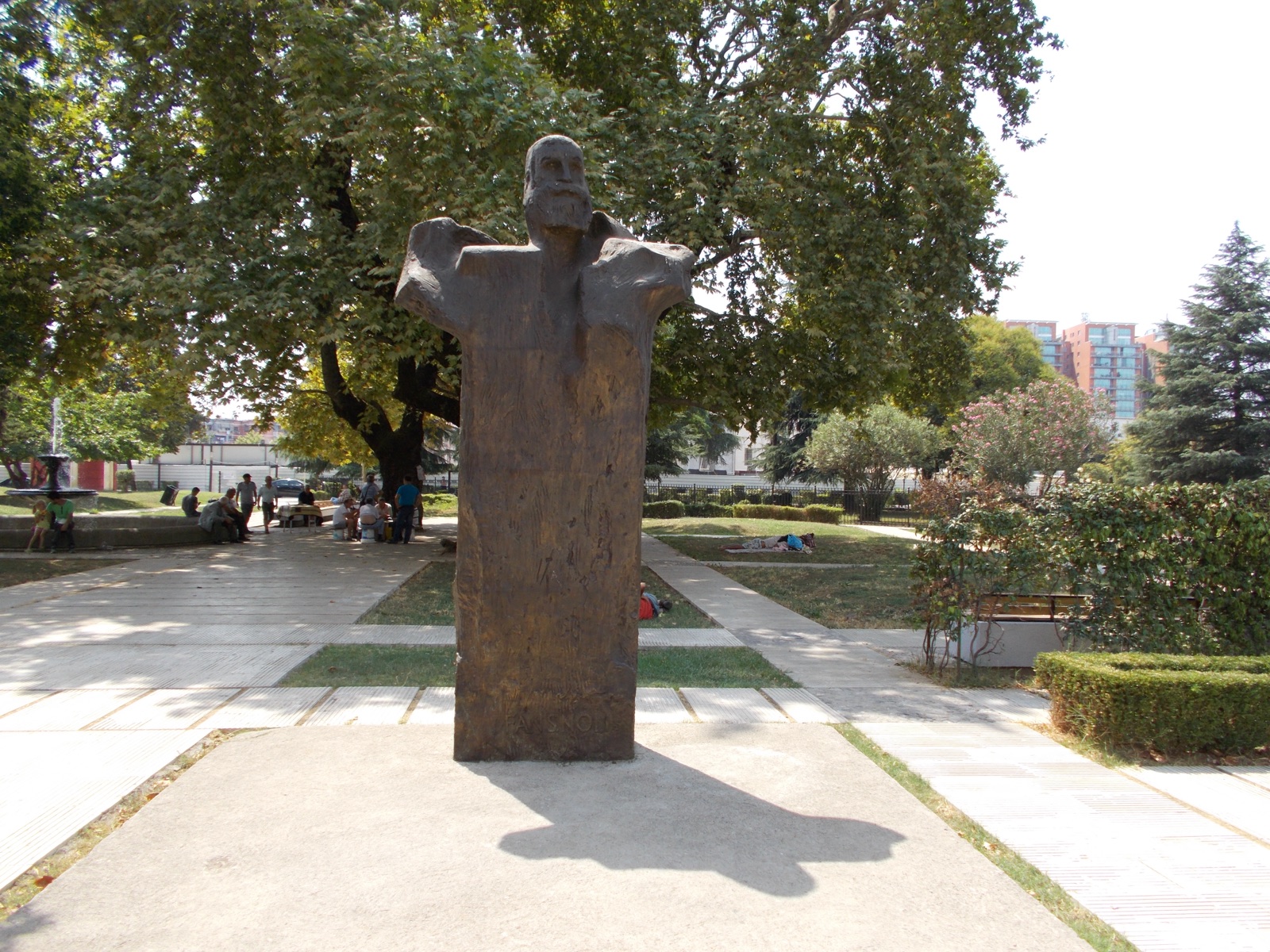 Photo: Big Virgil / Wikimedia Commons / CC BY 4.0
Noli died on March 13, 1965, in Fort Lauderdale, Florida, at age 83. He is buried at Forest Hills Cemetery in Boston’s Jamaica Plain neighborhood. St. George Albanian Orthodox Cathedral in South Boston, the parish he founded fifty-seven years earlier and led for most of his life, remains the institutional seat of the Albanian Orthodox Archdiocese in America and the closest thing the Albanian-American community has to a national shrine.
The National Albanian Registry exists to count Albanian Americans across every state, every generation, every faith. Fan Noli built the institutional spine of this community in five years between 1907 and 1912. NAR is the registry layer on top of that spine: a community-led count and a recognition certificate.
If your family’s story runs through any of the cities and decades Noli’s institutions reached, get counted at /register. It takes about a minute. We don’t sell anything. We never share data. We add one more name to the count.