

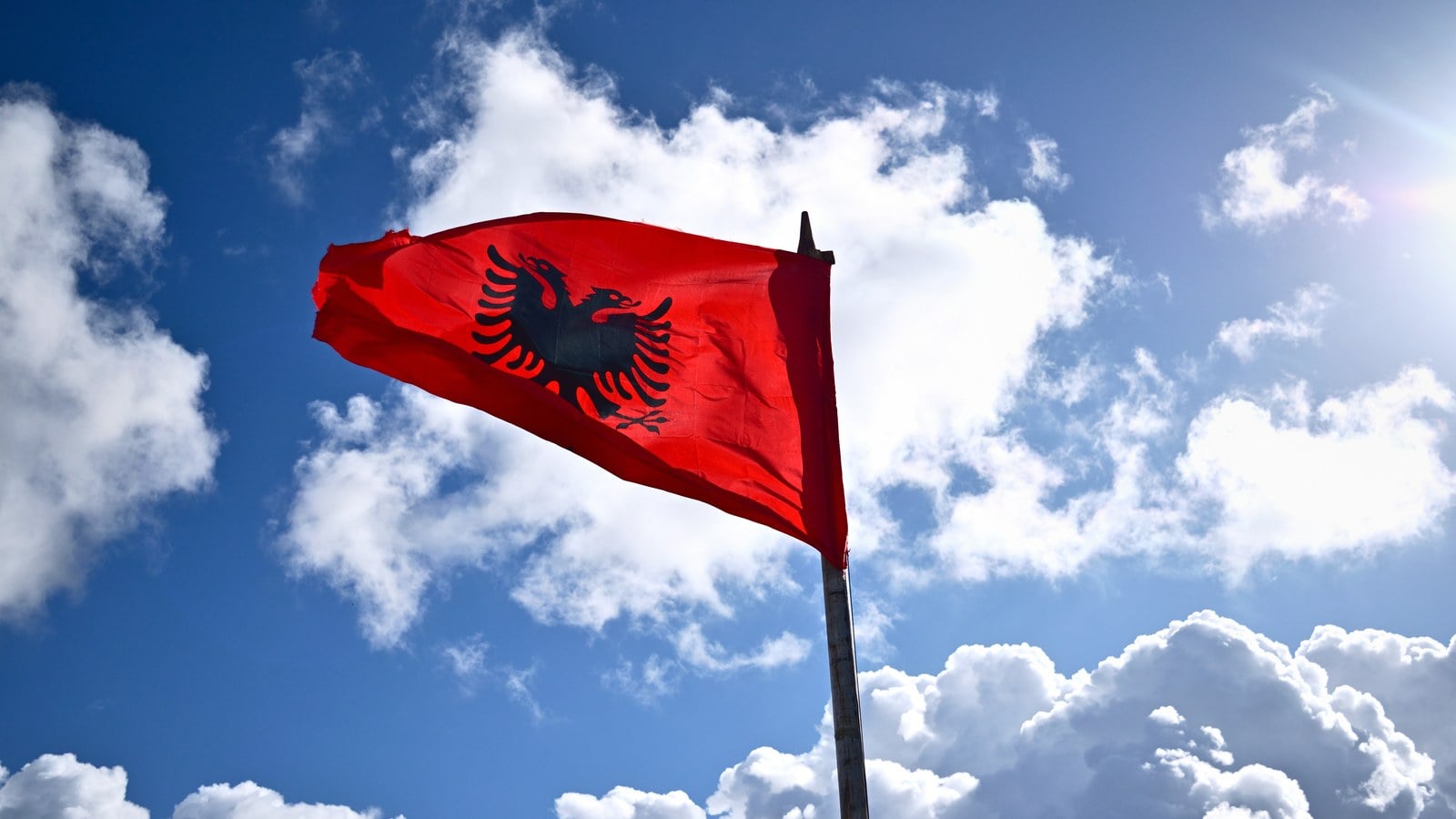
Albanians are, as far as we know, the only people on earth who named their entire country after a bird and then put that bird on the flag, the currency, the passport, the jerseys, their forearms, and their hands. The black double-headed eagle on a red field is one of the most recognizable national symbols in Europe, and one of the oldest still in continuous use.
So here is a question that sounds simple and is not: where does it actually come from?
There is no single clean answer. There is a documented heraldic history, a contested claim about deep antiquity, a folk legend told to children, a linguistic debate about the name itself, and a modern hand gesture that took the whole thing global. Albanians do not fully agree on which of these is the story, and that disagreement is itself part of the story. What follows is all of the theories, laid out honestly, with what is documented separated from what is legend.
Theory 1: The Byzantine and Skanderbeg line (the documented one)
Start with what the historical record actually supports, because it is the strongest thread.
The two-headed eagle, as a symbol, was an imperial emblem of the Byzantine Empire, most associated with the Palaiologos dynasty that ruled from 1261. A bird with two heads, one looking east and one west, was a natural image for an empire that saw itself as the universal Christian Roman state straddling two continents. From Byzantium the motif spread across the Orthodox and post-Roman world.
In the Albanian lands, the eagle attached itself to the Kastrioti, a noble family from the north. The emblem was theirs before their most famous son made it a nation’s symbol. That son was Gjergj Kastrioti Skanderbeg. When he broke with the Ottomans, took the fortress of Krujë in 1443, and united the Albanian principalities under the League of Lezhë in 1444, he raised a red banner bearing a black double-headed eagle. In that moment a family crest became the flag of a resistance, and then of a people (Wikipedia: Coat of arms of Albania).
For the next 450 years, through Ottoman rule, the eagle survived as a memory of the last time Albanians had been sovereign. When Ismail Qemali declared independence at Vlorë on November 28, 1912, the flag he raised was Skanderbeg’s, and it has been the national flag ever since. We cover the flag itself in detail in The Albanian Flag.
This is the version taught in schools and printed in encyclopedias. If you want one documented answer, this is it: Byzantine heraldry, carried by the Kastrioti, made national by Skanderbeg.
Theory 2: The Illyrian claim (older, and contested)
Not everyone accepts that the eagle is a medieval Byzantine borrowing.
A second view holds that the double-headed eagle has much deeper roots in the region, reaching back to the Illyrians, the ancient population most Albanians regard as their ancestors. Supporters of this theory point to eagle motifs, single and double-headed, that appear on Illyrian shields, coins, funerary art, and stone carvings, and argue that the symbol was inherited from antiquity rather than imported from Constantinople.
This is a genuinely live argument among Albanians, and it is not purely academic. When one scholar stated bluntly that “the double-headed eagle on our flag is Byzantine, it does not represent us,” it set off fierce debate, because the question underneath is really about identity: are Albanians a people who carried an ancient symbol forward unbroken, or one who adopted a borrowed imperial badge in the Middle Ages?
The two claims are not fully settled. Byzantium clearly used the two-headed eagle. Older eagle imagery clearly existed in the Balkans. Whether there is an unbroken line connecting the two, or two separate traditions that later merged, is exactly the kind of question the surviving evidence cannot fully close.
The part people forget: the eagle is not only Albanian
This has to be said plainly. The double-headed eagle is not uniquely Albanian, and it did not begin in the Balkans.
Its oldest ancestors are far older than Byzantium, appearing in the ancient Near East, in Hittite Anatolia and Bronze Age Mesopotamia, and in Mycenaean Greece, thousands of years ago. From the Byzantine revival of the motif it passed to the Holy Roman Empire, to Serbia, to Russia (which saw itself as Byzantium’s heir), and to Montenegro, all of which have used a double-headed eagle. Today you can find it on coats of arms from Vienna to Moscow (Wikipedia: Double-headed eagle).
So the eagle is shared. What makes the Albanian case singular is how far they took it: no other people built the bird into the very name of their country and their name for themselves. The eagle did not stay a badge on a shield. It became who they are. Which brings us to the legend, and to the name.
Theory 3: The legend of the eagle
Alongside the heraldry there is the story, the one told to children, the one that was the most-clicked page on more than one Albanian website for years, because people genuinely want to know it.
The best-known version is The Tale of the Eagle. A young man is hunting in the mountains when he sees a great eagle fly overhead with a snake in its beak and carry it to a nest on a high crag. When the eagle leaves, the boy climbs up and finds an eaglet in the nest, and the snake, not yet dead, coiling to strike it. He kills the snake and takes the eaglet. The mother eagle catches him and demands her chick back. The boy answers that the eaglet is his now, because he saved it when she could not. Impressed, the eagle grants him the sharpness of her eyes and the strength of her wings, and tells him he will be known by her name.
The young man grows into a great warrior and leader. The people, marveling at him, call him the Son of the Eagle, and the land they live in becomes the Land of the Eagles, Shqipëria (Wikipedia: The Tale of the Eagle). There are regional variants of this legend, but the shape is always the same: the eagle chooses a human, and the human’s descendants take the eagle’s name.
This is folklore, not chronicle. It is the story a people tells about why the bird is theirs. Heraldry can explain where a symbol came from; the legend explains why we feel we are the eagle, and that is a different kind of power.
Theory 4: The name itself, “sons of the eagle” versus “those who speak clearly”
The legend leans on a claim about language: that Shqiptar means “son of the eagle” and Shqipëria means “Land of the Eagles,” from shqipe / shqiponjë, the Albanian word for eagle. Millions of Albanians understand their own name exactly this way.
Most linguists, though, favor a different origin. The scholarly consensus traces Shqiptar to the verb shqiptoj, “to speak clearly” or “to pronounce,” possibly linked to Latin excipere, “to hear.” On this reading, Shqiptar originally meant something like “one who speaks the language intelligibly,” a people defining themselves by their tongue. This etymology was first proposed by Johann Georg von Hahn in 1854 and is the one taught in most Albanian language departments today. The eagle connection, championed by the Albanologist Maximilian Lambertz, is usually classed as a folk etymology, though even scholars note it may be the very reason Albanians came to identify with the eagle in the first place.
There is a historical wrinkle that matters here. For most of recorded history Albanians did not call themselves Shqiptar at all. They were Arbër (Tosk) or Arbën (Gheg), the root behind Albania, Arbëresh, and the old European names. The name Shqiptar only spread in the late 1600s and early 1700s, replacing the older term. So whichever etymology is right, the “eagle people” self-understanding is, in its current form, a few centuries old, layered on top of a much older identity. We unpack the language question on its own in What Shqiptar Means.
Theory 5 (the newest): the hand, and how the eagle went global
The most recent chapter is not about origins at all. It is about how a 15th-century war banner became a hand gesture flashed by pop stars and footballers.
The gesture is simple: cross your hands at the wrists, hook your thumbs together, spread your fingers, and the shape of a two-headed bird appears against your chest. Albanians had been making it for a long time, but it went global in a single afternoon at the 2018 World Cup, when Switzerland’s Granit Xhaka and Xherdan Shaqiri, both from Kosovo-Albanian families, made the double-eagle sign after scoring against Serbia. In a match loaded with the history of Kosovo’s 2008 independence, the gesture read as defiance. FIFA fined each of them 10,000 Swiss francs for unsporting conduct but stopped short of a ban, and Kosovo publicly raised money to pay the fines (Wikipedia: Double-headed eagle).
From there it moved into pop culture. Rita Ora and Dua Lipa, the two biggest Kosovo-Albanian pop stars in the world, have thrown the eagle on stages and red carpets, and the makeup artist Mario Dedivanovic has flashed it alongside clients. Social media did the rest. A symbol that took Skanderbeg a war to establish now travels in a two-second video clip. Some call it branding. It is also the oldest identity marker the community has, moving through the newest medium.
So which theory is true?
Here is the reckoning. There is no single tidy answer, and pretending otherwise would only obscure it.
- As documented history, the flag’s eagle is Byzantine heraldry, carried by the Kastrioti and made national by Skanderbeg in the 1440s. That much is on the record.
- As deep origin, whether the symbol reaches further back into Illyrian antiquity is genuinely unresolved, and reasonable people argue it.
- As legend, the Tale of the Eagle is the beloved story, folklore rather than chronicle, and none the weaker for it.
- As a name, “those who speak clearly” is the linguists’ best answer, and “sons of the eagle” is the people’s, and both are now permanently true in the sense that matters.
You do not have to settle every one of these to know the eagle is yours. A people can hold a documented history and a folk legend at the same time, the way most peoples do. The eagle is Byzantine and Illyrian and legendary and linguistic and viral, all at once, because it has been carried by enough Albanians for long enough that every layer of the story is real.
Get counted
The eagle is a symbol of a people. The point of a symbol is that there are people behind it, and the whole reason this registry exists is that Albanian Americans are consistently undercounted, present everywhere and recorded almost nowhere.
Putting yourself on the record takes 2 minutes.
Get counted at /register: free, encrypted, community-led. We mint a recognition certificate. We do not sell anything. We never share your data.
The community-led count of Albanian Americans starts with you adding your name.