
Albanians do not call themselves Albanian when speaking their own language. The word they use is shqiptar (an Albanian person), the country is Shqipëria (Albania), and the language is shqip (the Albanian language). The English word Albanian comes from a different root entirely, by way of medieval Latin and Greek.
For Albanian Americans, the two names sit side by side in daily life. Parents say shqiptar at home and Albanian at the parent-teacher conference. Teenagers code-switch without thinking about it. Younger members of the diaspora — second- and third-generation — sometimes know the word shqiptar without knowing where it came from or why it replaced an older name that the community used for most of its history.
This piece is a plain-English explainer for that question. We cover what shqiptar and shqip mean and where they come from, what came before them (Arbër, Arbëresh, Arbënuer), why and roughly when the change happened, what the eagle has to do with any of it, and how the word is used across the modern Albanian world — Albania, Kosovo, North Macedonia, Montenegro, the Italian Arbëreshë, the Greek Arvanites, and the US diaspora. We also handle the shiptar slur question directly, because readers searching the topic will encounter it.
The goal is the version of the answer a reader cannot get from a Wikipedia summary: not just etymology, but how the word is used by Albanian Americans today.
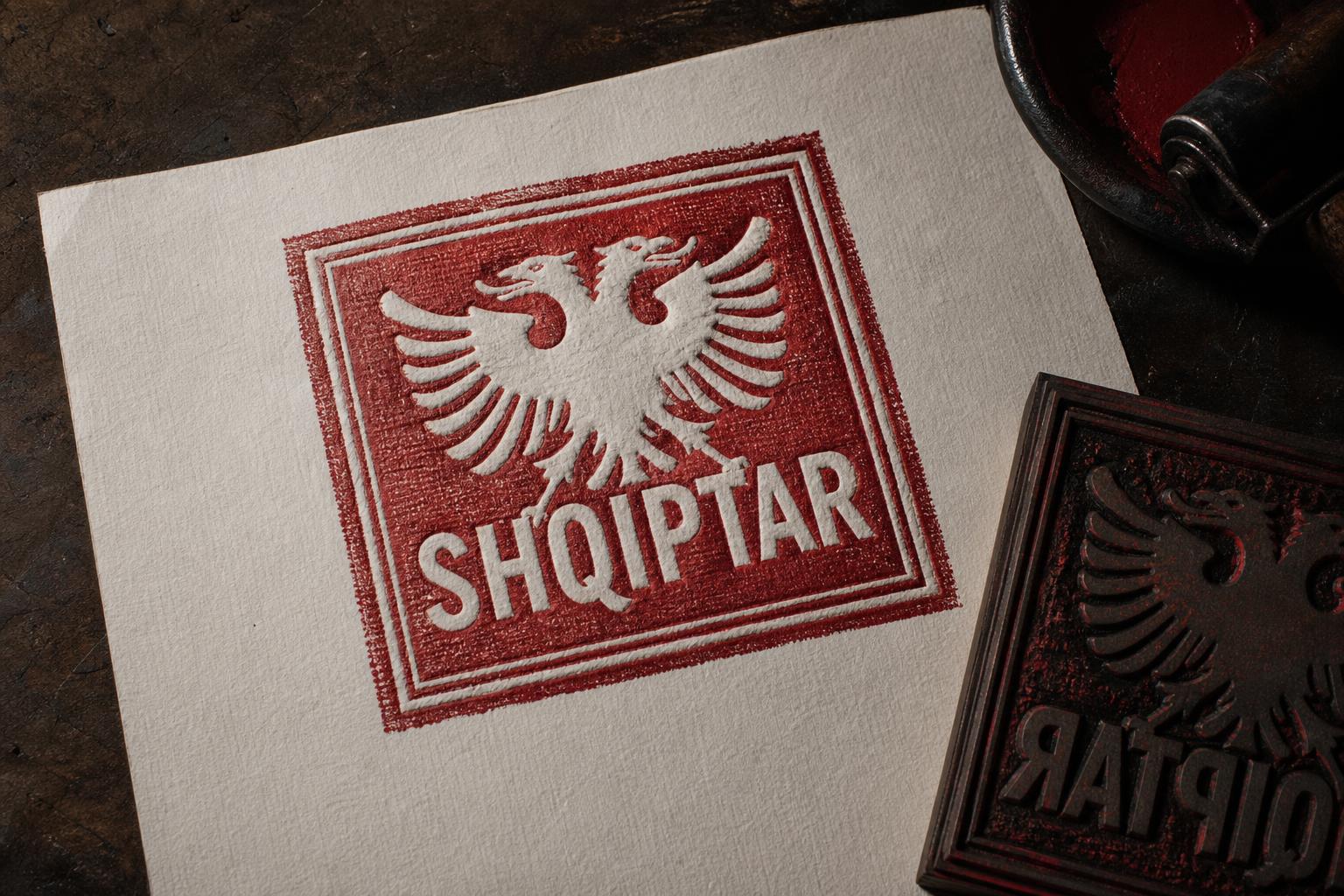 The word that names a people: shqiptar in print, with the double-headed eagle of Albanian heraldry at the margin.
Graphic by NAR
The word that names a people: shqiptar in print, with the double-headed eagle of Albanian heraldry at the margin.
Graphic by NAR
The four related words: shqip, shqiptar, shqiptarja, Shqipëria
Four Albanian words sit at the center of this story. They share a root, and they map onto distinct grammatical categories.
- Shqip — the Albanian language. Also used adverbially, as in fol shqip (“speak Albanian,” with the secondary meaning “speak plainly”).
- Shqiptar — an Albanian person (masculine, or generic). Plural shqiptarë.
- Shqiptarja — an Albanian woman.
- Shqipëria (or, with the definite article reversed off, Shqipëri) — the country, Albania.
In Albanian grammar, the suffix -tar attaches to a stem to form an agent noun — roughly the equivalent of English -er or -ist. Mësues is “teacher”; punëtor is “worker”; shqiptar is the person who does or carries the shqip — speaks it, belongs to it. The country name Shqipëria is built off the same stem.
These four words are inseparable in everyday Albanian. A Tirana newspaper headline, a Detroit Saturday-school lesson, and an Albanian Mass in Lungro will use them interchangeably without explanation. For an outside reader, the cleanest way to hold them together is: one root, four jobs — language, man, woman, country. (Wikipedia: Albanian language)
The leading etymology: “to speak clearly”
The mainstream linguistic view ties shqip and shqiptar to a native Albanian verb root meaning roughly “to speak clearly,” “to pronounce,” or “to understand the same speech.” The verb appears in modern Albanian as shqiptoj (“to pronounce, articulate”) and shqipoj (“to speak Albanian, to make oneself understood”). On this reading, a shqiptar is “one who speaks the same language plainly” — a member of the speech community.
Comparative evidence supports the verb-root reading. Albanian shqiptoj descends from a Proto-Albanian form related to verbs of speaking found in other older Indo-European languages. The semantic shift from “speak clearly” to “the people who speak our language” is well-attested across the world’s languages. The Slavic word Slověne (the medieval self-name of Slavic peoples) is built from the same idea: slovo means “word,” and the Slověne are the people of the word — the ones whose speech is intelligible. The opposite term, němci (literally “the mute ones”), became the Slavic name for Germans, who could not be understood. The Greek word barbaros worked the same way.
This pattern — a people calling themselves “the ones who speak” and outsiders “the ones who don’t” — is so common in human history that linguists almost expect it. In the Albanian case, the survival of shqip as both a noun (“the language”) and an adverb (“clearly, plainly”) is a strong internal clue. When a Tirana grandmother tells her granddaughter to fol shqip, the granddaughter hears both meanings at once: speak Albanian, speak clearly.
The leading etymology is the one a serious Albanian linguist will give a US journalist asking the question. It is not a romantic story, but it is the one supported by the comparative evidence (Wikipedia: Albanians).
The eagle theory: shqipe and the flag
The competing folk etymology connects shqip and shqiptar to shqipe, the Albanian word for eagle. The double-headed eagle is the central element of the Albanian flag, the heraldic symbol of Skanderbeg’s 15th-century resistance, and a recognizable national symbol from the Balkan Adriatic to the Bronx.
The folk version goes: Albanians are “the children of the eagle” (bijtë e shqipes), so Shqipëria is “the land of the eagles” and shqiptar means “eagle person.” It is a pleasing story, it appears in Albanian patriotic poetry from the 19th-century National Renaissance (Rilindja), and it gets repeated in tourist material and in Albanian-American family lore.
The linguistic case for the eagle theory is weaker than the speak-clearly case. Shqipe (eagle) and shqip (language) share consonants but the stem patterns and historical attestations point in different directions. Most academic Albanologists treat the eagle reading as a secondary folk association — a poetic reinterpretation that grew up around the words, not their actual origin. The 19th-century Renaissance writers who popularized the eagle reading were nation-builders, not historical linguists, and their goal was to attach a powerful image to a young national identity, not to settle the etymology.
That said, the eagle association is now part of how Albanians use the word, even if it is not where the word came from. Shqipëria and shqipe sit close enough in the language that for many speakers the two have fused emotionally, regardless of the linguistic record. Both threads of meaning live in modern usage. Linguists separate them; everyday speakers usually do not.
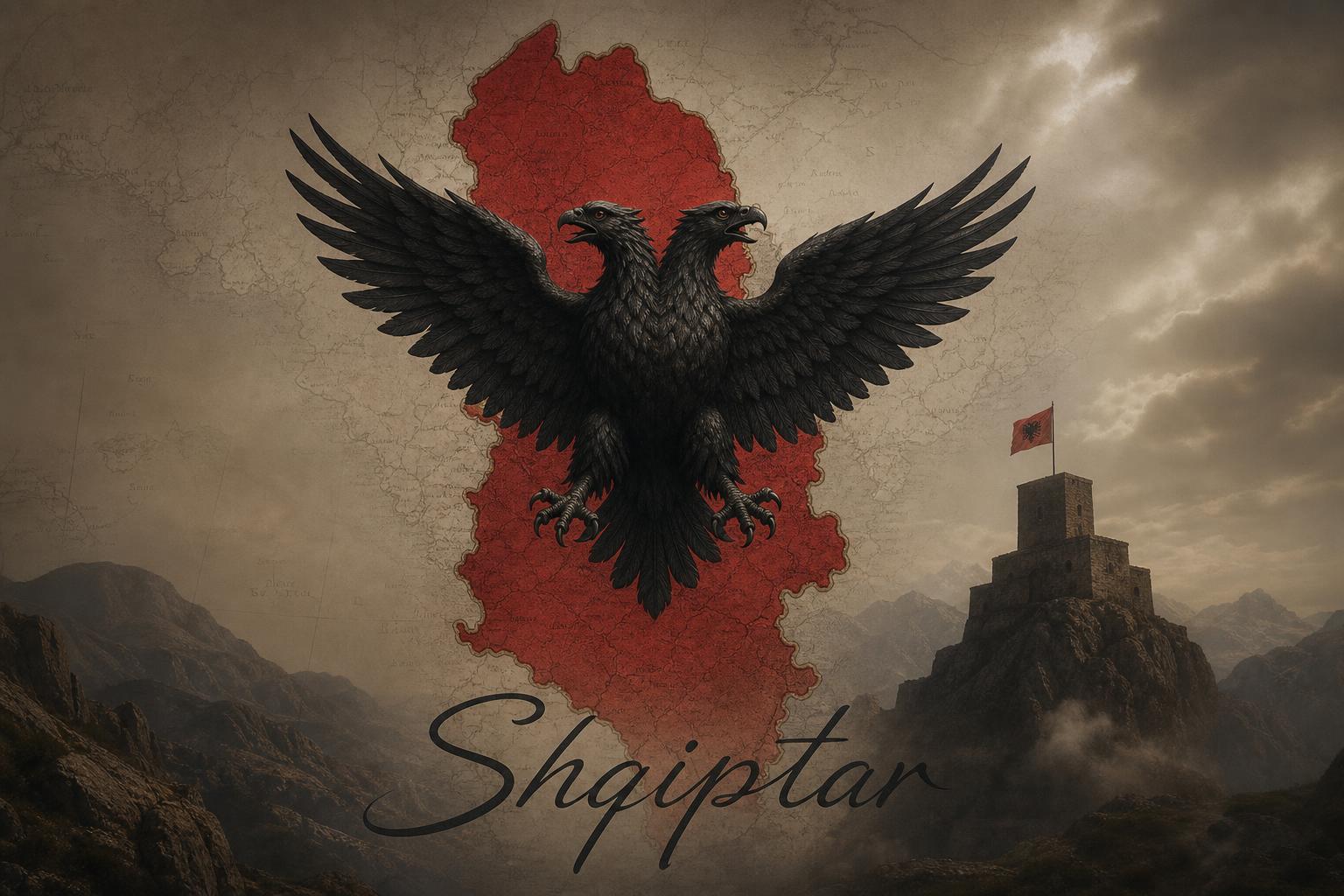 Shqipe — the double-headed eagle — and shqip share consonants, which fed a long-running folk etymology connecting the people-name to the bird. Most linguists treat the link as poetic rather than historical.
Graphic by NAR
Shqipe — the double-headed eagle — and shqip share consonants, which fed a long-running folk etymology connecting the people-name to the bird. Most linguists treat the link as poetic rather than historical.
Graphic by NAR
Before shqiptar: Arbër, Arbëresh, Arbënuer
For most of Albanian history, the people did not call themselves shqiptar. They called themselves Arbër, Arbëresh, or Arbënuer (a Gheg variant), and the land was called Arbëria (Wikipedia: Albanians).
The older name traces back to Albanoi, a tribe recorded by the Greek geographer Ptolemy in the 2nd century AD as living near a town called Albanopolis in central Albania. From the same root come three medieval forms:
- Arbër — the Tosk (southern) variant.
- Arbën — the Gheg (northern) variant. The “n”-to-”r” alternation is the classic feature linguists call rotacism, the same rule that gives Tosk rëra against Gheg rana for “sand.”
- Arbëresh, Arbërisht, Arbënuer — derived agent and adjectival forms used for the people and the language.
This is the name under which Albanians enter the historical record. The Byzantine writer Michael Attaleiates (1022–1080) refers to Albanians by an ethnic name in this family in the 11th century. Anna Komnene’s Alexiad, written in the mid-12th century, mentions Arbanon (medieval Arbën) as a region of the western Balkans. Throughout the medieval period and into the Ottoman era, Western European chroniclers, Venetian merchants, Byzantine bureaucrats, and the Albanians themselves used variations of the Arbën / Arbër root.
This older name is also the source of the English word Albanian. Medieval Latin Albanus and Italian Albanese descend from the same Greek-Latin root that sits behind Ptolemy’s Albanoi. So when an English speaker today says Albanian, they are using a name that has been in continuous European circulation for almost two thousand years. It just happens to be a name that the Albanians themselves stopped using as their primary self-designation about three hundred years ago.
When shqiptar replaced arbër
The shift from Arbër / Arbëresh to shqiptar / shqip is one of the more interesting things about Albanian self-naming. It happened relatively late by ethnonym standards — roughly the late 17th and early 18th centuries, deep into the Ottoman period — and it happened gradually, not by decree.
The earliest documented uses of shqip / shqiptar in their modern sense begin to appear in Albanian writing in the 1500s and 1600s, alongside the older Arbër terms. By the 18th century, shqiptar was clearly the dominant self-name in much of the Albanian-speaking world. By the time of the National Renaissance in the 19th century — the Rilindja period of writers, teachers, and political organizers who built the foundation for Albanian independence — shqiptar was the standard term, and the older Arbër names had retreated to historical and literary registers.
Why the change happened is not perfectly settled. The most plausible reading is that as Albanian-speaking communities became more conscious of themselves as a single linguistic community across confessional lines (Catholic, Orthodox, Muslim, later Bektashi), the word that emphasized shared speech — shqip, the language — became more useful as a self-name than the older regional name. Shqiptar foregrounds language; Arbër foregrounds geography and lineage. In a multi-confessional, multi-regional community living under a foreign empire, language was the most stable common thread.
Two communities left the Balkans before the shift was complete. They still carry the older name. The Italian Arbëreshë — descendants of Albanians who fled to southern Italy in the 1400s, mostly after Skanderbeg’s death in 1468 — call themselves Arbëresh, speak a language they call Arbërisht, and refer to their old homeland as Arbëria. The Greek Arvanites of southern Greece — descendants of similar medieval migration — call themselves Arvanites and their language Arvanitika. Both names descend from Arbën. They are linguistic time capsules of the older Albanian self-name, preserved by separation. (Wikipedia: Arbëreshë, Wikipedia: Arvanites)
“Albanian” in English: a separate root
The English word Albanian did not borrow from shqiptar. It came in through medieval Latin, ultimately from Ptolemy’s Albanoi. The chain runs: Greek Albanoi → Latin Albanus / Albanenses → Italian Albanese → French Albanais → English Albanian.
Most modern European languages use a name in this same family: Italian albanese, German Albaner, Spanish albanés, French albanais, Russian albancy. None of those names derive from shqip. They all descend from the older Greek-Latin root that the Albanians themselves used in earlier centuries before adopting shqiptar.
This is why the two names feel disconnected: they come from different naming traditions and different historical layers. Shqiptar is what Albanians call themselves now, in their own language. Albanian is what most of the rest of the world calls them, using a name that is itself an older Albanian self-name preserved in foreign mouths.
The Italian Arbëreshë community offers a useful illustration. Arbëresh (their self-name) and Albanese (the Italian word for them) are the same word at different historical stages — same Greek-Latin root, same starting point. The Arbëreshë did not switch to a new self-name when the Balkan Albanians did, so for them, the inside word and the outside word still match. For the rest of the Albanian world, the two have diverged.
How Albanian Americans use the words today
In the United States, the two names live alongside each other and the choice between them follows social cues, not strict rules.
At home and inside the community, Albanian Americans say shqiptar. A grandmother introducing her grandson to a visiting cousin will say “Ky është shqiptari im” — “this is my Albanian one.” A father telling his US-born son to remember where he comes from will use shqiptar. The word carries warmth and family register. Albanian in those settings would feel oddly formal, the way an English-speaking American family does not introduce a relative as “this is the American.”
At work, at school, on official forms, and with non-Albanians, Albanian Americans say Albanian. The English word handles the public-facing role. It appears on US Census ancestry write-ins, on school cultural-day signs, on community-organization names (the Albanian American Civic League, the Albanian American National Organization), and in conversation with the broader American public.
Code-switching happens constantly in households where one or more generations are bilingual. A second-generation Albanian American might describe a friend as “shqiptar — Albanian” in a single English sentence, the gloss following the term automatically. Third-generation speakers, more distant from active Albanian use, often default to Albanian and recover shqiptar as a heritage word — the term they learned from a grandparent and use deliberately to signal connection.
The diaspora is also where the inclusive scope of shqiptar shows up most clearly. The word covers Albanians from the Republic of Albania, from Kosovo, from North Macedonia, from Montenegro, the Italian Arbëreshë, the Greek Arvanites, and every American-born descendant. NAR uses it that way, because that is how the diaspora uses it: one word for a community that the maps split into pieces. Census ancestry data records roughly 230,000 Albanian Americans, with community estimates putting the actual number near a million when undercount is corrected.
The shiptar question: slur and reclamation
A reader searching for shqiptar will sometimes find shiptar instead, with a single s and no q sound. The two are the same root, but they are not the same word in modern usage.
In the standard Albanian alphabet, the word is shqiptar, pronounced with the shq- consonant cluster — a sound that does not exist in most Slavic languages. In Yugoslav-era Serbian and other South Slavic languages, the cluster was simplified to shiptar (Šiptar), and over the second half of the 20th century the clipped form picked up a strongly pejorative connotation. By the 1980s and 1990s, Šiptar was treated as a slur in Yugoslav public life, and in 2018 the Higher Court in Belgrade ruled that the term is racist and discriminatory against Albanians (Wikipedia: Shiptar).
In modern Albanian-American usage, the slur form is generally recognized and avoided. Albanians spell their own name shqiptar in any context where the spelling matters — a community organization name, a heritage publication, a bilingual road sign — and the slur form is something the community treats as foreign and insulting, not as a casual variant.
This is the kind of detail that benefits from neutral handling. The Šiptar / shqiptar distinction is real, the pejorative use is documented, and Albanian-American readers will encounter the slur online whether or not it is addressed directly. NAR addresses it factually, without partisan framing on the broader Balkan history that produced it. (Wikipedia: Albanians)
The diaspora shape of the word
One useful way to hold the whole picture is geographically. The word shqiptar — the modern self-name — covers a community spread across at least nine settings:
- Republic of Albania — shqiptar in everyday and official use; the country is Shqipëria.
- Kosovo — shqiptar is the standard self-name; Kosovo Albanians (shqiptarët e Kosovës) make up roughly 92 percent of the country’s population.
- North Macedonia — Albanians (shqiptarët) are about a quarter of the population, with established political and cultural institutions; the self-name is identical.
- Montenegro — Albanian communities along the southeast coast and inland use shqiptar in the same sense.
- The Preševo Valley in southern Serbia — two of its three municipalities, Preševo and Bujanovac, are Albanian-majority (the third, Medveđa, is Serb-majority); shqiptar in self-naming.
- Italian Arbëreshë — older self-name Arbëresh preserved; modern speakers often understand themselves as both Arbëreshë and shqiptarë italianë (Italian Albanians) depending on context.
- Greek Arvanites — older self-name Arvanites preserved; the modern Albanian word shqiptar is recognized but not the local self-name.
- The post-1990 European diaspora — Italy, Germany, Switzerland, Austria, Sweden, the UK; shqiptar is the everyday self-name.
- The US diaspora — roughly 230,000 recorded, near 1 million by community estimate, concentrated in New York, Michigan, Massachusetts, Connecticut, and the greater Detroit metro; shqiptar at home and Albanian in public.
The word does the same job in all of these settings: it names membership in a single linguistic community across the borders that politics has drawn through it. NAR’s working definition of who counts as part of the US Albanian community follows that usage exactly — Albanian by ancestry from anywhere in the historical Albanian world, including the Arbëreshë and Arvanite branches that carry the older name.
Why the name matters for the diaspora
Names are how a community keeps its shape across time. Shqiptar is younger than the people it describes — three hundred years old at most, against more than a thousand years of continuous Albanian presence in the western Balkans — but it is the name the modern community settled on, and it carries the choice that produced it: language as the thread that holds a multi-confessional, multi-regional people together.
For the second- and third-generation Albanian American — who may speak more English than Albanian, who may have visited Tirana once or never — the word is also a piece of inheritance worth knowing. It says something about how the community defined itself when it had to choose. Religion divided. Geography divided. Empires divided. Shqip — the language — was the part that stayed common, and shqiptar is the name that records the decision.
NAR’s count is built on the same principle. The recorded US Census figure — roughly 230,000 Albanian Americans in recent ACS ancestry data — captures Albanians by ancestry, but the community knows the real figure is closer to a million when undercount, mixed marriages, and unrecorded heritage are factored in. Naming yourself shqiptar is the first move in being counted. Adding your name to the National Albanian Registry is the second. If you are Albanian American and have not yet been counted, you can register here — the count is community-led, free, and never partisan.
Related reading
The FAQ block at the top of this page covers the most common search queries on this topic: what shqiptar means, how it relates to Albanian, what shqip means, where the word comes from, the difference between shqiptar and Arbëresh, and the shiptar slur question. For deeper dives on adjacent topics, see our explainers on the Albanian language, the Albanians as a people, Albanian names and naming conventions, and the Arbëreshë community of southern Italy.