

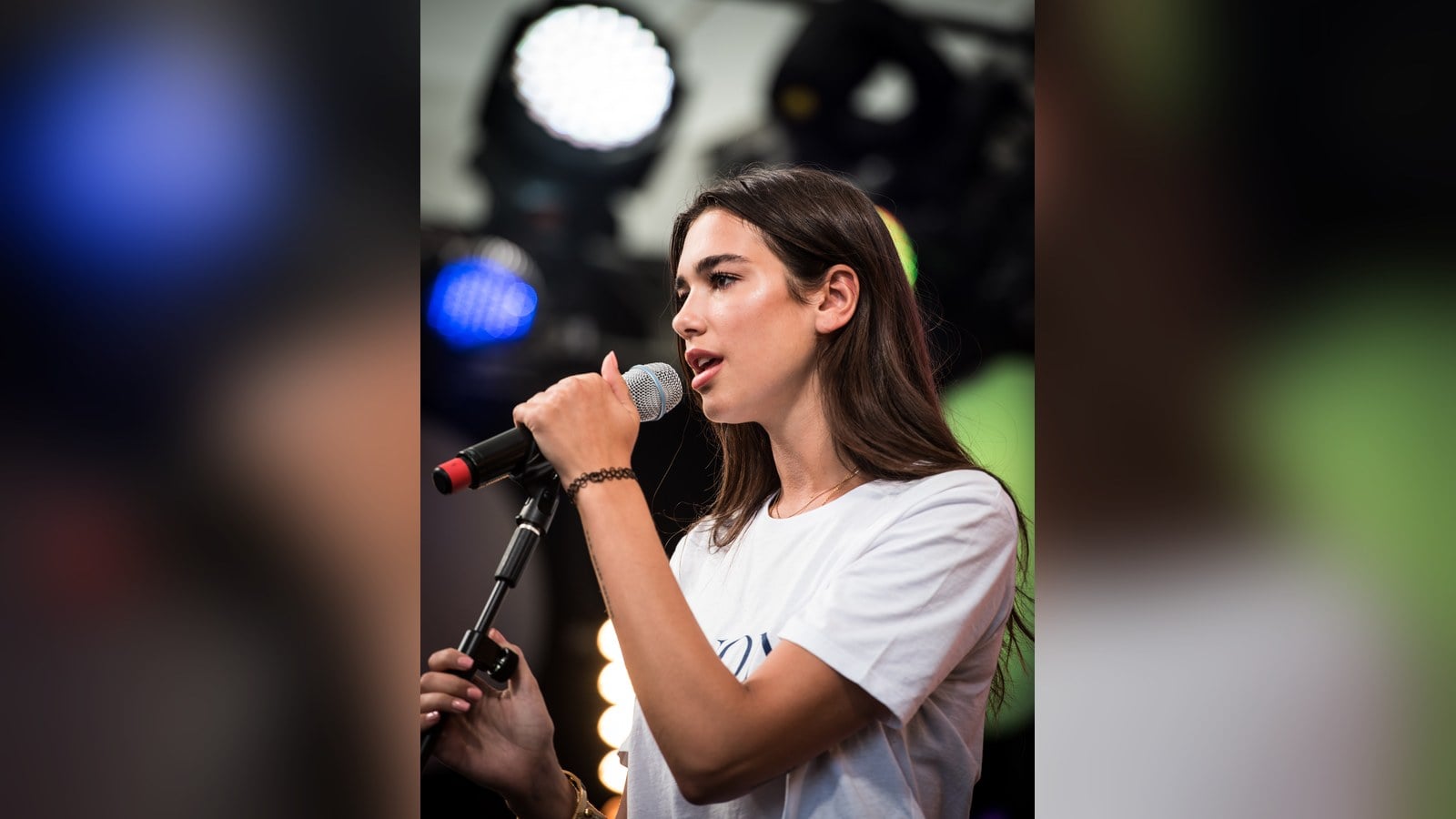
Dua Lipa, born in London on August 22, 1995, is the most globally visible Albanian musician alive. Her parents, Anesa and Dukagjin Lipa, are Kosovo-Albanians from Pristina. She broke through with the 2017 single “New Rules,” made herself a global star with the 2020 album Future Nostalgia, and reached number one in the UK again with Radical Optimism in 2024. She has won three Grammy Awards, took Albanian citizenship in November 2022, and co-runs the Kosovo-based Sunny Hill Festival with her father (Wikipedia: Dua Lipa).
The pattern that runs through her story is a second-generation diaspora one. She was born in a Western capital to parents who left the Albanian world, was raised bilingual, spent part of her adolescence back in Pristina, and then built a career in English-language pop while keeping a deliberate, public tie to where her family is from. For a registry that exists to count Albanians in the United States, she is a useful reference point on the other side of the Atlantic: proof of how far the diaspora reaches, and of how the highest-profile Albanians in the world tend to hold onto the identity rather than shed it.
What follows is an account of her family, her music, and the ways she has kept Kosovo and Albania inside a career that operates at the top of the global pop industry.
Family and early life: London and Pristina
Dua Lipa was born in London on August 22, 1995. Her father, Dukagjin Lipa, and her mother, Anesa (née Rexha), are both Kosovo-Albanians whose families come from Pristina, the capital of Kosovo. They had left the Balkans for London in the early 1990s, during the years of rising repression that preceded the 1998 to 1999 Kosovo War (Wikipedia: Dua Lipa).
The household was Albanian. Albanian was spoken at home, and her name is itself an Albanian word: dua is the first-person of the verb “to love” or “to want,” so the name reads as “I love” or “I want.” Her father was a musician in his own right, a member of the Kosovo rock band Oda, and later a marketing professional and festival organizer. The result was a childhood built around music, in a family that carried Kosovo with it into London.
When Dua was around eleven, the family moved back to Pristina. She has said she went to Kosovo to live in 2006, and first visited Albania itself at 12. She spent her early teens in Pristina, a stretch that included Kosovo’s declaration of independence in 2008. Then, at 15, she made the decision that shapes the rest of the story: she moved back to London on her own to pursue music, staying with family friends and finishing school while she started posting covers online and chasing a recording career (Wikipedia: Dua Lipa).
That detail matters for how the Albanian world talks about her. She is not an artist who happens to have Albanian ancestry three generations back. She grew up speaking the language, lived in Pristina as a teenager, and returned to Kosovo repeatedly as an adult. The heritage is first-hand.
Breakthrough: the debut album and “New Rules”
Dua Lipa signed with Warner Music in 2015 and spent two years releasing singles that built an audience before her first album landed. Her self-titled debut, Dua Lipa, was released in 2017 and included “Be the One,” “IDGAF,” and the song that turned her into a household name, “New Rules” (Britannica: Dua Lipa).
“New Rules” reached number one in the UK and became a defining pop single of 2017, with one of the most-watched music videos of its era. In 2018 she added “One Kiss,” a collaboration with Scottish producer Calvin Harris that became one of the biggest dance singles of the year and another UK number one.
At the 2019 Grammy Awards, she won Best New Artist, and Best Dance Recording for “Electricity,” her collaboration with the production duo Silk City (Mark Ronson and Diplo). Two Grammys in one night, three years after her first single, established her as a major artist rather than a one-hit act (Wikipedia: Dua Lipa).
Future Nostalgia and global stardom
The album that made Dua Lipa a global star was Future Nostalgia, released in March 2020. Built on disco and late-1970s and 1980s dance-pop, it arrived at the start of the COVID-19 lockdowns and became one of the defining pop records of that period. Its singles included “Don’t Start Now,” “Physical,” and “Levitating,” the last of which became one of the longest-charting hits of her career in the United States.
Future Nostalgia won the Grammy Award for Best Pop Vocal Album at the 2021 Grammy Awards, her third Grammy (Wikipedia: Dua Lipa). It also reset expectations for what her career could be. She was no longer a promising British newcomer; she was one of the small number of artists who could carry a global stadium tour.
In 2024 she released her third studio album, Radical Optimism, produced largely with Kevin Parker of Tame Impala and Danny L Harle. It debuted at number one in the UK and produced the singles “Houdini” and “Training Season.” That February she opened the 66th Annual Grammy Awards with a performance of “Houdini,” a marker of how central she had become to the industry’s own sense of itself (Wikipedia: Dua Lipa).
Albanian citizenship and the Kosovo tie
The clearest single moment of Dua Lipa claiming her heritage in public came in November 2022, when President Bajram Begaj granted her Albanian citizenship. The timing was deliberate: it was tied to the 110th anniversary of Albania’s declaration of independence on November 28, 1912. She received the citizenship as a recognition of her contribution to Albania’s global image (Wikipedia: Dua Lipa).
The deeper, continuous tie is the Sunny Hill Festival. Dua Lipa organizes it together with her father, Dukagjin Lipa. The festival is based in Pristina, Kosovo, has also staged editions in Tirana, Albania, and is connected to the Sunny Hill Foundation, which raises money for community causes in Kosovo. Every year it brings global headline acts to a part of the world that rarely sees them, and it puts Dua Lipa’s name on a permanent piece of Kosovo’s cultural calendar rather than a one-off visit (Wikipedia: Dua Lipa).
She has also been a consistent public voice for Kosovo itself, speaking about its independence and its recognition on the world stage across her career. For a country that only declared independence in 2008 and is still not universally recognized, having one of the biggest pop stars on the planet identify openly as Kosovo-Albanian is a form of visibility that no government campaign could buy.
Service95 and the Albanian conversation
In 2022, Dua Lipa launched Service95, a media company built around a weekly newsletter, the podcast “Dua Lipa: At Your Service,” and the Service95 Book Club. The project is where she operates as an interviewer and curator rather than a performer, and it has repeatedly turned toward Albanian subjects.
In 2026, the Service95 Book Club selected Free: Coming of Age at the End of History, the acclaimed memoir by the Albanian writer and London School of Economics professor Lea Ypi, and Dua Lipa interviewed Ypi about growing up in communist Albania during the collapse of the Enver Hoxha dictatorship (Service95: Dua & Lea Ypi). Using a book club with a global audience to put a serious Albanian memoir in front of readers who would never otherwise reach for it is the same instinct as Sunny Hill, applied to ideas instead of music. We cover that conversation, and what the two of them said about present-day Albania, in a separate piece.
Where she sits in the Albanian diaspora
Dua Lipa belongs to a small, highly visible cohort of Albanian and Albanian-heritage women who reached the top of global culture in the same decade.
- Bebe Rexha (b. 1989, Brooklyn) is the US-side counterpart, an Albanian-American singer and songwriter whose family is from Debar in North Macedonia.
- Rita Ora (b. 1990, Pristina) is, like Dua Lipa, a London-raised pop star from a Kosovo-Albanian family from Pristina.
- Eliza Dushku (b. 1980, Boston) is the American actor of the group, with family roots in Korçë in southern Albania.
Between them, these four trace their families to Kosovo, North Macedonia, Albania, and the American diaspora, which is close to the entire geographic span of the Albanian world. That is the lens worth keeping when the word “Albanian” comes up: it covers Albania, Kosovo, North Macedonia, Montenegro, the Italian Arbëresh, and a diaspora that has existed for centuries. We profile the wider group in our Famous Albanians piece and go deeper on Kosovo specifically.
What makes Dua Lipa distinct inside that cohort is how deliberately she has kept the tie active. The citizenship, the festival, the foundation, the book club: none of it is required of a British pop star with a billion streams. She keeps choosing it.
Get counted
Visibility across the diaspora is downstream of who claims their heritage in public. When one of the biggest pop stars in the world identifies as Kosovo-Albanian, runs a festival in Pristina, and puts an Albanian memoir in front of a global audience, the cost of claiming Albanian heritage falls a little for every other Albanian watching.
You do not need three Grammys to be part of the count. You need 2 minutes.
Get counted at /register: free, encrypted, community-led. We mint a recognition certificate. We do not sell anything. We never share your data.
The community-led count of Albanian Americans starts with you adding your name.