

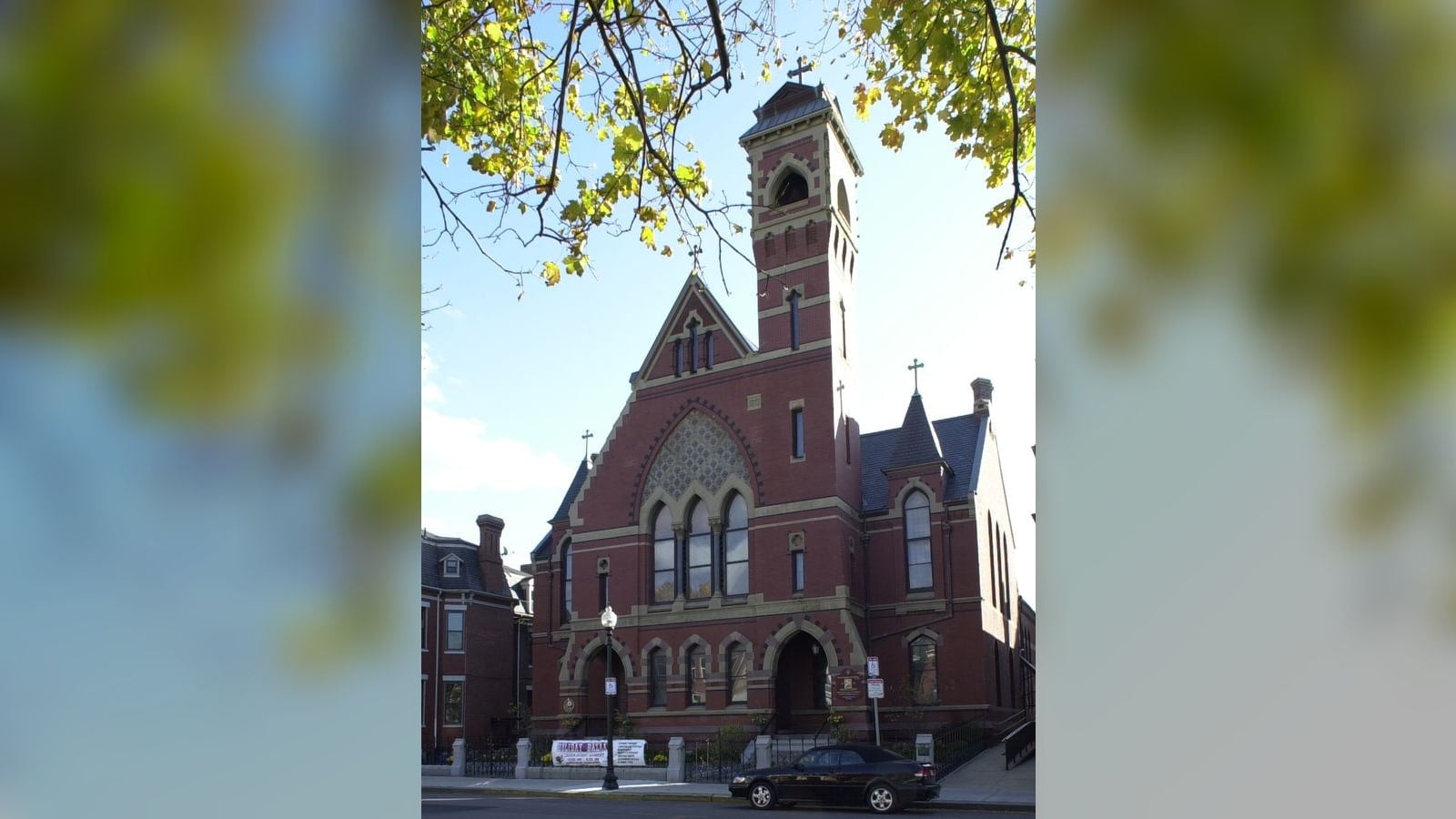
On a quiet block of East Broadway in South Boston sits a parish that doesn’t announce itself. The red-brick, stone-trimmed Gothic front is handsome but easy to walk past. There is no banner out front explaining what happened here. And yet, for a particular slice of Albanian-American history, this address is the closest thing the community has to a national shrine.
St. George Albanian Orthodox Cathedral was founded in March 1908 by Theofan Stilian Noli — the priest, scholar, translator, and briefly Prime Minister of Albania who, more than any other single person, built the institutional architecture of Albanian-American life. It was the first Albanian Orthodox parish in America, and it remains the seat of the archdiocese he built.
This piece profiles St. George as an institution rather than as a tourist site. We cover the founding moment in 1908 and what it meant; the cathedral’s role today as the seat of the Albanian Orthodox Archdiocese in America; Noli’s continuing presence in the life of the parish he founded; the jurisdictional context — the Orthodox Church in America and the parallel diocese under the Ecumenical Patriarchate; what worship and major feasts look like across the year; and how the cathedral connects to the wider Albanian-American Orthodox network.
The parent piece on the archdiocese as a whole maps the full national network of parishes. This piece stays close to one building on East Broadway and tries to do justice to what it is.
The 1908 founding moment
To understand why 1908 was significant, you have to understand what came before it. Before that year, Albanian Orthodox Christians — whether in the Ottoman south of Albania, in the diaspora villages of Italy and Egypt, or in the new mill-town neighborhoods of Boston and Worcester — worshipped under the Ecumenical Patriarchate of Constantinople. Their services were in Greek. Their parish records were kept in Greek. And, officially, the Patriarchate’s ethnic category for them was Greek Orthodox.
For Albanian-speaking faithful, this was a slow erasure. Their language was excluded from worship. Their national identity was absorbed into a different one. Albanian-language priests existed, but Albanian-language liturgy did not.
By 1907, a young Noli was already a known figure in the early Albanian-American community in Boston. He had co-founded Besa-Besën — the first Albanian nationalist organization in America, named for the Albanian besa, the binding code of one’s word. The next step was ecclesial. If Albanian Orthodox Christians were to have liturgy in their own language, they needed an Albanian-speaking priest, ordained through a jurisdiction willing to bless that arrangement. The Patriarchate would not. The Russian Orthodox Greek Catholic Church — the North American Russian mission that later became the Orthodox Church in America — would.
In early 1908, Noli was ordained a priest by Archbishop Platon (Rozhdestvensky) of the Russian mission (Wikipedia: Albanian Orthodox Archdiocese in America). That March, in a small Boston space that would become St. George parish, he celebrated the first Divine Liturgy in the Albanian language on United States soil.
The act was both religious and political. It was a public declaration that Albanian Orthodox Christians had their own language, their own ethnic identity, and their own canonical standing — at a moment when independent Albania did not yet exist (it would be declared four years later, in 1912). Every Albanian Orthodox parish in America that exists today, in either US jurisdiction, traces its lineage back through that Boston liturgy.
Inside the cathedral today
St. George today is at 523 East Broadway, South Boston — a working parish on a residential block, less than three miles south of downtown Boston, in a neighborhood whose Irish-American roots are still visible in the surrounding triple-deckers and parish landmarks (Wikipedia: Albanian Orthodox Archdiocese in America).
The building itself is older than the Albanian parish. It was built in 1872 as a polychrome Gothic Revival church for a Unitarian congregation — designed by Boston architect Samuel J. F. Thayer — and the Albanian Orthodox Archdiocese acquired it in 1949, refitting the interior for Orthodox worship (Wikipedia: Cathedral of St. George Historic District). That interior now follows Eastern Orthodox conventions — an iconostasis screening the altar, candle stands at the entrance, icons of Christ, the Theotokos, Saint George, and Albanian-significant saints distributed through the nave. The choir loft and chanter’s stand serve a tradition where the music is primarily sung rather than instrumental. Worshippers stand for most of the liturgy; pews exist but seating is light by Western Christian standards.
What distinguishes St. George from a typical parish is the layered function the building has accumulated. It is the cathedra — the bishop’s seat — of the archdiocese. Ordinations to the priesthood and the diaconate for clergy serving the archdiocese’s parishes across seven states happen here. Hierarchical visits, archdiocesan assemblies, and major liturgical events draw clergy and families from Massachusetts, Connecticut, New York, Michigan, Ohio, Pennsylvania, and California.
The parish hall — adjacent to the worship space — functions as a community room for the Albanian-American Orthodox community. Saturday school for children, Albanian-language classes, name-day commemorations, post-funeral receptions and forty-day memorials (shtatë ditët and dyzetë ditët), engagement parties with traditional valle dancing, and parish meetings all run through that space. On a non-Sunday afternoon, the cathedral grounds can look more like a community center than a church complex — coffee urns, folding tables, the smell of byrek (Albanian filo pastry) baking in a back kitchen.
The current archdiocesan leadership — Bishop Nikodhim (Preston), enthroned September 16, 2023 — operates out of the cathedral. The parish clergy serve both the local congregation and the wider administrative life of the diocese.
Fan Noli’s death and legacy
Noli’s death in March 1965 in Florida closed a chapter that had run for nearly six decades. He had founded the parish in 1908, founded Dielli (The Sun) newspaper in 1909, co-founded the Pan-Albanian Federation Vatra in 1912, briefly served as Prime Minister of Albania in 1924, lived in European exile for several years after Ahmet Zogu deposed him, returned to the United States in the 1930s, and led the Albanian Orthodox Archdiocese for the rest of his life (Wikipedia: Fan Noli).
His body was brought back to Boston. He is buried not at the cathedral but at Forest Hills Cemetery in the Jamaica Plain neighborhood — the historic garden cemetery where many of Boston’s notable figures rest (Wikipedia: Fan Noli).
What sits on the grave is unassuming — a marker, the Orthodox cross, the name in Albanian and English. Forest Hills is a public cemetery about six miles from South Boston, and Noli’s plot is a quiet stop rather than a staged shrine.
The legacy held in the cathedral, though, was never really at the grave. It is in the language used at the altar each week.
Noli’s liturgical-translation work is the part of his career that most directly shapes what happens at St. George today. Over decades, he translated the Divine Liturgy of St. John Chrysostom, the Liturgy of St. Basil, the daily and festal hours, the Holy Week services, and the principal sacramental rites — baptism, matrimony, funeral, ordination — into Albanian. He also produced literary translations of Shakespeare, Cervantes, Edgar Allan Poe, and other canonical authors into Albanian during the same decades. The full Byzantine corpus, in Albanian, became available to a community that had previously heard it only in Greek.
That body of work is still in active use. When the cathedral celebrates Pashkë in Albanian, the words are Noli’s. When a couple is crowned at an Albanian wedding here, the rite is Noli’s translation. When the albanian-history of the early-twentieth-century diaspora is taught to children in the parish Saturday school, the priest in the textbook is the one who first served at its altar. That continuity — founder, translator, liturgical voice — is unusual for any religious institution. At St. George most of it lives in one building.
For deeper biographical context on Noli’s full life, our profile of Fan Noli covers the political career, the literary work, and the exile years in more detail.
The OCA jurisdiction explained
A reader who arrives at St. George via search may be surprised that there are two Albanian Orthodox jurisdictions in America. Both are Eastern Orthodox in faith, sacraments, calendar, and tradition. The difference is administrative.
The Albanian Orthodox Archdiocese in America (AOAA) is the larger of the two and is headquartered at St. George. It has been a constituent diocese of the Orthodox Church in America (OCA) since October 1971 (Wikipedia: Albanian Orthodox Archdiocese in America). The OCA is an autocephalous — self-governing — Eastern Orthodox church that traces its institutional lineage to the Russian Orthodox mission in North America. It received autocephaly from the Patriarchate of Moscow in 1970, and the Albanian Archdiocese joined the following year as a distinct ethnic diocese within the broader OCA structure.
The Albanian Orthodox Diocese of America is the smaller body. It was organized by Bishop Mark Lipa in 1950 — consecrated by the Ecumenical Patriarch that September — and remains under the Ecumenical Patriarchate of Constantinople. It has grown to several worshiping communities, historically anchored by Saint Nicholas in Chicago and Holy Trinity in South Boston, the latter sitting just blocks from St. George; it is led today by Bishop Theophan (Koja) of Philomelion, elected in June 2023 following the death of his predecessor, Bishop Ilia (Katre), in October 2022.
Between them, the two bodies serve Albanian Orthodox communities across the country. The AOAA is the larger — parishes and missions in seven states (California, Connecticut, Massachusetts, Michigan, New York, Ohio, and Pennsylvania), organized into three deaneries: Great Lakes, Massachusetts, and Mid-Atlantic. The Patriarchate body is smaller, anchored in Chicago and South Boston.
NAR doesn’t take a position on which jurisdiction is canonically preferable. We describe both because both are part of Albanian-American religious life, and the two communities overlap socially — families intermarry, attend each other’s festivals, and cooperate on Flag Day and Independence Day events. The point worth keeping in view is that St. George Cathedral is the institutional center of the larger body — the OCA-affiliated archdiocese — and that this status dates to 1971.
What services and feasts look like
The cathedral runs an Eastern Orthodox liturgical calendar, with two threads layered on top: an Albanian national thread and the patronal feast of Saint George.
The standard Sunday rhythm centers on the Divine Liturgy of St. John Chrysostom, celebrated in a mix of Albanian and English. The proportions vary by service. Major feast days lean more Albanian; ordinary Sundays often run with English at meaningful weight, in deference to younger and intermarried families whose Albanian comprehension is partial. The Liturgy of St. Basil replaces Chrysostom on the ten or so days a year prescribed by the typikon — most notably during Great Lent and on Christmas Eve and Theophany Eve.
The two highest-attendance services of the year are the festal liturgies:
Pashkë (Easter) is the largest gathering. Holy Week services — the Bridegroom matins, the Holy Thursday twelve gospels, the Friday lamentation service before the epitafios, the Saturday afternoon liturgy — build toward the midnight Easter Vigil. Worshippers gather outside in the dark holding unlit candles, the priest emerges with the paschal flame, the candle-to-candle exchange spreads light through the crowd, and the procession circles the building before re-entering for the Resurrection liturgy. Afterward: red eggs cracked against each other with the greeting Krishti u ngjall — Christ is risen — and the reply Vërtet u ngjall — truly he is risen.
Krishtlindja (Christmas) anchors the winter calendar. The Christmas Eve royal hours, the vigil, and the Christmas Day liturgy together draw the second-largest crowds. Many parishes hold a children’s pageant in the hall afterward.
Saint George’s Day — typically observed on April 23 in the New Calendar tradition — is the patronal feast of the cathedral itself. It is a day when the diocesan hierarchy visits, when clergy from sister parishes concelebrate, and when Albanian-American families travel in from across New England to mark the cathedral’s name day. The patronal feast is also a major name-day (emërdita) for the many men and boys named George (Gjergj in Albanian) — a common Albanian Orthodox given name with deep historical roots.
Beyond the high feasts, the cathedral keeps the normal sacramental life of an Orthodox parish: baptisms, weddings (including the crowning rite, the Common Cup, and the Dance of Isaiah), funerals, and forty-day memorials. The community hall fills accordingly through the year.
How the cathedral connects to the wider Albanian-American Orthodox network
St. George does not stand alone. It functions as the administrative and ceremonial center of a network that stretches across at least seven states.
The archdiocese’s three deaneries route Albanian Orthodox parish life upward to South Boston:
- The Massachusetts Deanery clusters the New England parishes — Worcester, Lowell, Hartford-area, Waterbury — alongside the cathedral itself, with a handful of more distant parishes also administratively included.
- The Great Lakes Deanery covers the Detroit-metro Albanian Orthodox communities in Michigan and the Ohio parishes — serving the dense industrial Midwest diaspora that built up across the twentieth century.
- The Mid-Atlantic Deanery covers Pennsylvania and the broader mid-Atlantic, with overlap into New York and New Jersey.
Clergy from across these deaneries gather at the cathedral for ordinations, archdiocesan assemblies, and feast-day concelebrations. Children from across the network participate in summer programs that often route through the cathedral or through partner camps. Major Albanian-American civic events — including Vatra’s annual events and the Albanian American National Organization’s gatherings — frequently coordinate with the cathedral’s calendar.
Civic ties to Vatra (the Pan-Albanian Federation) — the umbrella body Noli co-founded in 1912 — remain close. The cathedral and Vatra share founding lineage and overlapping membership, and the institutional relationship has held across more than a century. Joint Flag Day banquets, Independence Day commemorations, and scholarship galas often involve both bodies.
For a fuller map of the parish network — Worcester’s 1911 founding, the Detroit-metro deanery, the Bronx and Queens parishes, the Chicago and South Boston churches under the Patriarchate — see our Albanian Orthodox Archdiocese in America directory.
The cathedral also sits inside the wider plurality of Albanian-American religious life. The same neighborhoods that host Orthodox parishes often host Catholic parishes serving Albanians from the northern Catholic regions, as well as Sunni mosques and Bektashi tekkes serving the Muslim Albanian majority. At NAR we count all of it. The cathedral is one node in a much larger Albanian-American institutional landscape that includes religious bodies of every tradition and a growing layer of secular civic infrastructure.
Visiting and getting involved
A first-time visitor walking into St. George on a Sunday morning should know a few practical things. Liturgies are open to the public. Reception of Holy Communion is reserved for prepared Orthodox Christians; everyone else is welcome to be present, to listen, to receive antidoron (blessed bread) at the end of the service, and to join the parish for coffee in the hall afterward. Modest dress is expected. Photography during services is discouraged.
Beyond visiting, the cathedral — like any working parish — is carried by participation. Albanian-American Orthodox readers who want to involve themselves more deeply can ask about the choir, the Saturday school, the parish council, the festival-day kitchen crews, the youth programs, and the diaspora-language tutoring efforts. None of these require formal credentials beyond willingness and commitment. The parish has been running on volunteer labor since 1908; it has institutional muscle memory for absorbing new hands.
For Albanian-American readers further from Boston, the same patterns hold at the deanery parishes. The OCA’s official directory at oca.org lists Albanian Archdiocese parishes by region and is the canonical source for clergy assignments and parish contacts. Calling ahead before a first visit is normal and welcomed — parish secretaries can tell you about service times, language balance, parking, and any special arrangements for major feast days.
NAR’s role is upstream of the cathedral, not parallel to it. We’re not building a parish or a denomination. We’re building a count and a registry of Albanian Americans across every religious and secular tradition. The Orthodox parishes — and St. George specifically — have done the institution-building work over more than a century. The registry layers a national count on top of that work, so that the community as a whole is visible in the demographic record.
If you’re Orthodox, your parish is your home. The count is one more thing your community can be part of.
NAR is a community-led count of Albanian Americans — Orthodox, Catholic, Muslim, Bektashi, secular, and every combination. If your story passes through a parish like St. George, the count is one way to make sure your community is visible in the national record. Get counted →