The short answer: The Louis M. Prifti Audio Archive is built around 17 historic recordings that document Archbishop Fan Noli — his own speeches and interviews, along with recordings of the events around him, including his funeral and a symposium marking the centennial of his birth — plus additional interviews with other Albanian-Americans, taped by a Voice of America broadcaster and now being preserved and distributed to the Albanian Orthodox Archdiocese in Boston, the Library of Congress, and other institutions. It is a rare thing: the early Albanian-American story, in sound rather than on paper.
For three decades, a broadcaster in Washington quietly kept a microphone running on the Albanian-American century.
The result, announced through the diaspora’s oldest newspaper, Gazeta Dielli, is the Louis M. Prifti Audio Archive — seventeen recordings built around one towering figure, Fan Noli, plus interviews with other Albanian-Americans. Some are his own voice — his speeches, his interviews. Others are of the events around him: his funeral in 1965, and a recorded event the collection describes as a Harvard symposium marking the centennial of his birth, held years after his death.
Almost everything else that survives from that world is text. This is the sound of it.
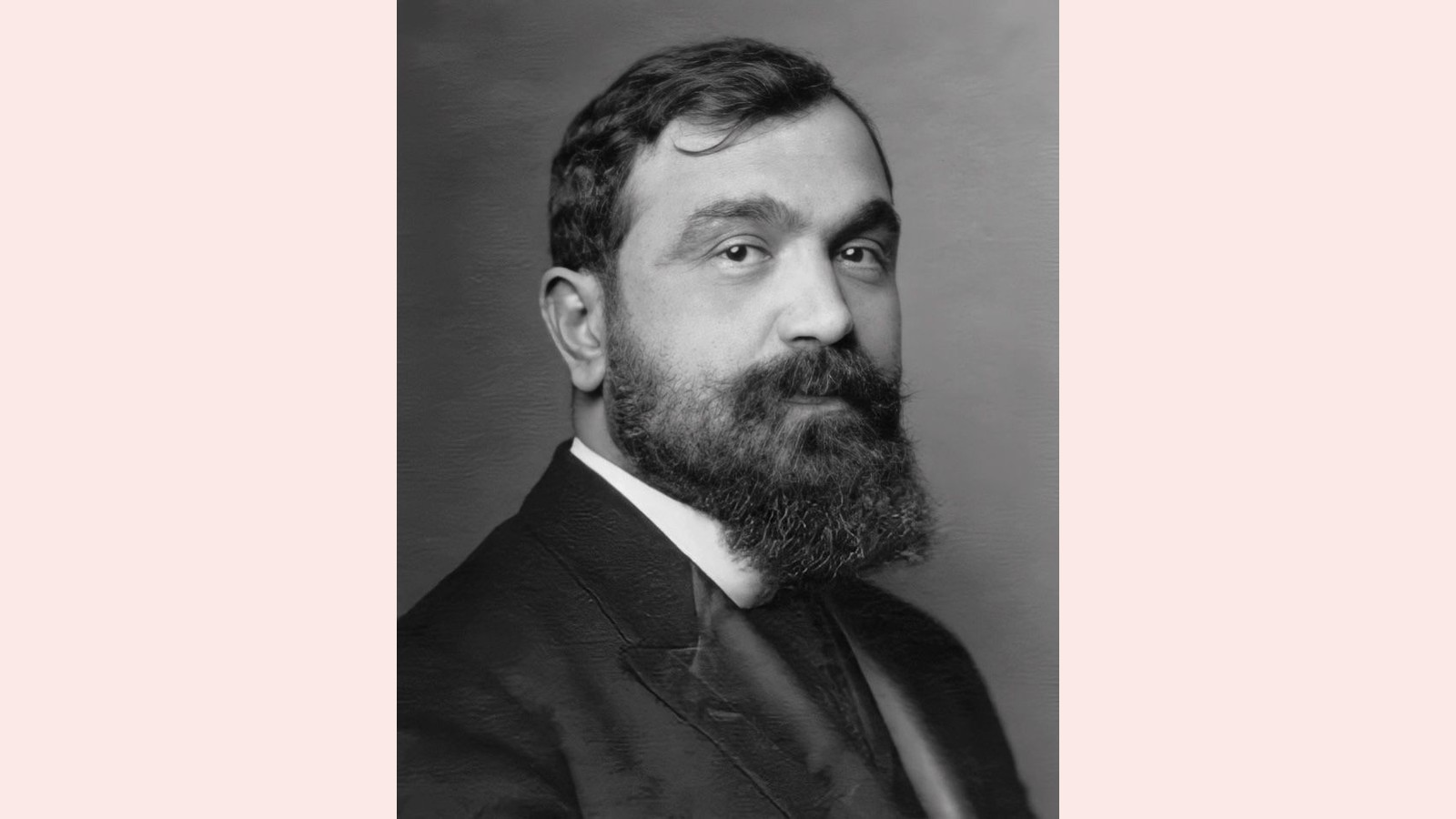
Who Noli was
It is hard to overstate Fan Noli’s place in Albanian-America. Born in 1882 in İbriktepe, in Ottoman Thrace, he arrived in the United States and, in 1908 in Boston, founded the Albanian Orthodox Church in America — a church in the immigrants’ own language, at a time when an Albanian could be refused a Christian burial simply for being Albanian.
He did not stop there. He took his degree from Harvard in the class of 1912. He founded Dielli in 1909 and, in 1912, co-founded VATRA, the Pan-Albanian Federation of America — for decades the political heart of the diaspora. In 1924 he went home and served six months as prime minister of Albania before being driven back into exile. He translated Shakespeare, Cervantes, and the Orthodox liturgy into Albanian, and later earned a doctorate from Boston University, in 1945, with a dissertation on Skanderbeg.
Archbishop, scholar, editor, statesman, translator: Noli is the closest thing the Albanian-American story has to a founding father. And until now, most people who invoke his name have never heard it.
The man with the tape
The recordings exist because of Louis M. Prifti. According to his family and Gazeta Dielli, Prifti was born in Borova, Albania, in 1914, immigrated to Philadelphia in 1931, and served as a decorated soldier in the Second World War. Then, from 1951 to 1982, he worked for the Voice of America Albanian Service — as a script writer, editor, producer, and on-air voice.
That job matters to the story. VOA had resumed its Albanian broadcasts in 1951, and through the long isolation of communist Albania it was the main line the outside world had into the country, where being caught listening could mean prison. Prifti spent his career being the voice Albania heard. Along the way, with a broadcaster’s instinct, he recorded the voices around him: the archbishop, the immigrants, the community as it actually sounded.
(Prifti’s own biography rests largely on family accounts, so we report it as such. His 1951 start does line up with the documented 1951 resumption of VOA’s Albanian broadcasts.)
What is on the reels
The seventeen recordings, as the archive describes them, run from the ceremonial to the intimate:
- Fan Noli, in his own voice — multiple speeches and interviews.
- His funeral, 1965 — a recording of the event itself, an occasion about Noli rather than his own voice.
- A recording of an event the collection calls a Harvard symposium for the centennial of Noli’s birth — necessarily held around 1982, some seventeen years after his death in 1965. (We flag this one carefully: it is described in the archive’s own announcement, and the independently documented 1982 Noli centennial event was a seminar in New York — so treat the Harvard framing as the archive’s account rather than an established fact.)
Beyond those seventeen, the archive’s own account also includes interviews with other Albanian-Americans of the era: Anthony Athanas, the Boston restaurateur behind the famous Anthony’s Pier 4; Dr. Andrew D. Elia; Rev. Arthur Liolin, who served as chancellor of the Albanian Orthodox Archdiocese in America for decades; and several more.
Taken together, it is a sound-portrait of Albanian-America across the middle of the twentieth century — the church, the professions, the restaurants, the exile politics — captured while the people who built it were still alive to speak.
Why saving it is the whole point
Audio is the most perishable form of memory a community owns. A newspaper can sit in a box for a century and still be read. Magnetic tape sheds its own surface, and the machines that play it disappear. A voice recording survives only if someone decides, deliberately, to move it forward into the next format — which is exactly what is happening now, as the collection is digitized and handed to the Archdiocese, the Library of Congress, and other keepers. According to the family, the Voice of America has confirmed that the material is in the public domain — which clears the way for it to be copied and shared freely as it moves into those hands.
The Prifti archive makes the same point the National Albanian Registry does: a community that only exists on paper is easy to erase. A community that keeps its own record decides for itself what it was: its voices, its numbers, its names. Being counted takes about two minutes, and it is a small act in the same tradition as a man in Washington keeping a reel running so that, decades later, you could still hear where you came from.
Sources
- Gazeta Dielli, “Historic Albanian American Audio Recordings from the Louis M. Prifti Audio Archive” by Joanne Prifti-Nicholas (gazetadielli.com, 10 July 2026) — the collection’s announcement, and the primary source for the archive’s contents and Prifti’s biography.
- Fan Noli — Wikipedia (1882–1965; Albanian Orthodox Church in America 1908; Harvard AB 1912; Boston University PhD 1945; prime minister of Albania 1924).
- Vatra, the Pan-Albanian Federation of America and Dielli — Wikipedia (Boston, 1909/1912; Noli and Faik Konica).
- VOA Albanian Service marks 70th anniversary — U.S. Agency for Global Media (marks the 70th anniversary of the first Albanian-language broadcast, 1943).
- Anthony Athanas — Wikipedia (Albanian-American restaurateur; Anthony’s Pier 4, Boston).
- In Memoriam: Protopresbyter Arthur E. Liolin — Orthodox Church in America (chancellor of the Albanian Archdiocese from 1975).
Correction (3 August 2026): An earlier version of this article implied, in its framing and summary, that all seventeen recordings capture Fan Noli’s own voice. It has been updated to clarify that the archive documents Noli — it contains both recordings of Noli himself (speeches and interviews) and recordings of events about him, including his funeral and the later Harvard symposium marking his birth centennial, which took place well after his death.