

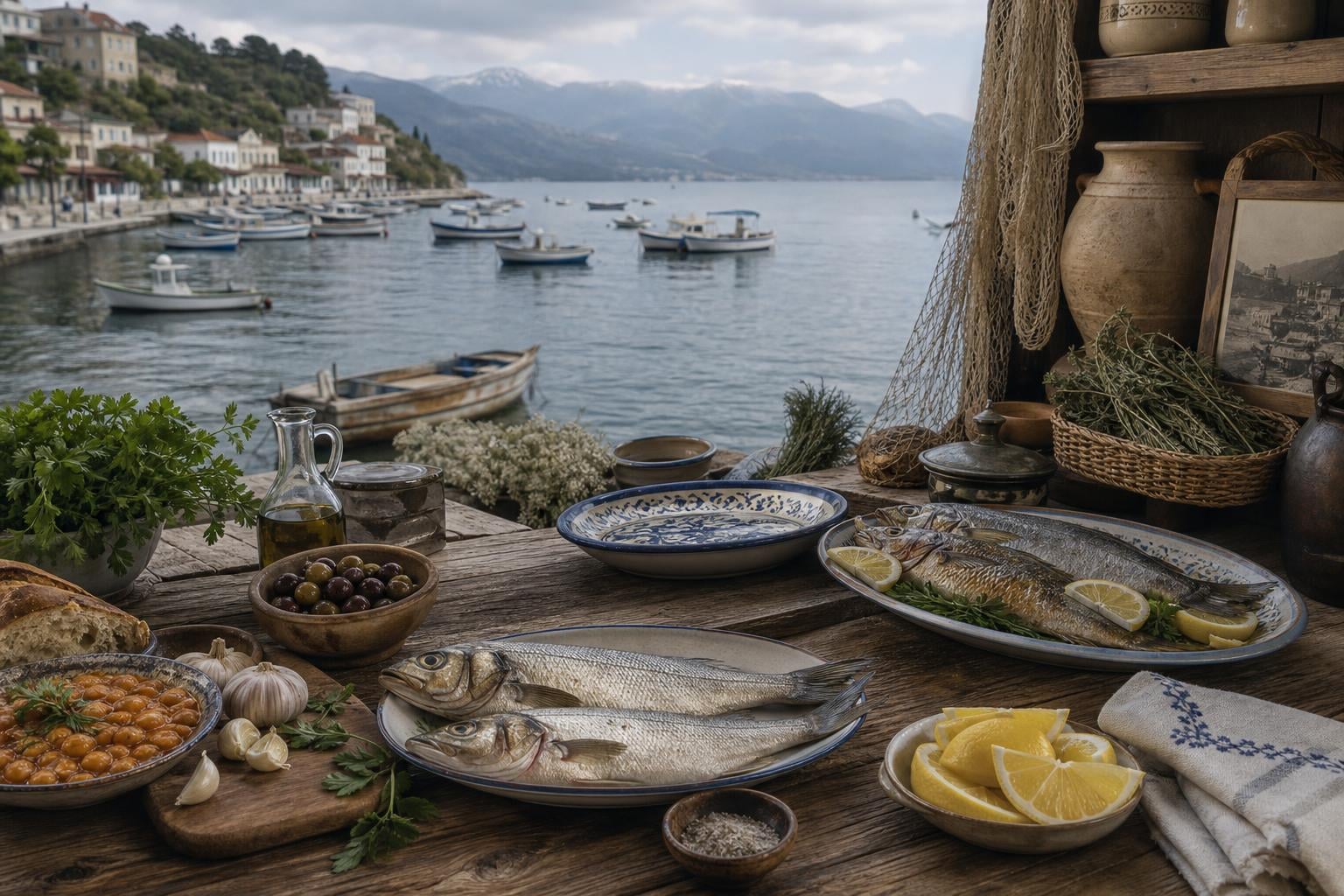
A Sunday lunch in Sterling Heights opens with a whole sea bass on a sheet pan — head still on, belly stuffed with lemon and a handful of parsley, the skin scored three times and crackling from forty minutes in the oven. A glass of cold white wine sits next to it. Across the room, a grandmother who left Vlorë in 1991 pours olive oil over the fish before anyone is allowed to touch it. In Worcester, a different table that same afternoon has a plate of sardines baked in tomato, eaten with bread, while a son explains to his American wife that the dish is called sardele tave and that the bones are part of the texture.
Six thousand miles east, on the shore of Lake Ohrid, a cousin grills koran — the lake’s endemic trout — over open coals, the skin blistering, the flesh pink and oily and faintly sweet. Behind him, the lake stretches into North Macedonia; the trout do not respect the border.
Albania’s relationship with fish is older than the modern country and broader than most people realize. The coastline runs more than 450 kilometers from the Montenegrin border down past Sarandë to the Ionian Sea; three large transboundary lakes — Ohrid, Prespa, and Shkodër — hold freshwater species found nowhere else; and rivers like the Drin, Vjosa, and Shkumbin carry trout, barbel, and chub into mountain valleys. The cooking that grew up around each of those ecosystems is regional, specific, and — for the Albanian American diaspora — recoverable at home with the right sourcing.
This is a guide for the cook who wants to understand it. What’s caught, what’s served, and how the families that traveled to New York, Michigan, Massachusetts, and New Jersey kept the table going.
Geography sets the menu
Three coastlines and three lakes. That is the short version of the Albanian fish map.
The Adriatic coast runs from the Montenegrin border at Velipojë down past Durrës, Kavajë, and into the Vlorë bay — sandy, shallower water, with lagoons (Karavasta, Narta) that produce mullet, eel, and shellfish. The Ionian starts at the Karaburun Peninsula and runs south past Himarë and Sarandë to the Greek border — deeper, rockier, clearer water, the kind of coast that produces sea bass, bream, octopus, and sea urchin. The two seas meet in the strait between Karaburun and Sazan island, and the species mix shifts noticeably as the bottom drops away.
Inland, three lakes carry the freshwater catch. Lake Shkodër, in the north, is the largest lake in Southern Europe by surface area and is shared with Montenegro; it produces carp, eel, bleak, and several catfish species. Lake Ohrid, in the southeast at Pogradec, is shared with North Macedonia and is widely cited as one of the oldest lakes in Europe — its long biological isolation produced endemic species, including the trout that gave the region its signature dish. Lake Prespa sits at higher elevation and is shared with North Macedonia and Greece; it holds carp, chub, and bleak. The two Ohrid-Prespa lakes are hydrologically connected through karst channels in the limestone — water from Prespa flows underground into Ohrid.
Then the rivers. The Drin runs through the north and feeds Lake Shkodër. The Vjosa — one of the last wild rivers in Europe — runs through southern Albania and supports brown trout, barbel, and chub. The Shkumbin splits the country roughly in half. Each river has its own regional specialties: trout from the mountain stretches, carp and catfish from the slower lowland sections.
Every ecosystem has its species, and every species has a way it is cooked. The list below works through them roughly south to north and salt to fresh.
Koran — the trout of Lake Ohrid
Koran (Salmo letnica) is the most culturally loaded fish in Albanian cooking. It is endemic to Lake Ohrid, meaning the species evolved there and exists nowhere else in the world. The lake’s age — widely cited as more than a million years, which would make it one of the oldest in Europe — and its depth (close to 290 meters at the deepest point) created a stable, oxygen-rich, isolated environment where the trout diversified into several forms distinguished by size, color, and spawning behavior.
The flesh is firm, pink, faintly sweet, and high in fat — closer in feel to a wild Atlantic salmon than to a small rainbow trout. Adult fish typically run 1 to 2 kilograms; larger specimens, sometimes called belvica in casual usage (the actual belvica, Acantholingua ohridana, is a separate Ohrid endemic), have been recorded historically at much larger sizes.
The traditional preparation is straightforward. A whole gutted koran is scored across the skin, brushed with olive oil, salted, and grilled over wood coals — typically vine cuttings or oak — until the skin is blistered and the flesh pulls cleanly from the bone. Lemon, parsley, and crushed garlic finish it. A second version bakes the fish over a bed of rice, with onion, tomato, and the trout’s own rendered fat soaking into the grain — a dish you will see called koran me oriz (trout with rice) in Pogradec restaurants.
Because the population is under sustained pressure from overfishing and habitat change, the species is protected, and fishing is regulated and seasonal on both sides of the lake. Wild koran from the lake is not legally exported in any volume, and the koran that appears on menus inside Albania is often farmed or, in some cases, mislabeled. For diaspora cooks, this means that “real” koran is functionally unobtainable in the US; the workaround is whole rainbow trout or steelhead from a good fishmonger, treated the same way.
That substitution matters. The dish — whole fish, coals, olive oil, lemon, garlic, no extra interference — is the inheritance. The species is the constraint, not the point.
Adriatic and Ionian catch
The salt-water repertoire is broader and more accessible, both in Albania and in the diaspora. Six species do most of the work.
Levrek (sea bass — Dicentrarchus labrax) is the showpiece. A 1- to 1.5-kilogram whole fish, baked or grilled, is the standard Sunday lunch fish along the coast. It is the same species sold in US markets as branzino or Mediterranean sea bass — typically farmed in Greece or Turkey for the American market, sold both frozen and fresh, with fresh whole fish generally costing more per pound than frozen. The preparation is universal across the Mediterranean: scale, gut, score, stuff the cavity with lemon and herbs, brush with olive oil, salt, and roast at 425°F for 25 to 30 minutes.
Kocë or sparida (gilthead sea bream — Sparus aurata) plays the same role with a slightly sweeter, denser flesh. The same treatment works. American fishmongers usually call it dorade or orata.
Sardele (sardines — typically Sardina pilchardus) are the everyday fish of the southern coast. Cheap, plentiful in season, and rich in oil. Albanian sardines are traditionally cleaned, salted lightly, and either fried in olive oil with a dredge of flour or baked in tomato as sardele tave. Frozen Mediterranean sardines are widely available in US markets that serve Greek, Italian, and Balkan communities.
Skumbri (mackerel — Scomber scombrus or S. japonicus) is the other oily-fish workhorse. Grilled whole, the skin charred and the belly salted, served with raw onion and lemon. The American equivalent — Spanish mackerel, sometimes Boston mackerel — works in the same recipe.
Kallamarë (squid) and karkaleca (shrimp, sometimes prawns) round out the seafood side. Squid is grilled whole, sliced into rings and fried, or stewed with tomato and white wine. Shrimp appears in tomato-based stews along the coast and as part of meze with olive oil and lemon.
Then the shellfish. The lagoons and bays of southern Albania — particularly around the Butrint area near Sarandë — produce farmed mussels (midhje) that are well-known regionally. Butrint Lake, a brackish lagoon connected to the Ionian, has had organized mussel cultivation for decades. The mussels are typically steamed open with white wine, garlic, and parsley, or baked under a breadcrumb crust.
Lake Shkodër and the rivers
Lake Shkodër is the freshwater counterpart to the coastal trade. The lake’s fish community is dominated by carp (krap — Cyprinus carpio), European eel (ngjala — Anguilla anguilla), bleak (gjuhza), barbel, and several freshwater catfish species.
The eel is the historically important catch. For generations, Shkodër eel was traded into Italian markets — eel is prized in northern Italian cooking, particularly around Christmas — and the Lake Shkodër fishery supplied a meaningful share of that demand. Local preparations are simpler: smoked over beechwood, grilled in chunks on skewers (ngjala në hell), or stewed slowly with onion and wine. The flesh is rich, oily, and slightly sweet; the texture firms up when smoked.
Carp is the everyday lake fish. Stuffed and baked whole with rice and herbs, fried in pieces, or — most traditionally in the Shkodër region — slow-stewed in a tomato broth with paprika and onion. The roe, when available, is salted and dried as a meze.
The mountain rivers produce a different fish entirely: small brown trout (Salmo trutta), pan-fried whole in olive oil and butter, eaten with bread and a glass of lake-cold white wine. The Vjosa, the upper Drin, and the streams above Theth and Valbona all support local trout populations. River fishing in Albania remains largely informal and regional; the catch rarely leaves the valley where it was taken.
Sardele tave and the classic preparations
The Albanian fish repertoire is small and deeply made. Six preparations cover almost everything.
Sardele tave — sardines baked in a clay or metal tavë (baking pan) with tomato, onion, garlic, olive oil, parsley, and a splash of white wine or vinegar. The sardines are cleaned, gutted, and laid in a tight single layer; the tomato mixture goes on top; everything bakes at high heat (around 425°F) for 20 to 25 minutes until the edges crisp and the tomato thickens. Served warm with crusty bread, lemon wedges, and a glass of raki or cold white wine. The dish exists in regional variants from Sarandë up to Durrës, with the southern versions running heavier on olive oil and herbs and the central versions leaning more on tomato.
Peshk i pjekur (grilled fish) is the universal preparation. Whole fish, scored, salted, oiled, and cooked over coals. The version that goes onto American grills in Sterling Heights and Yonkers is the same dish that comes off coals in Vlorë — the fire is what matters.
Peshk në hell (fish on the spit) is a coastal variant in which whole fish, usually smaller mackerel or sardines, are threaded on a metal skewer and cooked vertically over coals. It is a meze dish more than a main, eaten with the fingers.
Peshk me oriz (fish baked with rice) appears in two registers: the lake version (koran me oriz in Pogradec) and the coastal version (whole bream or bass over rice with onion, tomato, and lemon). The rice absorbs the fat and stock from the fish and finishes lightly toasted on top.
Salt-baked whole fish — buried in a crust of coarse salt and egg white and baked at high heat — is a southern Albanian and Greek-influenced preparation, more common in restaurants than home kitchens but recoverable at any oven.
Fish soups — çorbë peshku — sit somewhere between a soup and a stew. The Shkodër carp version is the most distinctive: carp pieces simmered with onion, garlic, paprika, tomato, hot pepper, and bay leaf, finished with a squeeze of lemon and served over a slice of stale bread. Coastal versions use mixed white fish, sometimes with shrimp and squid, and lean Mediterranean — closer in spirit to a Provençal bourride than to a heavy stew.
Smoked, cured, and preserved
Before refrigeration, the lake and the sea were preserved through smoke and salt. The traditions survived the freezer.
Smoked eel from Shkodër is the most distinctive product. Eel is cleaned, gutted, butterflied, and hot-smoked over beechwood or oak until the flesh is firm and amber. It keeps for weeks under refrigeration and travels well. In the Italian market, anguilla affumicata in the Veneto region historically pulled in part from this supply chain. In the Albanian household, smoked eel is served sliced thin, dressed with olive oil and lemon, eaten as meze with bread and raki.
Salt-cured sardines and anchovies (sardele në kripë) are the coastal answer. The fish are cleaned, packed head-to-tail in coarse sea salt, weighted, and left to cure for several weeks or longer. The result is firm, intensely savory fillets that get rinsed before serving and laid out with olive oil, vinegar, and chopped onion. A jar of salted anchovies on the meze table — particularly in the south, from Vlorë down to Sarandë — is as basic as olives and feta.
Dried bleak (gjuhza e thatë) from Lake Ohrid is the lake version of the same idea. Small bleak are cleaned, salted, and air-dried; they are then either grilled briefly over coals or eaten as-is with a glass of raki. The flavor is concentrated, salty, and faintly sweet — closer in spirit to bottarga than to anchovy.
Roe is preserved in two registers. Salt-cured and pressed carp roe from Shkodër is sliced thin and served on bread; salt-cured gray mullet (qefull) roe from the lagoons of the central coast is the Albanian equivalent of Italian or Greek bottarga.
Sourcing fish in the US diaspora
The good news for the diaspora cook: most of the Albanian salt-water repertoire is recoverable in the United States with minimal effort, because the Mediterranean species overlap heavily with what American fishmongers already stock for Italian, Greek, and Spanish customers.
In New York — the Bronx (Arthur Avenue), Astoria, and the Italian fish markets of Belmont — branzino, dorade, sardines, mackerel, squid, and whole sea bream are weekly stock. The fish counter at Cosenza’s in the Bronx, the markets along 187th Street, and the Greek stores in Astoria together cover nearly every species in this guide.
In metro Detroit — Sterling Heights, Warren, and the Eastern Market in Detroit — Albanian-owned groceries stock frozen Adriatic catch in winter (often labeled “Mediterranean sea bass,” “Mediterranean sardines,” or “branzino”), and Polish and Middle Eastern markets carry whole carp on order. The carp is the same species that fills Lake Shkodër.
In Massachusetts — Worcester, Boston’s North End, and the Greek fishmongers of Watertown and Belmont — whole bream, bass, and sardines are reliable. The North End fish stores carry salted anchovies and the occasional smoked eel around Christmas, when the Italian community buys for the Feast of the Seven Fishes.
In northern New Jersey — Paterson, Garfield, and Lyndhurst — Albanian and Italian markets sit close enough together that one trip covers everything from frozen sardines to live carp.
A few practical sourcing notes:
- Branzino in the US is almost always Dicentrarchus labrax — the same species as Albanian levrek. The “Mediterranean sea bass” label means the same fish. Both are typically farmed in Greece or Turkey, both work for any Albanian sea-bass recipe.
- Dorade or orata in US markets is Sparus aurata — Albanian kocë. Treat it the same.
- Sardines sold frozen in 1-kg boxes at Mediterranean groceries are usually European pilchards (Sardina pilchardus) — the right species for sardele tave. Pacific sardines, sold fresh on the West Coast, work too.
- Spanish mackerel is a workable substitute for Albanian skumbri; Boston mackerel (Scomber scombrus) is the exact same species.
- Whole rainbow trout or steelhead is the workable substitute for koran. Arctic char is the next best option. Look for fish 12 to 16 inches whole, with the skin and head still on, for grilling.
- Eel is harder. A few Italian markets in New York and New Jersey carry whole or smoked eel seasonally — particularly around Christmas. Asian markets sometimes stock live or frozen eel year-round. The species and the preparation are not identical, but the workaround is acceptable for grilling and smoking.
For the Albanian American family that wants to do this seriously, the recurring pattern is the same: build a relationship with one Italian or Greek fishmonger, learn what they get and when, and time the meals to the catch. The fishmonger does not need to know what sardele tave is. The fishmonger needs to know that when the sardines come in, the customer is buying twenty.
Fish on the diaspora table
The point of this guide is not the tour — there is no tour. The point is the table.
A coastal Albanian meal with fish at the center looks roughly the same in Vlorë and in Sterling Heights. A meze opens: olives, feta, gjizë, salted sardines or anchovies, a slice of smoked eel if it is available, raw onion, crusty bread, a small carafe of raki. The conversation lasts longer than the food. The main fish — whole, grilled or baked — comes out on a single platter. A chopped sallatë (cucumber, tomato, onion, parsley, olive oil, lemon, salt) sits next to it. The fish gets divided at the table by the cook, the head goes to whoever asks first, and the bones are part of the deal.
The cook who learns four fish preparations — whole grilled sea bass, sardele tave, peshk me oriz, and a simple fish soup — can host any Albanian fish meal a family will ever serve. The pantry is small (olive oil, lemons, garlic, parsley, oregano, paprika, tomato, salt, white wine, raki on the side). The technique is direct: heat, salt, fat, acid.
For the Albanian Americans recovering this from family memory, the fish dishes are often the most accessible entry point — easier than the lamb roasts, less fragile than tavë kosi, less time-bound than byrek. A grilled whole bass with lemon is forgiving, fast, and on the table in under an hour. The first Sunday a family makes it is usually the moment somebody realizes how much of the cooking traveled intact.
That is the work. Honor what came over. Cook it on a fire that the grandmother would recognize. Pour the raki before anyone sits down. Let the meal run long.
If this cooking is part of the inheritance worth counting — the food, the language, the small-table hospitality that survived the move — the National Albanian Registry is where we count it. One signature, 2 minutes, no cost. The certificate is a recognition document, not a legal status, but the count it builds is a community-led record of who we are in the United States.