

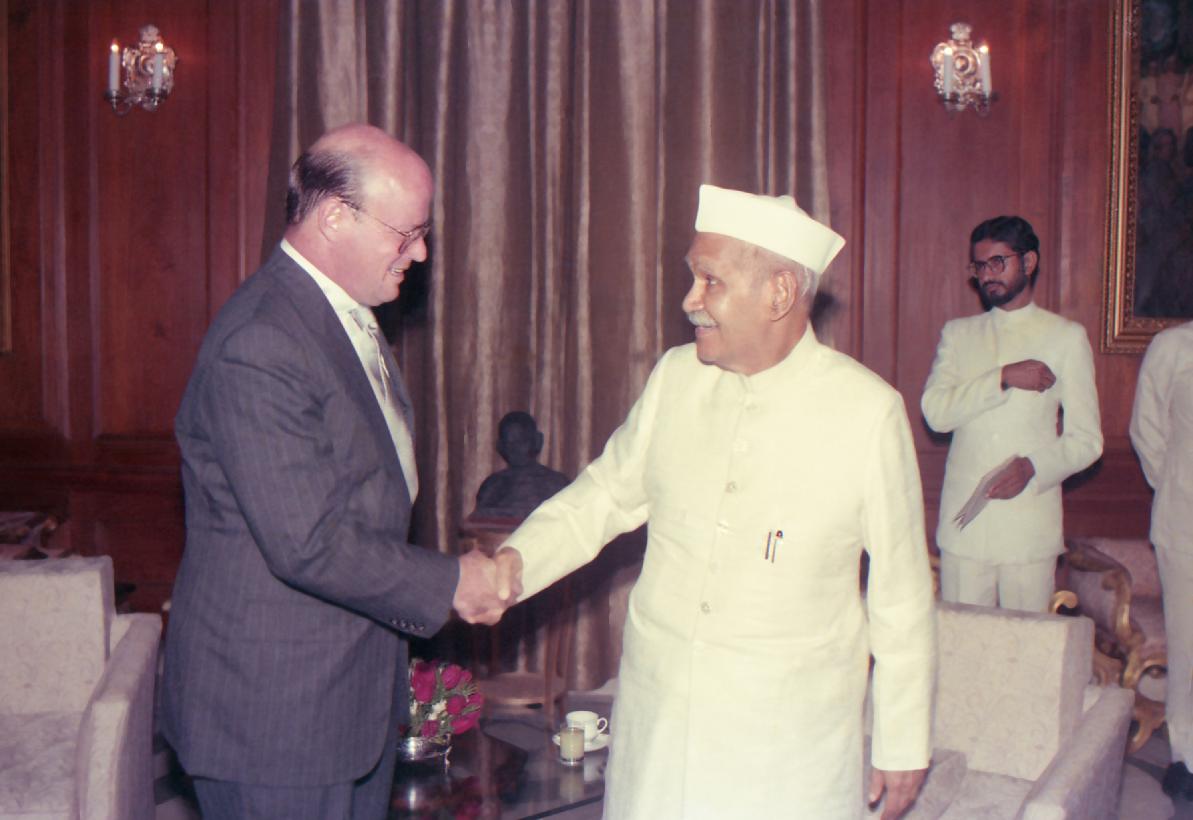
Frank George Wisner II — known professionally as Frank G. Wisner Jr. to distinguish him from his father, the early-Cold-War CIA officer Frank Gardiner Wisner Sr. (1909-1965) — was a retired US diplomat whose four-decade foreign service career ran from southern Africa to South Asia and ended on the file that mattered most to Albanian Americans: Kosovo. From 2005 to 2008 he served as the US Special Envoy / Special Representative of the President and Secretary of State for Kosovo Status under the George W. Bush administration, working alongside UN Special Envoy Martti Ahtisaari of Finland on the final-status settlement that culminated in Kosovo’s February 17, 2008 declaration of independence.
The Wisner name appears in two distinct chapters of American history. The father ran the Office of Policy Coordination and later the CIA’s Directorate of Plans in the 1940s and 1950s. The son took a different path — career State Department, ambassadorial postings under Republican and Democratic presidents alike, and a late-career assignment as the United States’ point man on a Balkan question that had defied resolution for nearly a decade. This article is about the son.
For the 230,000 Albanian Americans counted in the 2024 American Community Survey — and for the wider Albanian-American population that the same survey almost certainly undercounts — Wisner’s role on Kosovo is one of the under-told American foreign-policy stories of the 2000s. He is not a household name in the diaspora. He should be better known.
Who Frank G. Wisner Jr. was
Frank George Wisner II was born on July 2, 1938, into one of the foreign-policy families of mid-century Washington. His father served in the wartime Office of Strategic Services and the early Central Intelligence Agency; his mother, Mary Knowles Fritchey, was a philanthropist. The household was steeped in diplomacy and intelligence, but the son chose the open side of the trade — the State Department.
Wisner attended Princeton University, graduating in 1961. He joined the US Foreign Service in 1961 and remained a career officer for the next four decades, serving under eight presidents from Kennedy through George W. Bush.
His early postings took him to Algeria, Tunisia, and Vietnam. He did the staff work that builds an ambassador: country-team analysis, embassy reporting, regional policy planning at State, and posts on the National Security Council. By the late 1970s he had been promoted to ambassadorial rank, and his career from there is the standard arc of a senior US diplomat — successive chief-of-mission postings, a senior policy job at the Pentagon, and then a return to embassy leadership at the most demanding posts the State Department offers.
What sets him apart in the diaspora’s memory is the last assignment.
From Zambia to India: a four-decade foreign service career
Wisner’s ambassadorial record runs across four continents and three decades. He served as US Ambassador to Zambia from 1979 to 1982 under Presidents Carter and Reagan.
In 1986 he was named US Ambassador to Egypt, where he served until 1991 — a long, consequential tenure that spanned the late Mubarak consolidation, the first Gulf War, and the diplomatic groundwork for the Madrid Peace Conference. The Cairo embassy is one of the largest US missions anywhere; the ambassador to Egypt sits at the operational center of US Middle East policy. Wisner held the post for nearly five years.
From 1991 to 1992 he served as US Ambassador to the Philippines, managing the closure of Subic Bay Naval Base and Clark Air Base — the end of nearly a century of US military basing in the country. The negotiations were politically delicate on both sides; the eventual orderly withdrawal owed much to embassy leadership.
Back in Washington, Wisner served as Under Secretary of State for Arms Control and International Security Affairs from July 1992 to January 1993, then as Under Secretary of Defense for Policy from 1993 to 1994 under President Clinton — the senior civilian policy job at the Pentagon, with portfolio over NATO, arms control, and post-Cold-War alliance restructuring. He returned to the field in 1994 as US Ambassador to India, serving in New Delhi until 1997.
Across these postings he developed the qualities that made him useful on Kosovo a decade later: deep familiarity with multilateral negotiation, comfort working alongside allies whose national interests did not always align with Washington’s, and a reputation for delivering hard messages without producing diplomatic ruptures.
The 2005 appointment as Special Envoy on Kosovo
By the time Kosovo’s final status returned to the top of the international agenda, Wisner had retired from the foreign service and moved into the private sector. He served on the board of the American International Group (AIG), advised on international affairs at Kissinger Associates, and later affiliated with the law firm Squire Patton Boggs. Senior retired diplomats are routinely called back into government service for specific assignments; Kosovo was Wisner’s call-back.
The political context in 2005 was that Kosovo had been administered by the United Nations Interim Administration Mission in Kosovo (UNMIK) since June 1999, under the authority of UN Security Council Resolution 1244. Resolution 1244 had ended NATO’s air campaign and Serbian forces’ withdrawal but had deliberately left Kosovo’s final political status unresolved. By 2005 the international community had concluded that the status quo — indefinite UN administration without a settled political future — was no longer sustainable.
In November 2005 the UN Secretary-General appointed former Finnish President Martti Ahtisaari as the UN Special Envoy for the Future Status Process for Kosovo. The United States appointed Wisner the same year as the US Special Representative of the President and Secretary of State for Kosovo Status, working under Secretary of State Condoleezza Rice.
Wisner’s mandate was to coordinate the American position with the Contact Group — the informal grouping of the United States, the United Kingdom, France, Germany, Italy, and Russia that had been the principal Western forum on the Yugoslav wars since the early 1990s — and to support Ahtisaari’s UN-led process while maintaining direct US channels to Pristina, Belgrade, Moscow, and Brussels.
Working with Ahtisaari on the final-status plan
The Ahtisaari process ran for roughly fourteen months. From February 2006 through early 2007, Ahtisaari’s office held some seventeen rounds of direct talks between Pristina and Belgrade delegations in Vienna, plus expert working groups on decentralization, minority protections, religious heritage, and economic transition.
Wisner was the senior American interlocutor across this period. He shuttled between Washington, Brussels, the major European capitals, Pristina, and Belgrade, and he sat with Ahtisaari’s team at every stage of the drafting work. The American posture was that the talks should be given a real chance of success, but that the process could not be open-ended — at some point a recommendation would need to go to the UN Security Council whether or not the parties had agreed.
In February 2007 Ahtisaari submitted a draft to the parties; in March 2007 he formally transmitted his Comprehensive Proposal for the Kosovo Status Settlement — widely known as the Ahtisaari Plan — to the UN Security Council, accompanied by his recommendation that Kosovo move to independence supervised by the international community.
The plan ran to roughly sixty pages plus annexes. It proposed a Kosovo constitution; a comprehensive minority-rights framework with guaranteed Serbian municipal authority over six new majority-Serb municipalities; protected status for Serbian Orthodox Church sites including the patriarchate at Peć / Pejë and the monastery at Dečani; a continuing international civilian presence (the future International Civilian Office) with corrective authority over Kosovo legislation; an EU-led rule-of-law mission (the future EULEX); and a continued NATO-led security presence (KFOR).
Russia, however, signaled at the Security Council that it would not support a resolution endorsing the Ahtisaari Plan. After several months of further effort — including a final “Troika” mediation by the United States, Russia, and the European Union from August through December 2007, in which Wisner represented Washington — it was clear that no Security Council resolution authorizing the plan would pass. The Troika reported failure to the Secretary-General in early December 2007.
That left the Kosovo authorities, the United States, and the major European powers with a choice: accept indefinite stalemate, or proceed with a coordinated independence move outside the Security Council.
February 17, 2008: Kosovo declares independence
On Sunday, February 17, 2008, the Assembly of Kosovo convened in extraordinary session in Pristina and unanimously adopted a declaration of independence. The text committed Kosovo to implementing the Ahtisaari Plan in full, including its minority-protection provisions, and invited international supervision.
The United States recognized Kosovo on Monday, February 18, 2008. President George W. Bush issued a statement that same day; Secretary of State Condoleezza Rice transmitted the formal recognition. France, the United Kingdom, Germany, Italy, and Turkey recognized in the days that followed. Within a week more than twenty countries had recognized Kosovo’s independence.
Wisner was central to the diplomatic choreography of those days. The American position — that recognition would be coordinated with the major European allies, that it would be framed as a sui generis case driven by Kosovo’s specific UN-administered history rather than as a precedent for other separatist movements, and that it would be paired with continued investment in minority protections on the ground — was the position he had argued in capitals for nearly three years.
Serbia rejected the declaration, recalled ambassadors from recognizing states, and continues to consider Kosovo part of its sovereign territory. Russia and China likewise did not recognize. The legal status of Kosovo at the United Nations remains unsettled: Kosovo is not a UN member state, though as of the mid-2020s more than 100 UN member states recognize it bilaterally. The International Court of Justice, in a July 22, 2010 advisory opinion requested by the UN General Assembly, found that the declaration of independence did not violate international law.
The supervised-independence period formally ran from 2008 through September 10, 2012, when the International Civilian Office closed and Kosovo’s supervised status ended. The EU rule-of-law mission EULEX continues in a reduced form. KFOR remains deployed.
What Wisner’s role meant for the Albanian-American diaspora
The 2005-2008 Kosovo file is the most consequential foreign-policy episode for Albanian Americans since the NATO intervention of 1999, and arguably since Albania’s 1912 independence.
The diaspora was not a passive observer. Albanian-American organizations — the Albanian American Civic League, the Albanian American National Organization, Vatra, and a network of state-level associations — had spent more than a decade lobbying Congress on Kosovo, dating back to the Bob Dole-era advocacy of the early 1990s and through the 1999 air campaign. New York, New Jersey, Massachusetts, Michigan, and Texas-based Albanian Americans had organized rallies, written letters, raised funds, and built relationships with members of Congress representing districts with significant Albanian-American populations.
But organized advocacy and treaty-level diplomacy are different instruments. The Albanian-American community could push the American political system toward sustained engagement with Kosovo; it could not, on its own, draft a final-status proposal or coordinate the recognition decisions of a dozen capitals. That is what a senior State Department envoy with cabinet-level access does. Wisner’s role complemented diaspora advocacy at the level of execution.
When you talk to Albanian Americans who were politically active in those years, the names that come up most often are Joe DioGuardi, Eliot Engel, Joe Biden, Bob Dole, Wesley Clark, and the late President Ibrahim Rugova of Kosovo (covered in our piece on Ibrahim Rugova). Wisner’s name comes up less often, partly because his work was deliberately quiet — Special Envoys do not give campaign speeches — and partly because he was not Albanian and had no prior public profile in the community.
That under-recognition is worth correcting. The independence Kosovo declared on February 17, 2008 is the political fact that has most shaped Albanian-American identity in the twenty-first century. The diplomat who carried the American position into the rooms where it mattered deserves a place in the diaspora’s institutional memory.
After Kosovo: Egypt 2011 and the post-government years
Wisner’s Kosovo assignment ended in 2008 with the recognition decision. He returned to his private-sector advisory roles — Squire Patton Boggs, Kissinger Associates, board and advisory positions across financial services and energy — and to occasional senior consultation when the State Department needed an experienced hand on a fast-breaking question.
The most prominent of those return engagements came on January 31, 2011, when President Barack Obama sent Wisner to Cairo as a personal envoy to President Hosni Mubarak during the Tahrir Square protests. Wisner, the former US ambassador to Egypt with the deepest American working relationship with Mubarak, was asked to deliver a candid private message about the political situation. The mission generated controversy when Wisner remarked publicly that Mubarak’s “continued leadership is critical” during a transition period, a remark the White House quickly distanced itself from. Mubarak resigned on February 11, 2011.
The Egypt episode is the one widely-known footnote on Wisner’s late career. It does not alter the Kosovo record. Senior diplomats are sent into difficult assignments precisely because the cases are difficult; the public part of the work is rarely the part that matters most.
In the years after Kosovo, Wisner remained active on policy panels, wrote and spoke on US foreign policy across the post-Cold-War period, and continued his association with Squire Patton Boggs. He served on the board of the American Academy of Diplomacy and was a senior advisor at the EastWest Institute and other policy organizations. Wisner died of lung cancer on February 24, 2025, in Mill Neck, New York, at age 86.
Wisner’s legacy in US-Albanian and US-Kosovo relations
The Albanian-American relationship to the United States has many architects. Fan S. Noli built the institutional spine of organized Albanian-American life from a Boston parish in 1908 (we cover him in our Fan Noli profile). Bob Dole carried the Kosovo cause in the Senate through the 1990s. Madeleine Albright and Wesley Clark drove the 1999 NATO intervention. Joe Biden, then a senator, was an early and consistent voice for Kosovo recognition (see Albania-US relations and Kosovo-US relations for the longer arc).
Wisner’s place in this lineage is specific and bounded. He was the senior American diplomat assigned to the final-status process between 2005 and 2008. He did not invent US Kosovo policy; the strategic choice to support Kosovo’s independence had been made before his appointment, in the long sequence of decisions that runs from Dayton in 1995 through the 1999 air campaign and the 2004 unrest in Mitrovica. What Wisner did was carry that strategic choice through three years of granular, multilateral, often slow-moving negotiation, and into the recognition decisions of February 2008.
In the diplomatic record, that kind of work is the difference between a policy that exists on paper and a policy that produces a country. Kosovo today — with all its ongoing challenges, its EU integration process, its Serbia-Kosovo dialogue in Brussels, its NATO partnership — is a country in part because senior American diplomats including Wisner did the work of converting policy intent into international fact between 2005 and 2008.
For Albanian Americans, the institutional habit of remembering this kind of work is not strong. Albanian-American memory tends to focus on Albanian heroes — Skanderbeg, Ismail Qemali, Mother Teresa, Ibrahim Rugova. The American officials who built the US-Kosovo relationship deserve a place alongside them, even when those officials were not themselves Albanian.
Wisner was one of those officials. His name belongs in the diaspora’s institutional memory.
The National Albanian Registry exists to count Albanian Americans — across every state, every generation, every faith. The Kosovo file that Frank Wisner carried from 2005 to 2008 is one of the foreign-policy facts that defines the contemporary American Albanian community. NAR is the registry layer on top of that history: a community-led count and a recognition certificate.
If you are one of the 230,000 Albanian Americans counted by the 2024 American Community Survey — or one of the many more not yet counted — you can add your name to the National Albanian Registry. It is free, takes about a minute, and is a community-led count of the US Albanian diaspora.