
The United States is older than the Republic of Albania by 136 years, but the two states have spent more of that time as friends than as strangers. The arc runs from Woodrow Wilson’s veto of an Albanian partition at Versailles in 1919, through formal recognition in 1922, through a 47-year freeze under communism, through a fast post-1991 thaw, and into the post-NATO present, where Albania is a treaty ally of the United States and Albanian-Americans are one of the most concentrated diaspora populations in the country.
This article is the diaspora-side reading of that bilateral history. It is not an exhaustive diplomatic chronology — for that, the Wikipedia entry on Albania-United States relations and the US State Department country page are the standard references. What follows is the version that matters if you are an Albanian-American reading from New York, Detroit, Worcester, or Waterbury, and you want to understand how the country your grandparents left and the country you live in relate to each other on paper, in treaty law, and in practice.
The short version is that the relationship is older than most readers assume, more substantive than the small size of Albania suggests, and load-bearing for the diaspora in ways that the official story does not always make obvious. We move chronologically from 1912.
Early recognition and Wilson at Versailles (1912-1922)
Albania declared independence at Vlorë on 28 November 1912, in the closing weeks of the First Balkan War. International recognition came at the Conference of London (1913), but the borders the new state received left more than half of the ethnic Albanian population outside Albania, and the Principality of Albania (1914) under Prince William of Wied collapsed within months. World War I then handed Albania over to occupation by six different armies. By 1919 there was a serious diplomatic question of whether Albania would survive as a state at all.
The Paris Peace Conference convened in January 1919 to redraw the post-war map. Italy, Greece, and the newly formed Kingdom of Serbs, Croats, and Slovenes (later Yugoslavia) all advanced overlapping claims on Albanian territory. A secret 1915 Treaty of London had already promised Italy a protectorate over central Albania and territorial concessions to Italy, Greece, and Serbia carved out of the rest. The political momentum at the conference was toward partition.
President Woodrow Wilson intervened directly. During the Council of Four’s deliberations in the spring of 1919, Wilson rejected the partition proposal and insisted that Albania remain an independent state within recognizable borders. The intervention held. The conference did not authorize partition, the Treaty of London concessions were not honored, and Albania was admitted to the League of Nations on 17 December 1920 — the international recognition that mattered.
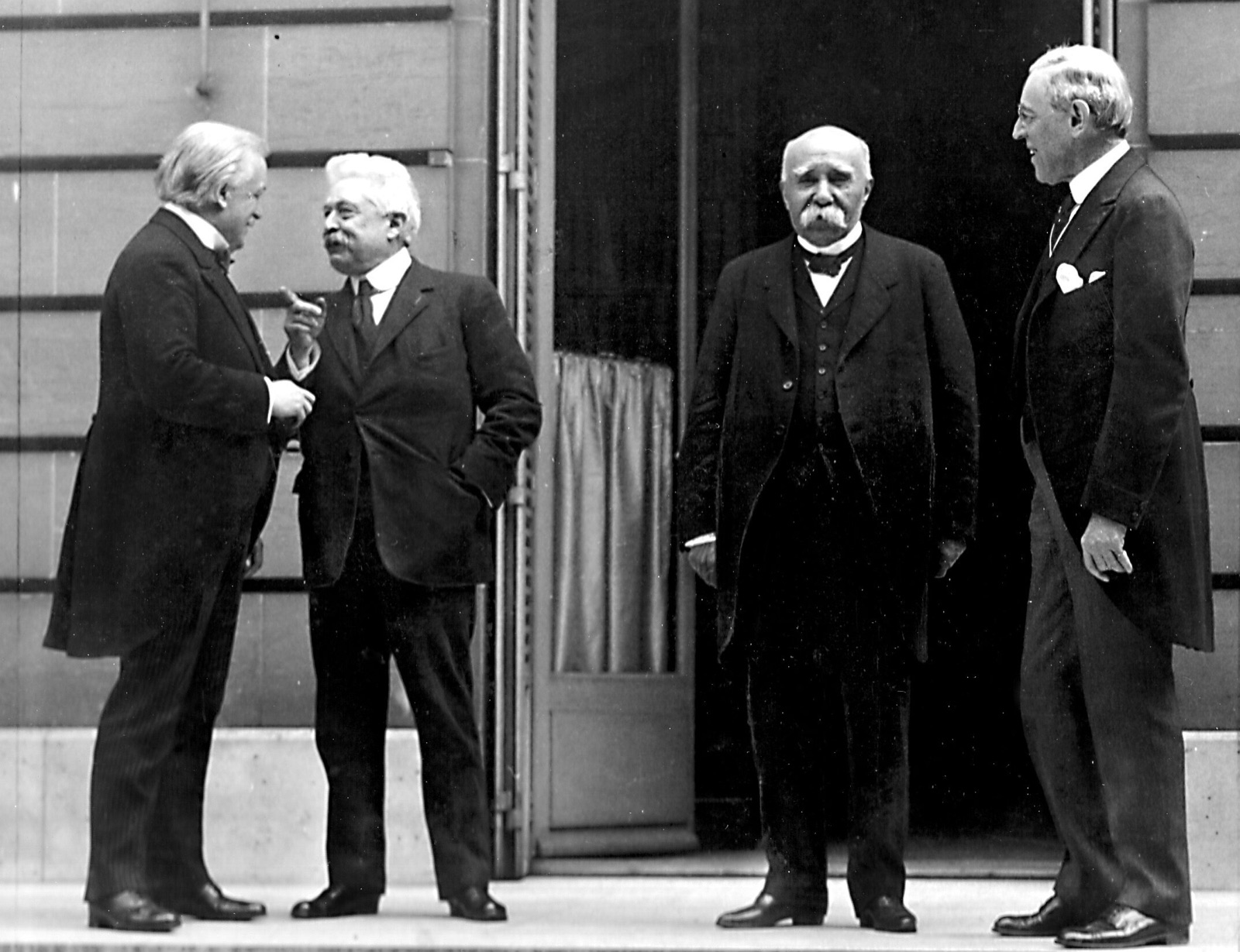 Photo: Edward N. Jackson, US Army Signal Corps / Wikimedia Commons / Public domain
Albanians did not forget. Wilson’s name became a fixed reference point in Albanian public memory across the 20th century, including throughout the communist period. A central boulevard in Tirana — Bulevardi “Wilson” — and a square in front of the Wilson statue were named for him, and his role at Versailles is taught as a foundational moment of modern Albanian statehood.
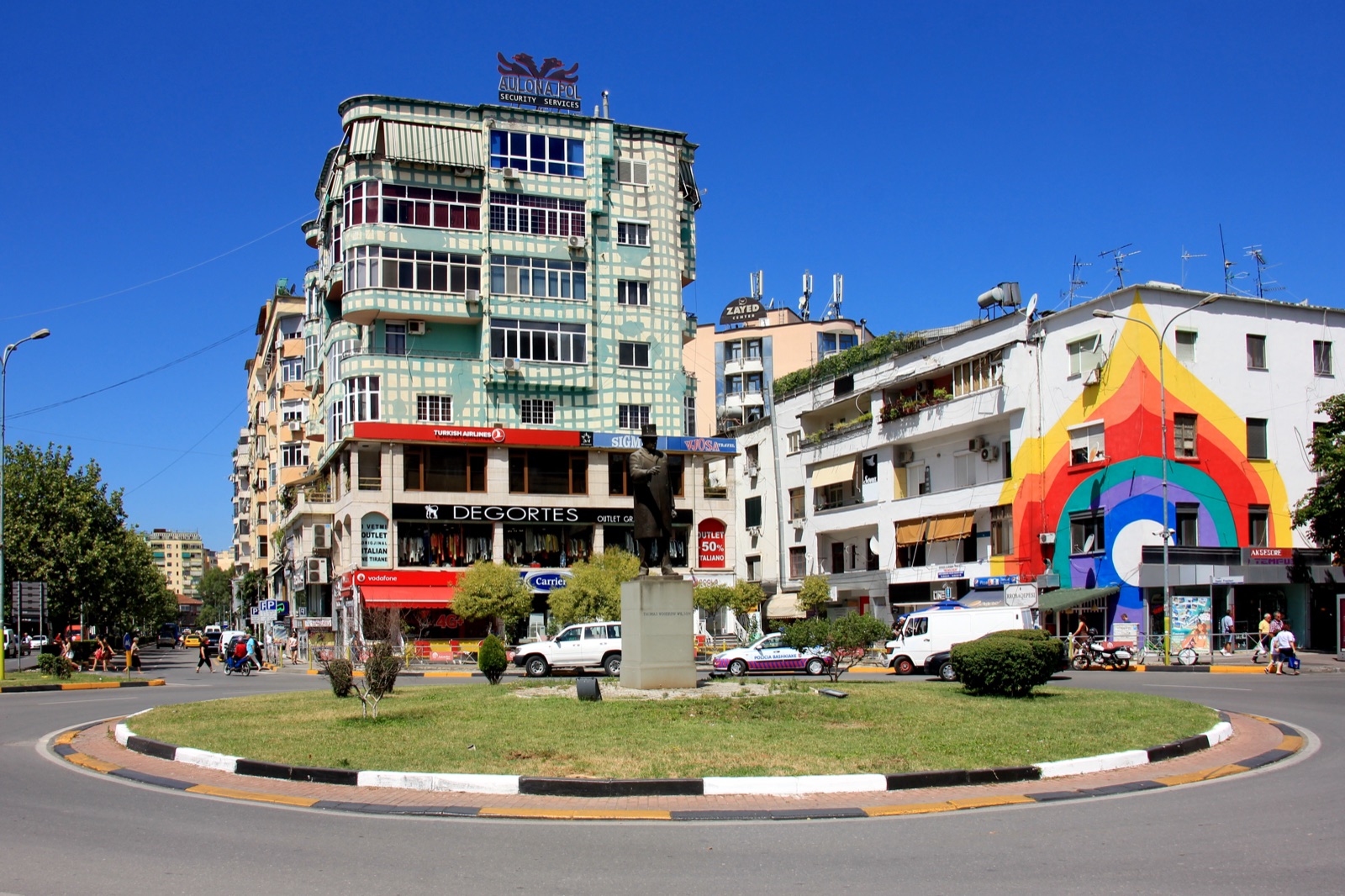 Photo: Shkelzen Rexha / Wikimedia Commons / CC BY-SA 4.0
Formal diplomatic recognition came shortly afterward. On 28 July 1922, Maxwell Blake, the American Commissioner in Albania, delivered written notification of US recognition to the Albanian Foreign Ministry. The 100th anniversary of that day was marked by both governments in 2022. The US legation in Tirana opened in 1922 and operated through the inter-war period until World War II shut it down.
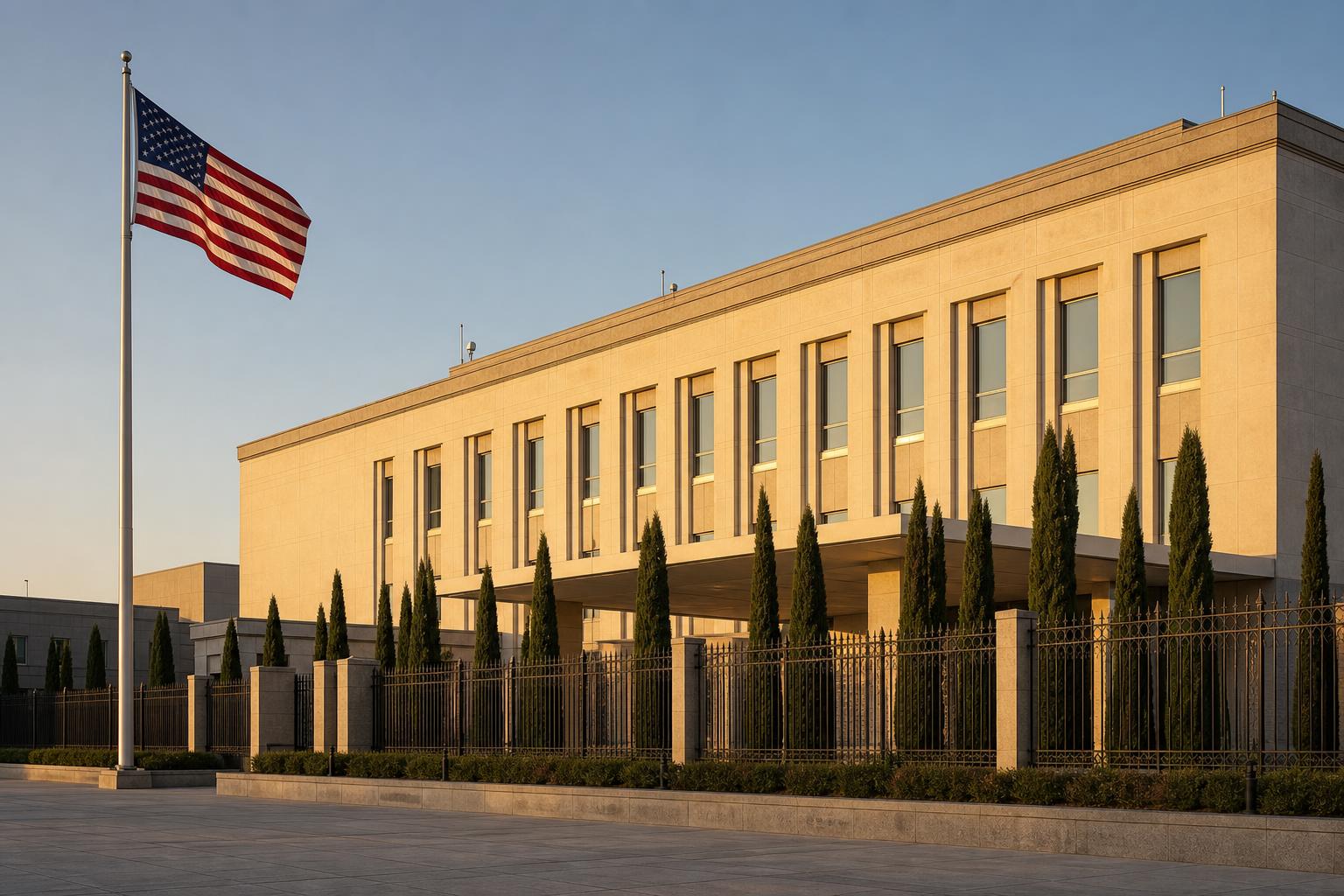
The building that housed it is a story of its own. In 1929 the State Department completed a purpose-built American chancery in Tirana, one of the first embassy buildings the United States ever constructed abroad. It was designed by Nathan C. Wyeth, the architect who had built the first Oval Office for President Taft, and its Italian-colonial lines deliberately echoed American plantation houses like Mount Vernon. Through the long freeze that followed, when the United States had no mission in Albania, the building did not sit empty: the Italian legation used it. The United States reoccupied and renovated the chancery after 1991, and it anchored the reopened embassy for years (Wikipedia: Embassy of the United States, Tirana).
The communist freeze (1939-1991)
Italy invaded Albania on 7 April 1939. King Zog fled, the legation operated under increasingly difficult conditions, and after Italy’s annexation the US recognized the de facto Italian control while not endorsing it. After Italy collapsed in 1943, Nazi Germany occupied Albania for the war’s final two years. When German forces withdrew in November 1944, the communist partisans under Enver Hoxha took Tirana. The monarchy was abolished in January 1946 and the People’s Republic of Albania was proclaimed.
The next 47 years were a diplomatic null. The Hoxha government refused to settle outstanding US property claims dating from the 1920s and 1930s — a precondition the State Department named for restoring relations — and Hoxha’s broader posture treated Western diplomatic ties as ideologically incompatible with the Albanian socialist project. The US legation never reopened. Albania built and then broke alliances with Yugoslavia (broken 1948), the Soviet Union (broken 1961, with Albania exiting the Warsaw Pact in 1968), and the People’s Republic of China (broken 1978), and ended the period in near-total international isolation.
Albania was the only country in Europe with no diplomatic relations with the United States for the entire Cold War. There was no embassy. There were no consular services. Travel was effectively impossible in both directions. The only continuous channel was the Albanian-American diaspora — newspapers, parishes, mutual-aid societies — which kept a record of the homeland that the state-to-state relationship did not.
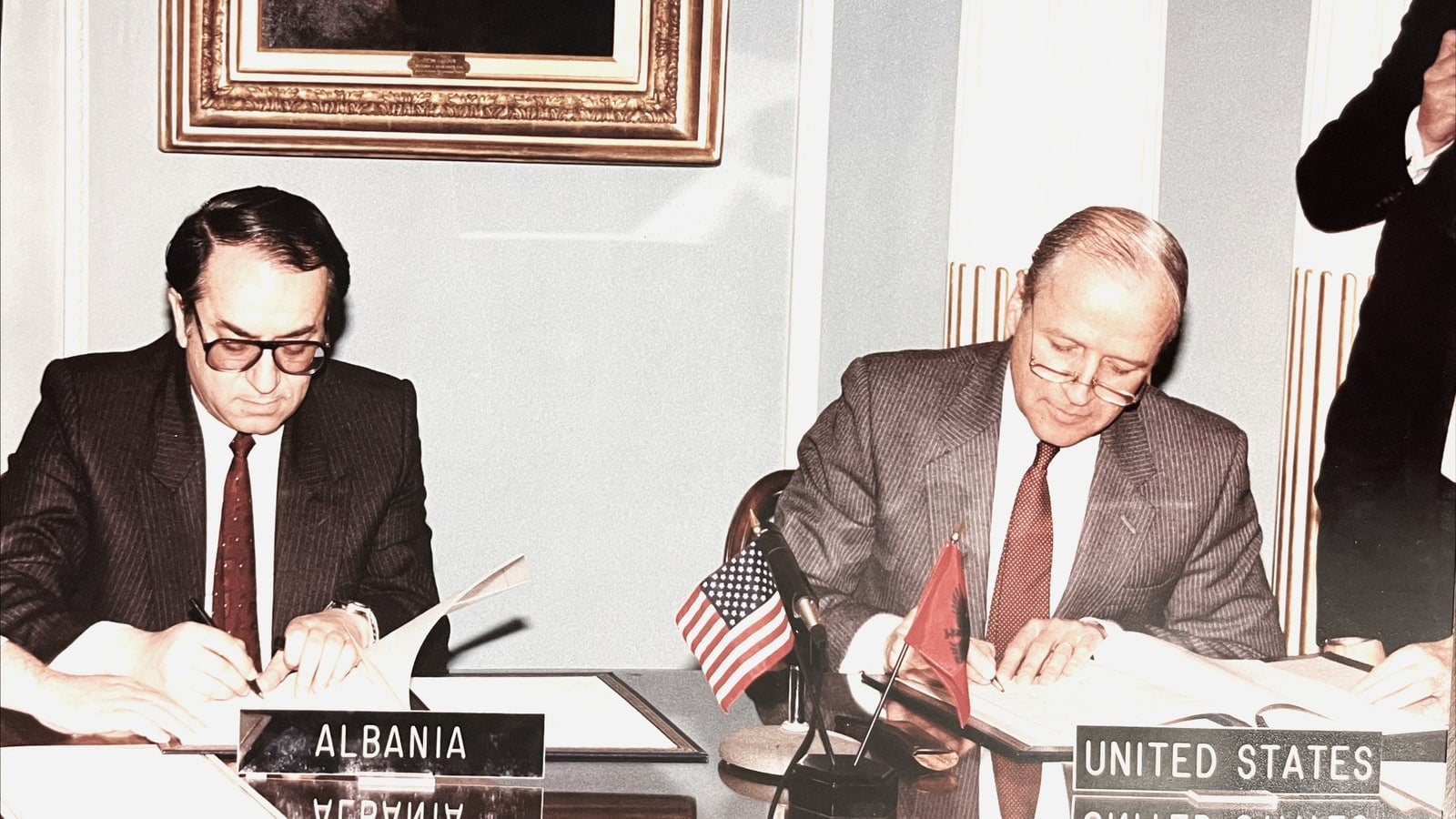
The freeze was not entirely frozen. After Hoxha’s death in April 1985, a quiet thaw began at the margins of Albanian diplomacy. Ilia Zhulati, an Albanian diplomat at the UN mission in New York, opened an unauthorized backchannel with Charles C. Moskos, the Northwestern University military sociologist whose Greek-American family came from a village in what is now southern Albania. The contact was unknown to most Albanian officials and ran for roughly six years through covert meetings in New York and Vienna. It is the bridge that runs underneath the 1939-1991 freeze in the official chronology.
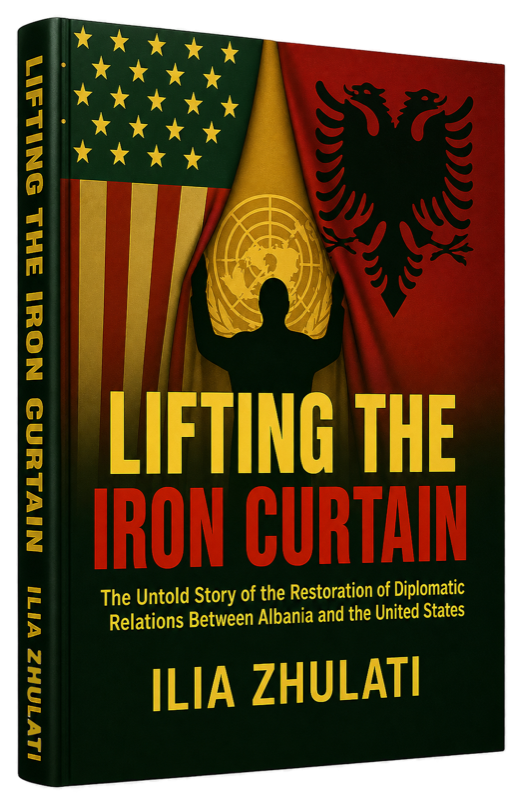
The bridge surfaced in 1990. After Zhulati briefed President Ramiz Alia on the positive American response coming back through the Moskos channel, Alia issued a presidential directive authorizing formal bilateral negotiations and, on 12 April 1990, publicly declared Albania’s willingness to establish diplomatic relations with both the United States and the Soviet Union. That declaration is the moment the freeze ended in policy. The mass demonstrations of 1990-1991, the toppling of Hoxha’s statue in Skanderbeg Square on 20 February 1991, and the first multiparty elections in March 1991 unfolded against a diplomatic track that had already been laid. The full account is in the memoir Lifting the Iron Curtain.
Reopening relations, 1991
Diplomatic relations were formally re-established on 15 March 1991, ending a 52-year break. The visible re-engagement that followed was unusually fast. Secretary of State James Baker visited Tirana on 22 June 1991 — the first US cabinet-level official in Albania since before World War II — and announced a $6 million initial aid package. Crowds in Skanderbeg Square greeted his motorcade in numbers reported by US press at over 300,000, an extraordinary public response that surprised the State Department’s own protocol officers.
The US Embassy in Tirana reopened on 1 October 1991, with Christopher Hill (later Assistant Secretary of State for European and Eurasian Affairs and chief negotiator on Kosovo, then ambassador to multiple posts) as the founding Chargé d’Affaires. Ambassador William Ryerson presented credentials in December 1991, restoring full ambassadorial-level relations after the 47-year break.
US engagement scaled up across the 1990s on multiple tracks:
- USAID opened a Tirana mission and ran transition-economy programs across infrastructure, agriculture, justice reform, and civil society. Albania was one of the largest per-capita recipients of US bilateral assistance in Europe during the early-1990s transition.
- The Albanian-American Enterprise Fund (AAEF), capitalized by the US Congress under the SEED Act, channeled investment into private-sector development and later spun off the Albanian-American Development Foundation.
- The Peace Corps opened in Albania in 1992 and has run continuously since.
- Fulbright programs resumed in both directions in the early 1990s.
The decade was not smooth. The 1997 pyramid-scheme collapse triggered nationwide civil unrest, the partial breakdown of state authority, and an Italian-led international intervention. US engagement continued through the crisis.
The Albanian-American diaspora as a bridge
The state-to-state story does not happen in a vacuum. By the time relations reopened in 1991, an organized Albanian-American community had already been operating in the United States for nearly a century. Vatra (the Pan-Albanian Federation of America) was founded in Boston on 28 April 1912, seven months before Albania declared independence. Its newspaper Dielli (“The Sun”) had been publishing since 1909. The Albanian Orthodox Archdiocese under Fan Noli was founded in 1908. By 1922, when the US formally recognized Albania, an Albanian-American press, religious infrastructure, and federation of mutual-aid societies were already doing the work of a diaspora.
Through the communist period, the diaspora was the only continuous channel between the two countries. Albanian-American newspapers in Boston, New York, and Detroit covered the homeland that US diplomats could not visit. The Albanian-American National Organization (AANO), founded in Worcester in 1946 by the post-WWII anti-communist refugee wave, kept a politically conscious diaspora active during the years when state-to-state contact was zero.
After 1991, the diaspora became a recognized policy interlocutor. The Albanian American Civic League (AACL), founded in 1989 by former US Congressman Joe DioGuardi, ran sustained advocacy on Balkan policy through the 1990s and 2000s — particularly on Kosovo. The National Albanian American Council (NAAC), founded in Washington in 1996, added a complementary policy track.
The numbers matter. The 2024 American Community Survey records roughly 230,000 Albanian-Americans by ancestry; community estimates that include ethnic Albanians from Kosovo, North Macedonia, and Montenegro put the working figure closer to one million. Top states are New York (~56,000), Michigan (~27,000), and Massachusetts (~21,000). For US politicians representing those concentrations, Albanian-American voters are a real constituency, and Albania’s bilateral standing in Washington reflects that.
Kosovo and the late-1990s alignment
The Kosovo question reshaped the bilateral relationship in the second half of the 1990s. After Slobodan Milošević revoked Kosovo’s autonomy in 1989 and Serbian authorities imposed parallel legal and education systems excluding Kosovo’s roughly 90% Albanian population, tensions escalated through the early 1990s. By 1998, the Kosovo Liberation Army (KLA) was in open conflict with Serbian security forces, and large-scale forced displacement of Kosovar Albanians was underway.
After the failure of the Rambouillet talks in March 1999, NATO conducted a 78-day air campaign against Yugoslav military targets between 24 March and 10 June 1999. The campaign ended with the Kumanovo Agreement (June 1999), the withdrawal of Serbian forces from Kosovo, and the establishment of UN administration (UNMIK) under Security Council Resolution 1244. Albania served as a logistical staging area during the campaign and accepted approximately half a million Kosovar Albanian refugees at the height of the displacement crisis — an extraordinary share of the population for a country of three million.
Two long-term consequences shaped the bilateral relationship after Kosovo:
- Camp Bondsteel, the US military installation built in southeast Kosovo at Ferizaj (Uroševac) starting in 1999 as the headquarters of the US contingent of the NATO Kosovo Force (KFOR), anchored a continuing US military presence in the region. While Bondsteel sits in Kosovo rather than Albania, it converted a wartime alignment into a durable post-war security architecture that included Albania.
- Kosovo’s declaration of independence on 17 February 2008 was recognized by the United States the following day. Albania recognized Kosovo on the day of the declaration. Kosovo today is recognized by the United States, the United Kingdom, France, Germany, and most NATO and EU states; Serbia, Russia, and several other states do not recognize it. The Kosovo recognition question remains a politically active topic between Belgrade and Pristina; the US-Albania-Kosovo policy alignment has been continuous since 1999.
NATO accession (2009) and post-accession defense ties
Albania’s NATO membership is the single most consequential post-1991 outcome of the bilateral relationship.
The path ran through several steps. Albania joined NATO’s Partnership for Peace program in February 1994. The Adriatic Charter (Adriatic Charter or A-3), signed in Tirana on 2 May 2003 by Albania, Croatia, and the Republic of Macedonia (now North Macedonia), with the United States as the lead external partner, created a US-led mechanism for coordinating the three countries’ NATO candidacies. The model was deliberately patterned on the earlier US-Baltic Charter that had supported Estonia, Latvia, and Lithuania into the alliance.
Through the 2000s, Albania met successive Membership Action Plan (MAP) benchmarks on defense reform, civilian control of the military, and force modernization. Albanian forces deployed to Afghanistan (ISAF) and Iraq as a way of demonstrating operational interoperability and political alignment with NATO operations. The Bush administration championed Albanian membership as a regional priority.
President George W. Bush’s visit to Tirana on 10 June 2007 was the public-facing capstone — the first sitting US president to visit Albania. Speaking in the courtyard of the Council of Ministers, Bush told the crowd he looked forward to welcoming Albania into NATO some day, and the trip — which included an enormous, adoring crowd in the nearby town of Fushë-Krujë — produced one of the warmest public receptions any US president has received abroad in the post-Cold War period. The Bucharest Summit invitation followed in April 2008, and Albania formally joined NATO on 1 April 2009 alongside Croatia.
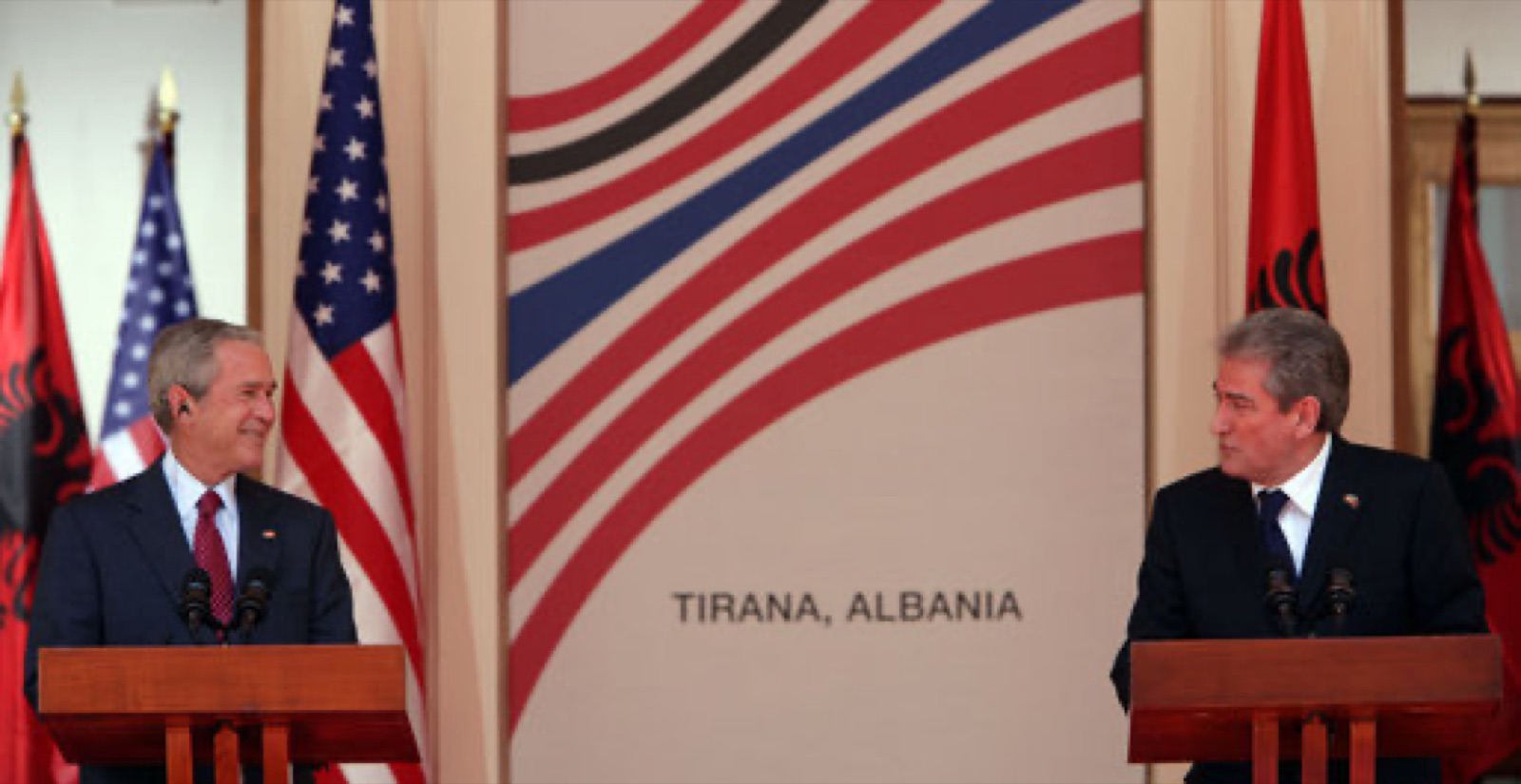 Photo: Chris Greenberg / The White House / Wikimedia Commons / Public domain
Post-accession defense cooperation has been concrete:
- Joint exercises under NATO frameworks at Albanian training facilities and US bases in Europe.
- Kuçovë Air Base, a Soviet-era facility in central Albania, was upgraded under a NATO Security Investment Programme project as a regional support base.
- Foreign Military Financing (FMF) and International Military Education and Training (IMET) programs support Albanian Armed Forces interoperability, including officer training at US war colleges.
- The Albanian contingent in KFOR continues to operate alongside US forces in Kosovo.
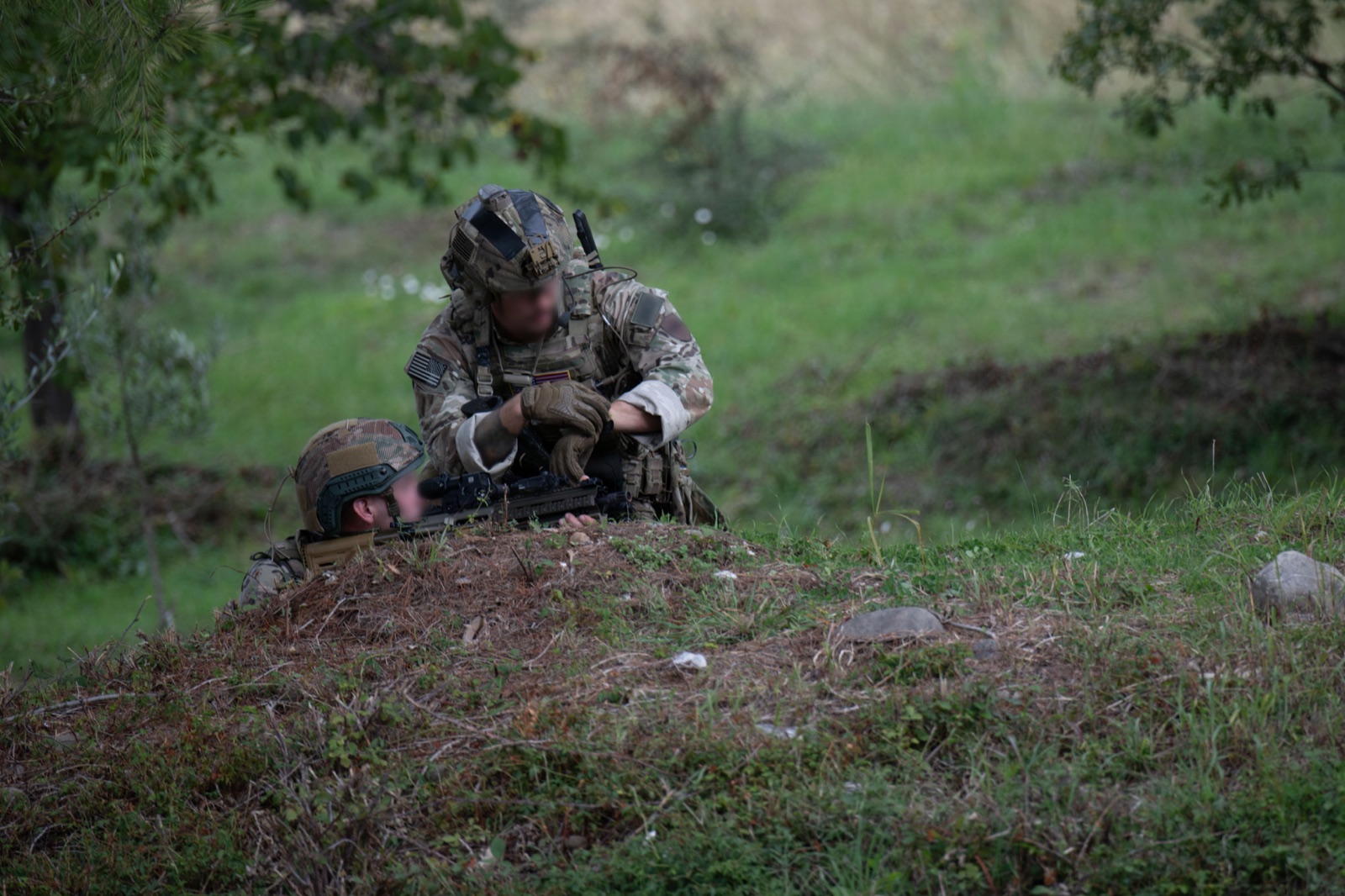 Photo: PO1 Leon Wong, US Navy / Wikimedia Commons / Public domain
NATO accession converted the post-Cold War alignment into a binding treaty obligation under Article 5 of the North Atlantic Treaty. That is the strongest available form of US security commitment to a European partner, and Albania holds it.
Bush 2007, Trump-era engagement, Biden-era strategic dialogue
The high-visibility moments since 2007 are worth tracing:
George W. Bush, June 2007. First sitting US president in Albania. Speech at the Council of Ministers courtyard on Albanian NATO membership, plus a rapturous crowd reception in Fushë-Krujë. The visit produced the most consequential US presidential photograph in modern Albanian public memory.
Barack Obama administration (2009-2017). Albania entered NATO at the start of the Obama presidency. Prime Minister Edi Rama met President Obama and Vice President Biden at the White House in 2014. The administration backed Albania’s EU candidacy track, granted in June 2014, and supported Tirana-Pristina dialogue under EU mediation.
Donald Trump first administration (2017-2021). US engagement on Kosovo-Serbia normalization intensified, including the September 2020 Washington Agreement between Pristina and Belgrade on economic normalization. Albania was not a direct party but was aligned with the US position. The administration also pressed Albania on judicial reform, particularly the vetting process for judges and prosecutors, which the State Department had supported since 2016.
Joe Biden administration (2021-2025). The administration upgraded the bilateral framework. 2022 was the centennial year of US recognition, and the two governments formalized a Joint Declaration on Strategic Partnership. The first US-Albania Strategic Dialogue was held in Washington on 25 October 2022, establishing the annual bilateral mechanism across defense, regional security, rule of law, energy, and economic cooperation.
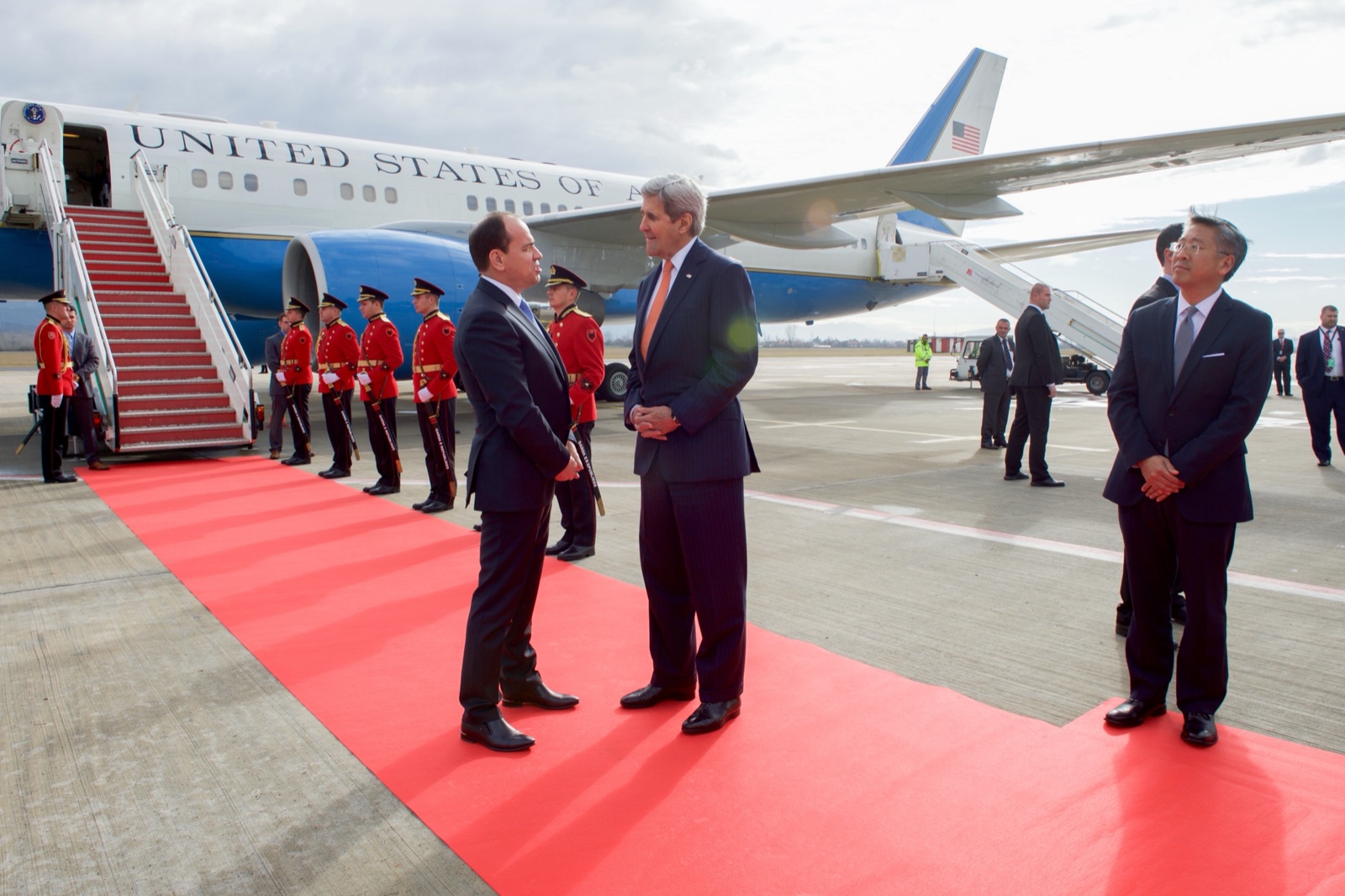 Photo: US Department of State / Wikimedia Commons / Public domain
Donald Trump second administration (2025-present). Engagement on regional issues continues. The Strategic Dialogue framework remains the operating bilateral channel, with public diplomacy emphasizing economic cooperation and energy — particularly Albania’s role in regional natural-gas infrastructure — alongside the existing NATO security agenda.
The pattern across four administrations is policy continuity. The strategic baseline — Albania as a NATO ally, the US as Albania’s most important security partner, Kosovo recognition as a fixed US position — has held.
Trade, education, and the USAID legacy
Beyond defense, the bilateral economic relationship is modest in absolute scale but disproportionate in its effect on Albania’s transition.
Trade and investment. US-Albania bilateral trade is small in absolute terms — Albania’s economy is roughly $25 billion in nominal GDP — but US firms are present in energy, telecommunications, and finance. The US-Albania Bilateral Investment Treaty, signed in 1995 and entered into force in 1998, remains the framework for investment protection. AmCham Albania operates as a working forum for US-Albanian business.
USAID (1992-present). Three decades of USAID programming in Albania is foundational. Early-1990s programs supported the privatization of state enterprises, agricultural land reform, and the rebuilding of municipal administration. Through the 2000s and 2010s USAID work shifted toward justice-sector reform (the vetting process and prosecutorial independence), local-government capacity, and economic competitiveness.
Education. The Fulbright Program has placed hundreds of Albanian scholars and students in US universities, and US scholars at Albanian institutions, since 1992. English-language education in Albania expanded dramatically after 1991, displacing the Russian and Italian instruction standard during communism. US-affiliated institutions including the University of New York Tirana opened in the 2000s, and high-school exchange programs moved Albanian students through US host families throughout the 1990s and 2000s.
Consular work. The US Embassy in Tirana issues a high volume of non-immigrant and immigrant visas annually. The Albanian Embassy in Washington, DC and the Consulate General in New York handle the diaspora-side consular load — passports, citizenship by descent under Law 113/2020, and civil-status documentation.
Diaspora as economic actor. Remittances from the US-based diaspora, while smaller than flows from Italy and Greece, are a meaningful share of household income for Albanian families with US-resident relatives. Diaspora-led investment in real estate, hospitality, and small business has been a steady factor in Albanian regional economies, particularly in the south and in the Kukës region.
What it means for Albanian-Americans today
If you are an Albanian-American reading this, the bilateral relationship is not abstract. It shapes the documents you can hold, the travel you can take, and the political access you have.
Citizenship. Under Albanian Law 113/2020, Albanian-Americans whose ancestors emigrated up to three generations ago — parent, grandparent, or great-grandparent — can claim Albanian citizenship by descent without renouncing US citizenship. Both countries permit dual citizenship without restriction. The bilateral framework that makes that practically workable — recognized passports, functioning consulates, established document chains — exists because of the diplomatic infrastructure rebuilt after 1991.
Travel. US passport holders enter Albania visa-free for stays up to one year. Albanian passport holders require a US visa, but the consular relationship is established and processing is regular.
Political voice. Albanian-Americans concentrated in New York, Michigan, Massachusetts, and Florida are an organized voting constituency for federal and state offices. The community’s policy priorities — Kosovo recognition, sustained NATO engagement, Western Balkans EU integration — align with the bipartisan US baseline.
Cultural and educational ties. Fulbright, the Peace Corps in Albania, university exchange programs, and US-affiliated institutions in Tirana mean the next generation of Albanian-Americans inherits a bilateral framework where moving between the two countries for school or work is routine.
The diaspora as part of the bilateral story. The Albanian-American community is not a side audience to the US-Albania relationship. It is one of the load-bearing elements — alongside NATO membership, the Strategic Dialogue, and the USAID legacy — that holds the whole thing up.
The National Albanian Registry counts Albanian-Americans — including ethnic Albanians from Albania, Kosovo, North Macedonia, Montenegro, and the broader diaspora. Adding your name takes about 2 minutes. The certificate of recognition is free; it is a community-issued recognition document, not a government ID and not citizenship. Get counted at /register.
Editor’s note: Ilia Zhulati is the author’s father. The backchannel account here draws on the memoir Lifting the Iron Curtain, co-authored with the author.