
Ibrahim Rugova (1944-2006) was the literary scholar, founding leader of the Democratic League of Kosovo (LDK), and first president of Kosovo who led a decade of nonviolent resistance against Yugoslav rule in the 1990s and served as the first internationally recognized head of state of post-war Kosovo. He is widely referred to in Kosovo as Ati i Kombit — the Father of the Nation. Known as “the Gandhi of the Balkans” for his commitment to peaceful resistance, he led the LDK for 17 years and served as president twice: from 1992 to 2000 in the unrecognized parallel government, and from March 2002 until his death in January 2006 in the recognized post-war administration.
He died of lung cancer two years before Kosovo’s February 17, 2008 declaration of independence — the political destination he had worked toward for two decades but did not live to see.
What follows is his life and his place in the long arc of recent Kosovar Albanian history. Kosovo’s status remains a subject of differing international positions; this piece treats the question neutrally and tracks the documentary record. Wikipedia is cited inline for dates and biographical detail.
Early life: a village in western Kosovo (1944-1980)
Ibrahim Rugova was born on December 2, 1944, in the village of Cerrcë (also rendered Crnce), near the town of Istog, in what was then Yugoslavia and is today western Kosovo. The family belonged to the Kelmendi clan, an old Albanian tribal lineage with roots in the highlands straddling modern northern Albania, Montenegro, and Kosovo.
The defining event of his earliest childhood took place when he was about six weeks old. In January 1945, his father Ukë Rugova and his paternal grandfather Rrustë Rugova were executed by Yugoslav communist partisans in the closing months of the war (Wikipedia: Ibrahim Rugova). The killings were part of the wider partisan score-settling across the Yugoslav lands in 1944-1945. The specific allegations against Ukë and Rrustë Rugova are not fully resolved in the available record. Ibrahim Rugova grew up without his father.
His mother raised Ibrahim and his siblings alone in the postwar village. He completed primary school in Istog and graduated high school in Peć (Peja in Albanian) in 1967.
He then enrolled at the University of Pristina in the Faculty of Philosophy, Department of Albanian Studies. His student years coincided with the 1968 Kosovo protests — a wave of demonstrations across Kosovar Albanian universities and high schools demanding a separate Yugoslav republic for Kosovo and broader cultural rights for Albanians. Rugova took part. He graduated in 1971.
The trajectory from there was scholarly rather than political. He stayed at Pristina as a research fellow at the Institute for Albanian Studies (Instituti Albanologjik) and pursued a doctorate in literary theory. In 1976-1977 he traveled to Paris and studied at the École Pratique des Hautes Études under the French structuralist literary theorist Roland Barthes — at the time one of the central figures in European literary criticism (Wikipedia: Ibrahim Rugova).
He completed his doctorate in 1984.
The Parisian-structuralist training is worth noting. It is not the standard background for a Balkan political leader, and it shaped a politician unusually attentive to symbolic action and to what theorists call the performative dimension of statehood — building a state by acting as if it already existed.
 Parliamentary chamber evoking the parallel Kosovo institutions Rugova helped build through the 1990s — an elected presidency and assembly that operated alongside, not against, Serbian rule.
Graphic by NAR
Parliamentary chamber evoking the parallel Kosovo institutions Rugova helped build through the 1990s — an elected presidency and assembly that operated alongside, not against, Serbian rule.
Graphic by NAR
Academic career: literature, criticism, and the Albanological Institute
Rugova spent the 1970s and 1980s primarily as a scholar of Albanian literature, particularly Albanian-language modernist poetry and 19th- and 20th-century literary history. He published essays prolifically. His major works include studies on Albanian literary theory and criticism, and the multi-volume Vepra letrare (Literary Works), a collected edition of his scholarly output.
He edited the student newspaper Bota e Re (“New World”) and the literary magazine Dituria (“Knowledge”) (Wikipedia: Ibrahim Rugova). In 1988, he was elected president of the Kosovo Writers’ Union.
He served as a senior figure at the Institute of Albanology in Pristina through the 1980s — the central Yugoslav institution for Albanian-language linguistics, folklore, and literary studies, and a nucleus of Kosovar Albanian intellectual life under the autonomy granted by the 1974 Yugoslav constitution.
In 1989, that autonomy was revoked, and the world Rugova had been operating in changed.
Founding the LDK (1989-1990)
The political crisis began in March 1989, when Slobodan Milošević — then rising as the dominant figure in Serbian politics — pushed through constitutional amendments that stripped Kosovo of the autonomy it had held under the 1974 Yugoslav constitution. The amendments dissolved Kosovo’s separate parliament and police, brought Kosovo under direct Serbian administrative control, and triggered a wave of dismissals of Kosovar Albanians from public-sector jobs, universities, and state-run media.
The response from the Kosovar Albanian intellectual class was rapid. On December 23, 1989, a group of Kosovar writers, academics, and former dissidents — Rugova among them — founded the Democratic League of Kosovo (Lidhja Demokratike e Kosovës, LDK).
The LDK was conceived from the start as a mass political movement rather than a narrow opposition party. Its growth was extraordinary. Within months it enrolled roughly 700,000 members — close to the entire adult Albanian population of Kosovo at the time (Wikipedia: Ibrahim Rugova). Rugova was elected president of the LDK in 1990 and held the position until his death sixteen years later.
The strategic question facing the LDK leadership in 1989-1990 was direct. Yugoslavia was dissolving — Slovenia and Croatia would declare independence in 1991, Bosnia in 1992 — and war was already visible on the horizon. Kosovo’s options, as Rugova read them, were three: accept the revocation of autonomy and integrate into a Serbian-administered Kosovo; take up arms, on the path Croatian and Bosnian forces would soon be forced onto; or refuse the legitimacy of the new Serbian administration entirely and build a parallel state outside Serbian control without overt armed confrontation.
Rugova chose the third path and committed the LDK to it for the next decade.
The intellectual influences he cited openly were Gandhi and the Eastern European dissident tradition — Václav Havel in Czechoslovakia, the Solidarity movement in Poland, the 1989 wave that had brought down communist regimes without civil war. Rugova’s own formulation, often quoted since: “The slaughterhouse is not the only form of struggle. There is no mass humiliation in Kosovo. We are organised and are operating as a state.”
The strategy bought time. While the rest of former Yugoslavia descended into the worst European fighting since 1945, Kosovo did not — for most of the decade.
The parallel state (1990-1998)
What Rugova and the LDK built between 1990 and 1998 has few modern parallels.
When Serbian authorities expelled Kosovar Albanian students and faculty from the University of Pristina, the LDK organized a parallel education system in private homes, basement classrooms, and converted apartments. By the mid-1990s the parallel system ran schools at every level, from primary school through university. Teachers worked for token wages or for nothing. The curriculum was Albanian-language and ran on the Albanian-Kosovar academic calendar.
When Kosovar Albanian doctors and nurses were dismissed from the public health system, the LDK built a parallel health network — clinics in private buildings, mobile dispensaries, a referral system that operated alongside (and sometimes in cooperation with) the official Serbian-run hospitals.
The parallel state had its own unofficial institutions of governance. An underground assembly was elected. Bujar Bukoshi, an LDK figure operating out of Germany, served as prime minister-in-exile. Rugova traveled to Western capitals throughout the decade — Washington, Bonn, London, the Vatican — meeting with heads of state, foreign ministers, and parliamentarians as the de facto president of an entity that, from the perspective of international law, did not exist.
Funding came primarily from the Albanian-Kosovar diaspora, especially in Germany, Switzerland, and the United States. The LDK organized what was effectively a voluntary 3% income tax, paid by Kosovar Albanians abroad — particularly the large gastarbeiter community in Germany — into accounts that financed the parallel state’s payroll, the education system, and the LDK’s diplomatic outreach (Wikipedia: Ibrahim Rugova).
In September 1991, an unofficial referendum was held — outside the Serbian state’s authority and contested by it — in which an overwhelming majority of participating Kosovar Albanians voted in favor of an independent Republic of Kosova. The reported result was 99.98% in favor on a turnout of about 87% of eligible Albanian voters (Wikipedia: 1991 Kosovan independence referendum).
In May 1992, Rugova was elected president of the self-declared Republic of Kosova in another unofficial vote. The republic was recognized internationally only by Albania. Serbian authorities responded by arresting many of the parallel republic’s elected assembly members and officials, charging them with “counter-revolutionary activity” (Wikipedia: Ibrahim Rugova).
The arrangement that resulted — a parallel Kosovar Albanian society operating in plain sight alongside, but largely apart from, the Serbian state — held in something like equilibrium for most of the 1990s. It was unstable. It was contested. But it was not war.
The KLA, the war, and 1999
By the mid-1990s, the patience of younger Kosovar Albanians for a strategy that produced parallel schools but no movement on the political question was running out.
The catalyst was the Dayton Accords of November 1995, which ended the war in Bosnia and made no mention of Kosovo at all. The reading on the ground was direct: Bosnia, which had fought, had been negotiated over. Kosovo, which had not fought, had been ignored.
The Kosovo Liberation Army (Ushtria Çlirimtare e Kosovës, UÇK / KLA) emerged as a small armed insurgency in 1996-1997, drawing on younger recruits, some of the diaspora’s funds, and arms that became available after the 1997 collapse of the Albanian state in the pyramid-scheme crisis. Its theory of action was different from Rugova’s: armed resistance, internationalization of the conflict, and political solution under arms.
Rugova’s response was continued commitment to the nonviolent line. He was concerned that armed resistance would invite Serbian counter-violence on the Bosnian model — mass displacement, mass casualties — without producing the expected political outcome. The disagreement opened a division within Kosovar Albanian politics that persists in modified form today.
By 1998, that disagreement was overtaken by events. Serbian security forces conducted increasingly large counter-insurgency operations in central and western Kosovo. By the end of the year, an estimated 100,000 Kosovars had been displaced, and the situation had become an open civil war.
Rugova was re-elected president of the unrecognized republic in 1998 and was awarded the Sakharov Prize for Freedom of Thought by the European Parliament that year (Wikipedia: Ibrahim Rugova).
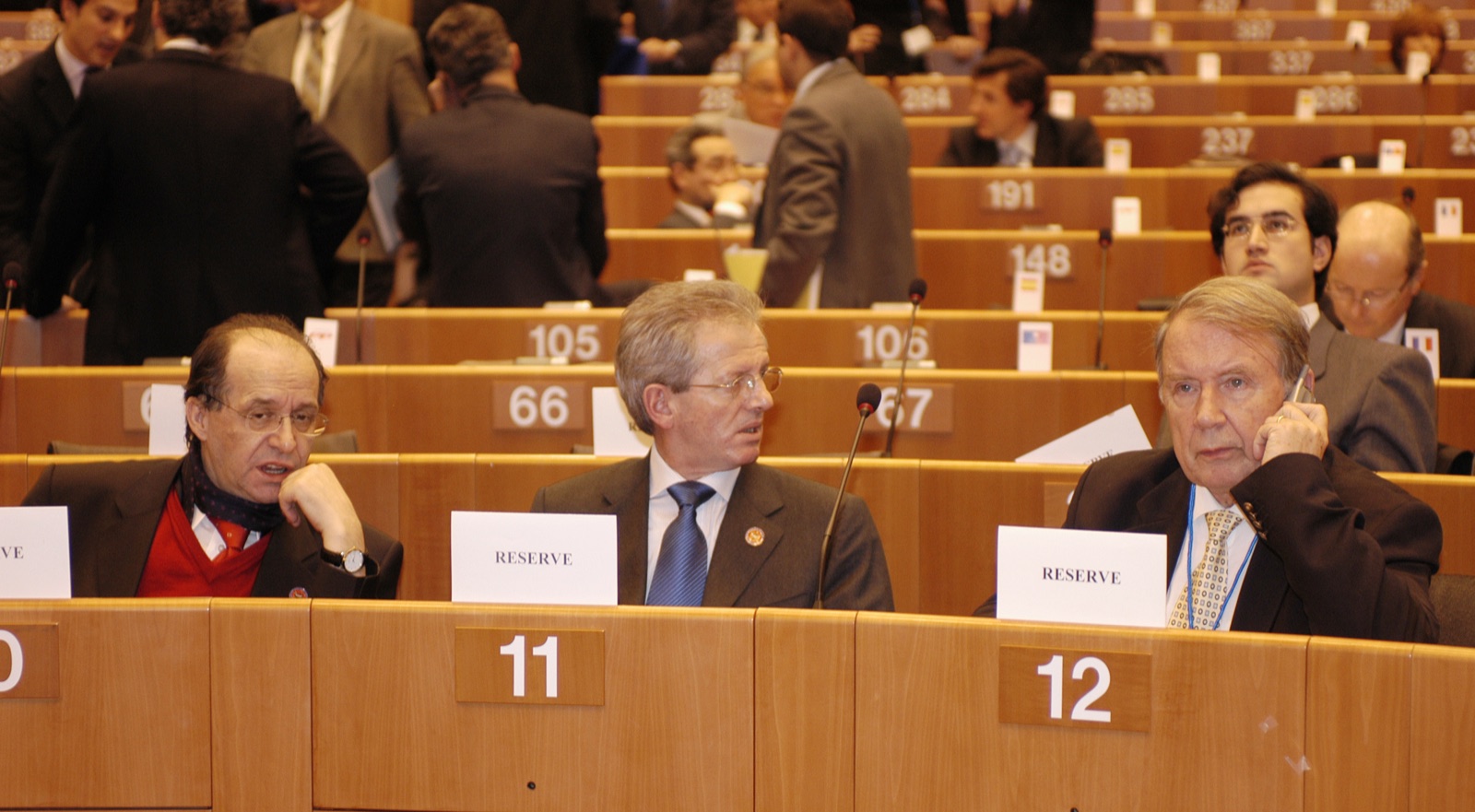 Photo: European People’s Party / Wikimedia Commons / CC BY 2.0
In February 1999, the Western powers convened the Rambouillet talks outside Paris, attempting to broker a settlement. Rugova was passed over in favor of the KLA’s Hashim Thaçi as head of the Kosovar Albanian negotiating team — a public sign that the political center of gravity had shifted toward the armed wing.
The Rambouillet talks failed. NATO began bombing Yugoslavia on March 24, 1999 in Operation Allied Force, the 78-day air campaign that would force Serbian withdrawal from Kosovo by June.
Rugova himself was placed under house arrest in Pristina by Serbian forces in late March 1999. In early April he was forcibly taken to Belgrade and appeared on Serbian state television alongside Slobodan Milošević, calling for an end to the war (Wikipedia: Ibrahim Rugova). The appearance was widely criticized within the Albanian-Kosovar community at the time. Rugova said afterwards that he had been coerced — that the alternative was disappearance — and the broader Kosovar Albanian political world eventually accepted that account, though the episode left a mark.
In May 1999 he was permitted to leave for Italy, where he remained in temporary exile until July 1999, when he returned to Kosovo to a hero’s welcome a few weeks after the Serbian withdrawal.
Post-war presidency (1999-2006)
After the war, Kosovo was administered by the United Nations Interim Administration Mission in Kosovo (UNMIK), established under UN Security Council Resolution 1244 (June 10, 1999), with NATO’s KFOR providing security on the ground. The settlement deferred the question of Kosovo’s final political status — the formula the international community would carry into the 2000s.
The first post-war elections produced a clear LDK win. In the October 2000 municipal elections, the LDK took roughly 58% of the vote, against roughly 27% for Hashim Thaçi’s Democratic Party of Kosovo (PDK) (Wikipedia: Ibrahim Rugova). The 2001 parliamentary elections confirmed the pattern.
On March 4, 2002, the Kosovo Assembly elected Rugova President of Kosovo — his first formally recognized international office. He was re-elected by the Assembly in December 2004.
Rugova’s post-war program was the same as it had been in 1992: independence by international agreement, peaceful means, close partnership with the United States and the European Union. In December 2004, in a calculated gesture toward the former armed wing, he backed the former KLA commander Ramush Haradinaj as prime minister — an attempt to pull the LDK and the post-KLA political families into a single governing coalition.
In March 2005, Rugova escaped unhurt from an assassination attempt when a bomb detonated near his motorcade (Wikipedia: Ibrahim Rugova). The attack was never definitively attributed.
By late 2005, the Final Status process had begun. The UN Secretary-General appointed the former Finnish president Martti Ahtisaari as Special Envoy in November 2005 to lead negotiations on Kosovo’s future political status. Rugova entered the negotiations as Kosovo’s president. He would not see them through to conclusion.
Cancer and death
On August 30, 2005, Rugova traveled to Landstuhl Regional Medical Center in Germany — a US military hospital — for medical evaluation. On September 5, 2005, his office announced that he had been diagnosed with lung cancer. He was a chain-smoker, which had been a publicly noted fact about him for two decades.
He refused to resign. He continued to receive visitors, sign documents, and appear at official functions through the autumn and into the new year, working from his residence and from the hospital as treatment continued. The chemotherapy did not arrest the disease.
Ibrahim Rugova died on January 21, 2006, in Pristina, at age 61 (Wikipedia: Ibrahim Rugova).
His state funeral on January 26, 2006 was attended by an estimated 500,000 mourners — close to a quarter of Kosovo’s population — and by regional leaders and senior international figures. He was buried at a hilltop grave site in the Velania neighborhood of Pristina.
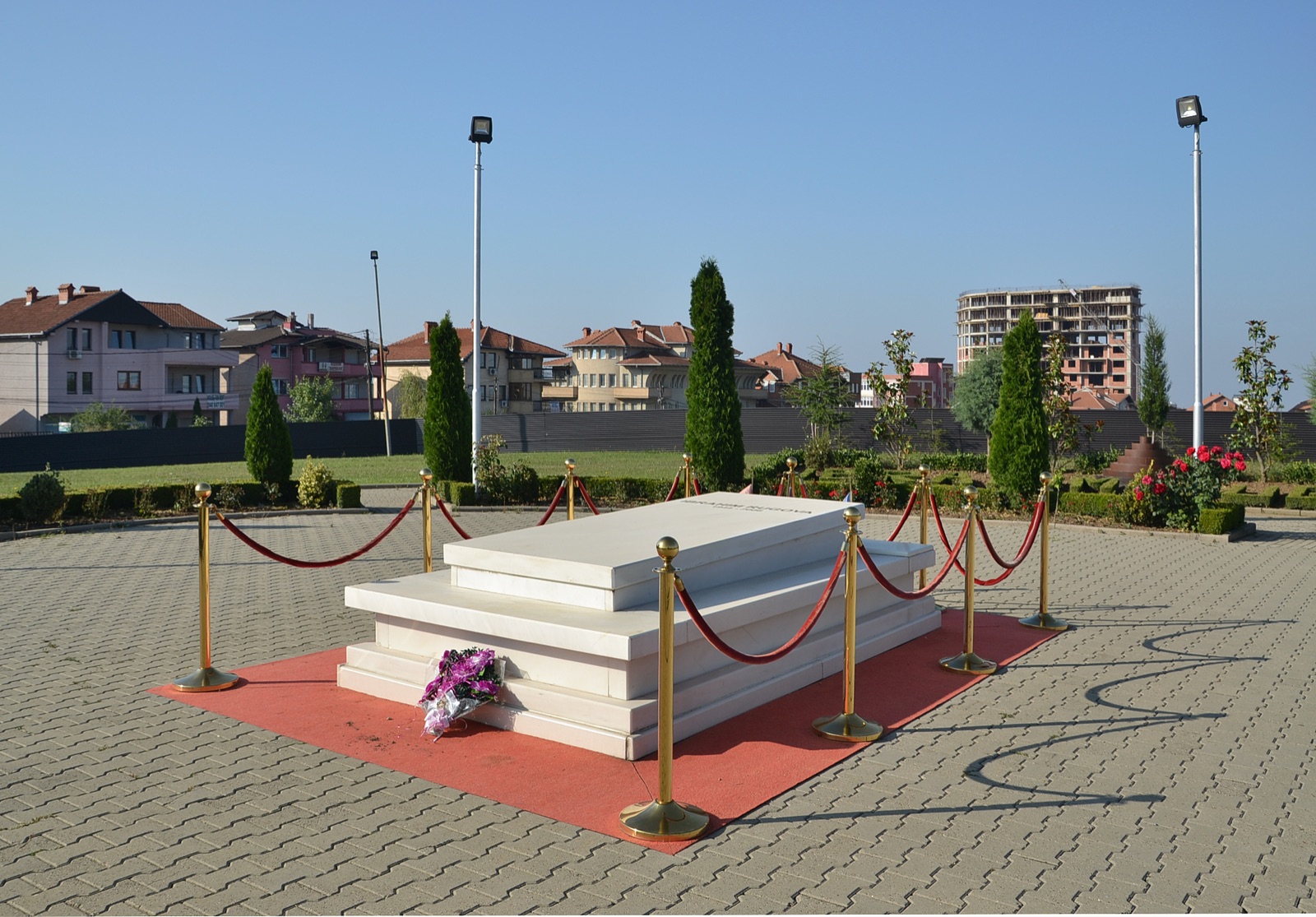 Photo: Wikimedia Commons / CC BY-SA
Legacy
Two years and twenty-seven days after Rugova’s death, on February 17, 2008, the Kosovo Assembly issued the Kosovo Declaration of Independence. It was signed by Rugova’s political successors — Prime Minister Hashim Thaçi, Assembly Speaker Jakup Krasniqi, and President Fatmir Sejdiu, the LDK figure who had succeeded Rugova as head of the party and as president of Kosovo.
Rugova’s reputation in Kosovo did not require the declaration to be settled. He had been called Ati i Kombit — Father of the Nation — and Ati themeltar — Founding Father — well before his death. Kosovo declared him a posthumous “Hero of Kosovo” in 2007. Albanian President Alfred Moisiu awarded him the Order of the National Flag in 2006. The R7 Motorway between Kosovo and Albania, completed in 2013, is named after him.
Schools, motorways, squares, and institutions across Kosovo and Albania carry his name. The competing question of which Kosovar Albanian political tradition — Rugova’s nonviolence or the KLA’s armed resistance — sits at the center of the new state’s symbolic life remains live, and the public memorial landscape of present-day Kosovo reflects both.
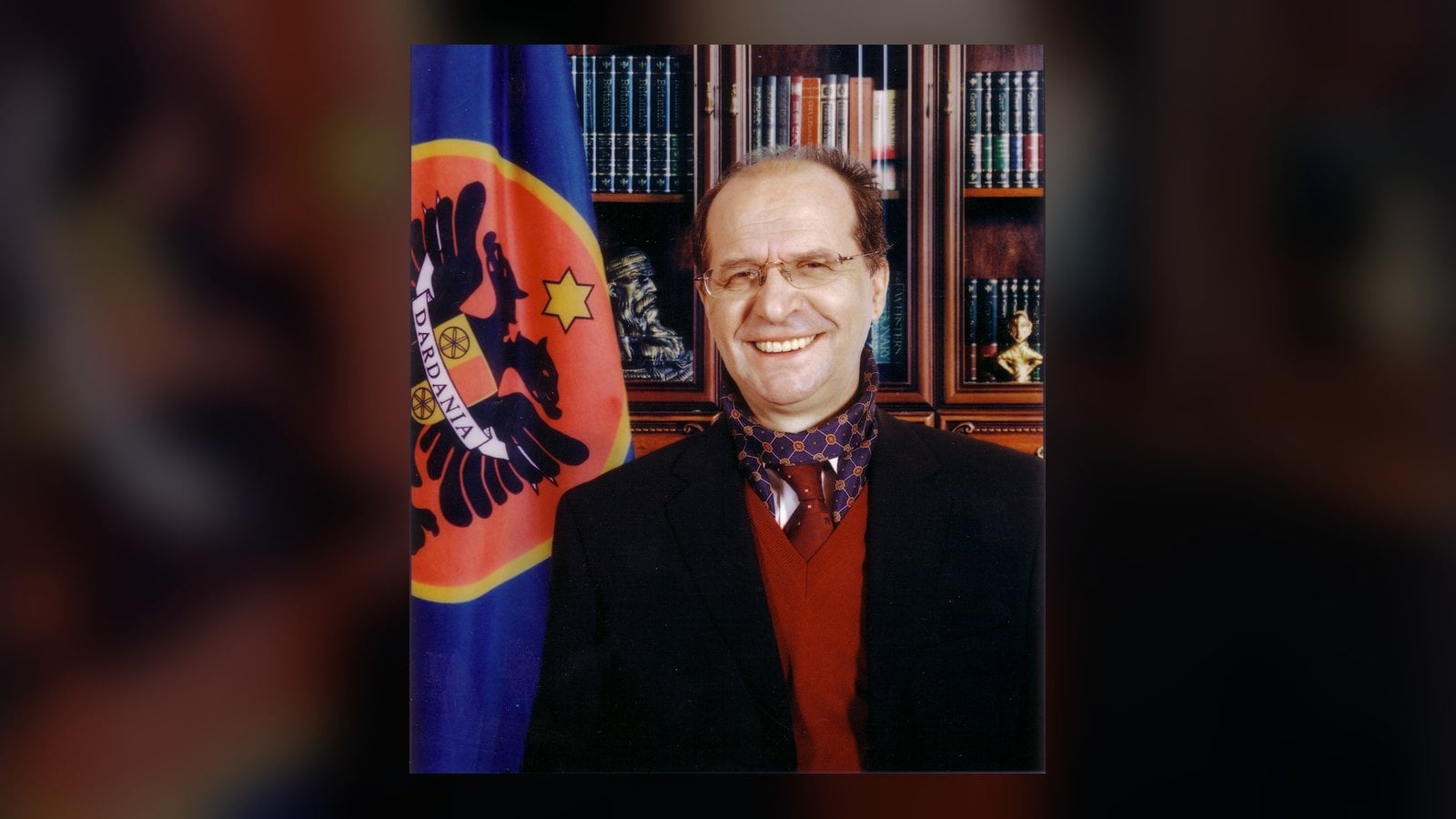
The silk neckscarf Rugova always wore, knotted at the throat in the style of a French intellectual, became after his death a recognizable symbol of nonviolent Kosovar Albanian identity. It still appears on memorial posters, on the wall of LDK offices in Pristina and across the diaspora, and in informal community iconography.
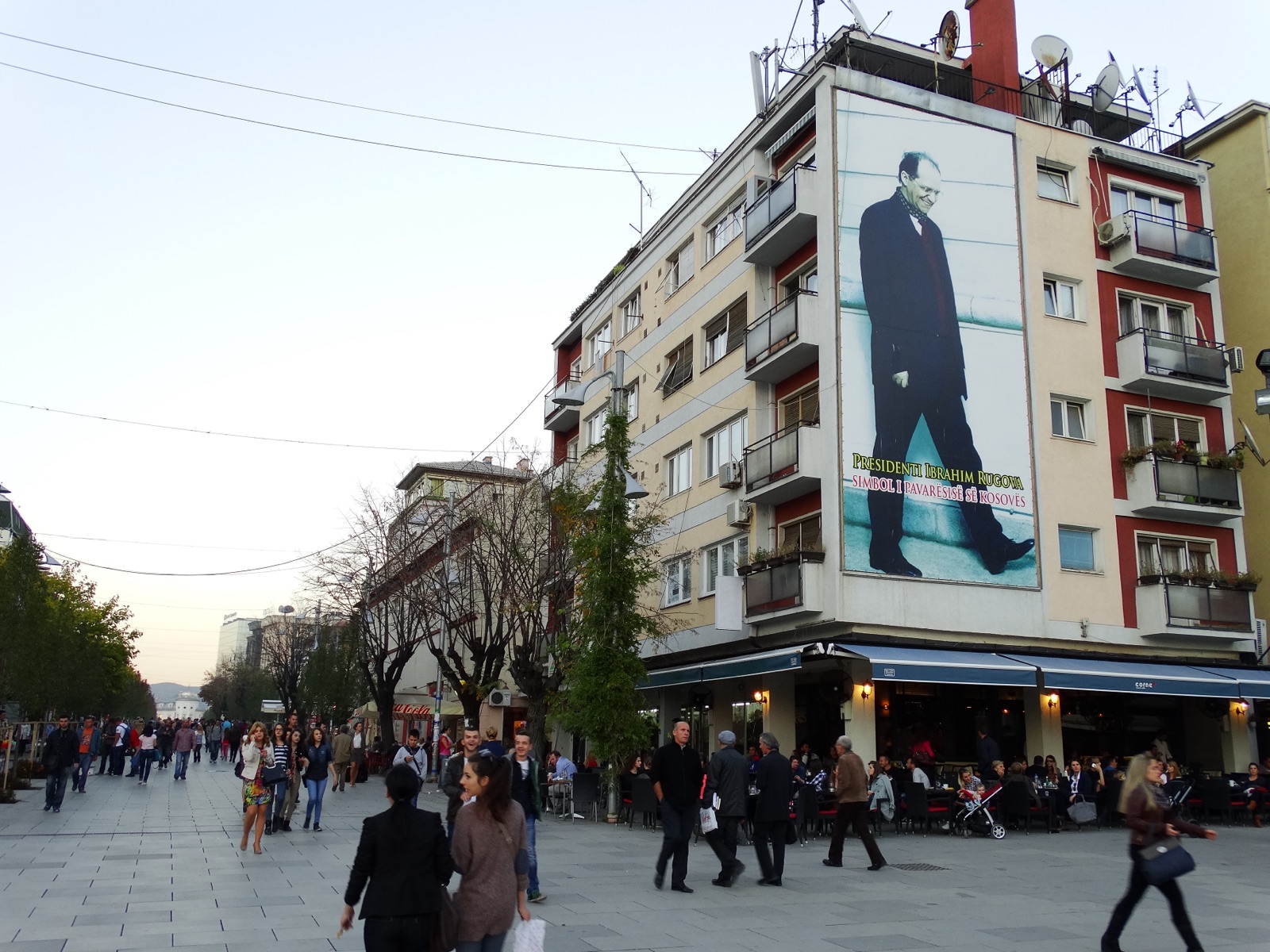 Photo: Adam Jones / Wikimedia Commons / CC BY-SA 3.0
The diaspora and Rugova
The Albanian-American and broader Albanian-Kosovar diaspora was central to the parallel state that Rugova and the LDK built. The voluntary 3% income tax that funded Kosovo’s parallel education and health systems through the 1990s was paid largely by the gastarbeiter communities in Germany and Switzerland and by the Albanian-American communities in New York, Detroit, Boston, Worcester, and the Bronx. LDK chapters operated openly across the United States through the 1990s, organizing fundraising, political outreach to US policymakers, and the diaspora end of the parallel state’s logistics.
For many Kosovar-descended NAR registrants, Rugova is one of the political figures most often cited as a defining presence of the community’s recent history. He is associated in particular with the generation that built the diaspora’s parallel-state infrastructure in the United States through the 1990s, and his portrait — knotted silk scarf, slight smile — is a recurring image in Albanian-Kosovar diaspora homes alongside photographs of relatives who left Peja, Drenica, or Pristina in the 1980s and 1990s.
The National Albanian Registry exists to count Albanian Americans across all the communities that make up the diaspora — from Albania, from Kosovo, from North Macedonia, from Montenegro, from the Italian Arbëreshë villages, and across the generations of the United States.
If your family’s recent history runs through the parallel-state decade, through a relative who paid the 3% tax in Detroit or sent kids to LDK-organized schooling in Pristina, through any of the long arc of Kosovar Albanian life that Rugova’s career spans — you belong in the count.
Get counted at /register — free, encrypted, community-led. We mint a recognition certificate. We don’t sell anything. We never share data.
The community-led count of Albanian Americans starts with you adding your name.