
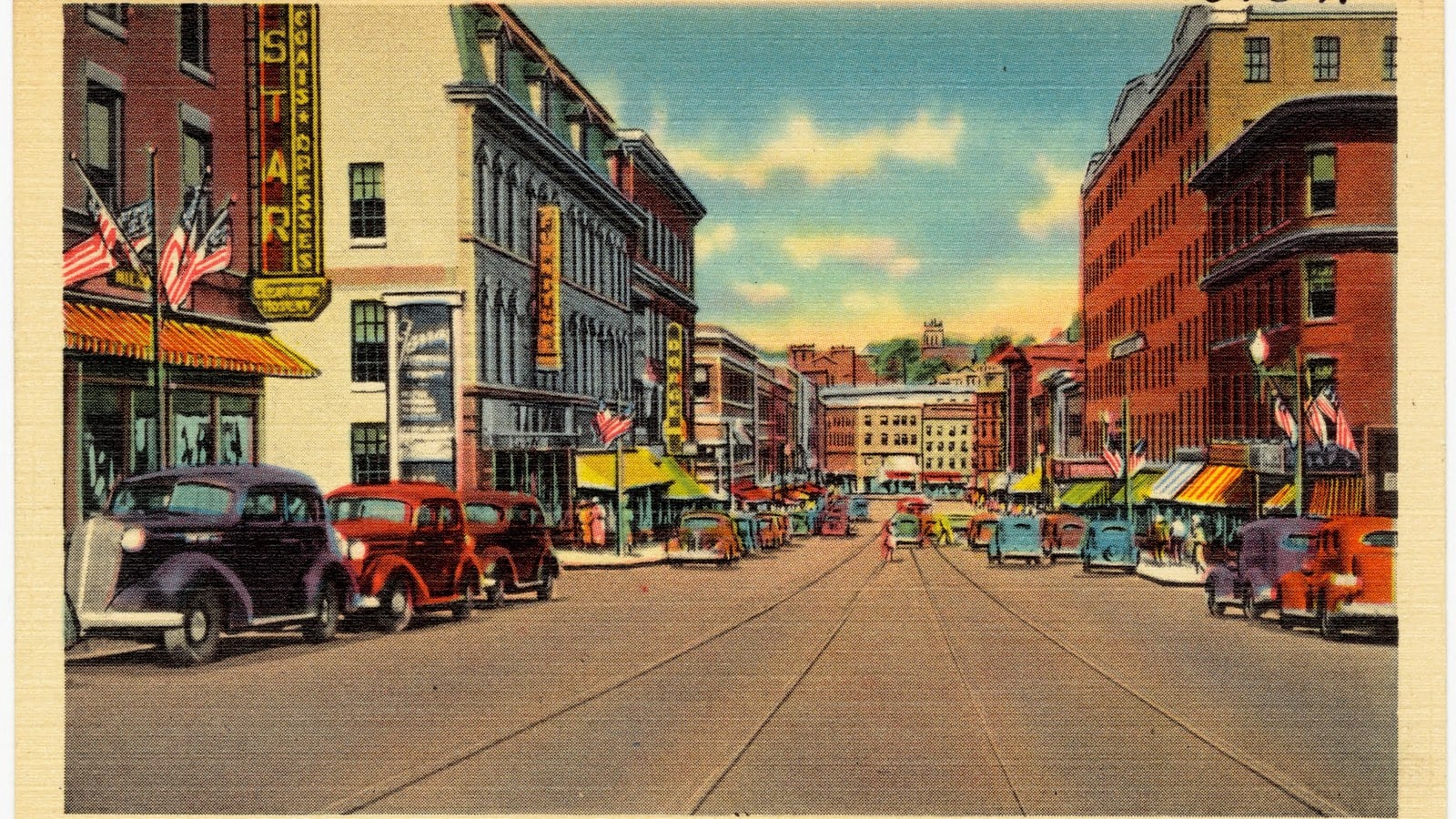
In February 1922, a fruit dealer named Spiro Adams got married in Bangor, Maine. The bride was Jennie Naum, a high-school graduate from Rockland, up the coast. The priest came all the way from Boston, from the Albanian Orthodox church there, and the local paper called it “the first big wedding in the Albanian colony of Bangor.” The arrangements were elaborate. A large company was present (Daily Kennebec Journal, 1922-02-07, p.8).
Read that again, because every word of it is a small surprise. A fruit dealer. In Bangor. An Albanian colony with enough people in it to have a “first big wedding.” A bride from Rockland. A priest riding the train up from Boston to marry them. There were Albanians in Maine, organized enough to have a church tie and a social life, a full century ago, and almost no one remembers.
This is the second of these we have pulled out of the Library of Congress newspaper archive, after a 1921 Albanian parade in Connecticut. The pattern is the same: a real community, visible for a moment in a local paper, and then gone from the record. Here is what Maine’s forgotten Albanians left behind.
A wedding in Bangor, a bride from Rockland
The wedding notice is short, but it does a lot of work. It puts an organized Albanian colony in Bangor on the record by 1922, large enough that this was its “first big wedding” and not its only one. It places a second Albanian family in Rockland, forty miles down the coast, close enough that a Bangor groom and a Rockland bride found each other. And it ties both to the Albanian Orthodox church of Boston, the parish Fan Noli had founded in 1908, which was still the mother church for Albanian Orthodox life across New England. A priest made the trip north to perform the ceremony.
The groom’s occupation is its own quiet detail. Spiro Adams, fruit dealer. The name is almost certainly Americanized from an Albanian original, the kind of small trade, produce, groceries, confectionery, that first-generation Albanian immigrants took up in dozens of American towns. He was a local businessman, established enough to marry with an elaborate ceremony and a large company. He was, in every sense that mattered in Bangor in 1922, a settled member of the community. He is also, as far as the written record goes, almost invisible today.
Eight people in Augusta, and a debt they insisted on paying
Ten months later, the same newspaper printed a second notice, from the state capital.
There was, it reported, a branch of an Albanian society in Augusta, with a membership of exactly eight. Every year the little group sent its Red Cross donation to the Boston office of the national Albanian society. In December 1922 they decided to give it to the Augusta Red Cross chapter directly instead. When their spokesman handed the subscription to Jean Todd, the chapter’s executive secretary, he told her why:
“As long as the world lasts, the Albanians will remember the Red Cross, what they have done for the children and the old people of our country.”
Eight immigrants, in a small city in Maine, most of them presumably millworkers or small tradesmen, making a point of giving money back to the relief agency that had fed and cared for Albania’s children and elderly through the Balkan Wars and the First World War. It is one of the most human sentences in the whole archive. It is also the entire surviving record of the Augusta Albanian society. Eight people, one gift, one line of gratitude, and then silence.
Maine, of all places
The Albanian-American story is usually told through its biggest concentrations: Boston and its suburbs, the mill towns of Massachusetts, later New York and Detroit. Maine is not in that story. It is not in most tellings at all.
But here it is anyway, in 1922: a colony in Bangor, a family in Rockland, a society of eight in Augusta, all connected to each other and to Boston, holding weddings and paying debts of honor. These were not tourists. They were residents, tradesmen, churchgoers, organized enough to run a society and route donations through a national office. They were a community. And the only reason we can say so is that a Maine daily happened to print two short notices, which happened to be digitized, which happened to survive the way almost nothing else about them did.
That is the whole problem in miniature. A people scattered thin across a country, real in every town and recorded in almost none, easy to miss and easy to undercount precisely because they were spread so wide. The Grosvenordale Albanians marched once and vanished from the histories. The Maine Albanians married and gave to charity and vanished the same way. Multiply that by every small city in America, and you have the gap between the number the Census records and the number that is really there.
Get counted
Spiro Adams and Jennie Naum built a life in Maine that took a hundred years and a newspaper scan to rediscover. The eight Albanians of Augusta gave what little they had and asked for nothing but to be remembered. You can put yourself on the record in a way they never could.
You do not need a colony or a society. You need 2 minutes.
Get counted at /register: free, encrypted, community-led. We mint a recognition certificate. We do not sell anything. We never share your data.
The community-led count of Albanian Americans starts with you adding your name.
Sources
- Daily Kennebec Journal (Augusta, Maine), February 7, 1922, p.8, “Big Albanian Wedding.” Library of Congress, Chronicling America, LCCN
sn82014248. View the page. - Daily Kennebec Journal (Augusta, Maine), December 21, 1922, p.12, “Albanian Society’s Gift to Red Cross.” View the page.