
In the summer of 1921, in a textile-mill village in the northeastern corner of Connecticut, an Albanian Society marched in a parade. It took its place in the line between the Swedish Society and the St. Jean Society, ahead of the Knights of Columbus. There was a band, a marching guard, a route from the fire station to the mill village and back, and a field day of athletic contests afterward.
The event was recorded in exactly one place we can find: page five of the Putnam Patriot for July 1, 1921, now digitized by the Library of Congress. It has never, as far as we can tell, appeared in a history book. The published histories of that mill village carefully list its French-Canadian, Irish, Swedish, Greek, Romanian, and Turkish immigrants. The Albanians are not in them. The only proof that an organized Albanian community stood on that street in 1921 is a few lines of newsprint that almost nobody has read in a hundred years.
This is the parade most of us have never heard of. Here is what the record actually says.
What the newspaper reported
Under the plain headline “Field Day Held,” in its Grosvenordale news column, the Putnam Patriot described a field day given under the auspices of the St. Jean Society at the Grosvenordale Athletic grounds on a Saturday afternoon in late June 1921. In the newspaper’s words:
“It was opened by a parade. The marchers assembled in front of the fire department and from there marched to Grosvenordale and back to the ballground. The marchers in the order in which they took their ranks: the Band Canadien, the Guard Martial, the Swedish Society, the Albanian Society, the St. Jean Society, and last the Knights of Columbus.”
After the march came the field day itself. Among the athletic events was a tug-of-war that pitted the Albanians against the host St. Jean Society. The St. Jean side won, but the paper gave the Albanians their due: “what they lacked in practice they made up in strength.” There was also a hundred-yard dash and a baseball game.
It is a small notice. It is also, in its way, a complete document: a named Albanian organization, marching in public, in ranks, as one of the recognized societies of an American town, in 1921.
Where this happened, and why it matters
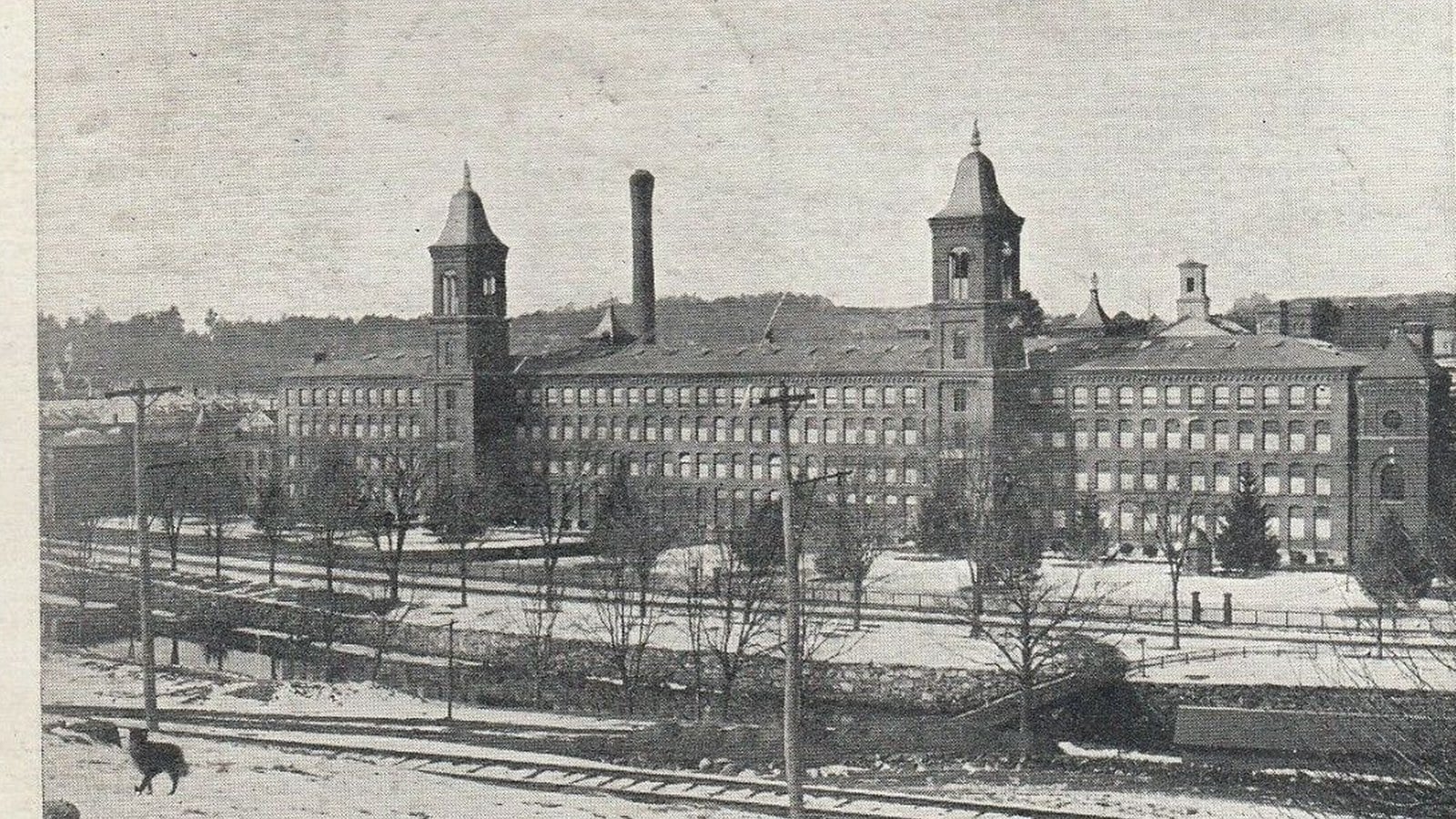
Grosvenordale and North Grosvenordale are mill villages in the town of Thompson, in Windham County, Connecticut, close to Putnam and the Massachusetts border. They were built around the Grosvenor-Dale Company, whose large brick mill went up in 1872 and which became one of the largest textile manufacturers in the state (Wikipedia: North Grosvenordale). Mills like it ran on immigrant labor, and the village filled with newcomers. Some of its neighborhoods carried names like “Little Canada” and “Swede Village.”
Albanians were part of that labor migration into New England’s mill towns in the early twentieth century, the same movement that built the Albanian churches and societies of Massachusetts and Connecticut. But the Grosvenordale Albanians left almost no paper trail. They do not appear in the village’s local histories. They did not, as far as the record shows, build a landmark church that outlived them. They organized a society, they marched one Saturday in 1921, a weekly paper wrote it down, and then the trail goes cold.
That is the point. This is what erasure usually looks like. No dramatic destruction. Just a community that existed, organized, and showed up for an afternoon, then got left out when the story was finally written down. Multiply that one Saturday by a hundred years and a few hundred towns, and you have the reason the recorded number of Albanian Americans has always been far lower than the real one.
How we found it
We did not find this in a book, because it is not in one. We searched the Library of Congress Chronicling America archive of digitized American newspapers, page by page, for Albanian organizations in the 1920s. The Grosvenordale field day was the one clear Albanian-American parade the search surfaced in the entire decade of digitized papers. The primary source is public and anyone can read it:
- Putnam Patriot (Putnam, Conn.), July 1, 1921, page 5. Library of Congress, Chronicling America, LCCN
sn84022396. View the page.
There are almost certainly more of these, sitting unread in newspaper morgues, church basements, and Library of Congress files, one notice at a time. Finding them and putting them on the record is the same work as counting the living community. Both are answers to the same problem: a people who were always here, and were rarely written down.
Get counted
The 1921 Albanians of Grosvenordale organized a society and marched down a mill-town street, and it took a century and a newspaper scan to prove they existed. You can put yourself on the record in a way they never could.
You do not need a society or a parade. You need 2 minutes.
Get counted at /register: free, encrypted, community-led. We mint a recognition certificate. We do not sell anything. We never share your data.
The community-led count of Albanian Americans starts with you adding your name.