

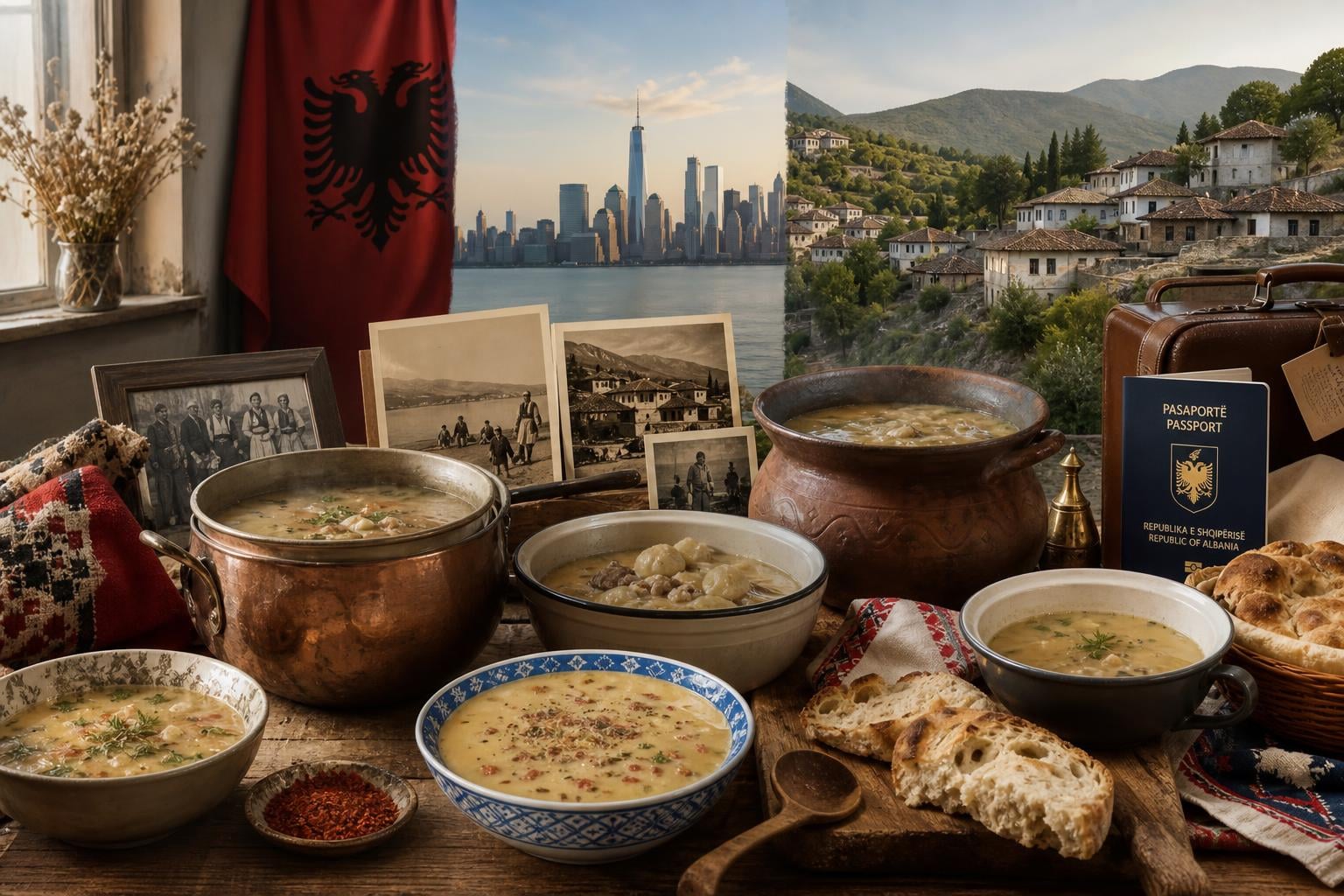
Albanian soup is rarely a starter. It is the meal — the pot a family circles on a Sunday, the bowl that arrives when someone is sick, the broth that opens a wedding and the one that closes a funeral. Every region of the Albanian-speaking world keeps its own version, and every diaspora kitchen has adapted at least one of them to what an American grocery store carries.
This piece covers the major soups in the Albanian repertoire: jani me fasule (a thick white bean stew/soup), paçë (a slow-simmered tripe or head soup), çorbë (the broth-based soup family, with Ottoman roots), supë me oriz (chicken-and-rice with lemon), supë me presh (leek soup), trahana (the fermented dried-yogurt grain soup), kungull supë (squash soup), and the broths that mark life events. It also covers what Albanian American households source where, what gets substituted in US kitchens, and how a pot of soup ends up carrying a generation of memory.
The point is the shape of the category, not a single recipe. Soup in the Albanian tradition is functional, regional, frugal, and ceremonial at once — the dish a household knows by hand, the one that travels from grandmother to granddaughter without ever quite being written down.
What Albanians Call Soup
The Albanian vocabulary for soup is layered, and the layers tell the cuisine’s history.
Supë is the modern Albanian word for soup. It comes from Italian zuppa and tends to name lighter Western-style soups — chicken-and-rice, vegetable soups, the things that read clearly as soup to an American eater.
Çorbë is older and heavier with meaning. The word entered Albanian through Ottoman Turkish çorba, which in turn came from Persian shorba. It names a brothy soup, often sour with lemon or vinegar, sometimes finished with egg, and shared across most of the former Ottoman world — Turkish çorba, Greek tsorvas, Bulgarian чорба, Romanian ciorbă, and Bosnian čorba are all the same word with the same role (Wikipedia: Çorba).
Jani names a third category — a thick stew-soup, more sauce than broth, almost always built around a single hero ingredient. Jani me fasule is bean jani, jani me presh is leek jani, jani me mish is meat jani. The word covers a dish that sits between soup and stew, eaten with bread, often as the main course.
Paçë is its own thing — a slow head-or-tripe soup with deep Ottoman roots, eaten before dawn or as a ritual restorative.
In a diaspora kitchen the words mix freely. A grandmother in Worcester might call the same pot supë on Monday and çorbë on Tuesday depending on how it tasted. That looseness is part of the cuisine — not a sign of imprecision but of a tradition that names dishes by what they are doing on the table rather than by a fixed menu category.
Jani me Fasule: The National Bean Stew
If you ask an Albanian American family what counts as the national soup, jani me fasule is the answer most often given. It is a thick white-bean stew-soup — small white beans (sometimes great northern or navy beans in the US), onion, paprika, olive oil, dried mint, sometimes a bay leaf, sometimes tomato, sometimes a finishing splash of vinegar.
The dish is plain on paper and load-bearing in practice. It is the Sunday pot in many households, the Lent dish for Orthodox families — meat-free, filling, acceptable across the forty-day fast — and the cold-weather weeknight dish for Catholic, Muslim, and Bektashi families too, because it costs almost nothing and feeds a table.
Regional variations matter. In central Albania the dish is built on olive oil and finishes lighter. In the north and in Kosovo it leans heavier, sometimes with smoked meat or a richer paprika base. In Çamëria the herb mix shifts. The Arbëresh communities in southern Italy carry a version that absorbs five hundred years of Italian beans and tomato.
In US kitchens, the bean is where adaptation happens. Diaspora cooks shop the bagged-dried-bean aisle of any supermarket; small white beans, navy beans, and cannellini are the common stand-ins. Some families special-order fasule plaku, the heirloom small Albanian white bean, from Balkan importers. The dried mint is non-negotiable — most households keep a jar in the cabinet, brought back from a trip or bought at an Albanian grocer.
See our companion piece on grosh — the related bean-stew that some northern Albanian families use as the same dish under a different name.
Paçë: Sunday Morning’s Heaviest Pot
Paçë is the soup that takes a full night to make. It is a slow-simmered tripe or head soup — most often lamb’s head and feet, sometimes beef tripe — cooked for hours until the broth is thick and gelatinous, then finished with raw garlic crushed in vinegar.
The dish has deep Ottoman roots and is shared across the former Ottoman world under variations of the same name: Turkish paça, Greek patsas, Bulgarian пача, Romanian ciorbă de burtă, and Bosnian paçja all sit in the same family (Wikipedia: Khash (dish)). The Albanian version keeps the garlic-vinegar finish that defines the dish across most regions.
The Sunday morning ritual is the part that travels. In Albania, paçëtore — small shops dedicated to paçë — open before dawn. Men come in after a long night, before a market day, before a wedding. The soup is restorative, hot, salty, and heavy enough to reset a body. The same role shows up in the diaspora when an uncle carries in a bowl on Sunday.
In US kitchens, paçë doesn’t get made often. Lamb’s head isn’t in the meat case at most American supermarkets. Halal butchers in Detroit, in New Jersey, and in the New York metro carry it, and households that want the real version go through them. Beef tripe is easier — most US supermarkets in cities with large Latin American populations stock it, and a diaspora paçë is more often beef tripe with garlic and vinegar than the full lamb-head version.
The soup also marks events. In some regions paçë is the breakfast of the day after a wedding — the heaviest soup for the heaviest morning. In others it opens a working week. In all of them it carries a memory of Ottoman-era kitchens straight into a Sterling Heights basement on a Sunday in October.
Trahana: Fermented Dairy Grain Soup
Trahana is one of the oldest preserved foods in the Balkans and Anatolia. It is made from flour — wheat, sometimes cracked wheat or bulgur — mixed with yogurt, milk, or sour milk, then fermented for a day or two, dried in the sun, broken into small pellets, and stored for months without refrigeration (Wikipedia: Trahana).
To cook it as soup, a household drops a handful of the dried pellets into simmering water, broth, or milk, and stirs until the soup thickens into a tangy, porridge-like bowl. Salt, sometimes a knob of butter, sometimes a sprinkle of cheese, and the soup is done.
The food crosses borders under variations of the same name: Greek trahanas, Turkish tarhana, Bulgarian tarhana, Cypriot trahanas. The Albanian version skews sweeter or sourer depending on the village — the fermentation ratio is the variable, and grandmothers will argue about it.
In Albania and Kosovo, trahana was the winter pantry food. A household made it once at the end of summer when the milk was thick and the sun was hot, spread it on cloths on a roof to dry, then stored it for the winter when fresh dairy was scarce. The soup was breakfast, lunch, or the bowl handed to a sick child.
In the US diaspora, trahana is harder to source. Greek and Middle Eastern grocers in Astoria, the Bronx, Worcester, Sterling Heights, and most cities with a meaningful eastern Mediterranean population carry it; Turkish tarhana and Greek trahanas are close enough cousins to substitute. A few Albanian American grandmothers still make their own each summer, drying the pellets on screens on a porch in Westchester or on a balcony in Yonkers.
The dish is the clearest case of how Albanian food encodes a climate. Trahana exists because the high villages had to survive a winter without refrigeration, and the dairy-fermentation tradition is how they did it.
Supë me Oriz: The Diaspora Sick-Day Soup
Supë me oriz — chicken and rice soup, finished with lemon and often a beaten egg — is the universal Albanian sick-day soup. It is what an Albanian American family makes for a child with a fever, for a new mother in the first week home, for an uncle recovering from surgery, for anyone who needs feeding without weight.
The dish tracks closely with Greek avgolemono and with broader Balkan and Levantine traditions of chicken-rice-lemon-egg soup. The Albanian version is often plainer than the Greek — a clean chicken broth, white rice, a generous squeeze of lemon, salt, sometimes a single beaten egg whisked into the hot broth at the end to thicken it without curdling.
The lemon is the load-bearing ingredient. It is the difference between a chicken soup and an Albanian chicken soup. In the diaspora, American supermarket lemons are smaller and less acidic than the lemons grown in southern Albania, so most diaspora cooks use a little extra. A pinch of dried mint at the end is the other quiet signature.
The rice is usually long-grain American white rice in US kitchens, which works fine. Some households use orzo or a small pasta instead, and that variation is acceptable across the diaspora. The chicken is whatever the household has — a whole bird simmered down, leftover chicken from a previous meal, or supermarket rotisserie chicken pulled off the bone and dropped into the pot.
The dish is one of the easiest to make and one of the heaviest with meaning. An Albanian American mother making supë me oriz for a sick child is performing a small handed-down ritual that takes about forty minutes and tastes like every previous time someone made it for her.
Wedding and Funeral Soups
Soup marks the threshold moments in Albanian life. At weddings and at funerals — and at the days that follow them — a soup is on the table.
The wedding soup is usually a clear meat broth, often lamb or beef, sometimes with rice or with a small handful of greens. In some northern Albanian and Kosovar traditions the wedding morning includes paçë for the men of the wedding party. In central and southern Albanian traditions a supë mishi (meat soup) opens the wedding lunch or dinner. The role is functional and symbolic at once: the broth carries the celebration through a long day of food.
The funeral soup serves the same function in reverse. A clear broth — sometimes chicken, sometimes beef, sometimes vegetable — is the dish handed to mourners after the burial. The forty-day memorial meal, observed across Orthodox and Catholic Albanian traditions and in modified form in Muslim Albanian families, often includes a soup at the center.
In the diaspora, these soups travel with the events. An Albanian American family in New York hosting a wedding at a hotel ballroom will still include a wedding soup as the first course. A family hosting a forty-day memorial in a community hall in Worcester or in Sterling Heights will set out soup before the rest of the meal. The exact recipe varies by region and household. The pattern — soup as the broth of a marked day — is constant.
Vegetable Soups: Leek, Squash, Spinach
The Albanian vegetable-soup category is wider than most diaspora kids realize until they cook it themselves. Three of the most common:
Supë me presh — leek soup. Leeks (presh) are sliced and sweated in olive oil, then simmered with potato or rice and salt. Some households finish with yogurt or with a beaten egg. The dish is winter food, deeply tied to the kitchen garden, and in the diaspora it is one of the soups that gets made when a US supermarket sells leeks at a good price. The leek itself is the same vegetable across continents — no substitution needed.
Kungull supë — squash or pumpkin soup. Kungull is the Albanian word for squash, and the soup covers a range from a thin broth with diced winter squash to a thicker pureed version. Olive oil, onion, sometimes garlic, sometimes a finishing yogurt swirl. The dish is autumn food in Albania and in the US, and butternut squash and kabocha squash are the closest American supermarket equivalents to the squashes grown across the Albanian countryside.
Supë me spinaq — spinach soup. Spinach (spinaq) is simmered with rice or with small pasta, then finished with lemon or with yogurt. The dish overlaps with the broader Mediterranean spinach-and-rice tradition and is one of the soups Albanian American households make as a clean light meal at the end of a heavy week.
These three sit in the everyday rotation of an Albanian kitchen. They are not the dishes that make it into cookbooks first, but they are the dishes that get cooked most often. Diaspora cooks find every ingredient at any US supermarket.
Albanian Soup in the US Kitchen
The diaspora kitchen is where the tradition is currently being kept. Roughly 230,000 Americans report Albanian ancestry in the 2024 American Community Survey (B04006), and community estimates including ethnic Albanians from Kosovo, North Macedonia, Montenegro, and the second and third generation push the actual count closer to a million. Top states are New York (~56,000), Michigan (~27,000), and Massachusetts (~21,300) — which is where the soup pots are.
Sourcing is the first adaptation. Dried white beans for jani me fasule come from the everyday supermarket aisle or from Balkan importers in the Bronx and in Detroit. Dried mint, paprika e ëmbël (sweet paprika), and olive oil arrive in suitcases from Albania, or from Balkan and Mediterranean grocers in the larger diaspora hubs. Trahana comes from Greek, Turkish, and Middle Eastern grocers — Greek trahanas is the acceptable substitute in almost every household.
Lamb’s head and feet for paçë are the harder source. Halal butchers in New Jersey, in Detroit, and in the New York metro carry them, and most households that want the full dish know exactly which butcher to call. The beef-tripe version is the more common diaspora compromise.
Equipment is the next adaptation. A US kitchen has a gas stove, a 6-quart Dutch oven, sometimes an Instant Pot or slow cooker. A village kitchen had a wood stove and a heavy clay or copper pot. Most diaspora cooks keep the dish recognizable by extending the simmer time — jani me fasule simmered for three hours on a low burner tastes like the dish.
Memory is the third. A grandmother who learned the soup from her mother in a village above Korçë is teaching it to a granddaughter in Westchester by phone. The granddaughter sends a photo of her pot, the grandmother says it needs more salt, the soup is right. That phone call is the diaspora’s actual cookbook.
See our broader overviews of Albanian dishes and the most famous Albanian foods, and companion pieces on Albanian bread, byrek, and Albanian coffee.
Regional Variations
Albanian soup is not one cuisine. It is the overlap of at least five regional cuisines, all of which feed the diaspora.
Albania (central and south). The base — jani me fasule, supë me oriz, paçë, supë me presh, kungull. Olive oil leads. Korçë in the southeast is famous for its bean dishes; Vlora and Sarandë on the coast lean more toward seafood broths.
Albania (north). Heavier, more reliant on dairy and on smoked meat. Trahana shows up more often as everyday food. Bean dishes in Shkodër and the highlands lean toward heavier paprika and longer simmers.
Kosovo. Overlaps with the north of Albania and adds South-Balkan influences from the broader region. The Kosovo çorbë repertoire is wide; trahana, paçë, and meat soups are central.
North Macedonia (the Albanian-speaking regions). Overlaps with Kosovo with influences from the surrounding cuisine. Beans, peppers, paprika, and trahana feature prominently.
Çamëria. A distinct repertoire from the southern Albanian / Greek border region that carries more lemon, more egg-finished broths, and a closer relationship to the avgolemono tradition.
Arbëresh (southern Italy). The five-hundred-year-old Albanian diaspora in Calabria, Sicily, Basilicata, and Apulia. The Arbëresh soup repertoire absorbs Italian beans, tomato, and Mediterranean herbs while keeping the Albanian core of jani and çorbë.
The diaspora in the US is fed by all of these traditions at once. An Albanian American household in Worcester may have a Kosovar grandfather and a Çam grandmother, and the soup on the table on a given Sunday reflects whichever side of the family was in the kitchen.
Soup as Memory
Soup is the most-repeated dish in an Albanian household. The byrek is for guests. The roast lamb is for Easter. The soup is for Tuesday — and that repetition is how a cuisine survives.
A grandmother teaching a granddaughter how to make jani me fasule is teaching her dozens of small things at once: how to judge a simmer by ear, how to taste for salt at the right point, when the onion is sweet enough, how to finish with mint. Those skills are not in a recipe. They are in the repeated pot. The diaspora pot is doing the same teaching, often by phone and often imperfectly — and that is still the soup. The lineage matters more than the precision.
If the soup pot is how your family remembers home, the National Albanian Registry is building the record of who carried which recipe across the ocean. Get counted — the recipes belong in the count as much as the names.
Frequently Asked Questions about Albanian Soups
What is the most famous Albanian soup?
Jani me fasule — a slow-simmered white bean stew with onion, paprika, olive oil and mint — is the soup most Albanian families would name first. It is treated as a national dish and shows up at Sunday lunch, at Lent, and on cold-weather weeknights. The recipe is plain on paper, but every household claims a different version, and the small choices about herbs and bean type are how a family is recognized at the table.
What is paçë and why is it eaten on Sunday morning?
Paçë is a slow-simmered tripe or head soup, typically lamb or beef, finished with garlic and vinegar. The Sunday-morning ritual comes from its Ottoman-era role as a restorative — eaten before sunrise, after a long night, before a market day. In Albania you’ll still find dedicated paçëtore shops that open before dawn.
What is trahana and how is it made?
Trahana is a dried fermented food made from flour mixed with yogurt, milk or sour milk, sometimes with cracked wheat, then fermented for a day or two, dried in the sun, and broken into small pellets. It stores for months without refrigeration. To cook, the pellets are simmered in water, broth or milk into a thick, tangy porridge-soup. Trahana is one of the oldest preserved foods in the Balkans and Anatolia and shares a name across Greek trahanas, Turkish tarhana, and Cypriot trahanas.
What is the difference between çorbë and supë?
Çorbë is the older word — borrowed from Ottoman Turkish çorba, ultimately from Persian shorba — and names a thinner, brothy soup, often sour with lemon or vinegar and finished with egg. Supë is the modern Albanian word for soup, taken from Italian zuppa, and tends to name lighter Western-style soups. Both live in everyday Albanian, and the two words map roughly onto the Ottoman and post-Ottoman halves of the Albanian kitchen.
What soup do Albanians make when someone is sick?
Supë me oriz — chicken and rice soup, finished with lemon and sometimes a beaten egg — is the diaspora sick-day soup. It tracks closely with Greek avgolemono and with broader Balkan and Levantine chicken-rice-lemon traditions. Albanian American families make it for colds, for new mothers, for anyone who needs feeding without weight. The lemon is the load-bearing ingredient and a pinch of dried mint at the end is the quiet signature.
Where can diaspora cooks find trahana in the US?
Trahana is sold at Balkan, Greek, and Middle Eastern grocers across the diaspora hubs — Astoria and the Bronx in New York, Worcester and Boston suburbs in Massachusetts, Detroit and Sterling Heights in Michigan, and Greek/Turkish grocers in most US cities. Greek trahanas and Turkish tarhana are close cousins and substitute well. Some Albanian American households still make their own each summer, drying the pellets on screens on a porch.
Are Albanian soups served as a starter or as the main meal?
Both, depending on the soup. Jani me fasule is a main — a single deep bowl with bread is lunch or dinner. Paçë is its own occasion. Çorbë and supë me oriz run lighter and can open a larger meal or stand alone. The Albanian table doesn’t always separate soup from main course the way American menus do.