
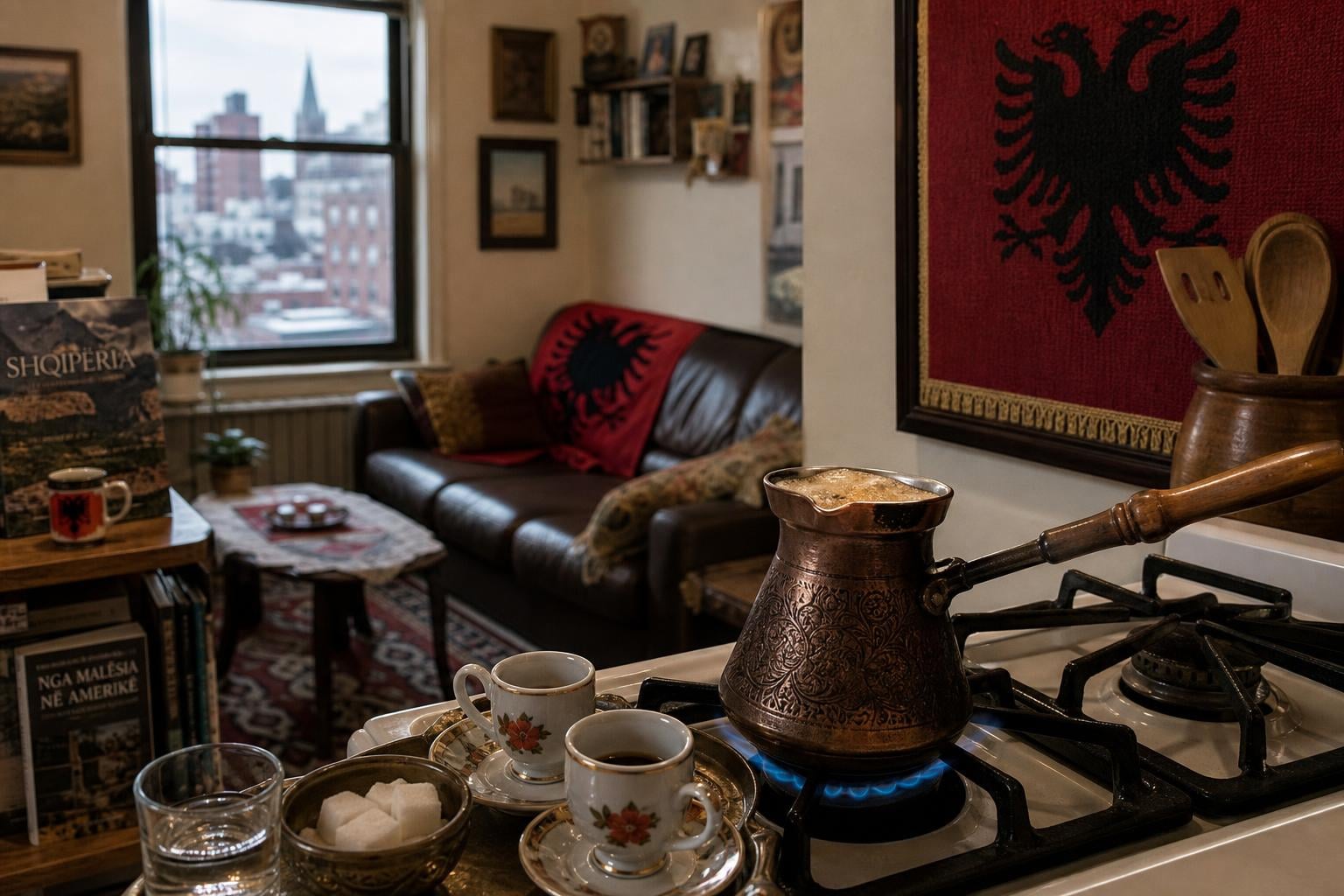
The first sound in an Albanian-American kitchen is often the same: the slow, low hiss of water heating in a small copper pot on a back burner. The pot is a xhezve (the long-handled brewing pot, also spelled cezve in Turkish). The grandmother — or the grandfather, or whichever family member claims the morning shift — stands over it without a phone, without a timer, watching the surface until a brown ring of foam begins to lift toward the rim. That moment is the cue. Off the heat, a quick swirl, and the coffee gets poured into two or three small cups waiting on the counter.
That is kafja shqiptare (Albanian coffee). It is the most common, most quietly important household ritual in the Albanian world.
This article is for Albanian Americans who grew up watching that pot and want to understand what they were watching, and for second- and third-generation kids who want to be able to make it themselves without a YouTube tutorial. We will walk through what Albanian coffee is, the equipment, the technique, the sugar levels, the social code around serving and accepting it, the kafene (coffee house) tradition that anchored it for centuries, the modern espresso shift inside Albania, and the way Albanian-American families keep the ritual alive in Bronx apartments, Hamtramck duplexes, and Worcester three-deckers.
It is a cultural piece, not a recipe blog. The recipe section is here because the technique is half the story, but the heart of this is what the cup is for.
What Albanian coffee actually is
Kafja shqiptare is finely ground, unfiltered coffee brewed slowly in a xhezve, poured into small demitasse cups, and sipped while the grounds settle at the bottom. The technique sits inside a broader regional family — Turkish coffee, Greek coffee, Bosnian coffee, Armenian coffee, Cypriot coffee, and Arab qahwa are all variants of the same preparation, shared across the former Ottoman territories (Wikipedia: Turkish coffee).
Most Albanians call it kafe turke (Turkish coffee) at home. The newer phrase kafja shqiptare shows up more often in diaspora settings and in modern Tirana cafés where staff want to distinguish the traditional brew from the espresso machine on the counter. The drink itself is the same drink.
That matters because Albanian coffee is not a “national” beverage in the sense of being uniquely Albanian. It is a regional inheritance from the five centuries of Ottoman administration that shaped food, drink, language, and hospitality customs across the southern Balkans. The grandmother in Korçë and the grandmother in Sarajevo and the grandmother in Thessaloniki are all making essentially the same coffee. What is Albanian about it is the social context — the words, the offering ritual, the raki on the side, the kafene it traveled from.
The drink itself: medium-to-dark roast Arabica, ground extra-fine (finer than espresso, almost to powder), brewed unfiltered with water and optional sugar, served unstrained. A standard cup is small — roughly 60 to 80 milliliters, closer to a double espresso than a single shot (a standard single espresso shot runs about 25 to 30 milliliters). The foam (kajmak in Albanian and Bosnian usage, kaimaki in Greek) on top of a well-made cup is a sign of skill. A coffee served without foam is considered a failure regardless of how good the underlying brew is.
The xhezve and the technique
The xhezve is the single piece of equipment that defines the tradition. It is a small, narrow-necked, long-handled pot, traditionally copper with a tin lining, designed specifically for stovetop brewing of unfiltered coffee. The same pot exists across the post-Ottoman region under different names: cezve in Turkish, džezva in Bosnian, Croatian, and Serbian, briki (μπρίκι) in Greek, ibrik in some older English sources and in Arabic (Wikipedia: Cezve). The Albanian spelling xhezve (pronounced roughly jezz-VEH) comes from the Turkish cezve, which traces back to the Arabic jadhwa (also transliterated jidhwa), meaning “ember.”
The design is functional. The narrow neck constricts the surface area as the coffee heats, which concentrates the foam. The flared rim helps direct the foam cleanly into the cup. The long handle keeps the user’s hand away from the heat, because traditional Ottoman brewing was done in hot sand or coals. The copper conducts heat evenly and gives the user fine control over the brew. The tin lining keeps the copper from reacting with the coffee.
Sizes are measured by the number of filxhan (small demitasse cups) the pot can produce. A two-cup xhezve is the most common household size in Albania and in Albanian-American homes — small enough for one person’s morning cup and a guest’s drop-in, large enough for a family pair. Four-cup and six-cup pots exist for larger gatherings. Going beyond six produces uneven brews, which is why traditional service for a big group uses two or three pots running at once.
The technique, in plain steps:
- Measure water into the xhezve — one demitasse cup per person, plus a splash extra for the pot.
- Add one heaping teaspoon of extra-fine ground coffee per cup of water.
- Add sugar if requested (see the next section for the levels).
- Stir once, briefly, while the water is cold.
- Place on low heat. Do not stir again. The longer the slow heat, the better the foam.
- Watch the surface. When a dark ring of foam rises and starts to climb the neck, take the pot off the heat before it boils over.
- (Optional, classic technique) Pour a small splash of foam into each cup first, then return the xhezve to the heat for a second rise, then pour the rest. This builds a thicker foam.
- Serve immediately. Let the cups sit for 30 to 60 seconds before drinking so the grounds settle.
The key rule: do not let it boil. A boil destroys the foam and gives the coffee a burnt, sharp edge. The slow rise is the entire game. A good cup takes four to six minutes from cold water to the first sip. There is no shortcut.
The sugar levels: kafe me sheqer, pa sheqer, e mesme
The sugar question is asked before brewing, not after. Sugar goes into the xhezve with the coffee grounds at the cold-water stage and dissolves during the slow heat. Stirring sugar into a finished cup is considered amateur — it disturbs the grounds, kills the foam, and produces a worse coffee.
The standard Albanian sugar levels:
- Kafe pa sheqer (without sugar) — coffee and water only. Strong, slightly bitter, traditional among older men and some northern households. Common at funerals and in mourning, where sweet coffee is considered inappropriate.
- Kafe me pak sheqer or kafe e lehte (lightly sweet) — about half a teaspoon per cup. The default for guests who do not specify.
- Kafe e mesme (medium-sweet) — about one teaspoon per cup. The most popular level in modern Albania and a common diaspora request.
- Kafe e embel (sweet) — one and a half to two teaspoons per cup. Common at engagements and weddings, where sweet coffee is symbolic of the sweetness of the occasion.
When a guest sits down, the host asks: si e do kafen? — “how do you want your coffee?” The expected answer is one of the four levels above, or the shorthand si e bën ti — “however you make it.” A polite guest does not demand a specific brand; a polite host does not over-sweeten without asking.
There is also a regional layer. In Korçë (southern Albania) and the wine-growing south, e mesme is the unmarked default. In Shkodër (northern Albania) and the highlands, pa sheqer is more common, in line with the broader Gheg tradition of unsweetened black coffee. In Kosovo and the Albanian-majority parts of North Macedonia, sugar levels skew sweeter, closer to the Bosnian and Macedonian norm. Diaspora kitchens generally inherit whichever side their family came from.
A separate convention applies at engagements (fejesa). When the bride’s family receives the groom’s family, the coffee served to the prospective groom is sometimes deliberately oversweetened or undersweetened as a coded message about whether the match is welcome. The custom is more rural than current, but older relatives still remember it.
How to make kafe turke at home (the diaspora kitchen method)
Most Albanian-American kitchens already have the equipment. If yours does not, here is the diaspora starter kit and the technique that works on a standard US electric or gas stove.
Equipment:
- A two-cup or four-cup xhezve (copper preferred, stainless steel acceptable). Albanian and Greek groceries in the US carry them for around $20 to $40. Online retailers ship them anywhere.
- A bag of extra-fine ground Turkish or Greek coffee. Common US-available brands: Kurukahveci Mehmet Efendi (Turkish, red bag), Loumidis Papagalos (Greek, parrot logo), various Bosnian and Albanian-imported labels. Grocery-store espresso grind is too coarse — the grind needs to be powder-fine. If you have a strong burr grinder at home, set it to the finest setting and run beans through twice.
- Small demitasse cups (filxhan). Any 2-to-3-ounce porcelain cup works. Many Albanian families use heirloom sets passed down from grandparents.
- A small saucer or plate for the cup. Traditional service includes a glass of cold water on the side, sometimes a piece of llokum (Turkish-style soft candy), a small piece of chocolate, or a single walnut.
Technique on a US stove:
- Pour cold water into the xhezve — measure with the filxhan, one cup of water per person plus a splash.
- Add one heaping teaspoon of ground coffee per cup of water.
- Add the requested sugar.
- Stir once with a small spoon while the water is still cold. This is the only time you stir.
- Place on low-to-medium heat. On gas, the lowest stable flame. On electric, 3 or 4 out of 10.
- Do not walk away. The window between “rising foam” and “boil-over” is roughly 30 seconds.
- Watch for the foam to climb the neck. The moment it starts climbing, take the xhezve off the heat.
- For richer foam: pour a small spoonful into each waiting cup, return the xhezve to the heat for another 20 to 30 seconds until it rises a second time, then pour the rest.
- Let the cups sit for one minute before drinking so the grounds settle.
The whole sequence takes four to six minutes. The first cup any new cook produces will not be great. The fourth cup will be. A note for diaspora kitchens specifically: a lot of glass-top electric stoves transfer heat unevenly, which makes the foam hard to control. A small cast-iron heat diffuser between the burner and the pot fixes it. They cost about $10. It is the small upgrade that takes home coffee from acceptable to excellent.
The social ritual: offering, accepting, the second cup
The coffee is the occasion. That is the rule.
When someone — a relative, a neighbor, the plumber, a child’s friend’s parent — walks into an Albanian home, the host’s first move is not “hello” or “have a seat.” It is po të bëj një kafe — “let me make you a coffee.” Refusing is considered rude unless you genuinely cannot stay. Saying “I just had one” works only once; the second offer fifteen minutes later is harder to decline. The act of putting the xhezve on the stove is the host’s way of saying: you are welcome, sit down, this conversation matters enough that I am giving it the next ten minutes.
The guest’s job, in turn, is to accept gracefully, to wait for the cup, and to sip slowly enough that the conversation outlasts the coffee. A guest who drains the cup in two minutes signals that they are eager to leave; a guest who nurses it for twenty minutes is settled in.
The second-cup rule is the soft signal that the visit is going well. After the first cup is finished, a good host offers a second. Accepting the second cup means the conversation has earned more time. Declining politely (jo, faleminderit — no, thank you) is the signal that the visit is wrapping up. The second cup is also the cup where the real conversation tends to happen — the first cup is for politeness, the second is for substance.
Across generations of Albanian-American households, this script is remarkably stable. A first-generation grandfather in Worcester and a third-generation niece in New Jersey will follow roughly the same sequence when an unexpected guest shows up. The words may be in English now, but the shape is the same. The xhezve goes on. Someone asks about sugar. The cups come out. The conversation begins.
There is also the matter of who pours. Traditionally the youngest woman in the household served, in a hierarchy that varied by region. That practice has thinned, especially in the diaspora, where the kid home from college or the visiting cousin often takes the pot. The pour still matters, though. Whoever holds the xhezve is hosting the moment.
Kafenetë: coffee houses in Albanian social life
The kafene (coffee house, plural kafenetë) is the public counterpart to the household ritual. Every Albanian town and most villages have had at least one kafene for as long as there has been a town. The Ottoman-era coffee house was a male social institution — men gathered to drink coffee, smoke, play dominoes (domino), cards, or chess (shah), read newspapers, argue politics, settle disputes, and conduct informal business. Women did not enter the traditional village kafene; coffee at home was the female social space.
The function of the kafene was not really the coffee. It was the place. In a society where private gathering was constrained — by religion, household structure, weather, village size — the kafene was the room where men could be unaccountable to their own homes for an hour. The coffee was the ticket of admission.
That structure persisted through the Albanian National Awakening of the late nineteenth century, the brief independence and monarchy periods, and — in a heavily-surveilled form — the four decades of communist rule under Enver Hoxha. State-run coffee houses were not private spaces, but men still went, played dominoes, drank weak coffee, and read the regime’s papers. The institution survived because the function did. After 1991, the post-communist transition reopened the kafene tradition with a vengeance, and cafés multiplied across Tirana and Albania’s other cities in the decades that followed.
In the US diaspora, the kafene tradition migrated with the people. The Albanian-American social clubs of the Bronx, the Yonkers cafés along McLean Avenue, the Albanian coffee shops of Hamtramck and metro Detroit, and the smaller gatherings in Worcester, Waterbury, and parts of Queens all function in the same way. Older men gather, drink coffee — sometimes Turkish-style in a xhezve, sometimes espresso, often both — play dominoes, watch Albanian-language TV from Tirana or Pristina, and talk. Some of these spots have been there for three decades. They are not tourist spots; they are infrastructure.
Modern Albania: the espresso shift and what didn’t change
Walk into a café in Tirana in 2026 and the first thing you will see is an espresso machine, not a xhezve. The espresso shift in Albania began in the 1990s with Italian commercial influence — Albania’s proximity to Italy, the heavy Italian investment after 1991, the wave of Albanian emigration to Italy and back, and the dominance of Italian coffee brands (Lavazza, Illy, Segafredo) all pushed the public coffee scene toward espresso, cappuccino, macchiato, and the rest of the Italian vocabulary.
Kafe ekspres (espresso) is now the default order at most Albanian cafés. A makiato in Albania is closer to a small cortado — espresso with a splash of foamed milk, served in a small glass. It is the order most younger Albanians make most days. Cappuccino comes second. Drip coffee barely exists.
What didn’t change: the household xhezve. Even Albanians who order espresso every morning at a café still keep a xhezve on the stove and make Turkish-style coffee when guests arrive. The household ritual stayed the household ritual. The café ritual is the new layer on top.
The split mirrors a generational pattern visible across the diaspora. Older Albanian-American households default to kafe turke for every cup. Younger households often have an espresso machine on the counter, a drip pot for weekday mornings, and a xhezve tucked in the cabinet for when the grandmother visits or when a friend who matters stops by. The xhezve did not disappear. Its job got more specific. Two coffee cultures coexist now, often in the same person’s day.
Albanian-American kitchens: keeping the ritual alive
The US Census records about 230,000 Albanian Americans in its 2024 American Community Survey, with community estimates closer to one million when ethnic Albanians from Kosovo, North Macedonia, Montenegro, and second- and third-generation diaspora are counted. Top concentrations are New York (about 56,000), Michigan (about 27,000), and Massachusetts (about 21,000), with established communities in New Jersey, Illinois, Pennsylvania, Connecticut, Texas, and Florida.
Across those communities, the coffee ritual is one of the most stubbornly persistent cultural inheritances. Other traditions thin across generations — language fluency drops, religious observance shifts, food repertoire narrows — but the xhezve on the stove tends to survive. The reasons are simple. It is cheap (a starter setup costs less than $30). It is fast (four minutes once you know what you are doing). It is portable (the recipe is the recipe, and US grocery stores carry every ingredient). And it is social — a xhezve makes two or four cups, not one. The recipe assumes a guest.
Practical patterns in Albanian-American kitchens: the xhezve lives on the stove or within arm’s reach, not in deep storage. Coffee is bought in small bags and replaced often, because old coffee makes flat foam. A small saucer with sugar cubes, a plate of llokum or chocolate, and a glass of cold water are kept ready to assemble when a visitor arrives unannounced. The phrase kafja s’duron nxitim — “coffee doesn’t tolerate hurry” — is a real saying. Recipes are passed down by watching, not by writing. A second-generation Albanian American who has never been to Albania often knows the technique cold because they watched their grandmother twenty times before age ten.
A subset of Albanian-American homes also keeps the older fall-i-kafes (coffee-cup reading) tradition — flipping the empty cup onto the saucer and reading the patterns the grounds leave inside. The practice is folk, not religious, treated by most families as light entertainment. Some grandmothers take it more seriously than others. It is part of the picture without being central to it.
Kafe and raki: the morning pairing
In some Albanian households — historically rural, increasingly rare in urban Albania, surviving among older men in the diaspora — the first coffee of the day comes with a small glass of raki (Albanian distilled spirit, typically grape brandy at 40 to 50 percent ABV). The pairing is called variously kafe me raki, kafe e raki, or simply, in shorthand, kafja e mëngjesit (the morning coffee, with the raki understood).
The practice has roots in rural southern Albania — Korçë, Përmet, parts of Berat and Skrapar — and in some northern highland villages. The traditional explanation is that the raki “opens the chest” before a day of physical work in the fields or on a construction site. The folk-medical claim that raki is digestive, germ-killing, or warming is folklore; we leave it as folklore. NAR makes no health claims about raki and treats this section as cultural description, not recommendation.
In the US diaspora, the morning kafe + raki pairing survives mostly among first-generation older men, especially in the social clubs and kafenetë of the Bronx, Yonkers, and Hamtramck. Younger generations have largely dropped the morning raki and kept the coffee. The pairing now reads as something a grandfather does on a Sunday, not something the household does every day.
The pairing is also reversed at the end of the day. A glass of raki after dinner, sometimes followed by a small kafe turke, is a traditional Albanian close to a long meal. This pattern is more common across the diaspora than the morning version. For the cultural context on raki itself — what it is, how it is made, where to find it in the US — see our companion guide on Albanian raki.
The point is that coffee and raki are the two pillars of Albanian household hospitality, and they often appear together. Where coffee is the everyday welcome, raki is the formal one. Both are quietly central. Neither requires anything but a small glass, a small cup, and someone to drink with.
Keeping the ritual counted
The National Albanian Registry exists to count Albanian Americans — across every state, every generation, every faith, every Balkan country of origin. The household xhezve is one of the clearest cultural threads connecting a first-generation grandmother in Worcester to a third-generation kid in Texas. NAR is documenting the diaspora that keeps that thread alive. Add your name at /register — it takes about a minute and is free.