

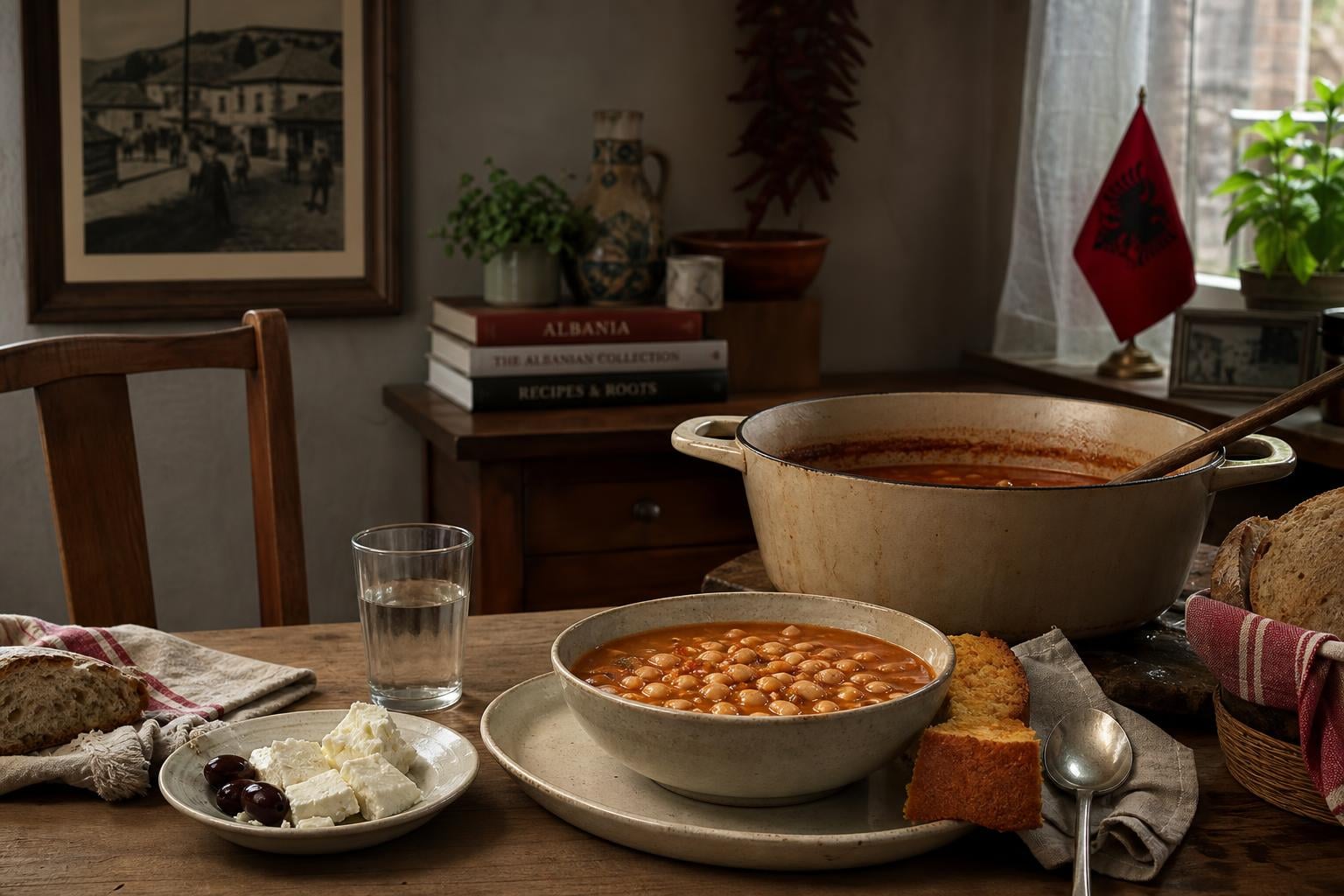
A pot of beans on the back of the stove. The smell of onion frying in olive oil. A dish of paprika on the counter, ready to be stirred in once the onion turns soft. This is what Sunday lunch looks like in thousands of Albanian-American kitchens, from the Bronx to Sterling Heights to Worcester. The dish has more than one name. Grosh, fasule, jani me fasule — older relatives use one word, younger cooks use another, and on a given Sunday the pot tastes the same regardless.
Beans are the quiet center of Albanian cooking. Lamb gets the holidays, byrek gets the family parties, and tavë kosi gets the magazine covers. But the dish a working family eats on a regular Wednesday, the meal a grandmother makes when grandchildren come over after school, the pot that simmers all morning while the household is at church — that is grosh. Cheap, filling, plant-based by default, and kept families through long winters and longer Lenten fasts.
This piece is not a single recipe. The recipe-form version of the dish lives in our fasule post, with measurements nailed down. This is the broader piece — the names, the history, the regional versions, the Lenten cook, and what the dish actually means to the families that keep cooking it.
What Grosh Actually Is
Grosh is a long-simmered Albanian white bean stew built on three things: white beans, a paprika-and-onion base, and time. The beans go in dried and soaked. The base is sweated in olive oil — onion, garlic, sweet paprika, sometimes a spoon of tomato paste, sometimes a dried red pepper crushed in. Water or stock covers everything by an inch. The pot simmers low for an hour and a half to three hours, depending on the bean and the elevation, until the beans are tender enough to crush against the roof of the mouth and the liquid has thickened into something between a soup and a stew.
The dish carries three common names in the Albanian-speaking world, and they cause more confusion than they should:
- Grosh is an older, regional word for the dish, most associated with northern Albania, Kosovo, Shkodër, the highlands, and large parts of the US diaspora whose families trace to those regions — though the name also shows up in older usage farther south.
- Fasule is the standard-Albanian word (from fasule, the Albanian word for beans), used across the south, in Tirana, and in most published Albanian cookbooks.
- Jani me fasule literally means “bean stew” — jani is a southern Albanian word for a slow-cooked vegetable or bean stew, often vegetarian. It is the term you hear in Korçë, Berat, Gjirokastër, and in households that lean on the Lenten version.
A north-Albanian grandmother and a south-Albanian grandmother can serve the same bowl at the same table and call it three different things. The structure does not change. The names are a map of where the family came from before they were a diaspora.
A note on what grosh is not. It is not American chili — the bean is different, the spice register is different, and there is no cumin or chili powder. It is not Bosnian pasulj, which tends to be thinner. It is not Greek fasolada, which is broth-forward and often meatless (Wikipedia: Fasolada). Grosh is paprika-forward, oil-rich, meat-flexible, and built for the bread basket next to it.
The Bean Itself: Fasule e Bardhë
The bean at the center of grosh is fasule e bardhë — white bean. The category covers three main varieties Albanian-American cooks reach for in US supermarkets:
- Great northern. Medium-sized, thin-skinned, mild-flavored. The closest match to what most Albanian grandmothers used in the old country.
- Cannellini. Slightly larger and creamier inside. Excellent in grosh; many cooks now use cannellini by default because they are cheap and consistent at the supermarket.
- Navy beans. The smallest of the three. Cook faster, go softer, and turn the broth more starchy. Fine for grosh but the texture is slightly different.
White beans dominate Albanian cooking for a practical reason. They were the bean that the Mediterranean and Ottoman trade networks settled on — Phaseolus vulgaris, the common bean, arrived in the region from the Americas in the 1500s and spread across Ottoman lands as a cheap, storable, protein-dense staple (Wikipedia: Bean). They replaced older legumes like cowpeas and broad beans in many dishes and became the default fasule.
Dry beans expand a lot when cooked. The numbers worth knowing for diaspora kitchens:
- 1 cup dry white beans yields roughly 2.5 cups cooked.
- 1 pound dry white beans (about 2 cups) feeds 6 to 8 people in grosh form.
- 1 standard 15-ounce can of cannellini contains about 1.5 cups of cooked beans — useful for weeknight shortcuts.
The skin matters. White beans have a thin skin that softens and almost disappears in the broth, which is part of why the stew thickens on its own without flour or starch. Kidney beans and pinto beans have a tougher skin and a stronger flavor; they push the dish in a Tex-Mex direction and are the wrong call for grosh.
White beans are also calorie-dense and protein-rich. A cup of cooked white beans gives roughly 15 grams of protein and 11 grams of fiber, with under one gram of fat. For a family stretching a small meat budget across a long week, this is how the math worked.
A Short History: Mediterranean Staples, Ottoman Routes, Communist Rationing
Albanian grosh sits inside a longer Balkan and Mediterranean bean story. Beans of various kinds — broad beans, lentils, chickpeas, lupins — were eaten in the Eastern Mediterranean for thousands of years. The white bean we cook with today is a New World plant; it crossed the Atlantic in the 1500s and was carried east through Mediterranean trade. By the 1600s and 1700s, white beans were a common peasant staple across the Ottoman provinces, Albanian lands included.
The Ottoman period mattered for the way the dish was seasoned. Paprika, the dominant spice in grosh, traveled the same route — capsicum peppers came from the Americas to the Iberian Peninsula, spread east through Ottoman trade into the Balkans, and from there into Hungary during the Ottoman occupation of central Hungary, becoming central to bean stews from Bosnia south to Greece. Onion, garlic, olive oil, and tomato paste (a later addition) round out the base. Nothing in grosh is unique to Albania at the ingredient level; what is Albanian is the proportion, the timing, and the place at the table.
Through the 20th century, beans carried Albanian households through hard stretches. The communist period (1944 to 1991) — Enver Hoxha ruled until his death in 1985, then Ramiz Alia — brought rationing and a long emphasis on self-reliance and plant-heavy meals. Meat was scarce; beans were not. A pot of grosh could feed a family for two days, and the leftovers thickened overnight into something even better on day two. Older Albanian-Americans who emigrated after 1991 carry the memory of a childhood in which grosh and bread were a weekly meal, not because anyone chose it but because it was what the household had.
Migration carried the dish to the US in waves — the small pre-WWII community in Massachusetts and New York, the post-Cold-War wave in the 1990s, the Kosovo arrivals of 1999, and the steady arrivals since. In every wave, grosh moved with the cooks. It is one of the most portable Albanian dishes: every ingredient is at the supermarket, and the result tastes the same whether the pot is on a wood stove in Tropojë or a glass-top range in Yonkers.
The Classic Sunday Version
The version most Albanian-American families cook on a regular Sunday is built on a meat base. The meat is usually one of three things, and the choice tells you something about the household:
- Smoked sausage — sujuk (sometimes suxhuk) or another Balkan-style smoked sausage, cut in thick coins. The fat renders into the broth and gives the dish a deep, smoky red. This is the most common diaspora version.
- Lamb shoulder — cut in inch chunks, browned hard at the start. Lamb is the richer, slower, more “Sunday lunch” version, especially around Easter.
- Beef shank or smoked bacon — less traditional but common in Albanian-American kitchens where lamb is hard to source or expensive.
The cook goes like this. The meat goes in first to brown and render fat. Onion follows, sweated until soft. Garlic, sweet paprika (and sometimes a smaller hit of hot paprika), a spoon of tomato paste, a bay leaf, and a teaspoon of dried oregano go in next. Soaked beans on top, water to cover by an inch, salt held back until the beans are nearly done so the skins do not toughen. Cover, simmer two and a half to three hours, stir every twenty minutes, taste and salt at the end.
A finished pot is brick-red on the surface, with rounds of sausage and tender beans visible below the broth. The liquid coats the back of a spoon. Olive oil pools at the edges. A wedge of cornbread sits ready next to the bowl. This is what an Albanian-American living room smells like on a Sunday afternoon when the windows are closed for winter.
The Lenten and Bektashi-Fast Version
There is a second grosh that lives in parallel — the meatless version cooked during fasting periods. Albania is a religiously layered country (Muslim majority, Bektashi, Orthodox, Catholic), and each tradition has its own calendar of fasts. The bean stew, made vegetarian, fits every one of them.
In Albanian Orthodox households, kreshmë (Lent) before Easter is a long fast. Meat, dairy, and often oil are restricted depending on the day. Grosh without meat — sometimes also without oil, depending on strictness — is a Friday staple across kreshmë and during shorter fasts through the year. Catholic Albanian families, mostly in the north, observe their own Lenten calendar and often cook a similar meatless pot. The Bektashi tradition, a Sufi order with deep roots in central and southern Albania, also has fasting periods (especially the ten days of Muharram), and meatless grosh is a common food across those days.
The meatless version is not a compromise. Some families cook it that way year-round because they prefer it. The build is similar but leans harder on the aromatics. Onion goes in heavier. Two carrots and a rib of celery often join. A second spoon of tomato paste pushes the depth. A generous pour of good olive oil at the end — sometimes a tablespoon per bowl — does what the rendered sausage fat does in the meat version. The result is cleaner, sharper, more bean-and-tomato in character. It is also lighter, which matters when grosh is the regular Friday meal for forty days running.
The framing of all this is neutral. Different Albanian families fast differently, and many do not fast at all. The point is that grosh is the rare Albanian dish that comfortably lives on every side of every Albanian religious calendar. The bowl is the same. The reasons in the room are different.
Regional Variations
The dish travels across the Albanian-speaking world and picks up small changes along the way. None of these are sharp lines — diaspora kitchens mix and match freely — but the general patterns hold.
Northern Albania (Shkodër, the highlands, Tropojë). This is where the name grosh is most strongly rooted. The version tends to be thicker, with more chili heat and sometimes a smoked pork or beef rib in the pot. Cornbread (buke misri) is the dominant partner. Kosovo and northwestern Albania share this register.
Southern Albania (Korçë, Berat, Gjirokastër). This is jani me fasule territory. The version is often vegetarian by default, leans on tomato and olive oil, and is sometimes finished with a squeeze of lemon — a southern habit that overlaps with the Greek border and reflects the fasolada family tree. Mint and bay leaf are more common in the south than in the north.
Kosovo and North Macedonia. Closer to the northern Albanian register, with smoked sausage common and a thicker broth. Albanian families in Skopje and Tetovo cook the dish in a way that overlaps with Macedonian tavče gravče, though the two are distinct.
Italian Arbëresh communities. The Arbëresh — descendants of Albanians who settled in southern Italy starting in the 1400s — kept their own bean stews, often closer to Italian fagioli but with Albanian seasoning. Some families still call the dish by a variant of the older Albanian name.
The US diaspora. The diaspora kitchen is a mix of all the above. A Kosovo-origin family in Yonkers might cook grosh with smoked sausage and serve it with cornbread; a Korçë-origin family in Worcester might cook a meatless jani me fasule and serve it with crusty bread and a lemon wedge; a mixed-origin family in Sterling Heights might cook both, depending on the week.
How Albanian-American Families Adapt the Dish
The diaspora version of grosh is shaped by what is at the supermarket, how long the cook has, and what the kids will eat. Three patterns show up repeatedly.
Canned beans for weeknights. Two 15-ounce cans of cannellini, drained and rinsed, replace the overnight soak. Cook time drops from three hours to about forty minutes. The texture is slightly less creamy and the broth slightly less thick, but the dish lands close. Many Albanian-American working parents keep four cans of cannellini in the pantry for exactly this purpose.
The slow cooker. A common rhythm: sauté the onion, garlic, and paprika base in a pan on Saturday night, dump it into a slow cooker with soaked beans and meat, set to low overnight or while at church, and come home to a finished pot. The slow cooker keeps the heat low enough that the beans cook evenly without splitting. Some families use an Instant Pot pressure cooker instead — 35 minutes at high pressure with natural release, with no soak needed.
Kid-friendly tweaks. American-raised kids sometimes resist the texture of whole beans or the smokiness of sujuk. Diaspora cooks adapt: the paprika is dialed down, the sausage is swapped for a milder Italian sweet sausage, a parmesan rind goes in for the last hour, the beans are partly mashed against the side of the pot to thicken the broth. The dish becomes a bridge food — recognizable to the grandparents and palatable to the eight-year-old.
The point of these adaptations is not authenticity policing. The dish has survived because it is flexible. A pot of beans that gets eaten is a pot of beans that gets passed down. The shape that matters is the table — Sunday lunch, family together, the same dish the grandmother made, even if the route to it goes through a slow cooker and a can opener.
What to Serve With Grosh
Grosh is rarely a single-dish meal. The table around it is part of the experience. The classic accompaniments:
- Cornbread (buke misri). The traditional partner. Yellow, dense, slightly crumbly, baked in a round pan and cut into wedges. The broth of grosh is meant to be sopped with cornbread, not eaten with a spoon alone. A piece of cornbread torn into the bowl is also common.
- Raw onion. A slice of raw white or red onion next to the bowl, often eaten in alternating bites with the stew. The bite cuts through the richness.
- White cheese. Djathë i bardhë — the Albanian-style brined white cheese — or feta. A wedge on the side, sometimes crumbled into the stew at the end. Salty, sharp, structural.
- Olives. A small dish of cured black olives, usually whole.
- Pickled vegetables. Pickled chilies are common in Kosovar households. Pickled cucumbers, peppers, or cabbage show up in the south.
- Yogurt. A small bowl of plain kos (yogurt) on the side, sometimes spooned over the beans, sometimes eaten in alternating bites.
- Byrek. When grosh is part of a bigger Sunday meal, a wedge of byrek (Albanian filo pastry) often sits on the table beside it.
For drinks, a glass of red wine works — an Albanian kallmet if it can be found, otherwise any Mediterranean red. Some families pour a small glass of raki (fruit brandy) before the meal, which is the Albanian aperitif tradition rather than a specific grosh pairing. For an everyday lunch, the table is simpler — a bowl of grosh, a wedge of bread, and a piece of cheese.
Health and Nutrition
Grosh is a quietly excellent dish from a nutrition standpoint, and the Albanian-American families that grew up eating it once or twice a week did not need a wellness magazine to figure that out. A few facts worth naming:
A cup of cooked white beans gives roughly 220 calories, 15 grams of protein, 11 grams of fiber, and under a gram of fat, plus iron, folate, magnesium, potassium, and several B vitamins. A bowl of grosh with a quarter pound of beans (about a cup cooked) hits a meaningful share of a day’s protein and fiber in one sitting.
The dish is naturally low in saturated fat in its vegetarian form. The olive oil it leans on is the same Mediterranean fat the public-health research keeps pointing to. Even the meat versions, built on small amounts of sausage or lamb, are leaner than most American comfort-food equivalents — the meat flavors the broth rather than dominating the bowl.
For diaspora families thinking about plant-based eating, grosh is already there. The meatless Lenten version is the vegetarian version, and it has been part of Albanian cooking for centuries. The same pot answers a Friday Lent observance and a Tuesday weeknight. The dish is also genuinely cheap — a pound of dry white beans is usually under two dollars and feeds six.