

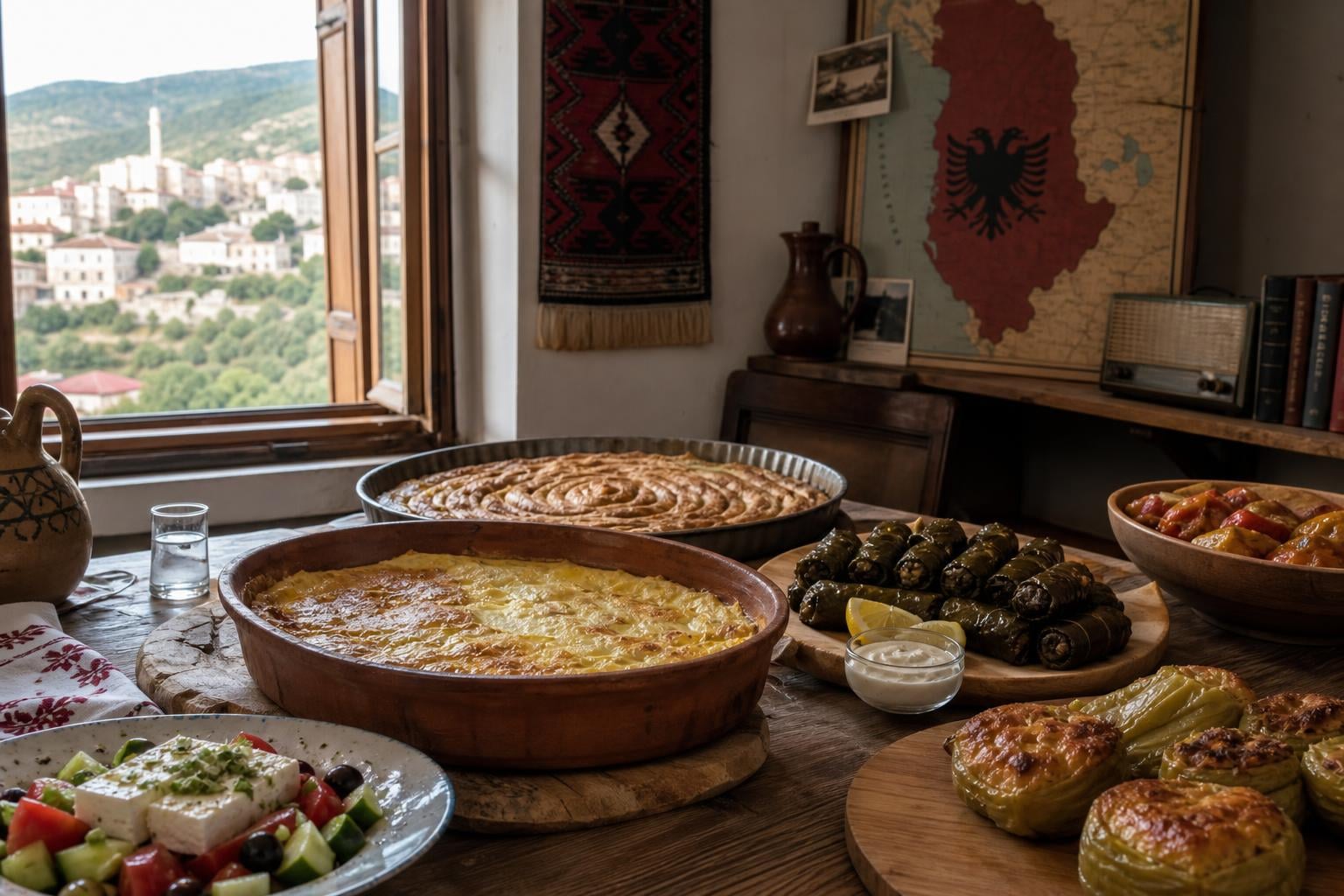
A plate of tavë kosi (baked lamb and yogurt) arrives at a Sunday table in Pelham Parkway, the Bronx. The yogurt topping is still bubbling at the edges. There is rice underneath, oregano on top, a piece of bread on the side, and a small glass of raki (fruit brandy) within reach. The grandmother who made it is from Elbasan in central Albania. The grandchild who is about to eat it is from New Jersey. The dish in between them has not changed much in two hundred years.
That dish — tavë kosi — is the dish most often named as Albania’s national food. Most Americans have never tasted it or heard of it. The gap between those two facts is what this article is about.
When the world thinks of Albanian food, the same handful of dishes keep coming up: a yogurt-baked lamb casserole, layered filo pies, a clay-pan vegetable bake from Tirana, grilled minced-meat skewers, a three-milk cake, walnut baklava, and a clear fruit brandy poured at every welcome. These are the foods that hit international rankings, fill Albanian-American restaurant menus, and travel intact across an ocean to family kitchens in the Bronx, Sterling Heights, and Waterbury. They are not the everyday weekday plate — for that, see our companion piece on popular foods in Albania. They are the iconic dishes, the ones with histories.
The names are Albanian. We italicize them on first use and translate inline. The audience is the US diaspora and anyone trying to understand what Albanian food actually is.
Tavë kosi (baked lamb and yogurt)
Tavë kosi — literally “yogurt casserole” — is the dish most often named as Albania’s national food. The version that traveled the world is from Elbasan in central Albania, sometimes called tavë Elbasani. Pieces of lamb (usually shoulder) are seared, layered over rice, covered with a topping of yogurt whisked with eggs, flour, and butter, and baked until the top sets and browns (Wikipedia: Tavë kosi).
The dish is old. Cookbooks place its codified form in the 18th or 19th century, but the underlying technique — slow-cooking meat under a yogurt-and-egg seal — is older than the Ottoman administration that helped spread it. The Ottoman court adopted versions of it; Greek, Turkish, and Balkan cuisines have cousin dishes; the Albanian rendering held on to the rice base, the lamb cut, and the oregano finish.
TasteAtlas, which crowdsources global food ratings, rates tavë kosi among the world’s casseroles — a specific, food-nerd corner of its rankings rather than an overall crown, but a real and rare Albanian entry on a global platform. The rankings are popular, not academic, but they reflect what food writers, travel media, and diaspora households have known for a long time.
In the United States, tavë kosi is the Sunday and holiday dish across the diaspora. Albanian-American restaurants in metro New York, Detroit, and Waterbury serve it. Family kitchens make it for Easter, Eid al-Fitr, Christmas, and the first dinner after a relative arrives from Albania or Kosovo. Greek-yogurt-and-supermarket-rice approximations are fine — the dish is forgiving — but the right yogurt (full-fat, tangy, not Greek-strained to the point of sourness) makes the difference. A trayful feeds eight.
If we had to pick one dish to argue for Albanian cuisine on the world stage, this would be it.
Byrek (Albanian filo pie)
Byrek is the layered filo pie that holds Albanian cooking together. Phyllo sheets brushed with oil or butter, stacked over a filling of white cheese (me djathë), spinach (me spinaq), leek, pumpkin, tomato-onion, or seasoned meat, then baked in a round or rectangular tin until the top shatters. It is everyday food in Albania and a ceremonial food in the diaspora.
The dish belongs to a broader Balkan and Anatolian filo-pie family — börek in Turkish, burek in Bosnian and Serbian, pita in Bulgarian — but the Albanian version has its own filling logic and its own pastry traditions. Northern Albania, Kosovo, and North Macedonia favor the rolled-and-coiled byrek me oriz (with rice) and the meat byrek. Southern Albania has lakror, a thinner-doughed cousin baked on embers under a saç lid. Korçë is the lakror capital (Wikipedia: Albanian cuisine).
What makes byrek iconic internationally is its sheer ubiquity in Albanian life. Every neighborhood bakery (furrë byreku) in Tirana sells slices for the equivalent of a dollar. Children carry it to school. Workers eat it standing at the counter. Families bake a full tray on weekends and reheat it Monday through Wednesday. Few national foods do this much work.
The diaspora kept byrek almost intact. Albanian-owned bakeries in the Bronx (notably along Belmont and around Arthur Avenue), in Astoria, in Sterling Heights, and in Waterbury sell it by the slice and the tray. Home cooks adapt with supermarket phyllo when the hand-rolled dough (petë) is not available. The frozen Greek phyllo sold at Costco works. The hand-rolled version, when a gjyshe (grandmother) is still doing the rolling, does not have a fair comparison.
Byrek travels. It is the dish Albanian-Americans bring to potlucks.
Fërgesë (peppers, tomatoes, and cottage cheese)
Fërgesë e Tiranës — the Tirana version of fërgesë — is the dish that put central-Albanian cooking on the international culinary map. Green peppers and tomatoes are cooked down with garlic and olive oil until soft, then mixed with crumbled gjizë (fresh cottage-style cheese), sometimes butter, sometimes liver or veal, and finished in a clay pan in the oven (Wikipedia: Albanian cuisine). The result is somewhere between a stew, a dip, and a baked vegetable dish.
The name comes from the verb fërgoj (to sauté or pan-fry). The Tirana version is the canonical one, codified in 20th-century Albanian cookbooks and present on every traditional restaurant menu in the capital. Summer fërgesë leans heavily on peppers and tomatoes; winter fërgesë adds meat — most often liver, which is one of the few liver dishes that even liver-skeptics enjoy.
TasteAtlas has ranked fërgesë in the top tier of Albanian dishes since the platform started tracking it. It is the dish first-time visitors to Tirana tend to bring up unprompted, the one that surprises people who arrived expecting only byrek and grilled meat. The dish photographs poorly and tastes excellent, which is the inverse of most food-media celebrities.
In the United States, fërgesë is harder to find on restaurant menus than tavë kosi or byrek because the gjizë is the hardest ingredient to source in American supermarkets. Diaspora cooks substitute with ricotta or farmer’s cheese; Albanian-owned shops in the Bronx and metro Detroit carry the real thing. Where it shows up — Çka ka Qëllu in the Bronx among them — it disappears off the menu fast.
The Tirana provenance matters. Fërgesë is the central-Albanian answer to the Mediterranean stuffed-pepper repertoire, and it is the dish that proves Albania’s cuisine is not a smaller version of its neighbors’.
Qofte (grilled meatballs and kebabs)
Qofte (singular qoftë) is the Albanian member of the broader kebab-and-meatball family that stretches from the Adriatic to South Asia. The Albanian rendering is distinct enough to stand on its own. Ground lamb or beef is seasoned with onion, garlic, oregano, mint, and sometimes feta or breadcrumbs, shaped into oblong or round pieces, and either grilled (qofte në zgarë), pan-fried (qofte të fërguara), or skewered in the long Korçë style (qofte korçare).
The Korçë version is the most internationally cited. Long, thin, finger-shaped, grilled over wood embers, served four to six per plate with raw onion, ground sumac or paprika, yogurt, and bread. Korçë’s historic gostiloret (grill houses) in the city’s old quarter are the canonical addresses. Kosovo’s qofte are similar but tend to be rounder and heavier on the onion.
The dish is old in the sense that all kebab traditions are old — Ottoman in administrative spread, pre-Ottoman in technique — but the Albanian seasoning palette is its own. Mint and oregano lean stronger than in Turkish or Greek versions. Lamb dominates over beef in the south; the north uses more beef and veal.
In the United States, grilled qofte is one of the easier Albanian dishes to find. Steakhouses run by Albanian-American owners across the Bronx, Westchester, and northern New Jersey put it on their menus next to the New York strip. Pizzerias owned by Albanian families — there are thousands across metro New York — sometimes hide it on a back page of the menu. The Albanian-Italian cevapi-pizza fusion exists and is better than it sounds.
For diaspora households, qofte is the summer barbecue food. Grills come out in May; the seasoning is the same as in a backyard in Tirana.
Trileçe (three-milk cake)
Trileçe — sometimes spelled triliçe or tri leçe — is the modern dessert that conquered the Balkans through Albania. A sponge cake is soaked in three milks (evaporated, condensed, and heavy cream), then topped with a thin layer of caramel or whipped cream. It is light, wet, sweet without being cloying, and easy to make in any home kitchen with a tin can and a whisk.
The dish is not ancient. Albanian cookbooks pick it up in the 2000s, adapted from the Latin American tres leches (which itself is a 20th-century dish associated with Nicaragua and Mexico, though its condensed- and evaporated-milk base dates to the mid-19th century). The Albanian version went viral domestically in the 2010s, helped along by reality-cooking shows and a generation of Albanian café owners who put it on every menu from Tirana to Pristina. By 2020 it was the default birthday cake in much of urban Albania.
What makes trileçe iconic now is its market dominance. It is the only dessert that competes with bakllava on national wedding tables. It has a TasteAtlas entry, restaurant chains built around it (Lori in Tirana among them), and a strong export route into the diaspora.
In the United States, trileçe is the easiest Albanian dessert to introduce to non-Albanian friends. The flavor reads as familiar (caramel, milk, sponge), the texture is comforting, and the portion size is right for a coffee break. Diaspora bakeries in the Bronx, Astoria, and metro Detroit sell it by the square; Albanian wedding caterers in New York and New Jersey list it as a default option alongside baklava.
Trileçe is the dish that proves Albanian cuisine is still being written.
Bakllava (Albanian-style baklava)
Bakllava — the Albanian rendering of baklava — is the centerpiece dessert for every major holiday in Albania, Kosovo, North Macedonia, and the diaspora. Layered phyllo, ground walnuts (more often than the Turkish pistachio), butter, and a lemon-scented sugar syrup poured over the cooled tray. Cut into diamond pieces. Stacked on a platter that comes out once a year (Wikipedia: Baklava).
Albania shares baklava with the entire former Ottoman Empire, but the Albanian version has signatures. Walnuts dominate over pistachios; the syrup is thinner and brighter with lemon; the diamond cut is standard. Northern Albanian and Kosovar versions sometimes use a higher walnut-to-phyllo ratio than the Turkish original. Southern Albanian recipes occasionally fold in cinnamon or clove.
The dish is religious territory in both directions. Muslim Albanian households make it for Bajram (Eid al-Fitr and Eid al-Adha), Catholic Albanian families for Christmas, and Orthodox families for Easter and Christmas. The tray that comes out on Bajram morning in a Kosovar family in Sterling Heights is the same tray, by recipe, that comes out for Christmas in a Catholic Albanian family in the Bronx. The holiday is different. The dessert is the same.
That cross-confessional shared-table quality is one reason bakllava matters culturally beyond the dessert course. In a country that has been Catholic, Orthodox, Muslim, and Bektashi simultaneously for five hundred years, very few foods belong to everyone. Bakllava is one of them.
In the United States, every Albanian wedding banquet has a baklava station. Albanian-American bakeries in Belmont, Astoria, Waterbury, and Sterling Heights produce it year-round. Most home cooks have at least one aunt who is known for hers. The trays are heavy. The leftovers last a week. The recipe goes in the WhatsApp family thread.
Raki (fruit brandy)
Raki is the national drink of Albania and the ceremonial pour for every welcome, every farewell, every funeral, every wedding, and most ordinary Tuesdays. It is a clear fruit brandy, double-distilled, typically from grapes (raki rrushi), plums (raki kumbulle), or mulberries (raki mani), and bottled at 40 to 50 percent alcohol by volume. The best is homemade or village-distilled. The shop-bought versions are good. The store-bought industrial versions are fine for cooking (Wikipedia: Rakia).
A note on the name: Albanian raki is not the same as Greek ouzo or Turkish rakı. Both of those are aniseed-flavored. Albanian raki is not. It is closer in style to a French eau de vie or brandy — a clean, fruit-forward distillate that lets the fruit do the work, made from the whole fermented fruit rather than the grape pomace that Italian grappa is distilled from. The mulberry version (mani) is the prized Albanian specialty; bottles of it from Berat, Korçë, or Përmet show up in diaspora households as the gift Albanian relatives bring to weddings and graduations.
The ritual around raki is older than the drink. A small glass is poured for every guest who enters the door. A toast — gëzuar (cheers) — is offered. The glass is drunk in one sip or two. Food follows. The drink is small (a gotë is closer to 20 milliliters than a shot), the company is the point, and the host’s raki is a matter of household pride.
In the United States, bottled Albanian raki is sold in liquor stores in heavily Albanian neighborhoods — the Bronx, Sterling Heights, Waterbury, Astoria, Garfield. Homemade raki travels in suitcases and gets decanted into water bottles. Customs has opinions about this. Diaspora weddings pour it from carafes on every table. The drink is the welcome, and the welcome is the point.
For deeper detail on the drink, see our piece on albanian raki.
Lakror and the regional pies
Lakror is the southern Albanian member of the byrek family — thinner dough, larger diameter, traditionally baked on embers under a saç (a metal lid covered with hot coals). The Korçë region is its heartland. The most cited fillings are wild greens (me bar), leek (me presh), tomato-and-onion (me domate dhe qepë), and pumpkin (me kungull). It is what Albanian food looks like when the kitchen is a fire pit and the cook is using what the season gave them (Wikipedia: Albanian cuisine).
Northern Albania has its own regional pies. Pite — the slightly thicker, multi-layered version — is more common in Shkodër and the Dukagjin region. Kosovo has flija, the famous layered crepe-stack cooked under a saç and brushed with cream and butter between layers, served for big mountain gatherings.
What unites the regional pies is method. They are all built on the principle of unleavened dough, layered or stacked, finished with seasonal filling, and baked or griddled in a covered vessel that recreates an oven from a fire. The technique predates ovens. It survived because it works, and because it makes feeding twenty people from one pan possible.
These pies are the dishes Albanian food media reaches for when explaining what makes Albanian cuisine specifically Albanian, rather than generically Balkan. They reflect terrain — Korçë’s highlands, Shkodër’s lake basin, the Kosovar mountains — and they survived because mountain food survives.
In the United States, lakror is rare on restaurant menus but common in diaspora kitchens with roots in Korçë or the south. Flija is the centerpiece dish at Albanian-American mountain retreats and family camp gatherings in upstate New York and northern Michigan, where the saç gets brought out and the cooking takes four hours. These are not Tuesday-night dishes. They are the foods that anchor the year.
How the diaspora keeps these dishes alive
The famous Albanian dishes traveled to the United States in three waves. The first was the early 20th-century Tosk migration from southern Albania to Massachusetts and Connecticut, which brought byrek, qofte, and raki to Boston and Waterbury before most Americans had heard of Albania. The second was the post-1990 wave that landed in the Bronx, Westchester, Astoria, and northern New Jersey, which brought the full repertoire intact. The third was the Kosovar wave that anchored in metro Detroit (Sterling Heights, Warren, Troy) through the 1999 displacement and after.
Each wave kept the holiday dishes. Tavë kosi is on Easter and Eid tables in all three regions. Bakllava comes out for every wedding and every major religious day. Byrek is sold at neighborhood bakeries from Belmont in the Bronx to Schoenherr Road in Sterling Heights. Qofte shows up at backyard barbecues from May to October.
The infrastructure is mostly family. Albanian-American restaurants in New York and Michigan — Çka ka Qëllu and Tradita among them — anchor the public face of the food. Albanian-owned bakeries handle the daily byrek-and-bread supply. The home kitchen does the rest, and the recipes pass through WhatsApp threads, Facebook groups, and grandmother visits.
The hardest ingredients to source are the dairy ones — proper kos (yogurt), gjizë (cottage cheese), and Korçë-style djathë i bardhë (white cheese). Albanian shops in the Bronx (Belmont), Sterling Heights, Waterbury, and Garfield carry them. Greek-American delis cover most of the rest. The Albanian diaspora’s food map closely tracks where the community itself lives; for the geography of the community, see albanian americans.
The dishes survive because they are good and because they are tied to the calendar — Easter, Eid, weddings, baptisms, the first dinner after someone arrives, the wake after someone dies. As long as the calendar is honored, the food gets cooked.
Get counted alongside the food
If these are the dishes that show up on your family’s table — tavë kosi on Easter, byrek on Sunday morning, bakllava at Bajram — your family is part of the count we are building. Add your household to the National Albanian Registry at /register. It takes a minute and helps us produce a community-led count of Albanian Americans.