

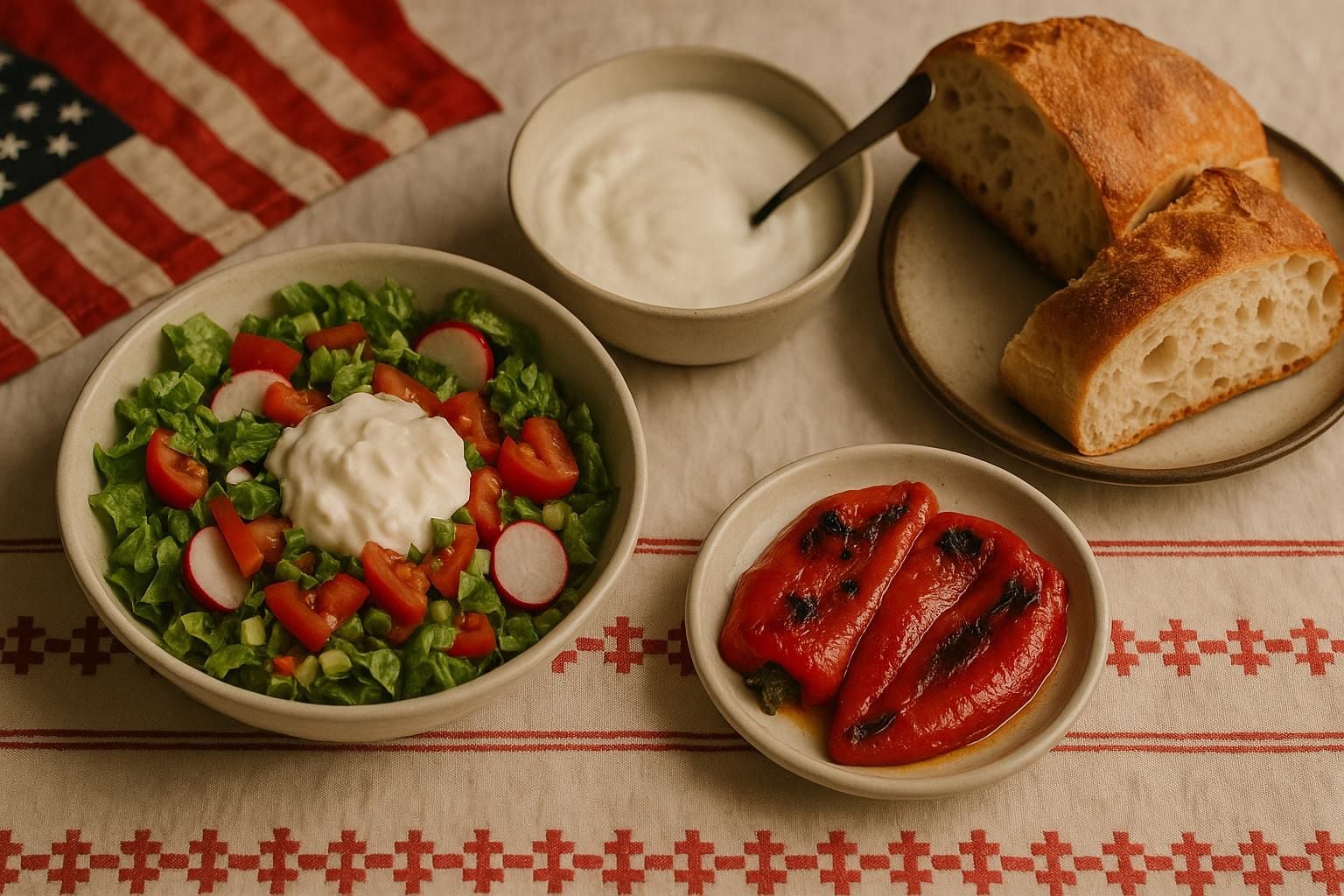
Sunday lunch in an Albanian household runs to a script. Before the tavë kosi arrives, before the byrek gets cut, before the qofte come out of the pan, a wide bowl sits at the center of the table. Inside: sliced romaine, a slick of olive oil, a splash of red wine vinegar, and salt. Nothing else. That bowl is sallate jeshile — green salad — and it sits in front of every plate from the moment the family sits down.
The bowl is not a side dish in the American sense. It is structural. Albanian meals are built on three load-bearing components: the gjelle (the main hot dish), the sallate (the salad), and the bukë (the bread). The gjelle is the heat and the protein. The bukë is the sponge that mops up what the fork misses. The sallate is the acid, the crunch, and the cold-bright contrast that keeps the other two from feeling heavy.
This piece covers the Albanian salad family — sallate, plural sallata — as a category and as a meal-structure element. The major varieties, how they differ from their Greek, Bulgarian, and Turkish cousins, how they vary across Tosk and Gheg cooking, and how the diaspora keeps them on the table with US supermarket ingredients.
What Sallate Means in Albanian Cooking
Sallate is the Albanian word for salad. Plural is sallata. The word is a loan — most Balkan languages share some version — but the structural role sallate plays at the Albanian table is specific.
In American cooking, a salad is optional. Skip it and the meal still reads as a meal. In Albanian cooking it does not work that way. A meal without sallate is incomplete. The three components — gjelle, sallate, bukë — sit alongside each other and read as a single unit.
The sallate lives on the table the whole meal. It does not arrive as a course and get cleared. It sits next to the gjelle, gets spooned onto each plate, and stays until the table is cleared.
The Albanian word gjelle (sometimes gjellë) covers any hot, cooked main dish — stew, casserole, baked meat, braise. The sallate is the cold, fresh, raw, or pickled counterpart. What goes into the sallate depends on season: lettuce in spring, tomato and cucumber in summer, roasted peppers in early fall, cabbage and pickles in winter.
Sallate Jeshile — The Green Salad
Sallate jeshile is the default sallate across most Albanian-speaking lands. Jeshile means green. The salad is what the name says — a bowl of green leaves dressed in oil and vinegar, with as few additions as possible.
The lettuce is romaine in most modern kitchens — it holds up to the dressing without wilting. Butter lettuce and the small-leaf garden lettuces (sallate kopshti) work better in spring, when they are tender. The leaves get washed, dried, and sliced crosswise into thin ribbons — not torn into chunks the way an American Caesar gets handled.
The dressing is olive oil, red wine vinegar, and salt. Some families add a squeeze of lemon. Some add finely diced scallion or fresh dill. The proportions run roughly 3 to 1 — three parts oil to one part vinegar — but the measurement is by eye and by taste. The dressing goes on at the table, not in the kitchen.
What does not belong in sallate jeshile: tomato, cucumber, feta, croutons, peppers, raw garlic, or anything that turns it into a chopped salad. Sallate jeshile is intentionally minimal.
In the diaspora, the dish survives well because the ingredients are universal. A head of romaine, a bottle of olive oil, a bottle of red wine vinegar, and a salt shaker get any Albanian-American household within striking distance of the original. The hardest substitution is the vinegar — Albanian home cooks often use a homemade red wine vinegar with more bite than the supermarket version.
Sallate me Kos — Yogurt-Cucumber Salad
Sallate me kos is the cold yogurt-and-cucumber salad served all summer across Albania and into the diaspora. Me kos means “with yogurt.” Cucumber gets diced, salted to draw out water, drained, and folded into seasoned plain yogurt with crushed garlic, dried mint or fresh dill, salt, and a splash of olive oil.
The dish is part of a wider Balkan family. Greek tzatziki treats the same ingredients as a sauce — cucumber grated and squeezed dry, blended into yogurt, served as a dip. Bulgarian tarator is the soup version — yogurt thinned with cold water, diced cucumber, garlic, walnuts, dill, eaten with a spoon. Turkish cacık sits close to tarator. Albanian sallate me kos is its own format: thicker than tarator, chunkier than tzatziki, served as a salad. The yogurt is full-fat, plain, and ideally Albanian kos — tangier and thicker than American supermarket yogurt. Full-fat plain Greek yogurt is the closest US substitute.
The herb question splits regionally. Southern Tosk households lean on fresh dill. Northern and Kosovar households use dried mint, sometimes both. Garlic is everywhere, raw and crushed fine. The olive oil goes in last, drizzled over the top.
Sallate me kos is the salad of August. It pairs with anything heavy or fried — qofte, grilled lamb, speca të mbushur, byrek — by cooling the palate between bites. Some families call the dish tarator and serve it thinner; others call it sallate me kos and serve it thicker. The texture decides — bowl with a spoon and a fork is a salad; bowl with only a spoon is a soup.
Sallate me Speca — Roasted Pepper Salad
Sallate me speca is the roasted red pepper salad that shows up across Albanian, Kosovar, and southern Balkan tables in late summer and early fall. Speca is the Albanian plural for pepper.
Whole red bell peppers — or the long horn peppers (speca kapia) when available — get charred over a flame, grill, or broiler until the skin blisters. They go into a covered bowl to steam for fifteen minutes, then the burned skins peel off in sheets. The flesh underneath is silky, sweet, and smoky. The peeled peppers get sliced into wide strips, laid in a shallow dish, and dressed with olive oil, red wine vinegar, chopped garlic, and salt. Some households add parsley or a shaving of raw onion. The salad rests at room temperature thirty minutes so the dressing soaks in.
The technique is older than the bell pepper itself in this part of the world. Peppers reached the Balkans through Ottoman trade routes in the 16th and 17th centuries, after Columbus brought them back from the Americas. The technique of charring and dressing them in oil and vinegar spread across the eastern Mediterranean — Greek piperies psites, Turkish közlenmiş biber, and other cousins sit in the same family. The Albanian version leans heavier on garlic than the Turkish one and skips the lemon that often shows up in the Greek one.
In households that put up vegetables for the winter, sallate me speca gets jarred — peppers roasted in volume in September, packed with olive oil, vinegar, and salt. The jarred version is often called speca turshi or speca në vaj depending on whether the brine leans vinegar or oil. Albanian groceries in the Bronx, Sterling Heights, and Waterbury stock imported jars year-round. The diaspora shortcut is the supermarket jar from Mancini, Cento, or Divina — drain well, slice, dress.
Sallate Fshatare — The Village Salad
Sallate fshatare is the village salad — fshatare means “village-style” — and it is the Albanian answer to Greek horiatiki and Bulgarian shopska. The dish that shows up at every summer Albanian table when tomatoes are at their peak.
The structure: ripe tomatoes in wedges, cucumbers in thick half-moons, green or red bell pepper sliced thin, white onion in rings, white feta (or fresh gjizë) crumbled or laid in a slab on top, olive oil, red wine vinegar, salt. Sometimes olives, sometimes parsley. The vegetables get chopped large enough to spear with a fork.
The dish belongs to a family of Balkan village salads that developed in the same century around the same set of ingredients. Greek horiatiki uses chunked tomato, cucumber, pepper, onion, olives, and a slab of feta. Bulgarian shopska — a documented mid-20th-century creation that became Bulgaria’s national salad — uses similar vegetables topped with grated sirene (Bulgarian brined white cheese). Macedonian shopska salata sits in the same family. The Albanian version is closer to the Greek version in execution — the cheese is sliced or crumbled rather than grated, and the proportions favor the vegetables over the cheese.
The naming is a cultural fact, not a political one. These are sibling dishes built on the same Mediterranean garden, reflecting the long porous border Ottoman-era cuisine drew across the southern Balkans.
What makes the Albanian fshatare recognizably Albanian is small. The cheese is a brined white feta — sometimes Albanian djathë i bardhë, sometimes Greek or Bulgarian feta in the diaspora. The dressing leans olive oil heavier than the Greek version. The herb is parsley if anything; dill is rare. And the salad sits next to the gjelle with bread, not as a starter, but as the structural cold component for the whole meal. In the diaspora, sallate fshatare is the easiest Albanian salad to recreate — vine tomatoes, English cucumber, a green pepper, half a red onion, a block of feta from any deli case, olive oil, red wine vinegar, salt.
Regional Variations Across Albanian-Speaking Lands
Albania, Kosovo, North Macedonia, Montenegro, and the Arbëresh communities of southern Italy share a salad tradition with regional fingerprints. The variations sit along the same Tosk-Gheg split that shapes the rest of Albanian cooking (Wikipedia: Albanian cuisine).
Tosk (southern Albania, Berat, Gjirokastër, Korçë, Sarandë). Southern salads run lighter and more Mediterranean. More olive oil, more fresh herbs, lighter use of cheese. Sallate jeshile with fresh dill is the southern signature; sallate me kos leans on dill over mint. The coastal kitchens — Vlorë, Sarandë, Himara — add more olives and sometimes wild greens (lakra).
Gheg (northern Albania, Shkodër, Tropojë, Kosovo, parts of N. Macedonia and Montenegro). Northern salads run heavier and more dairy-forward. Cabbage salads (sallate me lakër) appear more often in winter. Kosovar households often dress a cabbage salad with thinned yogurt. Dried mint dominates over fresh dill. Sallate me speca leans hotter, sometimes finished with red pepper flakes.
Kosovo and North Macedonia. The Kosovar and Macedonian Albanian traditions sit inside the wider Gheg register but absorb some Slavic regional habits. Shopska-style salads appear more often on Kosovar tables, sometimes called sallate fshatare and sometimes sallate shope.
Arbëresh (southern Italy). The Arbëresh communities of Calabria, Sicily, Basilicata, and Puglia preserved a foodway that diverged from the homeland in the 15th century and absorbed five centuries of Italian influence. Arbëresh salads use the same ingredients with Italian ratios — more olive oil, more raw garlic, sometimes pecorino in place of feta.
The lines blur in any kitchen with mixed regional ancestry. A Bronx household with a Korçare grandmother and a Prishtina grandfather ends up with a salad rotation that takes the dill from one tradition and the dried mint from the other.
Why Olive Oil and Vinegar Anchor the Dressing
The Albanian salad dressing — me vaj e uthull, with oil and vinegar — is so consistent across regions that most home cooks do not name it as a dressing. It is just how a salad gets seasoned.
Albania sits on the eastern Adriatic. The southern hills — from Vlorë through Sarandë and inland into the Drino valley — have produced olives and pressed oil for centuries. Modern Albania is a real but modest olive oil producer — it ranks among the world’s top olive-oil-growing countries by volume, well behind Mediterranean leaders like Spain, Italy, and Greece (Wikipedia: Agriculture in Albania) — and regional cooking has been built around olive oil as the default fat since long before the modern era. In Tosk kitchens — the south — olive oil is the only cooking fat. Salads get a heavy pour at the table, often more than the salad itself by volume. In Gheg kitchens — the north — olive oil shares space with butter and rendered animal fat, but for salads specifically, olive oil still dominates.
The vinegar is red wine vinegar in most households. Albania has a long wine-making tradition — the indigenous kallmet and shesh grape varieties produce reds with enough acidity to make a sharp homemade vinegar. Home vinegar production is older than home wine production in many villages, since the vinegar pot was where the wine that went too sharp got rescued. Apple cider vinegar appears occasionally; balsamic is a recent import and rarely used in traditional recipes. Lemon shows up in some southern coastal recipes.
What does not appear: mayonnaise, mustard, sugar, soy sauce, cream, or any creamy emulsion. The Albanian salad tradition treats the three-ingredient dressing — oil, vinegar, salt — as the only honest way to handle a vegetable. The yogurt-based salads are a separate category; the yogurt is its own dressing.
The Diaspora Kitchen — Sallate With US Supermarket Ingredients
The Albanian salad family travels well into the US because the ingredients are universal. Lettuce, cucumber, tomato, pepper, onion, garlic, yogurt, olive oil, vinegar, salt. Every US supermarket carries every item.
For sallate jeshile. Romaine is the workable default; butter lettuce in spring. Skip the bagged mixes — the cut leaves wilt under oil and vinegar.
For sallate me kos. Full-fat plain Greek yogurt is the closest substitute for Albanian kos. Fage, Chobani, or any deli-counter strained yogurt works. Avoid low-fat — the texture goes thin.
For sallate me speca. Fresh red bell peppers under the broiler take 12 to 15 minutes. The jarred shortcut — Mancini, Cento, or Divina — works on a weeknight; drain well before dressing. Albanian and Balkan groceries in the Bronx, Sterling Heights, Astoria, Paterson, and Waterbury stock imported jars in olive oil.
For sallate fshatare. Vine-ripened or Roma tomatoes work in any season; in summer, a farmer’s market heirloom is worth the trip. English cucumber, a green bell pepper, half a red or white onion, and a block of Bulgarian or Greek feta from any deli case cover the rest.
The harder loss is the homemade vinegar. The wine vinegar an Albanian grandmother kept in a clay pot — sharp, brick-red, made from whatever wine went too far — does not appear in any US supermarket. The supermarket bottles are uniform and milder. The dish still reads as Albanian; the edge softens. Bulgarian kiselo mlyako in the dairy case of any Balkan grocery is closer in tang to Albanian kos, and imported tubs of kos itself show up at Albanian-owned shops in Detroit, the Bronx, and Worcester.
Why Sallate Anchors the Meal Structure
The Albanian meal is built on a tripod. Take any one leg away and the table tilts. The three legs are gjelle, bukë, and sallate.
The gjelle is the hot, cooked main dish. It carries the protein, the fat, and the seasoning. Fasule, qofte, tavë kosi, stuffed peppers, lamb stew, baked fish, fërgesë — all gjelle. The hot center of the table.
The bukë is the bread. Not a side dish, not an optional carb — the center of the meal. The Albanian phrase for “going to eat” translates word-for-word as “going to eat bread” (Wikipedia: Albanian cuisine). Bread is what you tear to scoop the sauce, what you wrap around a piece of meat, what you eat with the cheese and olives before the main arrives.
The sallate is the cold counter to the hot gjelle and the dry bukë. It carries the acid, the crunch, the fresh vegetable, and the water content the other two lack. Without it, an Albanian meal feels heavy. A bowl of sallate jeshile with a piece of leftover byrek is a complete dinner. A plate of qofte with a bowl of sallate me kos is a complete dinner. Two of the three legs is enough; one is not.
In the diaspora, the structure persists even when the rest of the meal changes. An Albanian-American household serving spaghetti will often still put out a sallate jeshile alongside, in a way an Italian-American household would not.
The kos bowl belongs in this picture too. A small bowl of plain whole-milk yogurt next to the gjelle is nearly as constant as the salad bowl. Kos and sallate together form the cold side of the table — the gjelle the hot side, the bukë the bridge. That four-part structure — gjelle, sallate, bukë, kos — is the underlying shape of every traditional Albanian meal worth the name.
A Diaspora Practice
A salad does not announce itself. It does not show up on Albanian-restaurant menus the way qofte and byrek do. It does not have its own holiday or its own grandmother-handed-down techniques the way flija does. Sallate is so ordinary that most cookbooks barely include a recipe — the assumption is the cook already knows.
That ordinariness is what makes it diaspora-defining. The bowl of vinegar-dressed lettuce on a Tuesday table in a Worcester apartment is the same bowl on a Tuesday table in a Vlorë kitchen. The sallate family travels because the structure is forgiving and the ingredients are universal.
The National Albanian Registry is building a community-led count of Albanian Americans. Counting the diaspora is, in part, counting the kitchens where the sallate still goes on the table before the gjelle arrives. If you have not been counted yet, take a minute and register at albanianregistry.org. Free, neutral, and the recognition certificate is yours to keep.