

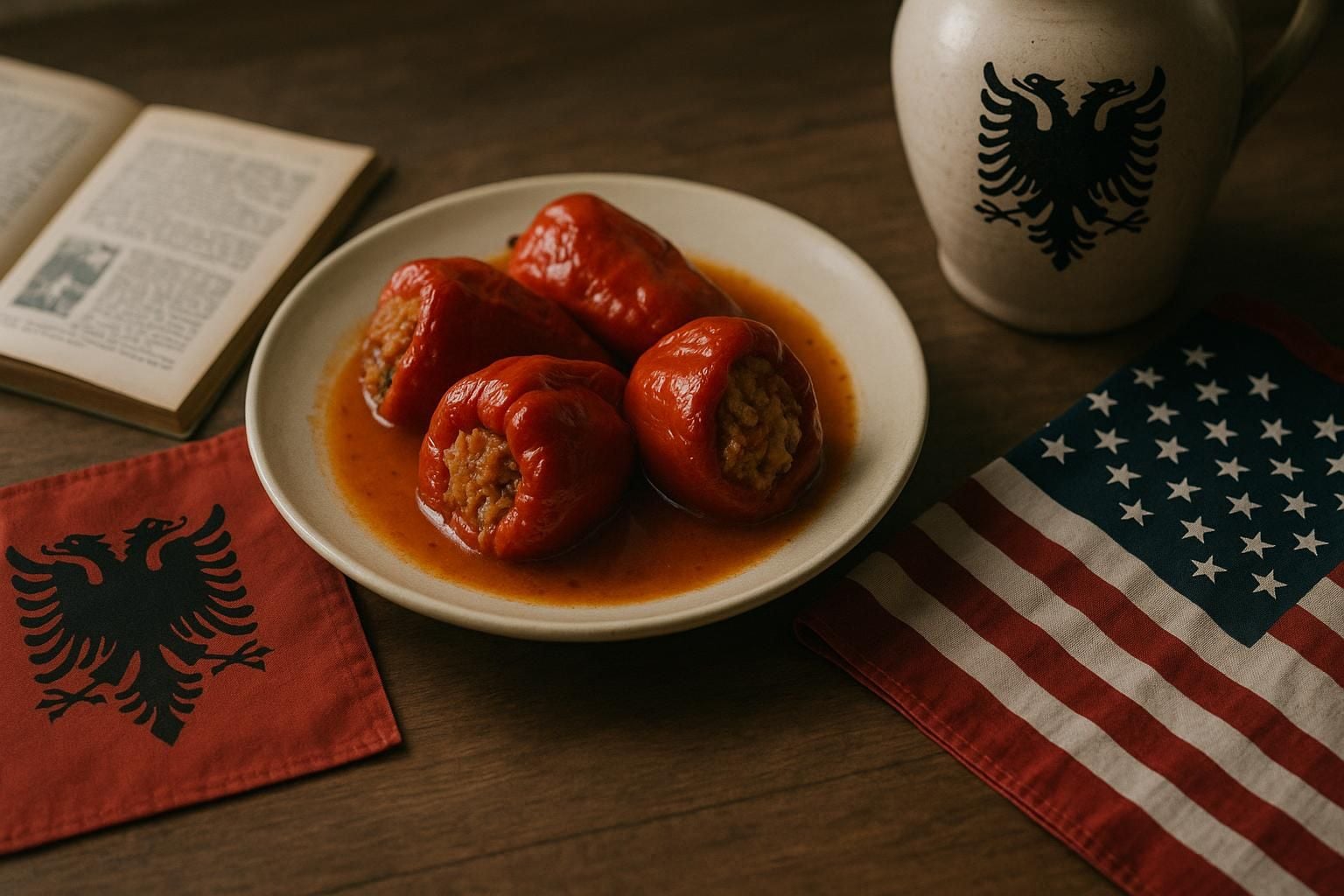
Late-summer markets in Tirana, Prishtina, and Skopje pile sweet peppers in red, green, and yellow heaps. In the diaspora, the same peppers show up at Stop & Shop, Meijer, and Market Basket from August through October. Albanian cooks buy them by the bag. The dish they go into is speca të mbushur — peppers hollowed, packed with rice and ground meat, set upright in a pan with tomato sauce, and baked until the skins slump.
The Albanian version is part of a Balkan family — Greek gemista, Turkish biber dolması, Macedonian piperki polneti, Bulgarian chushki s oriz — that traces back to the same Ottoman dolma technique. Same family, different fingerprints. What sets the Albanian version apart is a specific rhythm of rice, ground meat, grated onion, and tomato, plus the kos (Albanian yogurt) bowl that almost always sits next to it on the table.
This piece covers what speca të mbushur is, where the dish comes from, the base recipe, the regional variations across Albania and the wider Albanian-speaking world, how it differs from its Balkan cousins, why it travels so well into the diaspora, and how the dish is served at home and away from home.
What “Speca të Mbushur” Means
The phrase splits into two words. Speca is the Albanian plural for pepper — bell pepper, horn pepper, hot or sweet. Të mbushur is the past participle of mbush, “to fill,” conjugated for the plural object. The literal translation is “filled peppers.” In English the convention is “stuffed peppers,” and the two phrases name the same dish.
The word speca is simply the Albanian term for peppers. The pepper as a plant is a New World crop; it arrived in Europe in the late 15th century, traveled the Mediterranean through Italian and Ottoman trade, and was naturalized in Balkan gardens within a few generations. By the 19th century, sweet peppers were a staple of every Albanian kitchen garden.
In Kosovo and parts of North Macedonia, the Gheg dialect sometimes renders the dish speca të mbushun, dropping the final -r the way Gheg often does. The same dish in some households is just called speca me oriz — peppers with rice — which describes the filling rather than the technique. All three phrases name the same dinner.
A bilingual gloss helps the diaspora reader. Speca të mbushur is the standard form in Tirana home kitchens; speca të mbushun is the Gheg variant heard in Kosovo and Shkodër. The dish itself — peppers, rice, meat, tomato, yogurt — is one tradition spoken in two dialects.
Where the Dish Comes From
Stuffed-vegetable dishes are an Ottoman invention by way of older Persian and Byzantine traditions. The Turkish word dolma — from the verb dolmak, “to be filled” — names the entire category: stuffed grape leaves, stuffed cabbage, stuffed zucchini, stuffed eggplant, stuffed peppers. Over four centuries of Ottoman rule, the technique spread across the Balkans, North Africa, the Levant, and the Caucasus. Every region absorbed it and adapted it.
The bell pepper itself entered this story later. Capsicum annuum is native to Central and South America; it reached Europe after 1492 and was adopted in the eastern Mediterranean through Ottoman trade with Hungarian, Italian, and Spanish merchants in the 16th and 17th centuries. By the 1800s, sweet peppers were established kitchen-garden crops from Anatolia to Albania. Once peppers were available, applying the dolma technique to them was a short step.
Albania sat at the western edge of the Ottoman world. The dish came in with the same wave of culinary technique that brought byrek, qofte, raki, Turkish coffee, and a long list of vegetable preparations. What the Albanian kitchen did with those imports was selective adaptation — keep the technique, change the herbs, adjust the meat-to-grain ratio, and pair the result with locally distinctive accompaniments like kos (yogurt) and gjizë (whey cheese).
The historical record on a specific Albanian speca të mbushur recipe is thin before the 20th century, which is true of most Albanian peasant cooking. What survives is the dish as practiced — passed kitchen to kitchen, mother to daughter, village to village — and reconstructed in mid-20th-century cookbooks published in Tirana and Prishtina once standardized Albanian cuisine became a state-supported genre.
The Albanian Base Recipe
Strip the dish down to its working parts and four constants emerge: peppers, rice, ground meat, and tomato. Almost everything else is variation.
The peppers are the vessel. Most cooks use medium-sized bell peppers — the round, blocky kind familiar in US supermarkets — though longer horn peppers (the kapia style) work equally well and are more traditional in southern Albania. Color matters less than wall thickness. Thin-walled peppers collapse during baking; thicker walls hold their shape.
The filling is built on rice. Short-grain or medium-grain white rice is standard; the rice goes in raw and finishes cooking inside the pepper as the dish bakes. Long-grain rice works but produces a slightly drier filling. The ratio is roughly one part rice to one-and-a-half parts ground meat, by volume, mixed before it goes into the pepper.
The meat is ground beef, ground lamb, or a mix. The grated onion is non-negotiable — half a large yellow onion per pound of meat, grated on the large holes of a box grater so it dissolves into the filling. Crushed garlic, finely chopped parsley, salt, black pepper, and a small spoon of sweet or smoked paprika round out the seasoning.
The tomato shows up in two places. A small spoon of tomato paste goes into the filling for color and depth. A thin tomato sauce — diluted paste, crushed canned tomatoes, or fresh tomato pulp — pools at the bottom of the baking dish, both to keep the peppers from scorching and to baste them as they cook.
The aromatic ceiling is set by parsley and a touch of dried mint or oregano, regional choice. Some southern families add chopped dill; some northern families add a pinch of red pepper flakes. The combination is recognizable but never identical between any two cooks.
Regional Variations Across Albanian-Speaking Lands
Albanian cuisine splits between Tosk and Gheg the way the language does. The dividing line — roughly the Shkumbin River in central Albania — separates two cooking traditions that share core ingredients but lean in different directions on technique and seasoning.
Tosk (southern Albania, Çamëria, Arbëresh). Southern Albanian kitchens lean Mediterranean — more olive oil, more fresh herbs, lighter meat, a willingness to skip meat entirely during Orthodox fasting periods. Tosk speca të mbushur often uses a beef-lamb blend or all-lamb when sheep are around, parsley and dill in the filling, and a generous pour of olive oil over the top before baking. The pepper of choice is the long horn — sweet, thin, slightly smoky when roasted.
Gheg (northern Albania, Kosovo, parts of North Macedonia and Montenegro). Northern kitchens lean heavier — more dairy, more beef, more paprika. The Kosovar version often uses all-beef filling with a stronger paprika note, sometimes with a dollop of yogurt mixed into the rice for tenderness. Bell peppers dominate in this register, and the dish is sometimes finished with a yogurt-and-flour topping similar to the tavë kosi technique.
Italo-Arbëresh. The Arbëresh communities of southern Italy — Calabria, Sicily, Basilicata, Puglia — preserved an Albanian foodway that diverged from the homeland in the 15th century and absorbed Italian influence. Arbëresh stuffed peppers often use Italian rice varieties, sometimes pecorino or ricotta in the filling, and frequently finish with grated cheese on top — a step the homeland version does not take.
Diaspora-American. The Albanian-American version is mostly Tosk and Gheg recipes adapted to US supermarkets. Beef dominates because it is cheaper and easier to source than lamb; basmati or jasmine rice often replaces short-grain; supermarket bell peppers replace horn peppers. The kos question is the most diaspora-specific question — Greek yogurt, strained whole-milk, is the closest US substitute and what most Albanian-American households use.
The regional lines blur in any kitchen where a Kosovar grandmother and a Tosk grandmother share recipes over a phone call. A Bronx household with relatives from both Korça and Prishtina ends up with a version that takes the paprika from one side and the parsley from the other.
How Albanian Stuffed Peppers Differ From Their Balkan Cousins
The stuffed-pepper family is wide. The Albanian dish sits in a recognizable position inside it, and the differences are worth being precise about.
Greek gemista. Greek stuffed peppers are part of a broader category — gemista simply means “stuffed” and covers peppers, tomatoes, eggplants, and zucchini, often baked together in one pan. The Greek filling leans heavily on rice with parsley, dill, mint, grated onion, and chopped tomato pulp, and is frequently served without meat — the nistisima (fasting) version is the standard for the long Orthodox calendar of meatless days. Olive oil is generous. The dish is served at room temperature, often the next day, with feta and bread. Compared to Albanian speca të mbushur, the Greek version is more often meatless, more often served cold, and almost always paired with feta rather than yogurt.
Turkish biber dolması. Turkey has two distinct stuffed-pepper traditions. Etli biber dolması — meat-stuffed — uses ground beef or lamb with rice, onion, parsley, and a tomato sauce, eaten warm with yogurt. Zeytinyağlı biber dolması — olive-oil stuffed — uses rice with currants, pine nuts, cinnamon, allspice, fresh herbs, and no meat, served cold or at room temperature as a meze. The Albanian version aligns closely with the meat-and-rice Turkish version. The cold sweet-spiced rice-only version has no direct Albanian equivalent.
Macedonian piperki polneti. The North Macedonian version is very close to the Albanian Gheg version, which makes sense — the two cuisines share a long border and a long history. The Macedonian recipe typically uses rice, beef, paprika, and a tomato-based sauce, sometimes finished with yogurt or sour cream. The main difference is herbal: Macedonian recipes often add a small spoon of vegeta or other dried-vegetable seasoning blend that Albanian recipes rarely include.
Bulgarian chushki s oriz. Bulgarian stuffed peppers lean toward the rice-and-pork variant common across the eastern Balkans, sometimes with a yogurt-and-egg topping baked on at the end. The pork question is the largest single difference from the Albanian version, where pork is rare in households of any religious background — a legacy of Ottoman-era Muslim majority cooking that persisted across denominational lines.
The takeaway: when a recipe says dolma, gemista, or polneti piperki, it is in the same family but not the Albanian dish. The herbs change, the meat changes, the accompaniments change, and an Albanian grandmother will notice the substitution within one bite.
Why the Dish Survives in Diaspora Kitchens
Some dishes travel into diaspora kitchens and some do not. The ones that survive share a small set of properties. Speca të mbushur has all of them.
It feeds a crowd cheaply. A pound of ground beef ($6–9), a cup of rice ($0.30), eight bell peppers ($6–8), an onion, a can of crushed tomatoes, and a handful of pantry seasonings produce dinner for six in most US cities. That economy matters in a community where multi-generational households and large Sunday lunches are the norm rather than the exception.
It scales. Double the recipe and the work does not double — the same prep, a bigger pan. Triple it for a holiday. The technique forgives scale in a way that delicate dishes do not.
It freezes. Cooked stuffed peppers, packed in their sauce, freeze well for two to three months. Many Albanian-American households cook a large batch in late August when peppers are cheapest and freeze a tray for a January dinner. The texture holds. The flavor on day-sixty is honestly close to day-one.
It is forgiving. Substitute lamb for beef, jasmine for short-grain, frozen tomato sauce for fresh — the dish still reads as itself. Compare to flija or hand-rolled petë (filo for byrek), where a single shortcut changes the dish identity. Speca të mbushur tolerates the diaspora ingredient substitution that other dishes do not.
It teaches without a recipe card. A Kosovar grandmother and a teenage granddaughter can make this dish together with no written recipe. The grandmother grates an onion, the teenager rinses rice, the steps are visible, the failure modes are minor. The dish transmits across generations because the technique is legible from across the kitchen.
The result is that speca të mbushur is one of the Albanian dishes cooked most often in American homes, right alongside qofte and byrek. Albanian groceries in the Bronx, Yonkers, Waterbury, Detroit, Sterling Heights, and Worcester all stock the ingredients side by side: long horn peppers in season, ground lamb in the refrigerated case, short-grain rice on the shelf, and tubs of kos and gjizë in the dairy section.
Common Mistakes (and How to Avoid Them)
The dish forgives a lot, but a few mistakes show up consistently in first-time attempts.
Skipping the rice rinse. Raw rice carries surface starch that turns the filling gluey as it cooks. A 30-second rinse under cold water solves the problem.
Overfilling the peppers. Rice expands as it cooks. A pepper packed to the top splits at the seams. Fill to about three-quarters full, leaving a finger of room.
Thin tomato sauce, dry pan. The peppers need moisture rising around them as they bake. The sauce should reach at least a quarter of the way up the side of the peppers when they go in the oven.
Wrong temperature, wrong time. A hot oven (425°F+) chars the tops before the rice cooks through. The standard is 350°F to 375°F for 60 to 75 minutes covered with foil, plus 10 to 15 minutes uncovered at the end for color.
Underseasoning the filling. Bell peppers absorb a lot of salt and a lot of black pepper, and the rice dilutes both. The raw filling should taste slightly over-salted when you sample it.
Cutting too soon. Baked stuffed peppers need 10 to 15 minutes out of the oven before serving. Cut into a pepper straight from the oven and it falls apart.
Microwaving the leftovers. The microwave steams the pepper skin into something slimy. The right reheat is a 325°F oven for 15 minutes, covered with foil, with a splash of water in the pan.
How to Serve: Kos, Bread, Turshi
The plate around the peppers is part of the dish. Few Albanian households serve speca të mbushur alone; the table around it is the meal.
Kos (yogurt). A small bowl of plain whole-milk yogurt, cold, served alongside. Some eat it spooned directly onto the pepper; some alternate bites; some pour it over the rice that spilled into the sauce. Greek-style strained yogurt is the closest US substitute. The cold-sour-creamy bite against the warm-savory pepper is the pairing the dish was built around.
Bread (bukë). A crusty white loaf, torn rather than sliced. Bread is structural — it mops the sauce, carries a forkful of rice that escaped the pepper, and provides the carb anchor next to the rice.
Pickled vegetables (turshi). Pickled chilies, pickled green tomatoes, pickled cabbage, pickled gherkins. The acid cuts the richness of the meat-and-rice filling and brightens the tomato sauce. Many Albanian-American households make their own turshi in mason jars every fall.
Chopped salad (sallatë). Cucumber, tomato, white onion, feta, olive oil, red wine vinegar, salt. The same salad that goes with qofte, byrek, and most of the Albanian table. Built fresh, eaten cold.
A glass of raki. A small chilled glass before the meal — homemade if a relative still distills, store-bought raki rrushi (grape) otherwise. With the meal, a young Mediterranean red works; nothing oaky.
For holidays and Sunday lunches, the spread expands. Add a tray of byrek for the carb anchor, a stew like fasule or fërgesë for variety, and a small plate of qofte for the meat course. The peppers become one element of a larger table rather than the entire dinner. The structure stays the same; the scale changes.
A Diaspora Practice, Not a Performance
Speca të mbushur is not a celebration dish. It does not show up on Albanian-restaurant menus the way qofte and byrek do. It does not anchor a holiday the way flija anchors a wedding or kurban anchors Bajram. It is what gets cooked on a Tuesday when peppers are cheap, when the cousins are coming over, when there is a pound of ground meat in the freezer and an onion on the counter.
That ordinariness is what makes it diaspora-defining. Big-occasion dishes carry their own ritual weight; weeknight dishes carry the texture of a community. Speca të mbushur in a Bronx apartment, a Sterling Heights basement, or a Worcester duplex is the same dish being cooked by people who would recognize each other’s kitchens within thirty seconds.
The recipe survives because cooks cook it. The grandmothers who learned it without measuring are aging out, and the version they made — long horn peppers from a Skopje market, ground lamb from a cousin who raised the sheep, rice from a sack in the pantry, tomatoes canned by hand in September — is harder to reproduce in a US supermarket. But the dish travels because the structure is forgiving and the ingredients are available. A bag of bell peppers, a pound of ground beef, a cup of rice, a can of tomatoes, and an onion will put most American kitchens within striking distance of the original.
The National Albanian Registry is building a community-led count of Albanian Americans in the United States. Counting the diaspora is, in part, counting the kitchens where dishes like speca të mbushur still get made. If you have not been counted yet, take a minute and register at albanianregistry.org. Free, neutral, and the recognition certificate is yours to keep.