
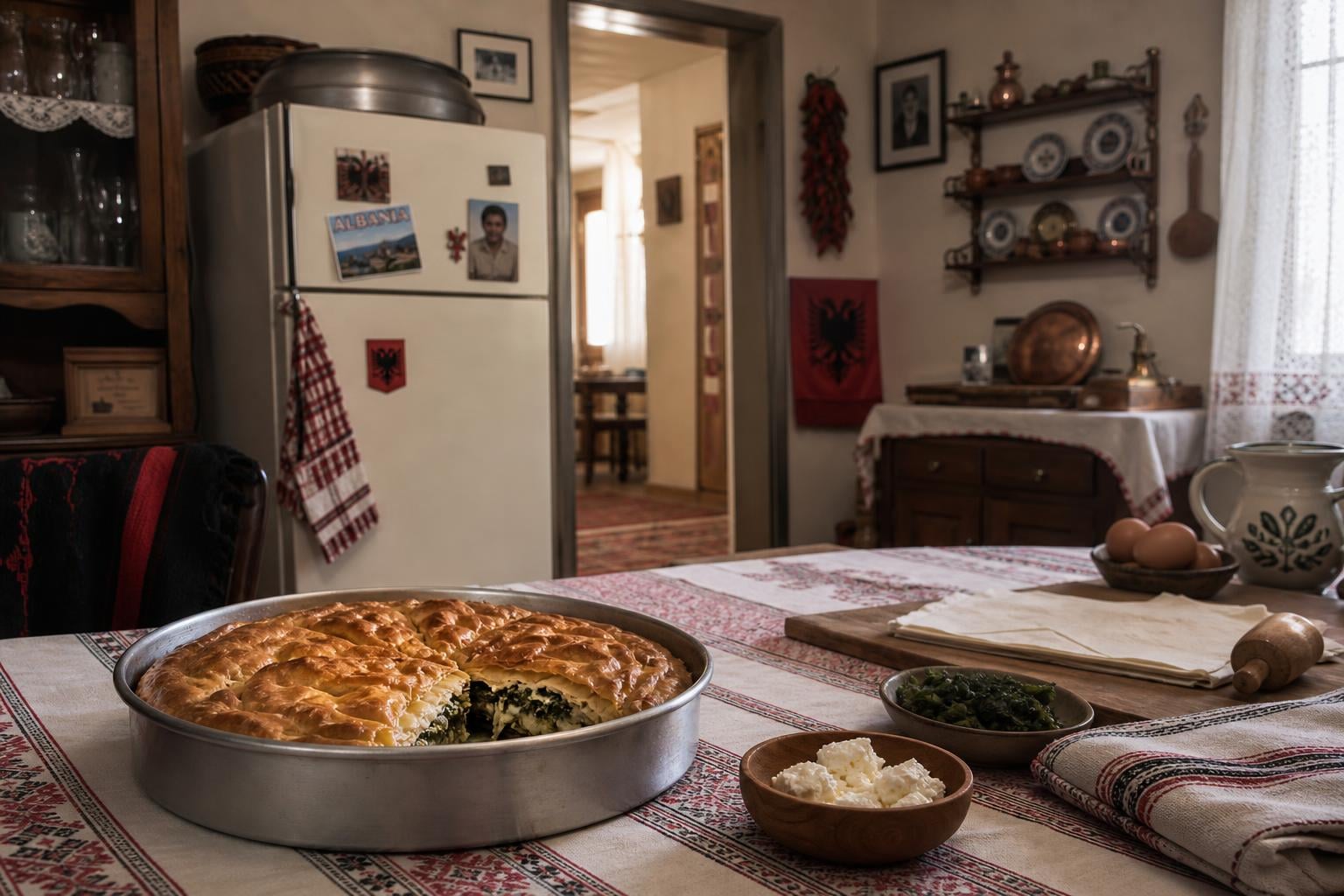
There’s a round metal pan that lives on top of the refrigerator in most Albanian-American kitchens, and it comes down for pite (the Albanian word for layered phyllo pie). What goes inside changes with the calendar — cheese on a Tuesday, spinach when the bunch in the crisper is about to turn, pumpkin in October, lamb on Easter and Bajram. The pie is the constant; the filling is the calendar.
The Albanian pite family is wide, regional, and lightly contested. The name itself shifts across the map — pite in much of southern Albania and the Çam communities, byrek in the north and in Kosovo, lakror in the Korçë region, fli (the layered batter pie) up in the Gheg mountains. The arguments about which name belongs to which pie are real, and they travel with the diaspora. A Tosk grandmother in the Bronx and a Gheg grandmother in Sterling Heights can both say they are making the same dish and use different words for it.
This piece is the umbrella overview — what pite covers, how the dialect split works, what the major varieties are, what makes the Korçë lakror its own thing, where sweet pite fit, and how US diaspora cooks adapt the whole family for American kitchens. Specific recipes for pite me djathë, pite me mish, the broader byrek entry, and the wider Albanian pastries tradition live in their own articles.
What Pite Actually Means
Pite is the Albanian word for a layered phyllo pie. The dough is rolled or stretched into thin sheets called petë (Albanian filo), stacked in a round pan with a savory or sweet filling between layers, brushed with olive oil, and baked until the top puffs and turns deep gold. The result is sliced into wedges and served warm or at room temperature.
The first source of confusion for new cooks is the name. Across Albanian, two words name this family of pies: pite and byrek. In southern Albania (the Tosk dialect area) and among Çam Albanians from northwestern Greece, pite is the default. In northern Albania (Gheg) and across Kosovo and much of North Macedonia, byrek is more common — though pite shows up there too. The Wikipedia: Pite and Wikipedia: Byrek entries both reflect this overlap.
A few older southern cooks make a finer distinction: pite for the country-style pie built with fewer, thicker dough rounds, and byrek for the modern thin-layered version. Most US diaspora kitchens have collapsed that distinction. If someone says they are bringing pite me djathë and someone else brings byrek me djathë, the two pies look identical on the table.
In Korçë, the southeastern Albanian city near the Greek border, the regional pie has its own name — lakror — and its own preparation, covered later in this piece. Kosovo’s flia (also spelled fli) is technically a different dish, built from alternating batter layers rather than stacked phyllo, but it lives in the same culinary neighborhood and shows up at the same celebrations. See the Wikipedia: Albanian cuisine overview for the regional map.
The point for a reader new to all this: when an Albanian-American family says pite, they almost certainly mean a layered phyllo pie. The filling, the region of origin, and the family tradition determine which specific pie shows up.
The Phyllo at the Center
Every pite starts from the same component: very thin sheets of dough. The Albanian word is petë (singular petë, plural also petë — the form does not change). Traditionally these were rolled by hand on a wooden board, sometimes the round table called an okllai, with a long thin rolling pin worked outward from the center. A skilled cook produces sheets thin enough to read newsprint through — the test that grandmothers across the diaspora still mention.
Handmade petë takes time. The dough is simple — flour, water, a pinch of salt, sometimes a splash of oil or vinegar — but rolling 8 to 12 paper-thin sheets requires technique that lives mostly in the hands. Most diaspora cooks have made the practical trade: frozen Athens or Apollo phyllo from the supermarket. The Greek-style phyllo sold in 1-pound boxes at any well-stocked US grocery store works for the entire pite family.
The compromise is real. Hand-rolled petë has a slightly elastic chew and a less uniform thickness; supermarket phyllo is faster, lighter, and more brittle. For a Sunday lunch where the cook has 90 minutes, frozen phyllo and a careful brush of olive oil produces a pie that no one at the table will complain about. For Easter or a wedding where the family standard is higher, someone will roll petë by hand.
A few practical notes for the diaspora kitchen. Thaw frozen phyllo overnight in the refrigerator, never on the counter — fast thawing makes the sheets stick and tear. While building the pie, keep the unused stack covered with a slightly damp kitchen towel, because phyllo dries in minutes and turns to dust. Brush every sheet with olive oil — a light pass with a pastry brush, not a flood. The layers should look barely translucent where the oil hit, not pooled. Pooled oil makes the bottom greasy; skipped oil makes the layers fuse into a slab.
Savory Pite: The Core Varieties
The Albanian pite family is named by filling. The grammar is consistent: pite me [filling] means “pie with [filling].” Five savory varieties cover most of what diaspora cooks make.
Pite me djathë — cheese pie. The most common everyday version. The filling is djathë i bardhë (Albanian white brined cheese), sometimes mixed with gjizë (fresh whey cheese), beaten eggs, and a splash of yogurt. In the US, a 60/40 mix of feta and ricotta is the standard substitute. This pie is the breakfast pie, the lunchbox pie, the cheese pie that arrives at every gathering. Full build at pite me djathë.
Pite me mish — meat pie. The Sunday-and-holiday pie. The filling is usually ground lamb or a mix of lamb and beef, sautéed with onion, sometimes tomato, and seasoned with black pepper, paprika, and parsley. Northern (Gheg) families lean toward beef; southern (Tosk) families lean toward lamb. The meat pie carries Easter, Bajram, and any table where the occasion is big. Full build at pite me mish.
Pite me spinaq — spinach pie. The greens pie, traditionally made from fresh spinach or wild greens, sometimes mixed with leek or scallion, often crumbled with feta. Diaspora cooks use frozen chopped spinach from the supermarket — thawed and squeezed dry, because spinach holds more water than people expect and a wet filling soaks the bottom layers. This pie is on weeknight tables more than the meat pie and travels well to picnics.
Pite me kungull — squash or pumpkin pie. Autumn and Lenten food. The filling is grated winter squash (butternut works) or pumpkin, mixed with rice, sometimes scallion, sometimes a little sugar. The southern version is typically savory or barely sweet; some northern variants lean sweeter. In Catholic and Orthodox households this is a Lent staple because it carries no meat or dairy in the strictest version.
Pite me presh — leek pie. Leeks sautéed soft with olive oil, sometimes with rice or cornmeal mixed in, sometimes with cheese. Strong wintertime pie, common in the south and in Korçë. The leek pie has a sharper, savory bottom note than the spinach pie and pairs especially well with cold yogurt on the side.
A few less common but traditional pite worth naming. Pite me krunde uses leftover dough scraps and crumbs as part of the filling — a frugal-kitchen pie, named for the crumbs themselves, that turns up in older recipe collections. Pite me hithra (nettles) belongs to the spring wild-greens tradition. Pite me patate (potato) shows up in Kosovo and parts of northern Albania, often with onion and sometimes ground meat.
Lakror: The Korçë Phyllo Pie
Korçë is the city in southeastern Albania that gives the Albanian pite family one of its most distinct regional forms — lakror. The name is local, the structure is recognizably a layered phyllo pie, and the preparation is the difference.
Traditionally, lakror is baked under a saç — a heavy metal dome placed over the pie, covered in hot embers, sometimes with more embers below. The setup produces a slow, even heat from above and below that gives lakror a particular character: a thin, almost lace-like top crust and a tender interior. The Wikipedia: Lakror entry is the canonical short reference.
The fillings are recognizably part of the wider pite family, with Korçë preferences. Leek lakror, tomato-and-onion lakror, spinach-and-greens lakror, and sometimes meat-and-rice lakror are common. A characteristic Korçë touch is finishing the top crust with a thinner spread of filling visible through it — lakror is often less stacked-and-sealed than a Tirana or Shkodër byrek.
Most US diaspora kitchens do not have a saç. The substitutes range from a heavy cast-iron Dutch oven with a lid (closest to the smothered, even heat) to a covered oven roaster, to a simple uncovered bake in a 400°F oven that gets the result close enough. Families from Korçë often have specific opinions about which substitute works best, and these opinions do not converge.
For Albanian Americans whose grandparents came from the Korçë region — a meaningful population in the Boston metro, Worcester, and parts of New York — lakror carries identity. The name itself is a marker. If a cook says lakror rather than byrek or pite, the listener can usually place the family within 30 miles of a single Albanian city.
Sweet Pite
The savory pite family gets most of the attention, but sweet pite are real and worth naming. The sweet category is smaller, and the line between sweet pite and the broader Albanian sweet-pastry tradition (covered in Albanian pastries and baklava) is sometimes blurry.
Pite me kremë — custard pie. A baked layered phyllo pie with a sweet custard filling — eggs, milk, sugar, sometimes vanilla, sometimes a little semolina to set the custard. The result sits between a pite and a Greek galaktoboureko; the name varies by family. Often soaked lightly with a sugar syrup after baking.
Pite me mollë — apple pie. Thinly sliced apples, sugar, cinnamon, sometimes ground walnuts, layered between phyllo. This is closer to a strudel in feel than to an American apple pie. Common in the autumn, often served with coffee rather than as a dinner dessert.
Sweet ravani and trileçe are not strictly pite — they are sponge or syrup-soaked cake forms — but families sometimes group them under the wider pite-and-pastry banner because they share the table and the post-dinner moment.
The category of sweet pite is also where the line with baklava gets contested. Baklava is its own thing — a separate Ottoman-derived tradition with its own structural rules: thin phyllo, ground walnuts (sometimes almonds or pistachios), butter rather than olive oil, and a sugar or honey syrup poured over the baked pastry. Albanian baklava is real and distinct from baklava elsewhere; the baklava in Albania article covers it. Sweet pite are not baklava — they are a sweet member of the layered-pie family, usually less syrup-drenched and less nut-forward.
Pite in the Albanian-American Kitchen
The US diaspora kitchen runs on substitutions. Almost no household in New York, Michigan, or Massachusetts is rolling petë by hand on a Tuesday night. The substitutions are well-tested and the result is recognizably Albanian. Here is the practical map.
Phyllo: Frozen Athens or Apollo phyllo, 1-pound box, thawed overnight in the fridge. This is the standard. Trader Joe’s sometimes carries a thinner version that works well. Whole Foods carries an organic phyllo that some cooks prefer.
Cheese: Feta, ideally a block in brine (Bulgarian sirene if available, Greek feta otherwise). For pite me djathë, a 60/40 mix of feta and whole-milk ricotta produces a texture close to djathë i bardhë loosened with gjizë. Avoid the pre-crumbled feta in plastic tubs — it carries anti-caking agents that make the filling chalky.
Yogurt: Fage Total 5% (the thick Greek-style yogurt in the white tub) is the closest to thick Albanian kos. Stonyfield whole-milk plain works as a budget alternative. Skip the low-fat versions — the cooked pie needs the fat for texture.
Flour: When making petë by hand, US all-purpose flour (King Arthur, Gold Medal) is what most diaspora cooks use. The protein content is lower than the harder-wheat Albanian flours, which produces a slightly less elastic dough; a tablespoon of vital wheat gluten per cup of flour closes the gap for cooks who care.
The pan: The traditional tepsi is a round, shallow metal pan, usually 14 to 18 inches across. Most US Albanian households have one. Substitutes: a heavy 14- or 16-inch round cake pan, a deep pizza pan, or a half-sheet pan if the cook is willing to cut squares rather than wedges. Cast iron works but holds heat too hard for the thinner pite — it browns the bottom faster than the top.
The meat: US ground lamb from a halal butcher (where available) or from the Whole Foods meat counter is the closest to Albanian lamb. Standard supermarket 80/20 ground beef works for mixed pies. A 50/50 lamb-and-beef blend is the diaspora compromise that most families have arrived at.
The result is a pite that an Albanian grandmother would recognize. Not identical to one made in Tirana or Pristina — the flour, the cheese, the oven heat are all slightly different — but unmistakably Albanian.
Where Pite Shows Up
Pite is not a sometimes-food. It travels through the Albanian-American calendar with a regularity that maps onto how families gather.
Weddings. Pite is on every Albanian wedding table. The meat pite carries the formal weight; the cheese pite carries the volume. At larger weddings the kitchen often produces three or four full tepsi pans of different fillings.
Funerals. The pite at a funeral is usually a cheese pite or a spinach pite — quieter, less celebratory. Albanian Orthodox tradition includes specific funeral foods (koliva), but pite shows up at the gathering after the service across all four major Albanian religious communities (Sunni Muslim, Orthodox Christian, Catholic, Bektashi).
Bajram — both Bajrami i Vogël (Eid al-Fitr) and Bajrami i Madh (Eid al-Adha). Pite me mish is common at both, alongside roasted lamb and the wider holiday spread.
Easter — Pashkët. Both Orthodox and Catholic Albanian families bring pite to Easter tables, often the meat pite, alongside red eggs (vezët e kuqe) and lamb.
Christmas — Krishtlindja. Where it is celebrated, pite is part of the meal.
Name days — Albanian Orthodox households often mark emërditë (the saint’s day matching a family member’s name) with a small gathering that includes pite.
Dita e Verës — Spring Day, March 14. A secular Albanian holiday tied to the older spring traditions, especially celebrated in central Albania. Pite is a standard.
Tuesday dinner. The pite on a Tuesday is usually cheese or spinach, made in 90 minutes after work, eaten warm with yogurt and a chopped tomato-cucumber salad. This is the version of pite that the Albanian-American kitchen runs on. Not the showpiece. The default.
How Pite Differs Across the Diaspora
The Albanian-speaking world is bigger than Albania, and the pite tradition shifts as the map widens.
Kosovo. The default name is byrek. The meat version is more dominant in everyday Kosovar kitchens than in southern Albania, and the cheese version often includes kos (yogurt) mixed directly into the filling. The Kosovar phyllo pie traditions also include flia (alternating crepe-like batter layers brushed with cream — distinct from layered phyllo byrek, though sometimes grouped under the same umbrella).
North Macedonia. Albanian communities in Tetovo, Skopje, Gostivar, and the Polog valley share the pite tradition with Kosovo and northern Albania. The naming and filling logic is close to Kosovar usage. Local Macedonian banitsa and Albanian byrek are related dishes with different ancestry; an Albanian household and a Macedonian household in the same town can produce pies that look similar and are named and made differently.
Montenegro and Çam communities. Albanian-speaking communities in Ulcinj (Montenegro) and the Çam diaspora (from northwestern Greece, now mostly in southern Albania and abroad) carry their own variations. The Çam tradition tends to lean toward pite as the name and toward greens, leeks, and cheese as the typical fillings.
Arbëresh in Italy. The Arbëresh communities — Albanian populations who settled in southern Italy and Sicily starting in the 15th century — preserve older Albanian food forms. The Arbëresh pie tradition is recognizably part of the pite family but has absorbed Italian techniques and ingredients over five centuries. Names diverge; some pies are documented under local Arbëresh dialect terms rather than standard Albanian pite or byrek.
US diaspora. The American Albanian community — roughly 230,000 self-identifying Albanian Americans on the 2024 American Community Survey (table B04006), with a wider community estimate around one million when ethnic Albanians and second- and third-generation Americans without explicit “Albanian” ancestry boxes checked are included — has converged toward a hybrid pite tradition. Tosk, Gheg, Kosovar, and Arbëresh traditions live next door to each other in places like the Bronx, Sterling Heights, Worcester, and Waterbury. The pie that comes out of an Albanian-American kitchen is often a mix: a Tosk filling in a pan size that came from a Gheg grandmother’s habit, baked with phyllo from a Greek-American grocery store, served with Fage yogurt.
That convergence is real, and it is one of the things the diaspora produces. A wider note on the food map lives in the Albanian dishes overview, and the wider table tradition — including Albanian coffee and the sweets that often follow pite — is covered in the related articles.
A Quiet Note Before the FAQ
If your family’s pite recipe lives only in one set of hands — in a grandmother’s measurements that nobody has written down, in a father’s pinch of paprika that came from somewhere in Korçë — the National Albanian Registry is building the record that says those hands existed, where they came from, and what they fed. The registration is short, the count is community-led, and the recipes are part of what the count is for.
Frequently Asked Questions about Albanian Pite
What is the difference between pite and byrek?
In most Albanian-American kitchens, the two words name the same family of layered phyllo pies and are used interchangeably. The split is regional and dialect-based. Southern Albanian (Tosk) and Çam households tend to say pite. Northern (Gheg) and Kosovar households tend to say byrek. Some older southern cooks reserve pite for the country-style pie with thicker, fewer dough rounds, and byrek for the thin-layered modern version. On a Sunday table in the Bronx or Sterling Heights, the two names refer to the same shape.
What are the main varieties of Albanian pite?
The core savory forms are pite me djathë (cheese), pite me mish (meat, usually ground lamb or beef), pite me spinaq (spinach), pite me kungull (squash or pumpkin), and pite me presh (leek). The Korçë regional form is lakror, often baked under a saç (metal dome with embers). Sweet pite are a smaller category and include pite me kremë (custard), pite me mollë (apple), and the walnut-and-syrup forms that border on baklava territory. Each filling has regional and family variations.
Is Albanian pite the same as Greek spanakopita or Turkish börek?
They share an Ottoman-era phyllo-pie ancestor and a basic shape, but each tradition diverges. Albanian pite typically uses olive oil between the sheets rather than the butter-and-yogurt batter of Bulgarian banitsa, layers more thinly than Turkish börek, and uses less binder in the filling than Greek spanakopita. Albanian pite is also built bigger — for the round tepsi pan and the communal table — rather than rolled into individual portions or coiled rosettes.
Can I use store-bought phyllo for Albanian pite?
Yes, and most US diaspora cooks do. Frozen Athens or Apollo phyllo from the supermarket is the standard. Handmade petë (Albanian rolled dough sheets) is better when there is time, but the gap between supermarket phyllo and a good final pie is mostly technique. Thaw the phyllo fully overnight in the refrigerator, keep the stack covered with a damp towel while working, brush every sheet lightly with olive oil rather than flooding, and the result holds up next to a handmade pie.
What is lakror and how is it different from regular pite?
Lakror is the regional phyllo pie of Korçë, the southeastern Albanian city near the Greek border. It uses the same layered phyllo structure as other pite but is traditionally baked under a saç — a heavy metal dome placed over the pie and covered in embers — which gives a slow, even heat from above and below. Lakror fillings lean toward greens, leeks, tomato, and sometimes meat or rice, often with a thinner top crust than a Tirana or Shkodër byrek. Korçë families consider it distinct enough to keep its own name.
When is pite served in Albanian and Albanian-American households?
Pite is on the table for almost every occasion that matters. Weddings, funerals, baptisms, Bajram (Fitr and Kurban), Easter, Christmas, name days, and Dita e Verës (Spring Day) all carry pite. It is also a regular weeknight dinner — cheese pite reheated with yogurt is one of the most-eaten meals in the diaspora. The pie scales easily, travels well, and feeds a crowd from one round pan. The filling changes with the calendar and the family; the pite itself is the constant.
How do Albanian-American cooks adapt pite for US kitchens?
Common substitutions: Athens or Apollo phyllo for handmade petë; a 60/40 mix of feta and ricotta for djathë i bardhë loosened with gjizë; Fage Total 5% or other thick strained yogurt for Albanian-style kos; King Arthur all-purpose flour for the higher-protein Albanian flours used in handmade dough; a heavy 14- or 16-inch round cake pan or deep pizza pan for the traditional tepsi. Olive oil stays olive oil. The result is a pite that an Albanian grandmother would recognize as the family pie.