
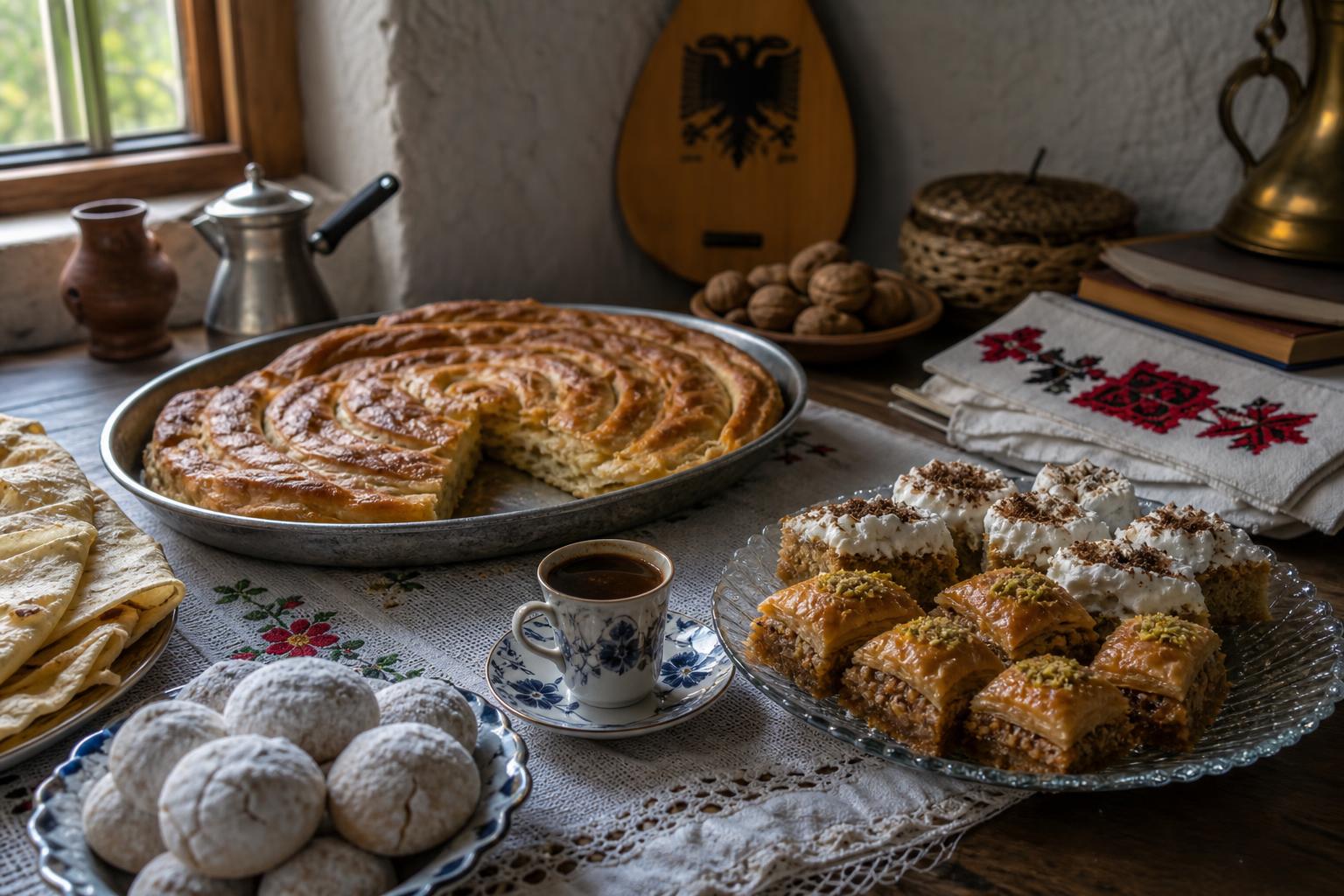
Walk into an Albanian-American home on Bajram, Christmas, or a wedding Sunday and the food layout is the same in Worcester, Sterling Heights, Yonkers, or Fort Worth. A wide round tray of byrek (the Albanian filo pie) sits in the center of the table, cut into squares. Beside it: a smaller pan of bakllava (Albanian-style baklava), cut into diamonds, drenched in syrup, dense with walnuts. Coffee cups go down between them. Reçel (Albanian fruit preserves) sits in a small dish for the coffee, and a plate of gurabija (Albanian butter cookies) waits on the sideboard. Somewhere a trilece (three-milk cake) is chilling in the refrigerator for after dinner.
This is the Albanian pastry table, and it is two tables at once — savory and sweet, holding equal weight, served together rather than in separate courses. The English word “pastry” usually triggers sweet associations, but Albanian pasta and brumëra (doughs) split roughly evenly across savory and sweet, and the savory side is the older and more everyday tradition.
This guide covers the full map. The savory filo pies — byrek, pite, lakror, laknur, and the northern crepe-stack flija. The syrup sweets — bakllava, shëndetlie. The cookies and small bites — gurabija, hallvë. The modern café star trilece. And the regional variations from Albania, Kosovo, North Macedonia, Çamëria, and the Arbëresh communities in southern Italy. The framing throughout is the Albanian-American kitchen: what to make, how to source ingredients in US grocers, and where the recipe shifts when the saç and the wood fire are not available.
The dough: filo, yufka, and what makes Albanian pastry distinct
Most Albanian pastry rests on one of two doughs. The savory pies use petë — hand-stretched sheets of unleavened flour-and-water dough rolled translucent on a long thin pin called an okllai. Petë is the Albanian word for the same thing Greek cooks call phyllo and Turkish cooks call yufka, with small regional differences in thickness and whether the sheet is pre-toasted on a dry pan before assembly. Sweet pastries split: bakllava uses the same translucent filo; gurabija uses a soft butter-and-flour shortbread dough; trilece uses a sponge cake; shëndetlie uses a denser semolina-walnut batter.
What makes the Albanian filo tradition distinct from its neighbors is not the dough itself — that technology runs unbroken from Anatolia through the Balkans and into the Arab world (Wikipedia: Burek). The distinction is in proportion and fat. Albanian byrek uses more filo layers per pan, brushes them with olive oil or melted butter (sometimes both), and stacks the layers tighter than a Greek spanakopita or a Turkish su böreği. The result is a denser, more layered, almost laminated final product — closer in texture to a thin baklava in cross-section, even when the filling is cheese or spinach.
The other distinguishing feature is the tepsi — the wide round metal pan, traditionally tinned copper, that gives the pie its shape. A standard tepsi byreku is 35 to 45 cm across, shallow, and built to slide on and off a saç (iron baking dome) or into a wood oven. In a US kitchen, a 14-inch round pizza pan or a half-sheet pan does the same job. The pie cuts into squares or wedges; portions are large because the assumption is that byrek is a meal, not a side.
A note on terms. Across the diaspora, the same pastry gets called byrek, burek, pite, or pitë depending on whether the cook’s family is from southern Albania, central Albania, Kosovo, or North Macedonia. The differences are dialect and slight regional preference on filling and dough thickness. They are all the same dish family.
Byrek and its cousins: pite, lakror, laknur
Byrek is the everyday pastry of the Albanian table. A US-Albanian household that cooks weekly probably makes byrek once a week, often on Sunday for the leftovers to carry through the workweek. Fillings split into a small number of canonical options. Byrek me djathë (cheese byrek) uses djathë i bardhë (Albanian brined white cheese, feta-style) crumbled with eggs and sometimes gjizë (fresh curd, similar to ricotta). Byrek me spinaq (spinach byrek) folds chopped spinach or chard with onion and the same cheeses. Byrek me presh (leek byrek) is the northern Albanian and Kosovar version, cooked-down leeks bound with cheese. Byrek me mish (meat byrek) uses ground beef or lamb with onion, sometimes rice. Byrek me kungull (pumpkin or zucchini byrek) is the autumn version, grated squash sweated to release moisture, often with a little sugar to nudge it toward the sweet-savory line.
Pite is the same pie under the standard Balkan-wide term, used more often in Kosovo, northern Albania, and across North Macedonia. Pite me djathë, pite me mish, pite me preshë — same fillings, same architecture, slightly different regional preferences (Kosovar pite tends to use slightly thicker filo layers; Albanian byrek in the south tends thinner).
Lakror is the Korçë regional cousin. Korçë in southeastern Albania has its own pastry tradition built around a thinner, more delicate dough cooked between two layers of saç, with coals on top and bottom. Lakror me presh and lakror me domate (with tomato and onion) are the classic versions. The texture is closer to a thin two-crust pie than to a layered Eastern byrek; the dough crisps darker because the cooking is faster and hotter.
Laknur is the broader name for vegetable-based pies in central and northern Albania, often using mixed greens, nettles, or wild herbs gathered in the spring. Burani — sometimes called burani me oriz — is the Albanian rice and spinach pie tradition, baked with yogurt and eggs, structurally closer to a Greek spanakorizo set in pastry form. Kulaç me kos sits on the bread-pastry line: a yogurt-leavened round, soft and sliceable, that serves as the bread for soft cheese and honey at breakfast.
All of these reward the same basic technique. Brush each filo layer with fat. Salt the filling more than US instincts say. Bake hot — 400 to 425°F — until the top is deep gold, not pale yellow. Rest fifteen minutes before cutting so the layers set.
Flija: the celebration pastry of the north
Flija (also spelled flia) is the most distinctive Albanian pastry and the hardest to make. It is a stack of crepe-thin batter layers, each cooked separately on a coal-fired iron saç under a domed lid, then layered atop one another with a brush of butter or yogurt-thinned cream between each pass. A finished flija is dozens of layers thick, and the cross-section reads like a striped marble cake.
The cooking method is communal and slow. A wood fire heats the saç (the iron baking surface) and the kapakë (the domed lid that traps heat from above). The cook ladles a thin strip of batter onto the hot surface, swings the heated lid over, waits a few minutes, lifts the lid, ladles another strip overlapping the first, and continues. A full flija takes three to four hours of constant attention. It is made for Bajram (Eid al-Fitr and Eid al-Adha in the Albanian Muslim tradition), for weddings, for the spring Verëza festivities — March 17, which Wikipedia’s Flia article documents as the dish’s traditional “Flia Day” (Wikipedia: Flia) — and for any large family gathering where the cooking itself is part of the celebration.
Flija is associated with the northern Albanian highlands — Malësia, Dukagjin, Tropoja — and with Kosovo, where it is widely considered a national dish. Both Albania and Kosovo claim it; the geography is the highland zone that pre-dates either modern border. Older recipes are unleavened; some modern versions add a small amount of leavening or yogurt. The accompaniments are simple — fresh yogurt, honey, or kajmak (clotted cream-like dairy spread) — because the pastry itself is the centerpiece.
US-Albanian families in the highland diaspora — significant communities in the Bronx, Westchester, and Detroit — make flija for major holidays, often gathering across multiple households because the cooking takes most of an afternoon. The home-kitchen substitute is a stovetop flija: a heavy nonstick pan, batter ladled and tilted to coat, layers stacked in a separate pan as they come off the heat and brushed with butter and yogurt. The texture is softer than a saç-cooked version (no charred-edge contrast), but the flavor carries. Restaurant flija in the US is rare; the production cost is too high for a menu item, so the dish stays in the home and at community events.
The sweet table: bakllava, shëndetlie, and trilece
Bakllava is the centerpiece of the Albanian sweet table on every major holiday — Bajram, Christmas, Easter (in Catholic and Orthodox communities), New Year’s Eve, weddings, the darka e mortit (memorial meal) that follows a funeral. The Albanian version sits in the broader Ottoman baklava family (Wikipedia: Baklava) but with two consistent local differences. First, the nut layer is denser — more chopped walnuts in the north, more almonds with walnuts in the south, packed thickly between filo sheets so a finished piece is roughly half nut by volume. Second, the syrup is lighter — sugar syrup with lemon, sometimes a little honey, poured warm over the cooled pastry so it absorbs but does not flood. The cut is diamond-shaped, the portions are small (a single diamond is rich), and the pan is wide so each piece carries the same proportion of corner crispness to interior softness.
Shëndetlie is the traditional Albanian walnut-and-honey cake — denser than bakllava, made with semolina or a semolina-flour blend, ground walnuts mixed into the batter, baked into a sheet, and soaked in honey syrup after baking. The name literally means “for health” — shëndet is the Albanian word for health, and the cake is offered at memorial meals and on Orthodox Christian feast days as a wish for the wellbeing of those present. The texture is moist, dense, almost pudding-like at the center, with a top crust crisped by the syrup. It travels well and keeps for several days; diaspora cooks often make a large pan to share across a weekend of family visits.
Trilece is the youngest member of the Albanian sweet table and the most ubiquitous in the modern cafés of Tirana, Pristina, and the diaspora. The recipe is tres leches — a sponge cake soaked in a mixture of three milks (whole, evaporated, sweetened condensed) and topped with caramelized cream — originally Latin American (Wikipedia: Tres leches cake). How the dessert reached Albania is debated, but the best-documented account runs the opposite direction from the old café story: the early-2000s popularity of Latin American telenovelas led Albanian cooks to reverse-engineer tres leches themselves, and trileçe then spread outward from Albania to Turkey, Bosnia and Herzegovina, and the rest of the Balkans (Wikipedia: Trileçe). Within a decade it became the default celebration cake — birthday parties, engagement dinners, baptisms — and is now made in Albanian-American homes from family recipes that feel decades old even though the dish itself is new to the cuisine. The caramelized top crust is the Albanian signature; Latin American tres leches is more often topped with whipped cream.
Cookies and small bites: gurabija, hallvë
Gurabija (also spelled kurabie, plural gurabije) is the Albanian butter cookie — round or crescent-shaped, made from butter, flour, sugar, and ground almonds or walnuts, baked pale and dusted with powdered sugar. The recipe is shared across the broader Ottoman pastry world (Turkish kurabiye, Greek kourabiedes, Bulgarian курабийки), each with regional variation. The Albanian version is typically less sweet than the Greek and slightly drier in texture, designed to be dipped into strong coffee. Gurabija is the celebration cookie of choice for Bajram in Albanian Muslim households — trays are made in the hundreds, packed in tins, and exchanged with neighbors and extended family in the days around the holiday. In Catholic and Orthodox households, gurabija shows up at Christmas, weddings, and baptisms in the same role.
Hallvë is the Albanian word for the broader halva family — a dense sweet made from either semolina (cooked with sugar syrup and butter into a soft, sliceable block) or tahini (compressed sesame paste with sugar and sometimes nuts or chocolate). Semolina hallvë is more often homemade and served warm, sometimes for breakfast, sometimes after a meal. Tahini hallvë is bought from a Middle Eastern or Greek grocer; the same product circulates across the eastern Mediterranean under variant names. Both versions appear on the Albanian sweet table around Lent in Orthodox communities (semolina hallvë is fast-day-friendly because it contains no dairy or eggs) and around Bajram in Muslim households.
Kabuni sits at the pastry-adjacent line — a rice-and-raisin sweet dish from southern Albania, cooked with sugar, butter, cinnamon, and sometimes lamb broth, served warm. It is closer to a rice pudding than a pastry in form, but it occupies the same dessert slot at a traditional southern meal.
The accompaniments to all of these matter as much as the pastries themselves. Reçel — Albanian fruit preserves, typically reçel mani (mulberry), reçel arre (green walnut, a Korçë specialty), or reçel fiku (fig) — sits in a small dish beside the coffee, eaten by the half-spoonful with the coffee itself rather than spread on bread. The Greek-influenced gliko tradition (spoon sweets in heavy syrup) overlaps in southern Albania and Çamëria. A cup of strong Turkish-style coffee, a small glass of cold water, and a teaspoon of reçel is a complete after-meal pause; the pastry comes later, with a second coffee.
Regional variations: Korçë, Shkodër, Kosovo, Çamëria, Arbëresh
Albanian pastry is regional before it is national. The unified “Albanian cuisine” framing is a 20th-century construction; the actual recipes track the geography of the southern Balkans more than they track modern borders.
Korçë, in southeastern Albania, is the pastry-confectionery capital. The city has a long urban tradition of professional bakeries and pastry shops dating to the late Ottoman period, when Korçë was a commercial center with deep ties to Constantinople and Salonika. Lakror is the Korçë signature savory pie. Sheqerpare (sugar-soaked semolina cookies) and kadaif (shredded-filo nut pastry) are stronger in Korçë than elsewhere in Albania. The walnut-preserve reçel arre is a Korçë regional product.
Shkodër, in the north, leans toward heartier, butter-richer savory pies and a tradition of yeasted breads and sweet rolls. Shkodran byrek is often thicker and uses more dairy in the filling. The city’s Catholic communities maintain a strong Christmas pastry tradition with kuleç (sweet braided breads) and rich bakllava served on Christmas Eve.
Kosovo shares the northern Albanian pastry tradition and adds its own emphasis on flija as a near-national dish, on pite (the Kosovar term for byrek) with leek and meat fillings, and on dense walnut-based sweets. Kosovar pastry kitchens are often more closely tied to the rural household tradition than to urban bakery culture, and home production of bakllava and gurabija for Bajram is widespread.
Çamëria, the historically Albanian region in what is now northwestern Greece (Thesprotia and Preveza), preserves an older southern Albanian pastry tradition with strong Greek influence. Bougatsa-style filo pies and Greek-style spoon sweets overlap with Albanian byrek and reçel in the Çam diaspora kitchen. Çam families displaced after 1944 carried the recipes to Albania and onward to the US and Australia, and the pastry tradition survives in those diaspora communities.
Arbëresh Italy — the descendants of 15th-century Albanian refugees who settled in Calabria, Sicily, Puglia, and elsewhere in southern Italy — maintain a parallel pastry tradition with five centuries of Italian influence. Arbëresh bukë (bread) and pastries like kanarikuj (a fried sweet dough) and grurë i pjekur (a wheat-based sweet for memorial days) are recognizably Albanian in name and structure but use ingredients and techniques absorbed from southern Italian baking. The Arbëresh communities are a separate diaspora from the Albanian-American one but share the same root tradition.
North Macedonia, especially the western regions with significant ethnic Albanian populations (Tetovo, Gostivar, Skopje), shares the Kosovar and northern Albanian pastry tradition with additional crossover with Macedonian and Turkish pastry — particularly with tulumba (fried syrup-soaked dough fingers) and the broader kashkaval cheese in pite fillings.
Making Albanian pastry in the American kitchen
The US kitchen can produce nearly every Albanian pastry on the list with one or two substitutions. The constraints are sourcing some specialty ingredients, the absence of saç and wood-fire cooking, and US flour and dairy that behave slightly differently from the Albanian versions.
Filo. Frozen phyllo from a Greek, Turkish, or Middle Eastern grocer is the standard substitute for hand-rolled petë. Thaw overnight in the refrigerator and let it come to room temperature before unrolling. The Athens brand sold in most US supermarkets works for byrek and bakllava. For a closer approximation to southern Albanian yufka, look for Turkish brands at a Mediterranean grocer; some are slightly thicker and pre-toasted. Hand-rolling is the gold standard for cooks with the time and the okllai (rolling pin); commercial filo is what most diaspora kitchens actually use on a weeknight.
Fat. Albanian byrek recipes traditionally use gjalpë (butter), olive oil, or both. A common diaspora recipe uses a 50-50 mix brushed between layers — the butter for flavor, the olive oil for crispness. Some cooks use sunflower oil for the savory pies and reserve butter for the sweet ones. Avoid extra-virgin olive oil for high-heat baking; a basic olive oil or olive-oil blend handles the temperature better.
Flour. US all-purpose flour has higher protein than the soft Albanian wheat flours. For hand-rolled petë, a mix of US AP and a small proportion of cake flour or Italian “00” produces a softer dough that stretches more like the original. For bakllava and cookies, US AP works directly. For trilece, US cake flour is the cleanest substitute for Albanian miell ëmbëlsire.
Cheese. The default cheese substitutions are feta for djathë i bardhë, ricotta (well drained) for gjizë, and a Bulgarian or Romanian kashkaval for kaçkavall. Many diaspora byrek recipes call for a 60-40 feta-to-ricotta mix, which lands close to the original cheese profile when combined with eggs.
Nuts. Walnuts are the dominant nut in Albanian sweets and are widely available in the US in good quality. Buy them whole and chop by hand for bakllava — pre-chopped supermarket walnuts are often rancid. For gurabija and shëndetlie, lightly toast the walnuts before grinding to deepen the flavor.
Sugar and syrup. Albanian syrups for bakllava and shëndetlie are lighter than Turkish (less sugar) and less honey-forward than Greek. A working ratio is 1.5 cups sugar to 1 cup water with a tablespoon of lemon juice and a tablespoon of honey, boiled five minutes and cooled before pouring over the warm baked pastry. The pour-cold-syrup-over-warm-pastry method produces a more even absorption than the reverse.
Oven. A standard US home oven covers everything except flija and authentic lakror. For byrek and bakllava, position the rack in the lower third and bake at 400°F for the first 20 minutes, then 375°F for the rest, until the top is deep golden. A pizza stone on the lower rack helps with bottom-crust crispness. For trilece, a 9x13 glass dish works well because the cake stays in the dish through the milk soak and into the refrigerator.
The full Albanian pastry repertoire fits comfortably into a US kitchen with a stand mixer, a few wide baking pans, a sharp knife for diamond-cutting bakllava, and a couple of trips to a Greek or Middle Eastern grocer. The technique transfers; the tradition does too.
Albanian-American pastry-making is one of the strongest threads of the diaspora kitchen. If you cook these dishes and want your household counted in a community-led census of Albanian Americans, add your name at the National Albanian Registry — the count is how the next generation gets recognized.