

In the summer of 1924, a newspaper in Omaha, Nebraska, printed a letter from a boy nearly six thousand miles away. It ran on the children’s page of the Omaha Bee, in the club column addressed to young readers, timed to appear just before Flag Day. The boy was writing from Tirana, Albania, and he had something to explain about flags.
His name, as the paper printed it, was Vlash V. Dushuiku. He was a pupil at a boarding school, and an American children’s club had mailed his group a gift: a copy of The Little Book of the Flag. He wanted to say thank you, and to describe his own.
A letter to Omaha
The heading the editors gave it was simple: “Flags of America and Albania Fly in School Yard.” Then Vlash’s own words, lightly touched by the newspaper’s typesetting:
“In our school there are two dormitory buildings. They are separated by a wall through which there is a gateway. One of them is to the east and the other to the west. Each has a court yard and in the yard we have a pole. On the pole in the western yard we fly the American flag; on the eastern one, the Albanian flag. The reason for flying the American flag on the western pole is because America lies towards the west. In the morning we go out and stand at salute while the flags are being raised. In the evening when we come from school we stand again at salute while the flags are being lowered.”
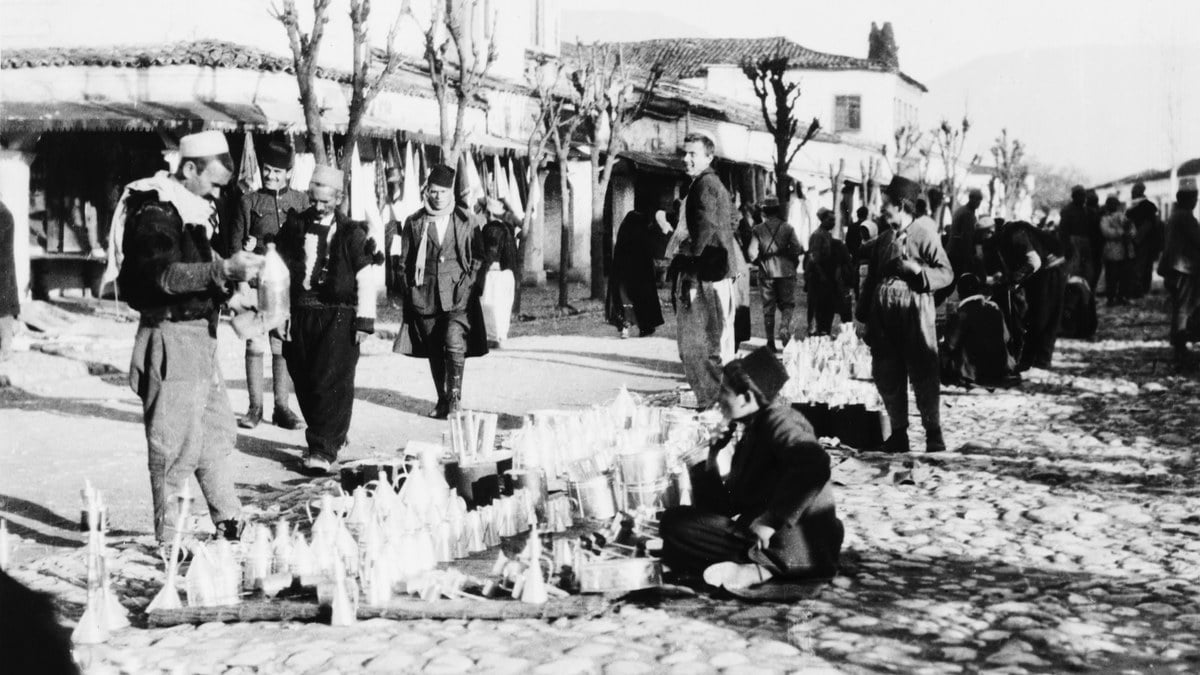
Sit with the picture for a second. A walled compound in Tirana in the early 1920s. Two courtyards, two poles. Each morning, a line of Albanian boys standing at salute while the Stars and Stripes goes up in the western yard and the red banner with the black eagle goes up in the eastern one. A child worked out the logic himself, that the American flag flew to the west because America is to the west, and wrote it down for readers in Nebraska.
The school with two flags
Vlash never named his school, but the historical record makes it almost certain which one it was.
In 1921, the American Red Cross Youth Corps founded the Albanian Vocational School in Tirana, the first such school in the country. From 1921 to 1933 it was funded chiefly by the American Junior Red Cross, the youth arm of the American Red Cross, with small grants from the Albanian government and money the school earned from its own workshops. It ran a commercial printing press, an electric power station, a farm, and an ice plant, and its students helped construct the American Legation in Tirana. In 1922 a Chicago-born educator named Harry Fultz took over as director, and the school still carries his name today, the Harry Fultz Institute.
That is the school behind the letter. The gift book Vlash was thanking Omaha for was part of exactly what the American Junior Red Cross did: it paired American schoolchildren with children abroad, sending books and letters across the ocean. An American club in Nebraska mailed The Little Book of the Flag to an American-funded school in Tirana, and a boy there wrote back to explain his country to them. The two flags in his courtyard were not a metaphor. They were the daily fact of an American school on Albanian ground.
What Vlash knew about his flag
The best part of the letter is the boy teaching the Americans about the Albanian flag. His history is a child’s history, part accurate and part the folklore of his time, and it is more moving for that.
“The color of our flag is red and black. Red represents bravery and black is mourning for Skanderbeg’s death… Our state was under the Turkish yoke for about 500 years, so we could not raise our flag. A patriotic Albanian, Ismail Qemal, raised the flag for the first time in one of our cities, Valona. He marched about the city surrounded by many people shouting in our language, ‘Long live the Albanian flag!’ We celebrate that way every year.”
He is describing the independence of November 28, 1912, when Ismail Qemali raised the flag at Vlorë (Valona). He gets the spirit exactly right even where the details blur. He also passed along the belief, common in his day, that Albania inherited the double-headed eagle “from ancient Rome,” which is one of several stories Albanians have told about the symbol over the centuries. We now trace the eagle’s path very differently, through Byzantium and the medieval Kastrioti house, as covered in our piece on why Albania carries the double-headed eagle and the full story of the Albanian flag. What matters here is not that a ten-something-year-old had the archaeology perfect. It is that he knew his flag was his, and wanted a roomful of American children to understand why.
He signed off the way you would hope: “I hope the American and Albanian flags will always be the symbols for advancement and every good thing. With love, Vlash V. Dushuiku. Tirana, Albania.”
The bond went both ways
The touching thing about the two flags is that the traffic ran in both directions.
While the American Junior Red Cross was funding a school in Tirana, Albanian immigrants in the United States were giving back to American relief. Two years before Vlash’s letter, the Albanians of Augusta, Maine, made a gift to the Red Cross for, in their own words, “the children and the old people of our country,” a story we told in the Albanians of Maine, 1922. Americans funded Albanian schoolchildren; Albanian Americans funded the Red Cross. The same two flags that stood in a Tirana courtyard could just as easily have stood over a church-hall collection in New England. It was one relationship, running on gratitude in both directions, and it is the same thread that runs through the century of Albania-U.S. relations.
Why this belongs in the count
A boy named Vlash wrote a letter in 1924 and, by pure luck, an Omaha editor printed it, and a scan of that page survived a hundred years in a national archive. That is the only reason we can hear his voice at all. There were thousands of children like him, on both sides of the ocean, and almost none of them left a trace we can still read.
That is exactly the problem a registry exists to solve. Memory should not depend on whether a newspaper happened to print your letter. The way to be sure the next Vlash is remembered is to write the name down on purpose, while the person is here to write it.
The U.S. Census counts about 230,000 Albanian Americans. The real number is close to a million. A community that records itself is a community that cannot be quietly forgotten.
Get counted at /register: free, encrypted, community-led. We mint a recognition certificate. We do not sell anything. We never share your data.
Vlash V. Dushuiku’s letter is quoted from The Omaha Bee, June 8, 1924, page 31 (Library of Congress, Chronicling America). Details on the Albanian Vocational School and Harry Fultz are drawn from published histories of the school, now the Harry Fultz Institute, and are linked where used. The identification of Vlash’s school is an inference from the historical record; the letter itself does not name it.