

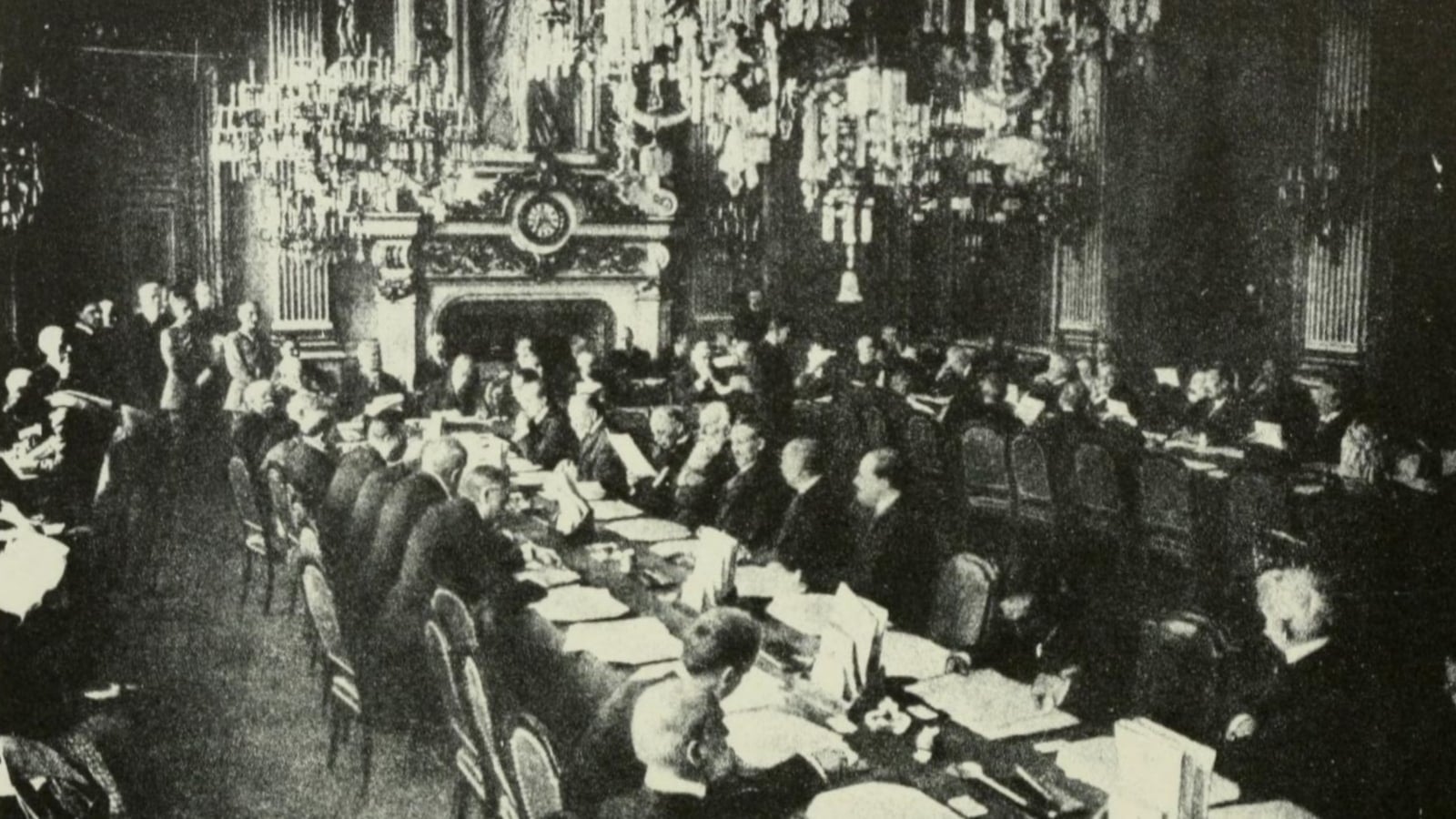
On March 2, 1919, in Chicago, a message went out over the transatlantic cable to Paris. It was addressed to Georges Clemenceau, the prime minister of France and host of the peace conference then redrawing the map of Europe, and to Robert Lansing, the American Secretary of State. It was short, and it was signed on behalf of 72 Albanian organizations in America.
The next morning, readers of the Birmingham Age-Herald in Alabama found it printed on the front page, under the headline “Albanians Cable Appeal to Paris for Independence.” The wording, preserved in that column, was plain:
“Americans of Albanian descent and Albanian residents of Illinois, natives of Kosova, Dibra, Përmet and Chameria, respectfully appeal to your excellency for independence and territorial integrity of Albania, including the provinces of Kosova and Chameria, in accordance with the noble principles enunciated by President Wilson and the allied powers.”
Read it again and notice what it is. This is not a letter home. It is a foreign policy demand, sent by immigrants, to the two men holding the pen over a nation’s future. In the spring of 1919 the Albanian state was barely six years old, occupied in pieces by five foreign armies, and had no seat at the table in Paris. So the people who did have a voice, the Albanians of Illinois and Massachusetts and Maine, used it.
The federation that spoke for a nation with no embassy
The cable did not come out of nowhere. Behind it stood Vatra, the Pan-Albanian Federation of America, founded in Boston in 1912, the very year Albania declared its independence at Vlorë.
Vatra was the diaspora’s answer to a hard problem: a new country with almost no diplomatic reach, and a large, literate, wage-earning Albanian community half a world away that wanted to help. Under its early leaders, the writer Faik Konitza and the priest and scholar Fan Noli, Vatra grew into something closer to a government-in-waiting than a social club. It published Dielli, the Albanian-language newspaper still in print today. It lobbied the U.S. Congress. It collected dues and donations across dozens of chapters. And when the peace conference opened, it appointed itself Albania’s advocate in America.
Historians have described Vatra in this period as functioning like a shadow Albanian government inside the United States. That is not an exaggeration. For a stretch of years, the most organized Albanian political body on earth was headquartered not in Tirana but in Boston.
What they were fighting: a secret treaty and a disappearing map
The stakes in Paris were not abstract. Albania was in real danger of being erased.
During the war, the Allies had signed the 1915 Treaty of London, a secret pact that bought Italy’s entry into the conflict by promising it, among other prizes, a protectorate over central Albania and the southern port of Vlorë. Italy, Greece, and the newly formed Kingdom of Serbs, Croats, and Slovenes all arrived in Paris with overlapping claims on Albanian land. The momentum of the conference ran toward partition: divide the country, satisfy the neighbors, and let the six-year-old state quietly vanish from the map.
That is the map the diaspora was cabling against. When the appeal insisted on “territorial integrity of Albania, including the provinces of Kosova and Chameria,” it was naming exactly the lands the Great Powers were preparing to give away.
The diaspora put up the money
An appeal is words. What made Vatra credible was that it also put up cash and a person.
In late December 1918, Vatra held a fundraising convention with a single goal: bankroll an Albanian presence at the peace talks. Albanian immigrants across the United States, factory workers and shopkeepers and dishwashers for the most part, raised a reported $150,000, a staggering sum from a community of that size. The greater part of it was wired to Vatra’s delegates in Paris.
The federation also sent its president. Fan Noli traveled as the diaspora’s representative, and in one of the more remarkable scenes of the period he got his case directly to the top: on a return trip from Mount Vernon aboard the presidential yacht Mayflower, Noli found the occasion to state Albania’s cause, informally, to President Woodrow Wilson himself. Vatra went further still, making an audacious formal request to Secretary Lansing that the United States take Albania on as an American protectorate rather than leave it to Italy.
Not every ask succeeded. But the diaspora had done what stateless peoples almost never manage in time: it had organized, funded, and personally lobbied the strongest man at the conference.
Wilson listened, and the map held
The American president heard the argument, from Noli and from the wider record Vatra had built, and he acted on it.
On May 6, 1919, in a meeting of the Council of Four, Wilson rejected the proposal to partition Albania and insisted the country remain independent within recognizable borders. The pressure did not end there. The powers kept drafting compromises through 1919 and into 1920 that would have carved Albania up. Then, in a note published on March 4, 1920, Wilson drew a hard line: he would not approve any plan handing northern Albanian territory to Yugoslavia. That refusal broke the partition scheme.
The result is the reason there is an Albania to be from. On December 17, 1920, Albania was admitted to the League of Nations by unanimous vote, its sovereignty confirmed before the world. The diaspora’s 1919 cable, its $150,000, and its delegate on the Mayflower were part of the chain of events that got there.
None of this makes Wilson an Albanian hero by himself, and Albanian resistance inside the country mattered enormously too. The point is narrower and, for a registry, more useful: American Albanians were not spectators to their homeland’s survival. They were participants in it.
Why this belongs in the count
There is a version of Albanian-American history that starts and ends with restaurants, churches, and remittances, the quiet story of people keeping their heads down and building a life. That story is real. It is also incomplete.
The 1919 cable is the other half. It shows a first-generation immigrant community, only a few decades into its life in America, acting as a coordinated political force on a world stage, in the name of a country most of them had left and some would never see again. Seventy-two organizations. One hundred and fifty thousand dollars. One priest on a president’s yacht. That is not a footnote. That is a diaspora doing what a diaspora is for.
It sits alongside the same community’s smaller, warmer acts of the same years: the Albanian-American parade at Grosvenordale in 1921, the Albanians of Maine giving to the Red Cross in 1922, the long arc of Albania-U.S. relations from Wilson to NATO. Different scales, one instinct: be counted, and be heard.
Get counted
More than a century after Vatra cabled Paris, the American Albanian community is still larger and more connected than the official record shows. The U.S. Census counts about 230,000 Albanian Americans. The real number is close to a million.
The people who cabled Paris in 1919 understood something simple: a community that is organized and on the record can change what happens to it. That has not stopped being true.
Get counted at /register: free, encrypted, community-led. We mint a recognition certificate. We do not sell anything. We never share your data.
The March 1919 appeal is quoted from The Birmingham Age-Herald, March 3, 1919, page 1 (Library of Congress, Chronicling America). Other facts are drawn from published histories of Vatra, the Paris Peace Conference, and Albania’s admission to the League of Nations, and are linked or cited where used.