

The shape of an Albanian drinking day
Walk into a kafe in Tirana at 9 a.m. and the tables are full. Walk in at 11 a.m. and they are still full, with mostly the same people. Walk in at 4 p.m. and a new shift has rotated in. The coffee shop is the central nervous system of the Albanian day, and the drinks that mark the rest of it — water, dhallë (salted yogurt drink), wine or beer with dinner, raki (fruit brandy) before the food arrives, çaj mali (mountain tea) after — all radiate from that anchor.
This guide covers the full Albanian beverage landscape. Raki gets the international headlines, and rightly so, but it is one part of a longer story that includes some of the oldest soft drinks in Europe, two beers that survived the Communist transition, indigenous wine grapes most Americans have never tasted, and an herbal tea sold under three national names in the same Balkan mountain range.
What follows is what Albanians drink, when, and why — with separate sections for coffee, raki, wine, beer, yogurt drinks, the older fermented and herbal drinks, and how diaspora households recreate any of it in the US. This is cultural reference for adult readers. The National Albanian Registry is a 501(c)(3) nonprofit producing a community-led count of Albanian Americans, not a beverage company. Where production traditions involve alcohol, we describe the drink in its Albanian context, nothing more.
The coffee comes first
The Albanian word kafe covers both the drink and the place. “Going to the kafe” can mean drinking coffee or it can mean spending three hours in a small room with friends, a smaller cup, and an ashtray that used to be allowed indoors. Both meanings are correct.
Two coffee styles dominate. Kafe turke — Turkish-style coffee — is the older one. Finely ground beans are boiled with water (and sugar, if requested) in a long-handled copper pot called a xhezve, then poured unfiltered into a small cup. The grounds settle. You sip from the top and stop when you hit the silt. Sweetness is specified up front — pa sheqer (no sugar), e mesme (medium), e ëmbël (sweet) — because adjusting it after brewing changes the recipe.
The second is makiato — the Albanian macchiato. This is the espresso-based drink that took over Albanian cafés after the 1990s, and it has very little to do with the watered-down Starbucks “macchiato” Americans know. An Albanian makiato is a single espresso shot topped with a small amount of steamed milk — closer to a Spanish cortado or an Italian macchiato as Italians actually make it. Total volume is small, around 60 to 80 milliliters. It is the default order in most cafés between mid-morning and late afternoon.
Coffee is consumed in volumes that surprise visitors. Three to five cups a day is common, spread across stops at different kafes. The kafe is where business deals are negotiated, marriages discussed, soccer arguments settled, and grief sat with. The drink is the smaller half of the transaction; the company is the larger half.
In the diaspora, the xhezve sits in many Albanian-American kitchens as inherited equipment. A first-generation parent who could not afford a coffee machine could always afford the pot, the grounds, and the burner. Albanian groceries in Queens, Hamtramck, Worcester, and the Bronx carry the same Turkish-style grind sold in Tirana.
Raki — the social drink
Raki is the Albanian fruit brandy poured at weddings, welcomes, and wakes. It is clear, unaged, distilled from fermented fruit — most often grapes, sometimes plums or mulberries — and bottled at 40 to 50 percent alcohol by volume. Skrapar, in southern Albania, is one of the country’s best-known raki-producing regions.
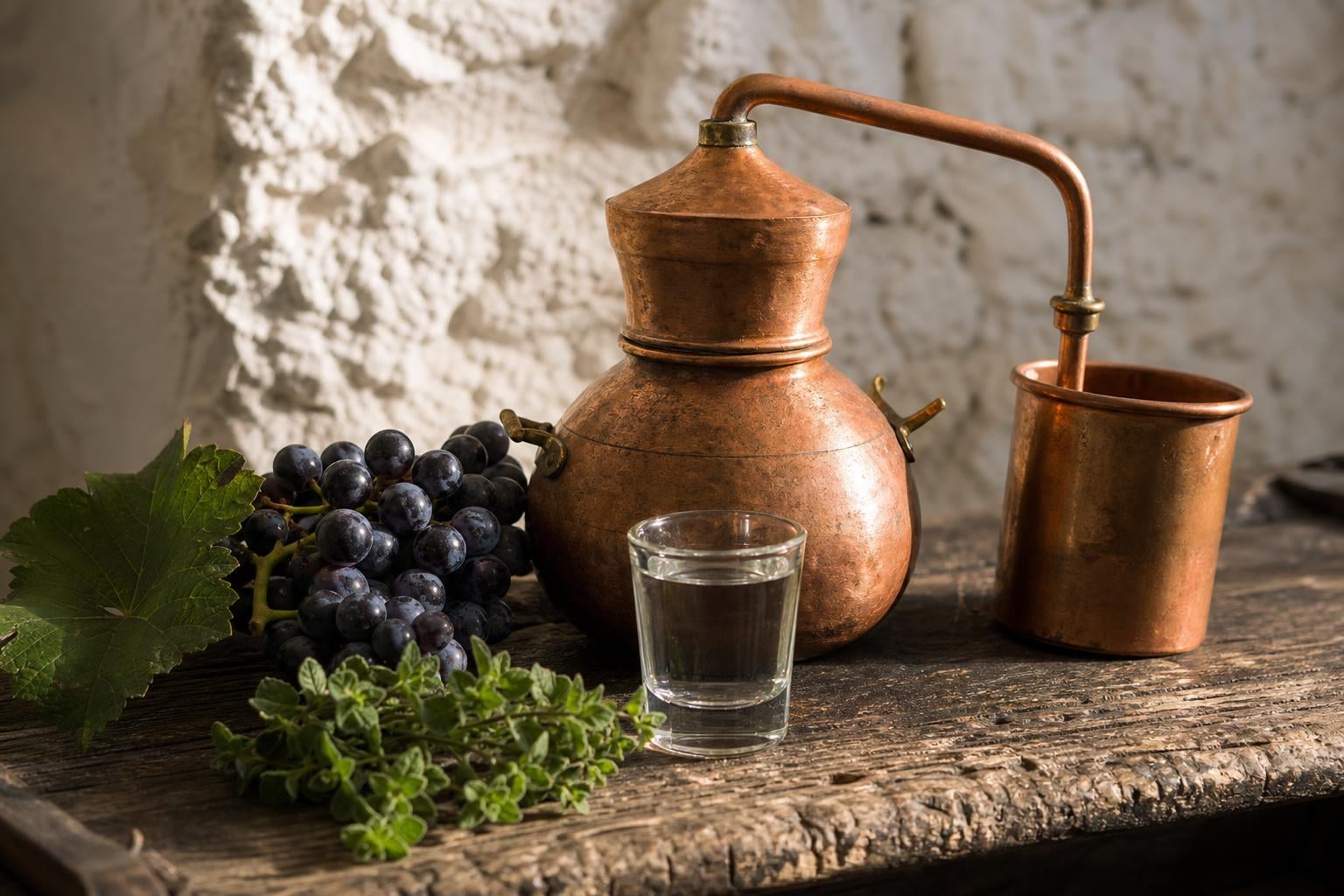
We have written two long pieces on raki already and will not repeat them here. For the full cultural guide — what raki means at the table, regional styles, where to buy it in the US — see Albanian Raki: A Cultural Guide. For the production side — fermentation, the copper kazan still, the heads-hearts-tails cuts — see What Is Raki Made Of.
Three things to know before moving on:
First, raki is sipped, not shot. The pour is small — 25 to 50 milliliters — and the pace is conversational. The toast is gëzuar (“cheers”), said with eye contact before the first sip.
Second, raki is the bottle that turns a meeting into a meal. Pour the first round before food arrives, and the rhythm of the evening shifts. The mezze comes out, the conversation slows down, the host stops checking their phone.
Third, raki is family. Almost every village has a producer, and the bottle at your aunt’s house in Yonkers was carried in a checked bag from someone’s cousin in Skrapar. The diaspora commercial bottles are good. The bottle from a relative is the story.
Wine country most Americans don’t know about
Albania has been making wine for at least three thousand years. Phoenician traders, Greek colonists, Illyrians, Romans, Ottomans — every civilization that touched the region left grapes in the ground. The country sits at the same latitude as central Italy and Greece’s wine regions, with a Mediterranean climate on the coast and a cooler continental one inland. The vineyards survived even the Communist period, when most production was consolidated into state cooperatives.
The grapes most Americans have never tasted are indigenous to the country.
Kallmet is the signature red of northern Albania, grown around Lezhë and the Zadrima plain near Shkodër. It produces a full-bodied, deeply colored red with firm tannins and cherry and dried-fig notes. Some plantings extend into Kosovo. Kallmet is the grape most associated with Albanian wine identity, and the label most likely to appear on a US specialty-store shelf.
Shesh i Zi (black Shesh) and Shesh i Bardhë (white Shesh) are the two grapes of the central Albanian coast around Tirana and Durrës. Shesh i Zi makes medium-bodied reds with a soft tannin profile. Shesh i Bardhë makes dry whites with apple and citrus character. Shesh refers to the flat coastal plain where the grape grew historically.
Vlosh is a red grape from the southern coast around Vlorë — deeper-colored, slightly higher in tannin, used both for varietal bottlings and blends.
Debinë is a white grape grown around Përmet in the south, in the same valley that produces the country’s celebrated mulberry raki. The wines are dry, mineral, often unoaked.
The most active modern wine regions are Berat (south-central, limestone soils), Korçë (southeast, cooler-climate whites and reds), Shkodër (north, for Kallmet), and Përmet (south, for Debinë). International grapes — Merlot, Cabernet Sauvignon, Chardonnay — are also planted, especially by producers aiming at export.
Albanian wine is hard to find in the US. A handful of importers stock Kallmet and Shesh bottles in metro New York, northern New Jersey, and Boston specialty shops. Bottles typically run $15 to $35. Special-ordering through a Mediterranean wine store is sometimes the only path.
The two beers everyone knows
Albanian beer is dominated by two pale lagers.
Birra Korça, brewed in the southeastern city of Korçë, is the older. The brewery dates to 1928 and is widely treated as the country’s flagship beer brand. The standard bottling is a pale lager around 4.5 percent ABV — clean, slightly bready, easy to drink with food. The line now includes a pilsner and a dark lager, but standard Korça is the one on most tables. Bottles and cans appear in some Albanian groceries in Detroit and the Bronx.
Birra Tirana is the capital’s lager. The Tirana brewery has been producing beer in some form since the mid-twentieth century. The standard Tirana is a pale lager in the 4 to 5 percent ABV range, slightly lighter on the malt than Korça. It is more visible inside Albania — on tap in most Tirana bars — but less exported.
Beyond the two domestics, the most common beers on Albanian tables are international brands brewed under license — Heineken, Stella Artois, Tuborg, and Peja (from Kosovo, a clean macro lager with a strong following on both sides of the border). Craft beer is small but growing in Tirana.
Albanian beer is a meal beverage. The pour is usually with food — grilled meat, byrek, fries — rather than a separate drinking occasion. A long evening that involves a lot of alcohol will more often be built around raki and wine. The diaspora pattern in the US tracks the same way: Albanian-American restaurants in NYC and Detroit carry Korça or Tirana when they can get them, but the bottle on the table is often a license version of an international brand rather than the Albanian-brewed beer.
Yogurt-based drinks: dhallë and the kos question
The drink most Albanians put on the table next to lunch is not soda. It is dhallë (sometimes spelled dhalle) — yogurt thinned with cold water and a pinch of salt, served in a tall glass.
Dhallë is the same drink as Turkish ayran, Persian doogh, Armenian tan, and the Balkan ajran. The base is plain whole-milk yogurt — Albanian kos — stirred with cold water until it is pourable, then salted lightly. Some households add a few drops of olive oil, dried mint, or crushed garlic for the savory version. The result is cooling, slightly tangy, and works as a digestive companion to heavier dishes like tavë kosi (lamb baked with yogurt), byrek, and grilled meats. See our piece on tavë kosi for the dish that pairs most naturally with a glass of dhallë.
Albanian yogurt itself — kos — is thicker than American supermarket yogurt and tangier than Greek yogurt. The thick-yogurt culture in Albania is deep. Kos gets stirred into stews, baked under meat, spread on bread, mixed with cucumbers and garlic for tarator (cold yogurt-cucumber soup), and thinned into dhallë. The dairy farms in the highlands and the Mati valley produce a regional kos that diaspora families miss; the closest US substitute is full-fat strained Mediterranean yogurt from brands like Karoun, Sophia, or a good plain Greek yogurt thinned slightly.
Diaspora practice: most Albanian-American households make dhallë on the spot. A jar of plain whole-milk yogurt, cold water, a pinch of salt, stir, pour. Adults drink it through the meal; kids who grew up in the US often need a few years of exposure before they like it. The salt throws first-time non-Albanian drinkers — Western expectation of yogurt is sweet, and dhallë is savory.
A regional note: kulaç me kos is a baked yogurt-bread combination from northern Albania — see our piece on kulaç me kos for the dish; the dairy logic is the same family.
Boza, salep, sherbet — the older drinks
Three drinks predate coffee in the region. They survive in pockets, mostly in winter, and they are part of the cultural picture even if you have never tasted them.
Boza is a thick, slightly fermented grain drink made from boiled millet or maize, sweetened, and served cold. Natural fermentation gives it under one percent alcohol. The flavor is mildly sweet and tangy with a porridge-like texture. Boza predates the Ottoman period and survives across Turkey, Bulgaria, North Macedonia, and Romania under similar recipes. In Albania it is mostly winter, mostly urban, increasingly nostalgic. Specialty boza shops still operate in Tirana; in the US diaspora it usually arrives as Bulgarian Vefa or Turkish imports.
Salep is a hot winter drink made from the powdered tubers of wild orchids (Orchis species), mixed with hot milk and sugar, sometimes dusted with cinnamon. The flavor is warm, slightly nutty, lightly thickening on the tongue. Salep is shared across the Ottoman cultural sphere, and in Albania it is a winter street drink sold from specialty stalls. Sustainable harvesting of the wild orchid is a real concern, so most modern commercial mixes are cornstarch-based with a small amount of true orchid powder plus vanilla and cinnamon. The US diaspora version is almost always the cornstarch mix.
Sherbet is a sweetened cold drink, usually fruit-syrup-based, served at weddings, engagements, and the post-funeral tezhga gathering. The most common version is lemon syrup diluted with cold water — sweet, sharp, served in a small glass to anyone arriving at the house. Other fruit syrups (rose, cherry, pomegranate) appear regionally. Sherbet is the drink offered when the occasion is too formal for water but raki is not appropriate, or for guests who are fasting, pregnant, very young, or otherwise not drinking alcohol. Many older Albanian-American households still keep a bottle of homemade lemon syrup in the fridge for the same purpose.
Mountain tea and herbal traditions
After dinner, in many Albanian homes, the kettle goes back on for çaj mali — mountain tea.
Çaj mali is brewed from the dried stems and flowers of Sideritis, a genus of flowering plants that grows wild across the Mediterranean and the Balkans at higher elevations. The plant goes by many names — Albanian mountain tea, Greek mountain tea (tsai tou vounou), Bulgarian mursalski chai, North Macedonian planinski čaj — but botanically it is the same family of related species, harvested from the same mountain range that runs through all of these countries. The Albanian variety is most commonly Sideritis raeseri, picked in the alpine zones of the southern and central highlands.
The flavor is earthy, lightly floral, mildly sweet, with no caffeine. Brewed by simmering a small bundle of dried stems in water for five to ten minutes, then sweetened with honey if desired. The traditional pairing is after dinner, often with a small piece of bakllava (see our piece on Albanian bakllava) or a wedge of fresh apple.
Albanian households treat çaj mali as a daily wellness habit more than an indulgence. Older generations attribute a list of benefits to it — digestive aid, mild anti-inflammatory, immune support — overlapping with folk-medicine claims in other Balkan countries where the same plant grows. Modern lab research has shown antioxidant and antibacterial activity in Sideritis extracts, though clinical claims should stay modest. The cultural function is the larger one: brewing the tea is the household saying that dinner is over and the evening has slowed down.
Other herbal teas appear in seasonal rotation: çaj bliri (linden flower) in late spring, çaj kamomili (chamomile) for sleep, çaj rigoni (oregano) for sore throats. Sage, thyme, and yarrow appear in highland homes.
Diaspora supply is reliable. Albanian, Greek, Bulgarian, and Macedonian groceries all carry packaged çaj mali (sometimes labeled Greek mountain tea or mursalski). Bundles run $4 to $12.
Wedding drinks and the ceremonial pours
Albanian weddings are long. The drinking pattern across them is specific and worth knowing if you have one to attend or are recreating the rhythm in the diaspora.
Before the ceremony at the bride’s home, female relatives serve coffee and sherbet (lemon syrup diluted with water) to arriving guests. The sherbet is the welcome drink — sweet, alcohol-free, offered to everyone regardless of age or observance.
At the ceremony, raki is poured for the formal toasts. Both families bring bottles. The toast is gëzuar, often followed by specific phrases — për familjen (to family), për të dyja familjet (to both families), për nuset e reja (to the new bride), për ata që mungojnë (to those who are missing).
At the reception, the alcohol load broadens. Wine appears on every table, usually domestic reds and whites. Beer is mostly Korça or Tirana. Raki sits on every table in small bottles, refilled through the night. Dhallë and bottled water cover everyone who is not drinking. Sherbet and tea stay available for older guests, pregnant attendees, and anyone fasting. A well-run Albanian wedding makes sure no adult is ever holding an empty glass and no one is pressured to drink.
At engagement parties (fejesa), the same pattern runs on a smaller scale — the families’ elders share rakis as part of the formal agreement, then coffee and dessert close it out. Funerals (morti) and the 40-day commemorations use a quieter version: coffee, water, and a small glass of raki to those who paid respects.
Most Albanian-American weddings in the US still follow this structure — abbreviated, sometimes Americanized at the edges, but with the same parallel-track logic. Sherbet for the kids and abstainers, raki for the toasts, wine through dinner, coffee at the end.
What Albanian-American households actually drink
Translate this from Albania to a kitchen in Hamtramck, Yonkers, Worcester, or the Bronx, and the daily pattern lands somewhere between full continuity and partial assimilation.
First-generation households keep the rhythm closest to the original. Xhezve on the stove for morning coffee. A jar of yogurt in the fridge that gets thinned into dhallë at lunch. Wine or beer with dinner. A bottle of raki on the shelf for guests. A box of çaj mali for after dinner. The drinks are imported or improvised — Skrapari raki from the Albanian liquor store, Karoun yogurt for the dhallë, Korça beer when the importer has stock, Greek-label mountain tea when the Albanian version is out.
Second-generation households keep the holiday and visitor patterns more than the daily ones. The xhezve comes out for grandparents but the everyday coffee is from a Nespresso machine. Dhallë is once in a while rather than a lunch default. Raki stays on the shelf for guests, Easter, and Christmas.
Third-generation households often have to learn the tradition deliberately. The xhezve may be a souvenir from a Tirana trip. The raki bottle is the one a cousin brought to a wedding three years ago. The drinks are present as heritage objects more than daily habits, and the next decision is whether to bring them back into the rotation.
The drinks are easier to bring back than most parts of Albanian heritage. A xhezve costs $20. Plain yogurt and salt makes dhallë. Mountain tea steeps in five minutes. The harder part is showing up at the same table with other people who care.
Where to buy Albanian drinks in the US
A short practical guide.
Coffee and the xhezve. Albanian groceries in the Bronx, Yonkers, Hamtramck, Worcester, and northern NJ carry Turkish-grind coffee and the long-handled xhezve. Pot prices run $15 to $40.
Raki. Skrapari and other Albanian-labeled bottles appear in Albanian groceries and liquor stores in metro NY, northern NJ, southeast Michigan, greater Boston, and Connecticut. Control states (PA, UT, NC) limit shelf availability. Bottles run $25 to $40.
Wine. Harder category. Specialty importers stock Kallmet and Shesh in metro NY and Boston stores. Ask your local Mediterranean wine store to special-order.
Beer. Korça and Tirana appear sporadically in Albanian-American restaurants and specialty importers. Peja (Kosovo lager) is sometimes alongside.
Dhallë ingredients. Any supermarket — plain whole-milk yogurt, cold water, salt. Karoun, Sophia, or Greek yogurt brands work as the base.
Mountain tea. Reliably stocked at Albanian, Greek, Bulgarian, and Macedonian groceries (often labeled Greek mountain tea or mursalski chai — same plant family).
Boza, salep, sherbet. Boza appears at Turkish and Bulgarian groceries (Vefa or similar). Salep sells as a powdered cornstarch mix at Middle Eastern groceries. Sherbet is almost always homemade — lemon syrup diluted to serve.
Most Albanian-American grocery owners can special-order what they don’t stock with a few weeks’ lead time.
How this fits into the larger story
The drinks are one of the easier parts of Albanian heritage to recreate in the US. They do not require a passport, a flight, a notary, or a translation. They require a small set of ingredients, a pot, and a willingness to slow the meal down.
The kafe in Tirana is the same kafe in Hamtramck. The raki at a wedding in Worcester is the same raki at a wedding in Berat, poured for the same toast in the same language. The dhallë at lunch in Yonkers is the drink your grandmother made in Korçë in 1962, with the same salt, the same yogurt, the same cold water. The continuity is real.
The US Census recorded about 230,000 Albanian Americans in the most recent American Community Survey. The community estimate, including ethnic Albanians from Kosovo, North Macedonia, Montenegro, Italian Arbëresh communities, and second- and third-generation Albanian Americans, is closer to a million. The National Albanian Registry is building a community-led count to close that gap.
Pour a glass of raki for guests, brew çaj mali after dinner, ask your dad about his grandfather’s vineyard — these are the small acts that keep Albanian heritage alive. Add your name to the National Albanian Registry so this community is counted as it actually lives.
Sources: Albanian cuisine and Albanian wine regional references, public producer information for Birra Korça (founded 1928) and Birra Tirana, indigenous grape names confirmed in Albanian wine literature and producer labels. This article is general cultural reference for adult readers (21+ in the US). It is not medical advice, not a recipe collection, and not an endorsement of any specific brand or producer.