

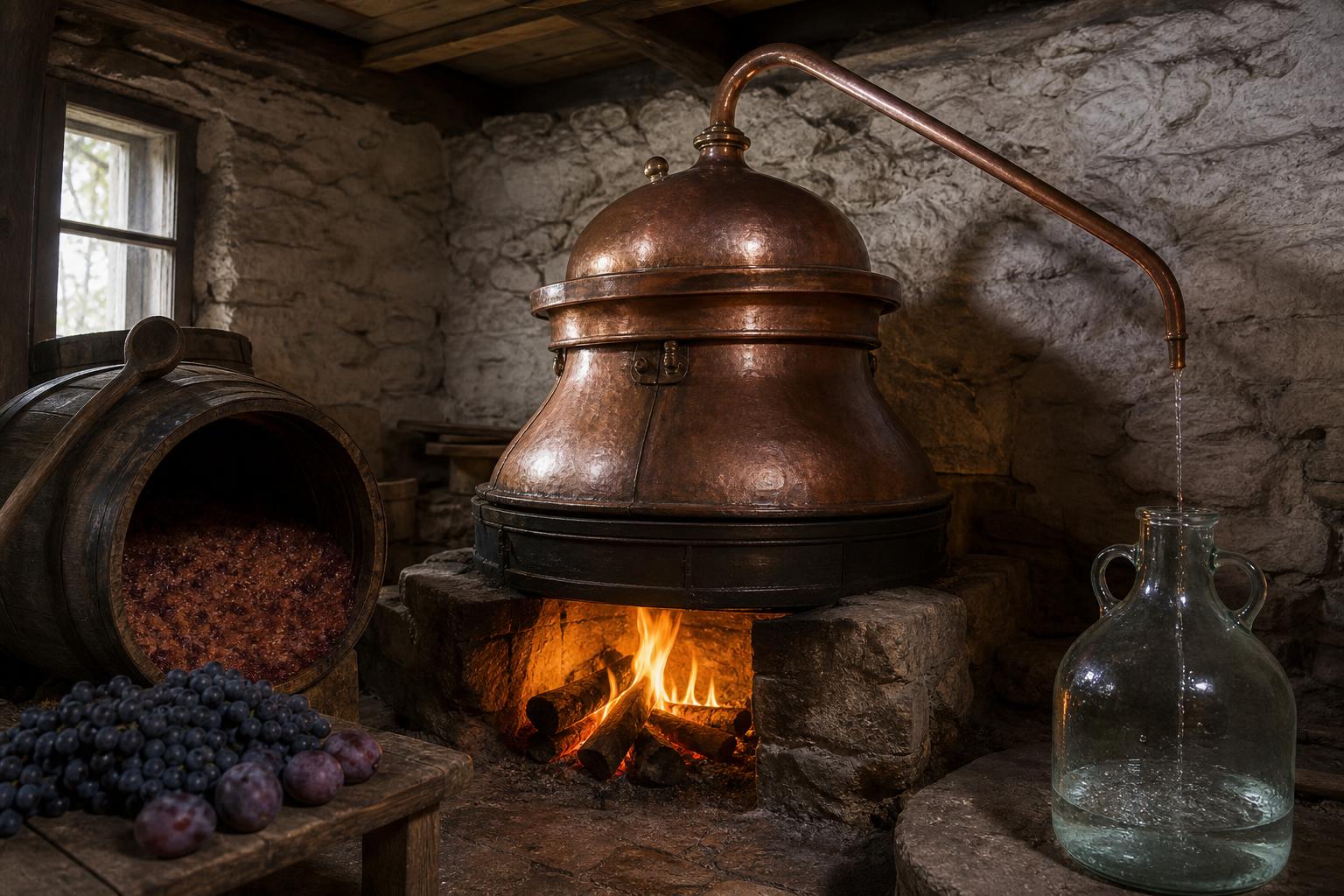
The substance in the bottle
There is a separate piece on this site about what raki means at an Albanian table — the welcome, the toast, the bottle a cousin sent from Skrapar. This is not that piece.
This is the answer to the narrower question: what is raki made of? If you have ever watched a copper still hiss in a yard outside Berat or stared at a Skrapari bottle at the Albanian grocery and wondered what is inside — this is the explainer.
The short version: raki is fermented fruit, distilled in a copper still, bottled clear. No malt, no oak, no spice, no anise, no added sugar, no flavoring. Whatever you taste in the glass — grape, plum, mulberry, fig — was in the orchard six months ago.
This guide covers the fruit, the fermentation, the distillation, the strength, and what raki is explicitly not made of. Home distillation in the US is a federal crime without a TTB permit. This describes tradition, not instructions.
The short answer
Raki is fermented fruit, distilled. That is the whole formula.
A traditional Albanian raki contains exactly two things: the fruit, and the alcohol the fruit’s sugars became. Grapes (most often), plums, or mulberries are crushed and left to ferment in open barrels for several weeks. Wild yeasts on the fruit’s skin do the conversion from sugar to alcohol — no commercial yeast is added in the village method. The resulting low-alcohol mash is then transferred to a copper pot still — the kazan — and distilled over a wood fire. The vapor is condensed back to liquid and collected in stages. The middle portion is the raki, rested for a few weeks and bottled.
That is it. No maturation in oak, no second distillation with botanicals, no infusion. A clean bottle of grape raki is grape sugar that became grape alcohol that was concentrated by heat and copper.
The spirit usually comes out at 40 to 50 percent alcohol by volume. The Wikipedia entry for rakia places the broader Balkan range at roughly 40 percent ABV for standard commercial bottlings, with home-produced batches typically running 50 to 80 percent.
The fruit comes first
The fruit defines a raki. In Albania, three are dominant.
Grapes are the most common base. Raki rrushi is the workhorse, the pour you get if someone in an Albanian home says “a small glass.” Wine grapes (Vlosh in the south, Shesh i Bardhë in central Albania, Kallmet in the north) become either pomace-based or whole-fruit raki. The character is dry, clean, and slightly grape-floral.
Plums make raki kumbull — plum raki — and the tradition is strongest in northern Albania. Plum raki is a cousin of Serbian šljivovica and Bosnian plum brandies. Softer than grape, often with a stone-fruit sweetness, rounder texture. Northern plum raki is frequently distilled stronger — 55 percent and above is not unusual.
Mulberries make raki mani, the southern specialty most identified with Përmet. White mulberries (mani i bardhë) and black (mani i zi) yield distinct flavors; white is more delicate, black more aromatic and lightly tannic. Mulberry raki is widely considered the smoothest of the three main styles, which is why Përmet bottles fetch higher prices in Albanian groceries.
Outside the big three: raki kajsie (apricot), raki ftua (quince), and raki fiku (fig) are family or regional traditions. A corn-based moonshine in the north is sometimes loosely called raki, though purists distinguish it from true fruit raki.
The constant across all of these: the fruit is the only flavor source. No spice rack, no botanical infusion, no caramel coloring. If a bottle of raki tastes like plum, that is because it was distilled from plums.
Why grape raki dominates
If you walk into a hundred Albanian households and count the bottles, grape raki wins. The reasons are agricultural and economic.
Grapes have grown in Albania’s coastal lowlands and inland valleys for at least two thousand years. The southern regions of Berat, Skrapar, and Përmet sit in particularly favorable terrain — long warm growing seasons, limestone soils, and old vineyard practices that survived multiple political ruptures.
The economic logic stacks on top. Wine production generates pomace — the skins, stems, and seeds left over after pressing. Pomace is essentially free at that point in the year. Fermenting and distilling it produces a spirit at zero added input cost. This is the same logic behind Italian grappa.
This is why Skrapar has become Albania’s grape-raki benchmark. The regional style — clean, dry, 42 to 46 percent ABV in commercial bottlings — has become the reference. Raki Skrapari is one of the most common Albanian raki labels found in the US. Berat produces well-regarded grape rakis. Përmet is dual-known for grape and mulberry. Korçë, in the southeast, has grape raki traditions on the drier and lighter end.
For the diaspora reader, this matters because grape raki is also the easiest to find legitimately in the US. Labeled bottles in Albanian groceries are overwhelmingly grape, overwhelmingly Skrapari or Berat-region, in the 40 to 46 percent ABV band.
Plum raki and the northern tradition
Cross from southern to northern Albania and the geography flips. Grape vineyards thin out. Orchards of plum, apple, and pear take over. The dominant fruit for distillation becomes the plum.
Raki kumbull is the signature spirit of the Albanian highlands — Dukagjin, Tropojë, Mirditë, and the area around Shkodër. The fruit is the European plum (Prunus domestica), often small dark-purple varieties that grow well in cooler upland climates. Plums are harvested at full ripeness, sometimes deliberately allowed to over-ripen on the tree to maximize sugar, then either crushed whole (pits and all, in the most traditional method) or pitted before fermentation.
The pit question is where craft enters. Plum pits contain trace amygdalin, which can break down to small quantities of cyanide and benzaldehyde during fermentation. Distillers who include the pits get a slight almond-marzipan note — the same character as Bavarian zwetschgenwasser. Distillers who pit the plums get a cleaner spirit. Both are traditional. The pit-included version requires careful cuts to keep the cyanide compounds, which concentrate in the heads, out of the final pour.
In the glass, northern plum raki is heavier-bodied than southern grape raki. The mouthfeel is rounder. The proof is often higher — 50 to 60 percent ABV is the village norm. The plum-raki tradition extends beyond Albania’s borders to Kosovo, Albanian-majority North Macedonia, Montenegro, and Serbia. They are a family.
Mulberry raki and the south
Mulberry raki is the smoothest, most aromatic, and usually the most expensive of the Albanian rakis, with Përmet as its center.
Mulberries (Morus alba and Morus nigra) grow across southern Albania, often planted as boundary trees between fields. The fruit ripens in early summer — much earlier than grapes or plums — and ripens fast. A tree loaded on Tuesday can be empty by Friday between the birds, the heat, and the natural drop.
Mulberries are notoriously delicate. They oxidize fast, ferment fast, and spoil if not handled fast. Distillers are usually set up for fermentation the same week as harvest. The fruit is crushed lightly (heavy crushing extracts too much tannin) and fermented in cool conditions to preserve aromatic compounds. Fermentation runs two to three weeks, because mulberries are high in sugar and the wild yeast population is active.
The distillation is where the value gets locked in. Because the aromatic compounds are fragile, distillers run the still slowly and at lower heat. The cuts have to be precise. A skilled mulberry distiller can produce a spirit at 45 percent ABV that smells more vividly of fruit than the original mulberries did. Përmet’s reputation rests on this combination — the right fruit, the right climate, and a multi-generational concentration of distillers. Bottles labeled raki mani Përmeti command higher prices in the US diaspora market than grape raki for that reason.
Pomace versus whole-fruit base
For grape raki specifically, there is a meaningful split: pomace, or whole fruit.
Pomace-based raki uses the leftover skins, stems, and seeds from winemaking. After grapes are crushed and pressed for wine, what remains in the press is pomace — wet, sticky, still containing some sugar and a lot of yeast. This pomace is fermented and distilled. Same approach as Italian grappa, Greek tsipouro, French marc, and Portuguese bagaceira. The Wikipedia entry for pomace covers the broader category. Character tends drier, grippier, sometimes more rustic.
Whole-fruit raki uses fresh grapes that go directly to fermentation rather than to a wine press first. Whole-fruit grape raki is generally smoother, more obviously fruity, and considered higher-end. More expensive to produce.
Most commercial Albanian grape rakis in the US are whole-fruit. Skrapari rakis are typically whole-fruit. Some smaller labels are explicit; many do not say.
The same logic does not really apply to plum and mulberry rakis, because there is no large-scale wine industry generating that pomace. Those fruits are almost always distilled from whole fruit. A pomace-based raki and a whole-fruit raki from the same grape taste different. Neither is wrong; they are stylistic choices on the same base spirit.

Fermentation: wild yeasts and patience
Fermentation is where sugar becomes alcohol. Yeast cells consume the sugars in the fruit (glucose, fructose, sucrose) and produce ethanol and carbon dioxide. The traditional Albanian method is distinguished by what is not added: no commercial yeast.
Wild yeasts on fruit skins drive the conversion. The most important is Saccharomyces cerevisiae, the same species used in commercial wine and beer fermentation, which lives naturally on grape skins. Other wild yeasts and bacteria contribute aromatic compounds a single-strain commercial fermentation would not produce. This is why traditional raki has a fuller, more variable aromatic profile than industrial grape spirits.
The fruit is crushed, placed in open barrels or sealed plastic drums, and left to ferment for two to six weeks depending on fruit, temperature, and the distiller’s preference. Open-barrel fermentation is older — the carbon dioxide blanket on top protects the mash from oxidation. Sealed-drum is the modern compromise — more sanitary, more predictable. A late-fall mash in northern Albania can take two months. The distiller knows fermentation is finished when the bubbling stops, the cap drops, and the mash tastes sour rather than sweet.
The resulting mash is roughly 6 to 10 percent alcohol by volume — comparable to a strong beer or a weak wine. It is not drinkable as is; its purpose is to be the input to the still.
A note on what fermentation does not do. It does not add color or flavor that was not in the fruit. It does not concentrate alcohol — that is the still’s job. And in a healthy fermentation, it does not produce dangerous levels of methanol. The methanol risk comes mostly at the distillation stage, when the still concentrates whatever methanol is present into the early heads cut.
Distillation in the kazan
This is the step that turns fermented fruit mash into raki. It is also the step that separates a clean bottle from a dangerous one.
The traditional Albanian still is the kazan — a copper pot still, usually wood-fired, often built and maintained by the family or village. Copper matters chemically: copper ions bind sulfur compounds during distillation, scrubbing them out of the vapor before they reach the condenser. A stainless-steel still produces a sulfurier, harsher spirit. Almost every traditional fruit-brandy region in Europe — Albania, Bavaria, Cognac — uses copper.
A wood fire heats the still. As the mash heats, the alcohol — boiling point 78.4°C for ethanol, versus 100°C for water — vaporizes first. The vapor rises through the neck of the still into a coiled tube (the worm, or serpentin), which passes through cold water. It condenses and drips out as a clear, high-proof spirit.
The drip is not uniform. The first liquid off the still is the heads — a mix of methanol, acetone, ethyl acetate, and other compounds with boiling points lower than ethanol. Methanol is the major concern: acutely toxic, capable of causing blindness or death in small quantities. This is exactly why the heads cut is not optional in unregulated home distillation. The heads must be discarded. A skilled distiller cuts the heads by smell — sharp, solvent-like — and by experience, typically discarding the first 5 to 10 percent of the run.
The middle portion is the hearts — the ethanol-dominant spirit that becomes the raki. The hearts run clean and warm, with the fruit’s character coming through.
The last portion is the tails — lower-proof, water-rich, containing fusel alcohols that produce harshness and bad hangovers. Tails are usually discarded or saved to be added to the next batch for redistillation.
A bad cut produces raki that is harsh, headache-inducing, or methanol-contaminated. A good cut produces raki that is clean, warm, and lingering.
Some Albanian rakis are double-distilled — the first run produces a low-proof spirit (25 to 35 percent ABV, sometimes called mesa), then redistilled to produce the final raki at 45 to 55 percent ABV. Both single and double distillation are traditional.
ABV and what raki strength means
Alcohol by volume (ABV) is the percentage of the bottle that is pure ethanol. A 45 percent ABV bottle is 45 percent ethanol and 55 percent water (plus trace flavor compounds).
Commercial Albanian raki typically lands between 40 and 50 percent ABV, most often 45. Most Skrapari bottles sit here. Homemade village raki runs higher — 50 to 60 percent is common, particularly strong batches push above 60. Village tradition rewards strength as a sign of skill, and higher-proof raki keeps better in unsealed glass jars.
ABV does not tell you about the quality of the cuts: a 60 percent village raki with a sloppy heads cut is more dangerous than a 45 percent commercial raki with a clean one. It does not tell you about the fruit. And it does not tell you about smoothness — a well-made 50 percent raki can drink smoother than a poorly-made 40 percent one. Smoothness comes from the cuts and the fermentation, not the proof.
A practical note: pour size matters more for high-proof raki than for wine or beer. A standard pour is 25 to 50 milliliters. At 45 percent ABV, a 30 mL pour contains about 13.5 mL of pure alcohol, similar to a standard US “drink.” At 60 percent village raki, the same small pour contains 18 mL — well above a standard drink. Eat first, sip slowly.
What raki is NOT made of
Half the confusion about raki in the US comes from what people assume is in it that is not.
No anise. Albanian raki does not contain anise, fennel seed, or any other licorice-flavored botanical. This is the single biggest point of confusion, because Turkish rakı (dotless ı) is anise-flavored and turns cloudy when water is added, and the names sound nearly identical in English. They are different drinks. Greek ouzo, French pastis, Italian sambuca, and Lebanese arak are also anise-based and also distinct. If a clear spirit turns cloudy when you add water, it is not Albanian raki.
No oak. Almost all Albanian raki is unaged or only briefly rested in glass demijohns or stainless steel before bottling. There is no barrel maturation that would give the spirit color, vanilla notes, or tannin.
No malt. Raki is fruit, not grain. There is no malt in the mash, no enzymatic conversion of starch to sugar, no relationship to whiskey production at all.
No spice or botanical. Gin’s character comes from juniper and other botanicals added during distillation. Raki has no botanicals. The still receives only the fermented fruit mash.
No added sugar. A traditional raki contains no added sweeteners. The slight sweetness some drinkers perceive comes from glycerol produced naturally during fermentation. Some flavored or infused rakis (raki with walnut, raki with honey) do add honey after distillation, but those are post-distillation infusions, not the base raki.
No coloring. A traditional raki is bottled clear because it is clear coming off the still. If a “raki” looks brown or amber, it is either oak-rested (rare and labeled), infused with herbs or walnut shells (raki me arra), or not really raki.
The cumulative point: the bottle of Skrapari on the table at your aunt’s house in the Bronx contains exactly two things — fermented grape juice that became alcohol, and water. If you can taste anything else, it is the natural aromatics of the grape coming through the distillation.
Why home distillation isn’t the move in the US
A practical note for the diaspora reader. Home distillation of alcohol in the United States is illegal under federal law without a Distilled Spirits Plant (DSP) permit from the Alcohol and Tobacco Tax and Trade Bureau (TTB). This is true regardless of how long the practice has been legal in your village in Albania, regardless of batch size, and regardless of whether the spirit is for personal use only.
The relevant federal statutes are 26 U.S. Code §§ 5601-5615, which criminalize unlicensed production of distilled spirits. Penalties include fines and imprisonment. No US state currently allows hobby home distillation in the way most states allow home brewing of beer and home winemaking. Beer and wine are fermented; raki is distilled. The legal categories are different.
The TTB process for a legitimate small-scale distillery is real and accessible, but not casual. It involves federal permitting, a bonded premises, federal excise tax on every proof gallon produced, state-level alcohol licensing, and ongoing compliance reporting. A handful of Albanian Americans have gone through this process and produce raki commercially in the US under proper licensure. That is the lawful path.
For most households, the practical path is to buy imported Albanian raki from a licensed distributor — Skrapari, Berat, or Përmet labels are widely available — or to bring home a bottle in checked luggage from a trip to Albania (subject to US Customs duty-free limits, generally 1 liter per adult).
This is not a moral judgment on the Albanian tradition. Home distillation is legal and common in much of Albania, where the regulatory environment is different. It is a description of the US legal reality.
If you grew up around the kazan and want that to mean something on this side of the Atlantic, the path is to buy and serve raki properly, or to pursue lawful US licensure. The community-led count of Albanian Americans is being built right now. Get counted.
Sources: Rakia — Wikipedia, Pomace — Wikipedia, Alcohol and Tobacco Tax and Trade Bureau — Distilled Spirits. This article is general reference information for adult readers (21+ in the US). It is not a recipe, not medical advice, and not an endorsement of unlicensed home distillation in any jurisdiction.