
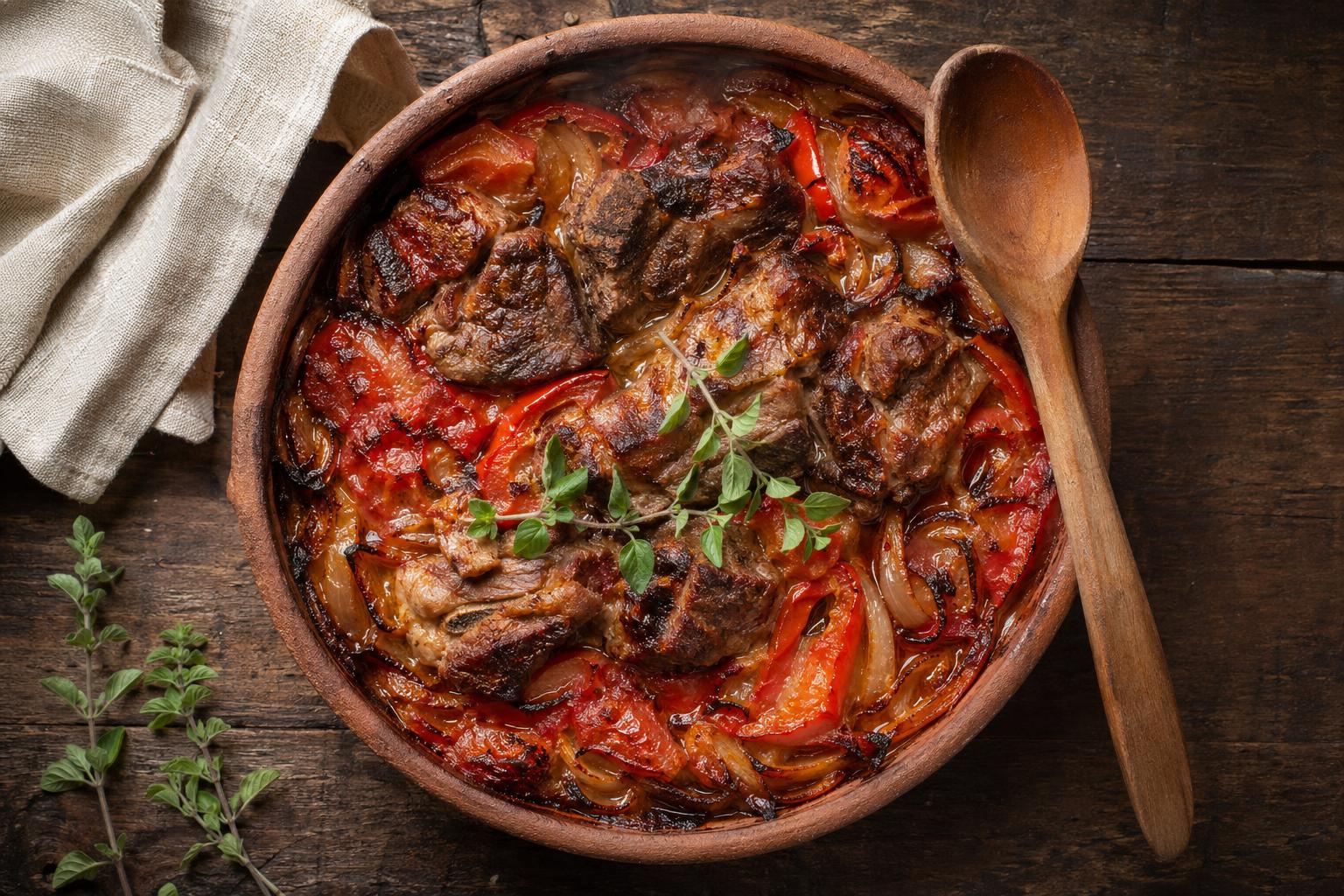
Tavë dheu is the dish that proves the pan matters as much as the meat. The name translates literally to “earthen baking dish” — tavë for the casserole, dheu for the earth, a direct reference to the unglazed clay pan the stew is slow-baked in. Lamb shoulder, onions, red peppers, ripe tomatoes, garlic, oregano, olive oil. Nothing else. The pan does the rest.
This is not the same dish as tavë kosi, which carries a yogurt-egg topping. Tavë dheu is a savory braise — meat and vegetables tucked into a clay pan, sealed for the long cook, then opened to the heat at the end so the top caramelizes and the juices reduce. The result is tender lamb with a roasted edge, vegetables that have released their water and reabsorbed it as flavor, and a layer at the bottom of the pan that no metal vessel produces.
This is one traditional version with the numbers nailed down. Serves six. Total time about three hours, most of it the oven doing the work.
What Tavë Dheu Is
Structurally, the dish is simple: lamb shoulder cubed and browned, layered into a clay pan over thick-sliced onions, surrounded by sliced red bell peppers, garlic, and chopped tomato, dressed with olive oil, oregano, paprika, salt, and pepper. Some families add white wine; some add stock; some leave it dry and let the vegetables release their own liquid. All three versions are correct.
The cook is two phases. The first 90 minutes are sealed — the clay pan covered with its lid (or with foil if there is no lid), the heat moderate, the meat braising in the pooled juices of the vegetables and the moisture released by the wet clay walls. The second phase is uncovered and hotter — the lid comes off, the oven climbs, and the top of the stew browns while the liquid below reduces to a glossy, concentrated sauce.
The clay pan is the entire reason this works. Unglazed terracotta absorbs water when soaked, then releases that water as steam during the first phase of the bake — keeping the meat tender without any added liquid. As the bake continues, the clay dries out, and the second phase becomes a dry roast. One vessel doing two different things at two different times. Metal pans cannot do that.
The Clay Pan
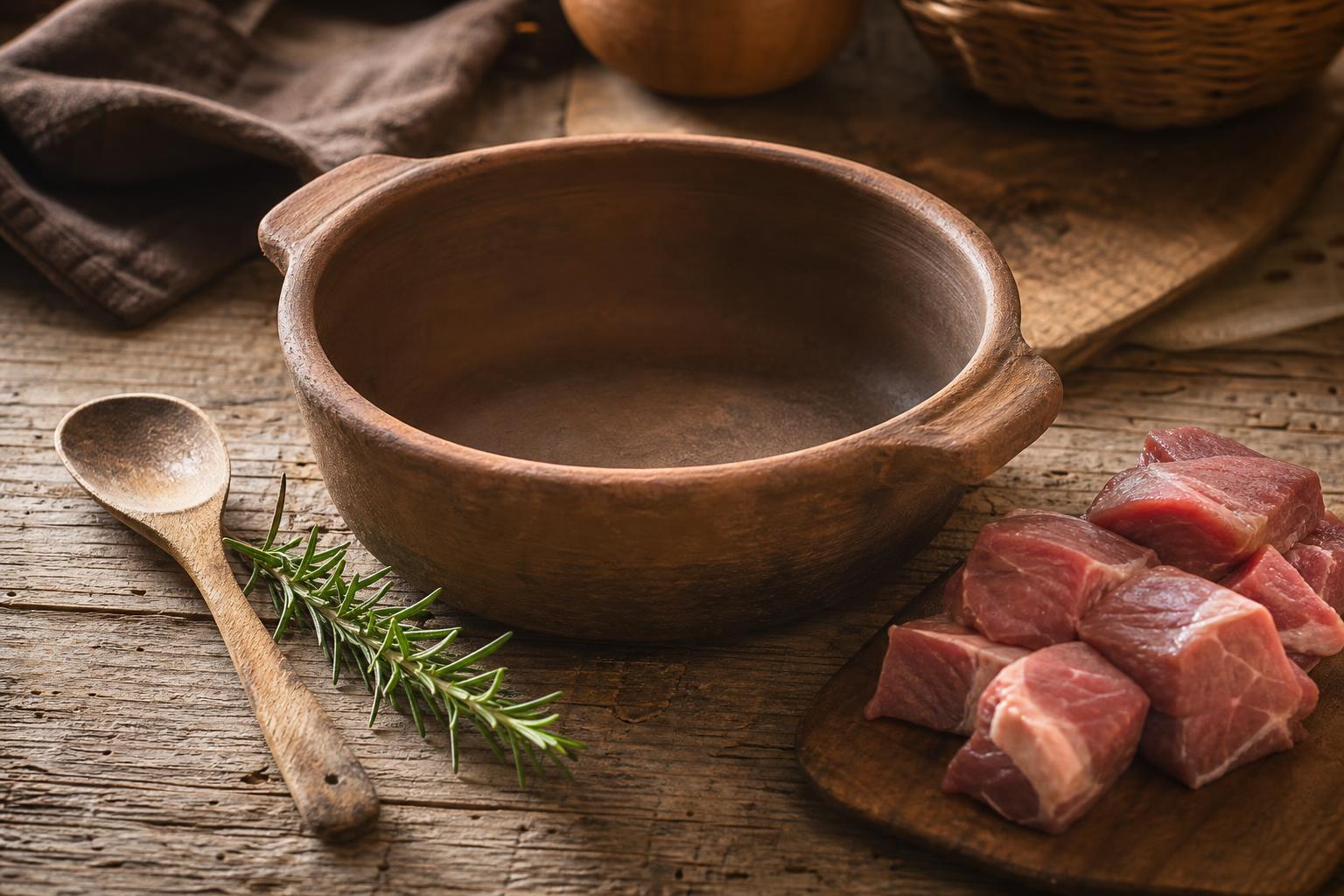
A traditional Albanian tavë dheu pan is unglazed earthenware — terracotta, sometimes with a rougher surface than glazed dishes. They are typically round, ten to twelve inches in diameter, two to three inches deep, with a matching lid. Some are rectangular. The defining trait is what they do not have: a glaze. The interior surface is bare clay.
Glazed clay pans look similar but cook differently. The glaze seals the pores and turns the pan into a ceramic version of a metal dish — moisture cannot move in or out of the wall. The whole moisture-trading effect disappears. If a clay pan has a glossy, glassy interior, it is the wrong pan for this dish.
Before the first use, an unglazed clay pan needs seasoning. The simplest method: submerge in cold water overnight, dry, rub the interior with olive oil, and bake empty at 250°F (120°C) for an hour. The oil soaks into the pores and creates a partial seal. After that, every use starts with a 30-minute cold-water soak to saturate the clay before it goes into the oven. A dry, unsoaked pan dropped into a 350°F oven will crack — sometimes immediately, sometimes the third or fourth time. Soak it.
For diaspora cooks: many Albanian-American families have brought their clay pans from Albania, packed in checked luggage. They are not impossible to find in the US — Mediterranean and Middle Eastern import shops carry them, and specialty kitchen stores stock Spanish cazuelas, which are functionally the same vessel. If a clay pan is unavailable, a heavy enameled cast-iron Dutch oven approximates the cook. Good result, but the top will not caramelize the same way and the bottom will not develop the slightly crusted layer that clay produces.
Ingredients
Serves 6. All measurements are US standard.
For the stew:
- 2 lb boneless lamb shoulder, trimmed and cut into 2-inch cubes
- 3 large yellow onions, sliced thick (about ½ inch)
- 4 red bell peppers, seeded and cut into wide strips
- 4 ripe tomatoes, peeled and chopped (or one 14 oz can of whole peeled tomatoes, drained and chopped)
- 6 cloves garlic, minced
- 4 Tbsp olive oil
- 2 tsp dried oregano
- 1 tsp sweet paprika
- 1¼ tsp kosher salt, plus more to taste
- ½ tsp freshly ground black pepper
Optional liquid:
- 1 cup dry white wine
- 1 cup beef stock
A note on the lamb: shoulder is the cut. Connective tissue breaks down into something tender during the long bake. Leg works in a pinch but cooks drier. Avoid generic supermarket “stew lamb” of unknown origin — ask the butcher for shoulder, bone-in or boneless.
A note on the peppers: red bells are traditional. The sweetness balances the lamb. Some Northern (Gheg) cooks use a heavier hand on peppers and a lighter hand on tomatoes; Southern (Tosk) cooks reverse the ratio. Both are correct.
A note on the wine and stock: optional but recommended. The wine sharpens the sauce; the stock gives it body. A dry version (no added liquid) leans more on the vegetables themselves and produces a thicker, more concentrated stew.
Equipment
- An unglazed clay pan, ~10–12 inch diameter, 2–3 inch deep, with lid
- A heavy skillet (cast-iron or stainless) for browning
- A sharp knife and cutting board
- Tongs
If using a Dutch oven instead of clay: a 5–6 quart enameled cast-iron Dutch oven works. Skip the clay-soaking step.
How to Make Tavë Dheu
Step 1 — Soak the clay pan (30 minutes, hands-off)
Submerge the clay pan and lid in cold water for at least 30 minutes. The clay should fully saturate — small bubbles will stop rising from the surface when the pan is ready. Drain and pat dry just before using. Do not skip this step on an unglazed pan.
While the pan soaks, heat the oven to 350°F (175°C).
Step 2 — Brown the lamb (10 minutes)
Heat 2 Tbsp of the olive oil in a heavy skillet over medium-high heat. When the oil shimmers, add the lamb cubes in a single layer — do not crowd the pan. Sear in two batches if needed. Brown the cubes on at least two sides, about 5–7 minutes per batch. The goal is color, not cooked-through. The meat will finish in the oven.
Crowding is the most common mistake here. Lamb crammed into the skillet steams instead of browning, and the dish loses the depth the bake is supposed to amplify. Two batches of golden-crusted cubes beats one batch of pale gray ones.
Transfer the browned lamb to a plate.
Step 3 — Build the pan (5 minutes)
Layer the soaked clay pan from the bottom up. Start with the sliced onions across the floor of the pan, overlapping slightly to cover. Lay the browned lamb cubes on top of the onions in an even layer. Scatter the pepper strips and minced garlic over the lamb. Spread the chopped tomatoes across the top.
Drizzle the remaining 2 Tbsp olive oil over the surface. Sprinkle the oregano, paprika, salt, and pepper evenly across the top.
If using wine and stock: pour both around the edges of the pan, where they will pool at the bottom. Do not pour them over the meat — the goal is liquid below, dry seasoning above.
Step 4 — Cover and bake, phase one (90 minutes, hands-off)
Set the lid on the clay pan. If the pan has no lid, cover tightly with aluminum foil. Bake at 350°F (175°C) for 90 minutes.
Resist the urge to open the lid early. The first phase is a moisture-trapping cook — the wet clay releases steam, the vegetables release their water, the lamb braises in the pooled liquid, and everything hits temperature together. Lifting the lid drops the pan temperature, lets steam escape, and lengthens the cook by 15–20 minutes. Set a timer and walk away.
Step 5 — Uncover and finish, phase two (25–30 minutes)
After 90 minutes, remove the lid. Increase the oven to 400°F (200°C). Return the pan, uncovered, for another 25 to 30 minutes.
This is where the dish finishes. The exposed surface caramelizes — the tomatoes go jammy, the peppers darken at the edges, the lamb develops a glossy roasted top. The liquid in the bottom reduces and thickens. Pull the pan when the top is deeply browned in patches and the juices have reduced to a syrupy layer that coats the back of a spoon.
If the top is still pale at 30 minutes, move the pan to the upper third of the oven for 5 more minutes. Watch it — clay holds heat, and the gap between deeply caramelized and burnt is short.
Step 6 — Rest and serve (10 minutes)
Pull the pan from the oven and rest it on the counter for 10 minutes. The meat reabsorbs juices during the rest and the sauce thickens further. Serve directly from the clay pan at the table — the vessel is part of the presentation.
Why the Clay Pan Matters (Food-Science Note)
Unglazed terracotta is a porous ceramic. Soaked in water, the clay walls hold a meaningful amount of moisture in their pores — a few hundred grams to over a pound, depending on the size and density of the pan. That trapped water is the engine of the first cooking phase.
When the soaked pan goes into a 350°F oven, the clay walls heat slowly because the water in the pores has to evaporate before the wall temperature can climb. As that water evaporates, it migrates inward and creates a humid, steam-rich environment around the food. The lamb braises in that steam without any added liquid, and the vegetables release water into the same environment without losing it to a dry oven.
After 60 to 90 minutes, the clay walls have largely dried out. The pan switches modes. The walls conduct dry heat into the food, and once the lid comes off in phase two, the open surface caramelizes while the bottom continues to roast in concentrated juices. One vessel, two cooking modes.
Cast iron and stainless steel have no porosity — they hold no water and trade no moisture with the food. A metal-pan version dries out faster in phase one, the meat needs added liquid to stay tender, and phase two is just a longer roast. The dish is good. It is not the same dish.
Variations
Veal version. Substitute 2 lb veal shoulder, cut the same way. Younger meat, milder flavor, slightly shorter braise — pull the lid at 75 minutes for phase one. Some Albanian-American families serve this on Sundays in place of the lamb version when good lamb is not available.
Chicken version. Substitute 2 lb boneless skinless chicken thighs, cut into 2-inch pieces. Skip the browning step or do it briefly — chicken thighs do not need the same sear as lamb. Reduce phase one to 45 minutes and phase two to 20 minutes. The dish lightens but stays recognizable. Common as a Sunday lunch alternative.
Vegetarian version. Not traditional, but the format holds up. Replace the lamb with 1½ lb mixed mushrooms (cremini and oyster, halved or quartered) and one 15 oz can of cooked chickpeas, drained. Sear the mushrooms in olive oil to drive off moisture before layering. Skip phase one of the bake — go straight to a covered 45 minutes at 350°F (175°C), then 20 minutes uncovered at 400°F (200°C). The dish loses the lamb depth but keeps the clay-pan caramelization.
Northern Gheg variant. More peppers, less tomato. Use 6 red bell peppers and only 2 tomatoes (or skip the tomatoes entirely). The dish leans sweeter and more vegetal.
Southern Tosk variant. More tomato, more wine. Use 6 tomatoes (or one 28 oz can) and 1½ cups of white wine. The dish leans more acidic and saucier — closer to a Mediterranean braise.
Serving and What to Pour Alongside
Tavë dheu is a centerpiece dish that asks for simple sides. What it wants:
- Crusty bread — bukë, a country loaf, a baguette. The juices at the bottom of the pan are the whole point of bread on the table.
- Kos — a small bowl of plain Greek or Balkan-style yogurt, served chilled, on the side. The cold acid against the rich, hot stew is the contrast that makes the dish feel finished.
- Sallatë — a chopped salad of tomato, cucumber, red onion, white feta, olive oil, red wine vinegar, and salt. Cuts through the richness.
- Red wine — Albanian kallmet if you can find it. Otherwise a young Italian red, a Greek agiorgitiko, or any unfussy Mediterranean table wine.
Tavë dheu shows up at family Sunday meals, darka (dinner) gatherings, and feast days that do not call for the full ceremony of tavë kosi. It is the everyday version of a special-occasion dish — substantial enough to be the main event, simple enough to make on a regular weekend.
Common Mistakes
- Using a glazed clay pan. The whole moisture-trading effect disappears. Glazed pans cook like ceramic dishes — fine for many things, wrong for this one. Check the interior before you start: glossy and sealed means glazed.
- Not soaking the unglazed pan. Cracks at high heat, sometimes the first time, sometimes the fifth. The 30-minute cold-water soak is not optional and not negotiable.
- Crowding the lamb in the skillet. Steams instead of caramelizing, the dish loses depth, the bake cannot recover what the sear failed to give it. Brown in two batches.
- Lifting the lid too early. Drops the pan temperature, lets steam escape, lengthens the cook. The first 90 minutes are sealed — set a timer and walk away.
- Pouring liquid on top of the meat. The seasoning sits on top, the liquid pools at the bottom. Mixing them dilutes the spice rub and prevents the top from caramelizing in phase two. Pour wine and stock around the edges.
- Pulling the dish too early in phase two. A pale top means the caramelization that defines the dish has not happened yet. Wait for deep brown patches and a syrupy reduction at the bottom — the clean-spoon test.
- Cutting straight into it. The 10-minute rest is part of the recipe. The juices need to reabsorb and the sauce needs to thicken.
This recipe is part of NAR’s growing archive of traditional Albanian dishes documented for the American diaspora. Family recipes do not need to be lost between generations — but writing them down is how they survive. If you cooked from this and want to be counted among the Albanian Americans NAR is documenting, register here. Free, takes about a minute, and includes a Certificate of Albanian Identity at the end.