
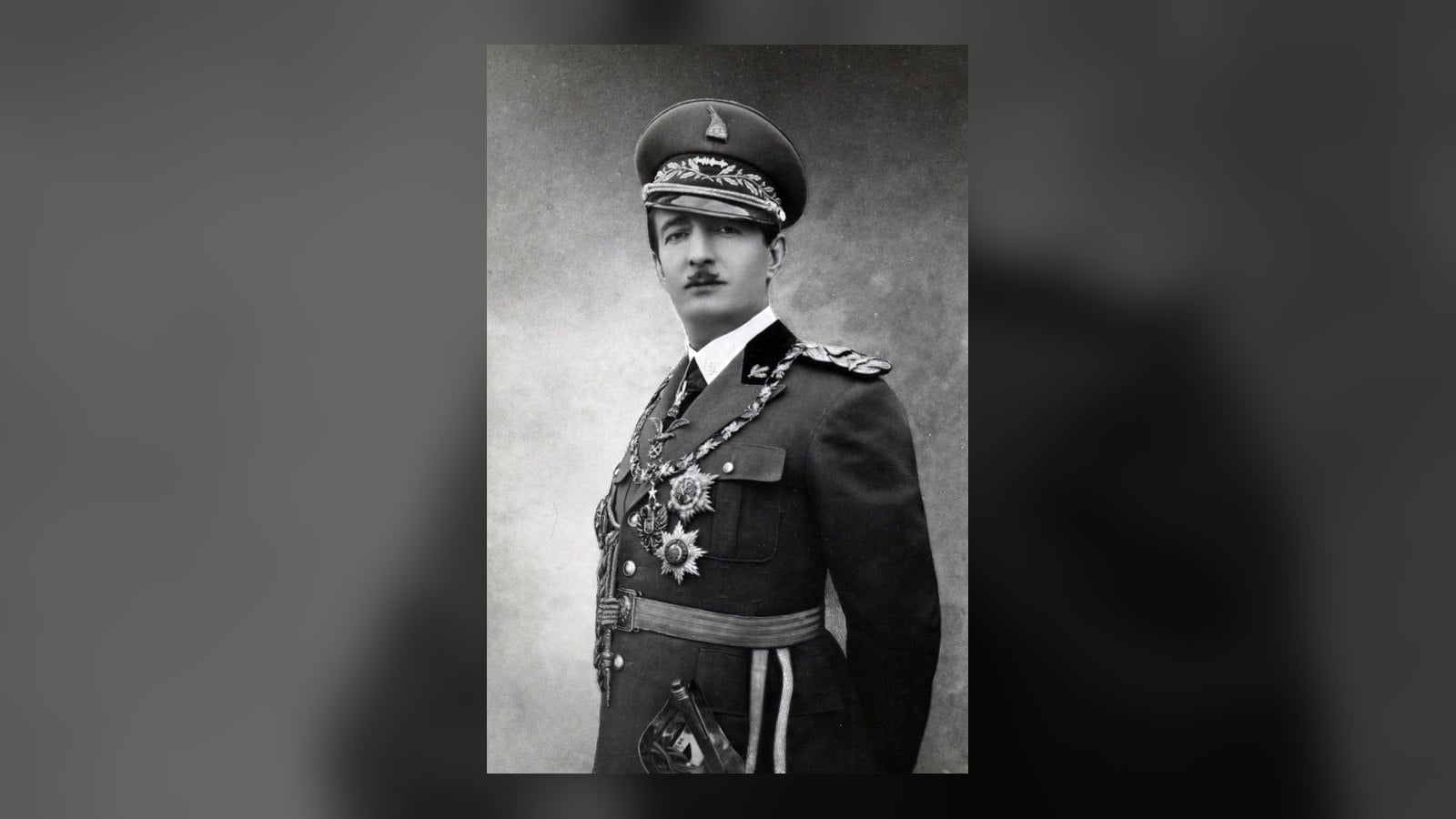
Ahmet Zogu was born in a castle in central Albania in 1895. By the time he was 30 he was running the country. By 32 he was a king — the only Muslim king in modern European history, governing a new state that most of Europe still regarded as barely real. By 44 he was in exile, carrying gold and a family across borders, never to return.
His reign lasted 11 years. It is the most consequential peacetime stretch in Albanian history between the 1912 declaration of independence and the communist takeover in 1944. Zog modernized Albania’s legal code, built the country’s first national infrastructure, opened schools, and tried to pull a feudal society into the 20th century. He also financed all of it with Italian loans that gave Mussolini a claim on the country — a debt trap that ended with tanks on the beach at Durrës.
For Albanian Americans, Zog is neither hero nor villain. He is the leader who built the modern Albania their grandparents left, and whose borrowing from Mussolini is the reason many of them left. His story is a case study in the cost of small-state sovereignty when a larger power is willing to pay for it.
The Zogolli clan and the Mat district
Ahmet Muhtar Zogolli was born on 8 October 1895 at Burgajet Castle in the Mati district of central Albania, roughly 60 kilometers northeast of Tirana. His father, Xhemal Pasha Zogolli, was the hereditary chief of the Mati clan — one of the most powerful Albanian feudal families in the Ottoman system. His mother, Sadije Toptani, came from another prominent Albanian family, the Toptani of central Albania.
The Mati was a highland region whose bey (feudal lord) system was closer to the old Kanun than to any modern political structure. Zogu grew up in a world where political authority rested on clan loyalty, armed men, and the family’s word. He would carry that system into national politics and never entirely leave it behind.
His father died when Ahmet was young. His mother raised the family, and his older half-brother, Xhelal Bey Zogolli, initially held the chieftainship. Ahmet was schooled in Istanbul at the Galatasaray High School (Lycée Impérial de Galatasaray), but returned to Albania in 1912 as the Ottoman Empire collapsed and Albanian independence was declared.
The post-independence chaos (1912–1924)
Albania between 1912 and 1924 was a country in name searching for a state in practice. The provisional government under Ismail Qemali lasted 14 months. The Principality of Albania under Prince Wied lasted six months before World War I swept it away. The country was occupied by Italian, Serbian, Austro-Hungarian, French, and Greek forces during the war.
Zogu entered national politics through the Congress of Lushnjë in January 1920, where Albanian leaders rejected the wartime partition plans and reestablished self-governance. He was 24. He was appointed to the governing council and quickly became one of the most powerful figures in the new government.
His rise was fast:
- 1920: Delegate to the Congress of Lushnjë; appointed governor of Shkodër.
- 1921: Named interior minister at 25 — the cabinet portfolio that controlled the gendarmerie.
- 1922: Became prime minister at 27 — Albania’s youngest-ever prime minister.
- 1924 (June): Overthrown by the June Revolution, a coalition led by Fan Noli, the Orthodox bishop, diplomat, and Harvard-educated reformer. Zogu fled to Yugoslavia.
The June Revolution was partly a democratic reaction against Zogu’s consolidation of power and partly a reformist bid for land redistribution and modernization. Fan Noli governed for six months but could not secure foreign recognition or internal stability.
- 1924 (December): Zogu returned with a Yugoslav-supported force — roughly 2,000 men, including White Russian émigrés and Yugoslav-armed volunteers — and retook the capital. Noli fled to Italy, then to the United States.
The December return settled the basic question of Albanian politics for the next 15 years: Ahmet Zogu would rule, and the price of his staying in power would be paid by a foreign patron.
President Zogu (1925–1928)
In January 1925, a constituent assembly declared Albania a republic and elected Zogu as its first president. He shortened his family name from Zogolli to Zogu and began consolidating state power.
The republic was not a democracy. Zogu held executive authority, controlled the military and police, and used personal loyalty networks rooted in the Mati clan system to maintain order. Political opponents were imprisoned, exiled, or killed. The parliament existed but did not constrain him.
His domestic agenda was modernization. Albania in 1925 was one of the poorest and least developed countries in Europe: no national road system, no national education system, a legal framework still partially based on the Kanun and Ottoman law, a population that was 80% rural and largely illiterate.
To finance the transformation, Zogu turned to Italy. In 1925 he signed the First Treaty of Tirana with Mussolini’s government, which provided economic aid and loans in exchange for political influence. The Albanian National Bank was established as a joint Italian-Albanian institution, with Italian capital. The 1926 Second Treaty of Tirana was a mutual defense pact — effectively giving Italy a security guarantee over Albania.
The money built things. The Italian loans financed roads, government buildings, and infrastructure. But each loan came with concessions: Italian companies received monopoly positions in Albanian oil, mining, and agriculture. Italian advisors embedded in the Albanian military. The pattern was familiar to anyone who has watched a small state borrow from a larger neighbor without the power to set terms.
King Zog I (1928–1939)
On 1 September 1928, the Albanian parliament approved a new constitution transforming the republic into a kingdom. Zogu became Zog I, King of the Albanians (Mbret i Shqiptarëve). He was 32 years old.
The title was unusual. He was not installed by foreign powers, as Prince Wied had been. He promoted himself. The constitutional change was legal in form — parliament voted — but in substance it was Zogu’s decision, ratified by an institution he controlled. The move consolidated his authority under a hereditary crown rather than an elected term.
He was the only Muslim king in modern European history, governing a country whose population was roughly 70% Muslim, 20% Orthodox Christian, and 10% Catholic. He treated the religious communities as politically equal, appointing cabinet members from all three faiths.
Modernization under the crown
Zog’s domestic program between 1928 and 1939 was the most ambitious effort at state-building Albania had seen:
- Legal reform: In 1929 he adopted a new Civil Code modeled on the Swiss Civil Code, replacing the patchwork of Ottoman law and customary Kanun. The code established civil marriage, inheritance rights for women, and secular courts. He banned the wearing of the Muslim veil and pushed for girls’ education — measures that were progressive for the Balkans in the 1930s.
- Education: He expanded the school system, building new primary schools across the country, and the literacy rate — while still low — began to climb. He established the first Albanian teacher-training schools.
- Infrastructure: Italian-financed roads connected the major cities for the first time. Public buildings, bridges, and ports were constructed. Tirana was developed from a small town into something resembling a capital, with a central boulevard, ministries, and government squares.
- Military: The Albanian army was expanded and professionalized — though still heavily reliant on Italian officers and equipment.
The Italian debt trap
The Italian financial relationship grew tighter with each year. By the mid-1930s, Italy was Albania’s largest trading partner, largest lender, and largest foreign employer. Italian companies ran Albanian oil concessions, held mining monopolies, and staffed key positions in the Albanian government.
In 1931, Zog attempted to push back. He declined to renew the Treaty of Tirana and tried to diversify Albania’s foreign relationships — approaching Britain, France, and Yugoslavia. Mussolini responded by suspending loans. The Albanian economy, dependent on Italian capital, contracted sharply. Zog had to accept new concessions.
By the late 1930s, Italy’s control was economic rather than military — but the line between the two had become thin. Albania was sovereign on paper and dependent in practice. The army was Italian-trained, the bank was Italian-capitalized, and the roads were Italian-built to specifications that served Italian strategic interests.
Zog knew the arrangement was unsustainable — but by the late 1930s he had no remaining power to change it.
Marriage and the royal family
On 27 April 1938, Zog married Countess Geraldine Apponyi de Nagyappony — a Hungarian aristocrat with distant connections to European royalty. It was a Catholic-Muslim marriage that drew attention across Europe: Geraldine remained Roman Catholic, and the wedding was a civil ceremony at the royal palace in Tirana. Religious leaders of both faiths — including the Pope, who had initially objected — ultimately blessed the marriage.
Crown Prince Leka was born on 5 April 1939. Two days later, Italy invaded.
The Italian invasion: April 7, 1939
On 7 April 1939, Italian forces landed at Durrës, Vlorë, Shëngjin, and Sarandë. The invasion force numbered roughly 22,000 troops, supported by naval bombardment and air power. Albania’s army — small, underequipped, and partially led by Italian-trained officers — offered resistance at Durrës for several hours but was overwhelmed by midday.
Zog and his family fled south by car, crossing into Greece on the same day. He carried with him a significant quantity of gold — reportedly from the Albanian National Bank and the royal treasury. Estimates of the amount vary: some Albanian sources cite 2.5 tons, others significantly less. The gold would finance the royal family’s exile for the next two decades.
The Albanian parliament, under Italian pressure, offered the crown to Victor Emmanuel III of Italy. Albania became a puppet state under Italian and, after 1943, German occupation. The country would not regain genuine sovereignty until after World War II — and then only under a communist regime that would last 45 years.
Exile (1939–1961)
Zog’s exile traced an arc across four countries and 22 years:
- Greece (April 1939): Immediate refuge after crossing the border ahead of the Italian invasion.
- France (August 1939–June 1940): Settled at the Château de la Maye in Versailles, outside Paris.
- England (June 1940–1946): Fled the German invasion of France, staying first at the Ritz Hotel in London before settling at Parmoor House in Buckinghamshire.
- Egypt (1946–1955): Zog and his family lived in Cairo under the protection of King Farouk. This was the most stable period of the exile. In 1951, Zog purchased the Knollwood estate on Long Island, New York — though the family never occupied it, selling it again in 1955.
- France (1955–1961): The family returned to France, settling in Cannes, where Zog died in 1961.
Throughout the exile, Zog maintained his claim to the Albanian throne. He issued statements, met with Albanian-American organizations, and kept the institutional forms of a royal court. But the political landscape had changed entirely. Albania was under Enver Hoxha’s communist dictatorship, which had declared the monarchy abolished and confiscated all Zogu family property. There was no prospect of return.
Zog died on 9 April 1961 in Suresnes, near Paris. He was 65. He had spent more years in exile than he had spent ruling.
Crown Prince Leka and the question of restoration
After Zog’s death, his son Crown Prince Leka — who had been two days old when the family fled Albania — took up the monarchist cause.
Leka I, as his supporters styled him, lived across multiple countries and maintained the claim for decades. In 1993, after the fall of communism, the Albanian parliament voted to not recognize the monarchy. Leka returned to Albania in 1997 — during the civil unrest that followed the pyramid scheme collapse — and campaigned for a restoration referendum.
The referendum was held on 29 June 1997. Official results: 66.7% for the republic, 33.3% for the monarchy. Leka’s supporters alleged fraud. There were protests and one fatality. Leka left Albania shortly after.
He returned permanently in 2002 after being pardoned for weapons charges. He died in 2011. His son, Leka II, lives in Albania today as a private citizen. He held a government position as a special envoy, but the monarchy remains a historical question, not a political one.
What Zog means to Albanian Americans
Zog’s legacy sits in an unusual space in Albanian-American memory. He is not the founding father — that is Ismail Qemali. He is not the national hero — that is Skanderbeg. He is not the dictator families fled — that is Enver Hoxha. He is the leader between the founding and the tyranny, the one who tried to build a modern state and failed to keep it sovereign.
For Albanian Americans whose families left before World War II, Zog is the Albania they remember: the first roads, the first civil code, the first attempt at a functioning modern state. For families who fled during or after the communist period, Zog is the prelude — the interwar chapter that explains how Albania entered the war vulnerable enough for Hoxha to emerge from it.
The interwar monarchy also produced a diaspora legacy of its own. Queen Geraldine became an ambassador for Albanian causes in exile, particularly in the United States and Europe. The Albanian-American community in the 1940s and 1950s organized around both republican and monarchist exile factions — a split that took decades to heal and that sometimes echoes in community politics today.
The numbers are concrete: Zog ruled for 14 years (3 as president, 11 as king). He modernized the legal system, expanded schools, and built infrastructure. He also borrowed from a dictator, lost the country’s sovereignty, and died in a rented house in France. The honest assessment includes both sides.
Queen Geraldine’s remains and King Zog’s remains were reburied together in Tirana in 2012, at the rebuilt royal mausoleum on Kodra e Gështenjave (Chestnut Hill) in Tirana’s Grand Park. Crown Prince Leka I was also moved there in 2012. The mausoleum exists, but the monarchy does not.
The U.S. Census counts 230,000 Albanian Americans. The real number is close to a million. A significant share of those families came from the Albania that Zog tried to build and Mussolini took away.