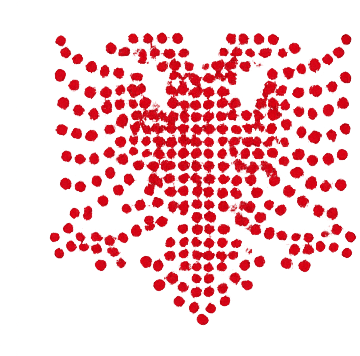

The town of Vlorë sits on the Adriatic coast of what is now southern Albania. On the afternoon of 28 November 1912, a delegation gathered in a house there and did something that, on paper, looked close to impossible: they declared a country into existence while a war moved across the land around them. The man who read the words was Ismail Qemali, 68 years old, a former Ottoman official who had spent most of his career inside the empire he was now helping to leave. The flag he raised — red, with a black double-headed eagle — has been the flag of Albania, in one form or another, ever since.
This is the story of how the Albanian declaration of independence came together in 1912: the men in the room, the war at the gates, the flag with five centuries behind it, and why a single November day still organizes the calendar of Albanian families from Vlorë to the Bronx.
The empire was coming apart
For five centuries, the Albanian lands had been Ottoman territory. By the autumn of 1912, that arrangement was ending fast. In October the Balkan League — Serbia, Montenegro, Greece, and Bulgaria — went to war against the Ottoman Empire in what became the First Balkan War. Ottoman forces collapsed quickly. Within weeks the allied armies were carving up the empire’s European holdings, and much of that fighting ran straight through the Albanian-populated regions.
For Albanian leaders this was the worst kind of opportunity. The empire that had governed them was finished, but the powers replacing it had no intention of leaving an Albanian state on the map. Serbian troops were pushing toward the Adriatic. Greek forces were advancing in the south. If the Albanians did not claim a country of their own, their lands would simply be partitioned among the victors.
The ground had been shifting for years before 1912. Albanian uprisings against Constantinople broke out in 1910 and 1911, and a large revolt in the spring and summer of 1912 — concentrated in the Kosovo region — extracted real concessions from the Ottoman government, including promises of administrative autonomy. But concessions inside a dying empire were worth little now. By November the war had overtaken every one of those promises. The choice in Vlorë was made under that exact pressure: declare a state, and do it before the borders were drawn by someone else. Waiting another month risked having no Albania at all to govern.
The Assembly of Vlorë
Ismail Qemali had spent the autumn lobbying. He traveled through Europe — Bucharest, Vienna, Trieste — trying to gauge how the powers would react, and he sent word back home calling for a national assembly. The delegates who answered came from across the Albanian lands: from the south, from the central regions, from the diaspora communities abroad. Roughly 83 delegates registered for the gathering, though the war made travel dangerous and many regions under occupation could not send anyone at all.
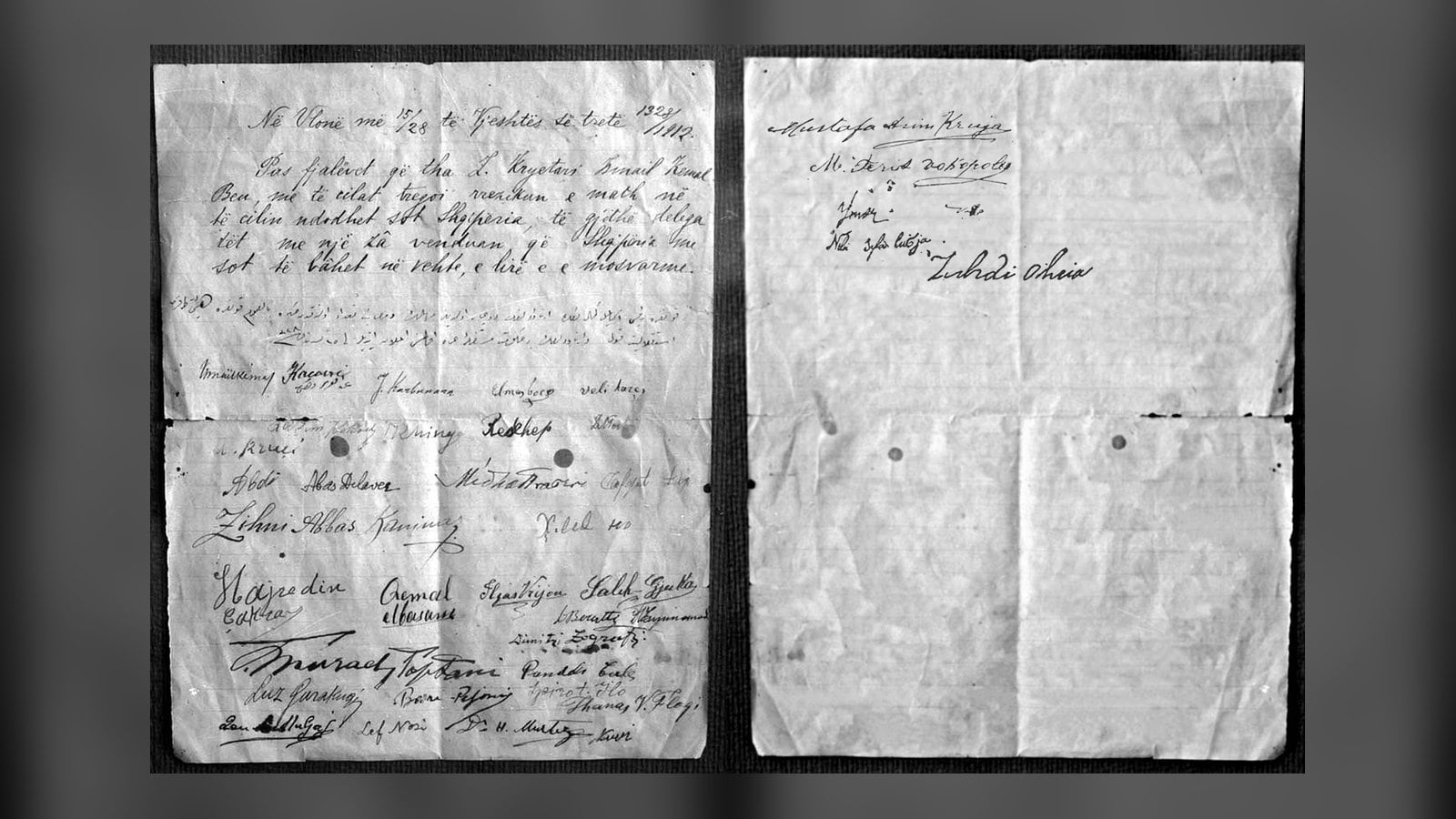
On 28 November the assembly met and declared Albania independent. The core of the declaration was short, almost stark: Albania, from that day, was to be on its own — free and independent — under a provisional government overseen by an elected council. There was no long preamble, no list of grievances in the American style. The moment did not allow for it. As the records later noted, Vlorë was very nearly the only town in the whole country under the delegates’ firm control. The signatures bear this out: of the registered delegates, 40 signed the declaration document — 34 names on the front, 6 on the back. The delegates came from Muslim and Christian communities and from north and south alike, a deliberate breadth meant to show the powers that this was a national act and not the project of one region or faith.
It is worth pausing on who Ismail Qemali was, because the choice of leader was not an accident. Born in Vlorë in 1844, he had studied and built a career inside the Ottoman system, rising to senior posts and governorships across the Balkans and serving as a deputy in the Ottoman parliament for Berat after the 1908 Young Turk Revolution. He knew the machinery of the empire from the inside, and he knew the European capitals from his lobbying tours that autumn. That combination — credibility with the powers and standing at home — is part of why the assembly turned to a 68-year-old former imperial official to read the declaration of secession.
A few days later, on 4 December 1912, the assembly established a provisional government with Ismail Qemali at its head as prime minister and foreign minister. The cabinet ran to nine ministries — internal affairs, finance, war, justice, education, public works, agriculture, and posts and telegraphs — staffed by names that recur throughout the period: Nikoll Kaçorri as deputy prime minister, Luigj Gurakuqi, Mid’hat Frashëri, Mehmet Pashë Deralla, Abdi Toptani, Petro Poga, Pandeli Cale, Lef Nosi, Mufid Libohova. A Council of Elders, the Pleqësia, was set up alongside the government to supervise it. It was a full state apparatus assembled in a town that controlled barely more than its own streets, with a treasury that was close to empty and an army that existed mostly on paper.
The flag with five centuries behind it
The flag raised at Vlorë was not new. The black double-headed eagle on a red field reaches back to Gjergj Kastrioti Skanderbeg, the 15th-century commander who held off Ottoman armies for a quarter-century. Skanderbeg’s family, the Kastrioti, used a black eagle on red as their coat of arms, and during his long revolt that emblem became the symbol of Albanian resistance. When Qemali raised the banner in 1912, he was reaching for the oldest available claim — not inventing a national symbol but restoring one.
One honest note on precision: historians have never found a photograph or contemporary illustration that fixes the exact appearance of the flag flown that day. The flag’s documented history tells us the design, the color, and the lineage with confidence; the literal cloth of 28 November 1912 lives in written accounts rather than images. What is certain is the meaning. The act of raising the eagle and the act of declaring independence were the same gesture, which is why 28 November is observed today as both Independence Day and Flag Day — Dita e Flamurit, the Day of the Flag.
The eagle’s pull is older than 1912 and bigger than any one banner. The Albanian word for the country, Shqipëria, is popularly linked to the word for eagle, shqiponjë — the land of the eagles. Whether or not that folk etymology is strictly correct, it tells you how completely the symbol and the self-understanding had fused by the time Qemali stood on that balcony. He did not have to explain what the flag meant. Everyone in Vlorë already knew.
A country recognized, then cut down
Declaring a state and keeping one are different problems. The provisional government held almost no territory and faced armies on two sides. Recognition had to come from outside, and it came slowly and on someone else’s terms. The Great Powers — Britain, France, Germany, Austria-Hungary, Russia, and Italy — convened in London to settle the wreckage of the Balkan Wars. They granted Albania de facto recognition on 17 December 1912, and full standing as a sovereign, neutral principality through a decision of the Conference of Ambassadors on 29 July 1913. (That conference had signed a separate document, the Treaty of London, back on 30 May 1913 to end the war between the Balkan League and the Ottomans — a different act from the July decision on Albania’s status.)
The recognition came with a cost that still shapes the region. The borders the powers drew left roughly half of the area’s ethnic Albanians outside the new state. Most of Kosovo was assigned to Serbia. Çamëria, in the south, went to Greece. The country that emerged in 1913 was smaller than the one the Vlorë delegates had spoken for, and that gap between the nation and the state has run through Albanian history ever since — through the Kosovo question across the entire 20th century and into the present.
Ismail Qemali himself did not last long in office. His government had almost no money, no recognized army, and a southern border still contested by Greek forces. He resigned in January 1914 after an international commission uncovered a plot involving Ottoman troops and weapons, and the provisional government dissolved on 22 January 1914, handing authority to the International Control Commission that the powers had installed to oversee the new principality. Qemali died in Perugia, Italy, in 1919, before he could see how the state he had declared would survive two world wars and a Communist dictatorship and still keep his flag. Albanians gave him the title that has stuck: Babai i Kombit, the Father of the Nation.
Why the diaspora keeps the date
The independence of 1912 was not only made at home. Seven months before the Vlorë assembly, Albanian immigrants in Boston founded Vatra, the Pan-Albanian Federation of America, which raised money and lobbied hard for the cause. Albanian Americans have marked 28 November every year since the first anniversary in 1913. More than a century on, the date is still the one shared civic anchor that crosses every line in the US Albanian community — Catholic, Orthodox, Sunni, Bektashi, secular, north and south, first generation and fourth. Parades in Manhattan. Dinners in Sterling Heights. Flag-raisings at city halls in Worcester and Waterbury.
There is a quiet thread running from that house in Vlorë to the diaspora today, and it is about being counted. In 1912 the question was whether Albanians would be counted as a nation or partitioned out of one. The question now is gentler but related. The U.S. Census counts about 230,000 Albanian Americans; community estimates put the real number closer to a million. The gap is mostly people who never got recorded. The National Albanian Registry exists to close it — a simple, independent count of who is here, so the community is legible to itself the way the delegates at Vlorë wanted to be legible to the world. If 28 November means something to your family, you can add your name to the count. It takes about two minutes.