
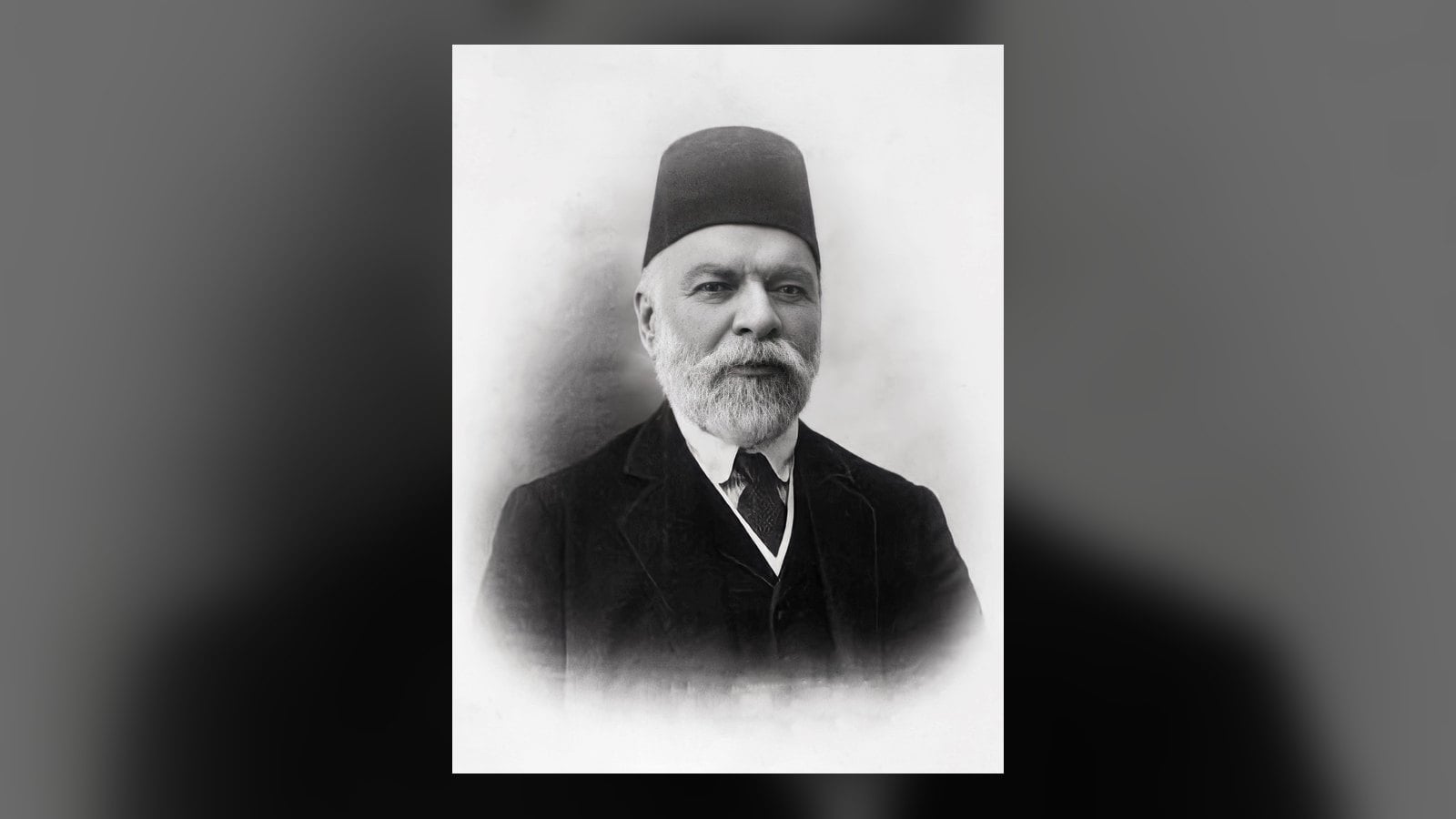
Ismail Qemali spent more of his life inside the Ottoman Empire than outside it. He was born in Vlorë in 1844, entered the imperial civil service at 16, governed Ottoman provinces on three continents, and rose high enough that he reported directly to the sultan. He served the empire loyally for 40 years. Then he left it, traveled across half of Europe in the middle of a war, and on a November afternoon in 1912 declared the country that empire had governed into a separate nation.
He was 68 years old.
The act took place on a balcony in his hometown. By the time he stood there, the Ottoman state he had spent his career serving was collapsing around him, and the armies of Serbia, Greece, and Montenegro were moving across the Albanian-speaking lands with no plan to leave an Albanian state on the map. Within two months, the Great Powers in London recognized what he had done. Within 14 months, they replaced his provisional government with a foreign prince. Within seven years, Qemali was dead in an Italian hotel room under circumstances that have never been fully explained.
Albanians call him Babai i Kombit — Father of the Nation. The title is not honorary. It is a description of the act. For the full story of the declaration itself — the Assembly of Vlorë, the delegates, the flag, the Great Powers — that article covers the event in detail. This one covers the man: where he came from, how a career Ottoman official became a national founder, and why a 40-year path through an empire matters to the country he built on the other side.
Vlorë, the Vlora family, and an education across three languages
Ismail Qemali was born on 16 October 1844 in Vlorë, then an Ottoman Adriatic port called Avlonya. His family, the Vloras, were a Muslim Albanian noble house with large landholdings in the region and a long record of loyal service to the Sublime Porte. His father was Mahmud Bey Vlora. His mother, Hadije Hanem, came from the Asllanpashalli family, another southern Albanian clan. A relative of his, Mehmed Ferid Pasha, would later serve as Grand Vizier.
The Vloras were Ottoman subjects, but they were Albanian-speaking, Albanian-rooted, and regionally anchored in ways that the empire’s administrative categories could obscure but not erase. This pattern — Albanian families operating fluently inside Ottoman structures while maintaining local identity — runs through the entire Albanian historical experience, from Skanderbeg in the 15th century to the Rilindja generation in the 19th.
Qemali’s education was broad by any standard. He did his primary schooling in Vlorë, then attended the Zosimaia School in Ioannina (Janina), where he studied ancient Greek morphology, Latin, and French. His family engaged a private tutor for Arabic and Persian. He later studied Ottoman law in Istanbul. By his twenties he spoke Albanian, Turkish, Greek, French, Latin, Italian, Arabic, and Persian — a range that the imperial system could use and that he, in turn, used to navigate it.
Forty years inside the Ottoman system (1860–1900)
In 1860, at 16, Qemali entered the Ottoman civil service as a translator at the Translation Office of the Sublime Porte in Istanbul — the nerve center of the empire’s diplomacy. The Translation Office was where the Ottoman state processed its contact with Europe, and it was a known pathway into the foreign ministry. Qemali’s language skills made him a natural fit.
Over the next three decades he held a succession of provincial appointments:
- 1860s: Translator at the Translation Office, then postings in Ioannina’s local administration.
- Late 1860s–1870s: Administrative roles in Ottoman Bulgaria, where he aligned with the reformist circle of Midhat Pasha, one of the empire’s most consequential liberal statesmen. He served as governor of Varna and the lower Danube region, and as vice-governor of Ruse (Rusçuk).
- 1876: When Midhat Pasha became prime minister, Qemali was appointed General Secretary of the Ministry of Foreign Affairs — one of the senior bureaucratic positions in the imperial government.
- 1877: After Sultan Abdülhamid II dismissed Midhat Pasha, Qemali was exiled to western Anatolia. Later recalled, he served as governor of Beirut and held other provincial appointments.
The career was not unusual for a talented Ottoman official from a provincial notable family. What was unusual was the political trajectory it traced. Qemali belonged to the empire’s liberal reformist wing — the same tradition that produced the first Ottoman constitution in 1876 and that Abdülhamid spent the next three decades suppressing. His exile after Midhat Pasha’s fall was the first of several moments when the imperial center decided he was more useful far from Istanbul.
The break: exile, flight, and the Albanian question (1900–1908)
In May 1900, Qemali boarded the British ambassador’s yacht in Istanbul and fled to political asylum in western Europe. He was 56. He had spent 40 years in Ottoman service, and the break was complete.
The exile years — 1900 to 1908 — were spent on two parallel tracks. On one, he worked for constitutional reform inside the Ottoman Empire, joining the network of Young Turk dissidents organizing in Paris and elsewhere. On the other, he engaged directly with the Albanian national movement: attending congresses, supporting efforts to standardize the Albanian alphabet, and building contacts with Albanian cultural associations across Europe. In an 1903 interview with an Italian newspaper, he publicly identified himself as an “Albanian patriot” — a statement that marked the shift from Ottoman reformer to national advocate.
The two tracks were not contradictory. Albanian political thought in this period often ran both at once: a reformed, constitutional empire could grant Albanian autonomy; a collapsed empire required Albanian independence. Qemali held both positions because both were plausible until events decided between them.
Back inside the empire — and then out again (1908–1912)
The Young Turk Revolution of 1908 restored the Ottoman constitution and the parliament. Qemali returned from exile and was elected as the representative for the Sanjak of Avlona (Vlorë).
The return was short. The Young Turks, who had promised constitutional government and equality for the empire’s peoples, moved instead toward Turkish centralism and military authority. Qemali opposed them, joined the opposition Liberal Party (Ahrar), and found himself again at odds with the ruling faction. Together with other Albanian deputies, he advocated for decentralization and full autonomy for the Albanian territories.
By 1912, events were outrunning every political position. The First Balkan War broke out in October, and the armies of Serbia, Greece, Montenegro, and Bulgaria began dismantling the Ottoman Empire’s European holdings. Serbian forces pushed toward the Adriatic through Albanian-populated land. Greek forces advanced in the south. If the Albanians did not declare a state, their lands would be partitioned among the victors.
November 1912: the race to Vlorë
In early November, Qemali left Istanbul and traveled through Bucharest, where he coordinated with the Albanian community in Romania. He then went to Vienna, where he met with Austro-Hungarian Foreign Minister Count Leopold Berchtold. Austria-Hungary had its own reasons to oppose Serbian expansion to the Adriatic — Qemali’s project and Vienna’s strategic interest aligned, even if their motives did not.
From Vienna he traveled to Trieste, then crossed the Adriatic. With Serbian forces approaching Durrës, he diverted south and landed in his hometown of Vlorë on 26 November 1912. Two days later, on 28 November, the Assembly of Vlorë convened, and Qemali read the declaration of independence from the balcony of a building that had served as a quarantine station.
He raised the red flag with the double-headed black eagle — the banner of Skanderbeg, unchanged in symbolism since the 15th century. The delegates — roughly 83 registered, though only about 40 signed the declaration — represented Albanian regions from the Adriatic to Kosovo.
The declaration was real. The state it described was, at that moment, a fiction. The provisional government controlled little more than the town of Vlorë.
The provisional government (1912–1914)
On 4 December 1912, the assembly formed a provisional government. Qemali served as head of state, prime minister, and — initially — minister of foreign affairs. The cabinet included nine ministers from across Albania’s regional and religious spectrum.
The government’s primary task was not domestic but diplomatic. In London, the Great Powers — Britain, France, Germany, Austria-Hungary, Russia, and Italy — were meeting to settle the aftermath of the Balkan Wars. Qemali sent memoranda to the six powers demanding recognition of Albania’s sovereignty and protection of its borders.
In the summer of 1913, the Treaty of London recognized Albania as an autonomous principality. That was less than Qemali had wanted — he had sought full sovereignty — and the borders the Great Powers drew left roughly half the ethnic Albanian population outside the new state, with most of Kosovo going to Serbia and Çamëria to Greece.
An International Control Commission was established to oversee Albanian affairs. The Great Powers selected Prince William of Wied, a German aristocrat with no connection to Albania, as the country’s new ruler. On 22 January 1914, Qemali resigned and handed power to the commission.
He had led the provisional government for 14 months. It was the first Albanian government in history, and it had no army, no treasury, and no territory beyond what the Great Powers chose to grant.
The final years (1914–1919)
After resigning, Qemali lived in Paris during the First World War. He was short on funds but maintained contacts across European diplomatic circles. He worked with the British journalist Sommerville Story on a memoir — The Memoirs of Ismail Kemal Bey, published posthumously by Constable & Co. in London in 1920. The book is notable as the only memoir of a late Ottoman statesman written in English, and it remains a primary source for the period.
In 1918 he traveled to Italy, where the Italian government confined him to a hotel in Perugia and prevented him from leaving the country.
He died there in January 1919 — sources differ between 24 and 26 January. He was 74. The official cause was a cerebral hemorrhage, but suspicions of poisoning have persisted for over a century. After his death, all internal organs were removed before burial — a decision that eliminated any possibility of a later autopsy. The identity of whoever may have wanted him dead has been attributed to Greek, Serbian, Italian, and Turkish agents, depending on the source and the decade.
He was first buried in Kanina, a village near Vlorë connected to his family. On 28 November 1932 — the 20th anniversary of the declaration — King Ahmet Zogu ordered his remains reburied in Vlorë.
What Babai i Kombit means to Albanian Americans
Ismail Qemali is the closest thing in Albanian political history to a George Washington figure: the person who convened the founding act, led the first government, stepped down voluntarily, and died before the country he built had settled into a permanent shape.
The differences are as instructive as the parallels. Washington had an army. Qemali had a declaration and a building in a port town. Washington’s state survived him; Qemali’s provisional government was replaced within 14 months by a foreign prince imposed by the Great Powers.
What survived was the act itself. The declaration of 28 November 1912 is the founding document of the Albanian state, and Qemali’s name is permanently attached to it. Every year, Albanian Americans mark 28 November as both Independence Day and Flag Day — the day that created the country their families came from or the heritage they carry forward.
For Albanian Americans navigating the question of what it means to maintain an ethnic identity across generations and an ocean, Qemali’s story carries a particular resonance. He operated fluently inside a larger political system — the Ottoman Empire — for 40 years, and when that system could no longer serve his people, he built an alternative. The act required both things: deep knowledge of the system he was leaving, and a clear-eyed assessment of the moment it was time to leave.
His memoir, freely available on the Internet Archive, is the firsthand account. The Independence Museum in Vlorë preserves his working cabinet and the room where the provisional government met. The 17-meter Independence Monument in Vlorë’s Flag Square depicts him holding the Albanian flag, surrounded by figures from across the regions that came together in November 1912 to say, for the first time in the Albanian language and under Albanian authority: this country exists.