
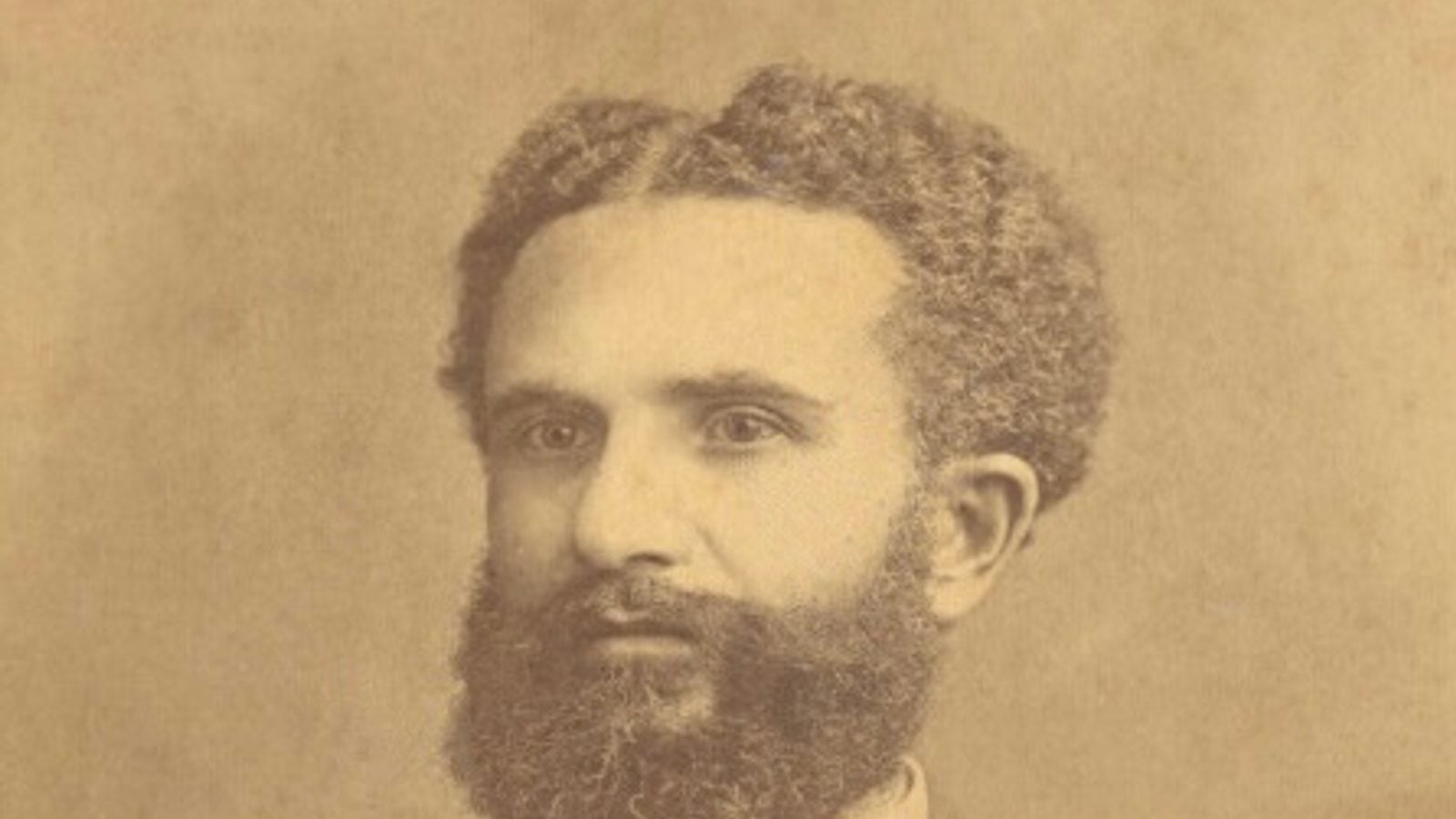
Abdyl Frashëri was born in 1839 in the village of Frashër, in the Ottoman Janina vilayet — today in the Përmet district of southern Albania. He was the oldest of three brothers who, between them, gave the Albanian National Renaissance its political organization, its literature, and its intellectual program. Naim wrote the poetry. Sami wrote the encyclopedia and the manifesto. Abdyl did the politics.
That meant something specific in the late Ottoman Balkans. It meant building an organized Albanian political voice from nothing — no recognized Albanian political body existed, no Albanian-language administration, no agreed alphabet, no legal framework for the claim that “Albanian” was a nationality at all. Greek, Serbian, and Montenegrin states were each working to absorb Albanian-speaking populations into their own national projects. The Ottoman center treated Albanian demands as provincial nuisance. Abdyl Frashëri’s contribution was to make those demands impossible to ignore.
He paid for it with his freedom and, not long after, his life.
The family and the context
The Frashëri family was a prosperous, landowning Albanian household affiliated with the Bektashi order of Sufi Islam. The Frashër Tekke — the Bektashi lodge in the village — had been founded in 1781 and was one of the order’s important southern Albanian centers. All three brothers grew up in that network.
After the death of his father, Abdyl moved to Ioannina (Albanian: Janina), the vilayet capital, where he entered the Ottoman administrative service. Unlike his younger brothers, who gravitated toward literature and scholarship, Abdyl built a career inside the Ottoman system — serving as a provincial official and member of the Ottoman administrative council in the Janina vilayet. He understood how the imperial bureaucracy worked because he had worked inside it.
That practical knowledge mattered in 1878 when the map of the Balkans was about to be redrawn.
The Congress of Berlin and the Albanian crisis
In 1878, the Russo-Turkish War ended with the Treaty of San Stefano, which proposed transferring large areas of Albanian-inhabited territory to Serbia, Montenegro, and a newly created Bulgarian state. The European Great Powers, unwilling to accept Russia’s terms, convened the Congress of Berlin to redraw the settlement.
No Albanian was invited to Berlin. No Albanian political body existed to send one. The decisions made there — ceding the predominantly Albanian cities of Ulcinj, Plav, and Gusinje to Montenegro, and parts of the Kosovo and Monastir vilayets to Serbia — were made without Albanian input and against Albanian interests.
Abdyl Frashëri saw this coming. In the months before Berlin, he helped organize a response.
Building the League of Prizren
On 10 June 1878, delegates from across the Albanian-inhabited regions of the Ottoman Empire met in the city of Prizren, in what is now Kosovo. They formed the Lidhja Shqiptare e Prizrenit — the Albanian League of Prizren — the first organized political body to speak in the name of Albanians as a people.
The League had two wings. The military wing, led by landowners and tribal leaders from the northern highlands, organized armed resistance to the border changes dictated at Berlin. The political wing, led by Abdyl Frashëri and a circle of southern Albanian intellectuals, pursued something harder: a diplomatic and administrative argument for Albanian autonomy within the Ottoman framework.
Abdyl served as the head of the League’s political committee. He drafted memoranda to the Ottoman Porte and to European governments arguing that the four Albanian-inhabited vilayets — Kosovo, Shkodra, Monastir, and Janina — should be unified into a single autonomous Albanian province with its own administration, schools, and Albanian-language governance. The demand was not independence; it was recognition that Albanians existed as a people and deserved to govern their own territory within the empire.
He traveled to Istanbul and to European capitals to press the case. He composed petitions in Ottoman Turkish and French. He met with Ottoman officials, foreign diplomats, and sympathetic intellectuals. The League’s political program, as Abdyl articulated it, was the first coherent Albanian political platform — and it set the terms for every Albanian political demand that followed for the next 34 years, through to independence in 1912.
Armed resistance and the Ottoman crackdown
The military wing of the League did what the diplomatic wing could not. Albanian fighters resisted the handover of Albanian territory to Montenegro, holding the cities of Plav, Gusinje, and Ulcinj through 1878 and 1879 against both Montenegrin forces and Ottoman pressure to comply with the Berlin settlement. The Great Powers eventually forced the exchange — Montenegro received Ulcinj in 1880 — but the armed resistance demonstrated that Albanian communities would fight for territory the Congress of Berlin had given away without asking them.
The Ottoman response came in 1881. Sultan Abdul Hamid II, who had initially tolerated the League as a useful counterweight to Slavic expansion, now saw it as a threat to central authority. Ottoman forces under Dervish Pasha were sent to crush the League militarily. Prizren fell. The League’s military leadership was scattered.
Abdyl Frashëri was arrested.
Imprisonment and death
The Ottomans held Abdyl in the Prizren fortress for three years. He was then transferred to forced residence in Balkesir and later Bandirma — Anatolian towns the empire used to isolate political detainees far from their networks.
The years of detention broke his health. By the time he was free to move, he was a diminished man — the tuberculosis or chronic illness he had contracted during imprisonment was progressing. He settled in Istanbul, the city where his brother Naim was already working as a civil servant in the Ministry of Education and writing the poetry that would define Albanian literary culture for the next century.
Abdyl Frashëri died on 23 October 1892 in Istanbul. He was 53 years old. He did not live to see the standardization of the Albanian alphabet at the Congress of Monastir in 1908, nor the declaration of Albanian independence in 1912, nor the rise of his son Mid’hat Frashëri to the leadership of the Albanian political movement in the next generation.
What Abdyl built
The League of Prizren lasted three years. The Ottoman army dissolved it. Its military wing was defeated. Its political program — a unified, autonomous Albanian province — was not realized in Abdyl’s lifetime.
But what the League established survived: the argument that Albanians were a people, not a collection of Ottoman Muslim subjects who happened to speak the same language. Before 1878, Albanian political identity was local — clan, village, region, religious community. After the League of Prizren, it was national. That shift did not happen by itself. Abdyl Frashëri organized it, articulated it, and went to prison for it.
The Rilindja Kombëtare — the Albanian National Renaissance — is usually described as a cultural and literary movement. That is half true. Naim Frashëri provided the literature. Sami Frashëri provided the intellectual framework. But Abdyl gave it the political claim: Albanians have a right to self-governance, and the territory they inhabit belongs to them. Without that claim, the poetry and the encyclopedias were a cultural exercise. With it, they were the foundation of a nation.
The Frashëri division of labor
The three brothers divided the work of nation-building among themselves so cleanly that later historians have sometimes treated them as a single project with three faces. Abdyl organized the political movement, articulated the demand for autonomy, and built the alliances that gave the Albanian cause its first institutional form. Naim wrote the poems, the Skanderbeg epic, and the Bektashi devotional literature that gave Albanians a shared literary culture across religious and dialect lines. Sami wrote the Turkish encyclopedia, the political pamphlet Shqipëria — ç’ka qenë, ç’është, e ç’do të bëhet? (Albania — What it Was, What it Is, and What it Will Be), and the analytical case for Albanian nationhood.
Each brother’s work was necessary. None of their contributions, alone, would have been sufficient. The political movement without the literature would have been a petition. The literature without the political movement would have been folklore. The intellectual argument without either would have been an essay.
Abdyl was the oldest. He started first. And because political organizing in the late Ottoman Balkans carried risks that writing poetry did not, he was the one who went to prison.
The son who carried it forward
Abdyl’s son, Mid’hat Frashëri (1880–1949), inherited the political side of the family project and ran it through the next half-century. Mid’hat chaired the 1908 Congress of Manastir that standardized the Albanian alphabet. He ran an Albanian-language bookshop and publishing house in Sofia and later Tirana. During World War II, he led Balli Kombëtar, the nationalist resistance front. In 1949, he became the first chair of the National Committee for a Free Albania in New York — an exile organization headquartered in the Albanian-American community — and died of a heart attack at the Lexington Hotel in Manhattan weeks into the role.
The line runs from a mountain village in the Përmet district to a hotel room on Lexington Avenue. It passes through Abdyl.
Why this matters for Albanian Americans
The League of Prizren was not an American story. It happened in Ottoman Kosovo in 1878, organized by men who had never heard of Detroit or the Bronx. But the political work Abdyl Frashëri did at Prizren — insisting that Albanian identity was national, not local, and that Albanians had a right to govern their own territory — was the foundation on which everything that followed was built: the alphabet congress, the declaration of independence, the state, the wars, the communist period, the collapse, the immigration waves that brought Albanian families to the United States.
The first organized Albanian-American institutions — Vatra in Boston (1912), the Albanian-American Civic League, the newspapers and community organizations — drew their sense of Albanian identity from the same source. The people who founded those institutions came from families and communities that had been shaped by the Rilindja, by the League of Prizren, by the argument Abdyl Frashëri made and went to prison for.
When NAR counts Albanian Americans, the number we count comes from somewhere. Part of where it comes from is a mountain village in Përmet, three brothers, and a political movement that started with the oldest one saying: we are a people, and we have a right to be counted.