

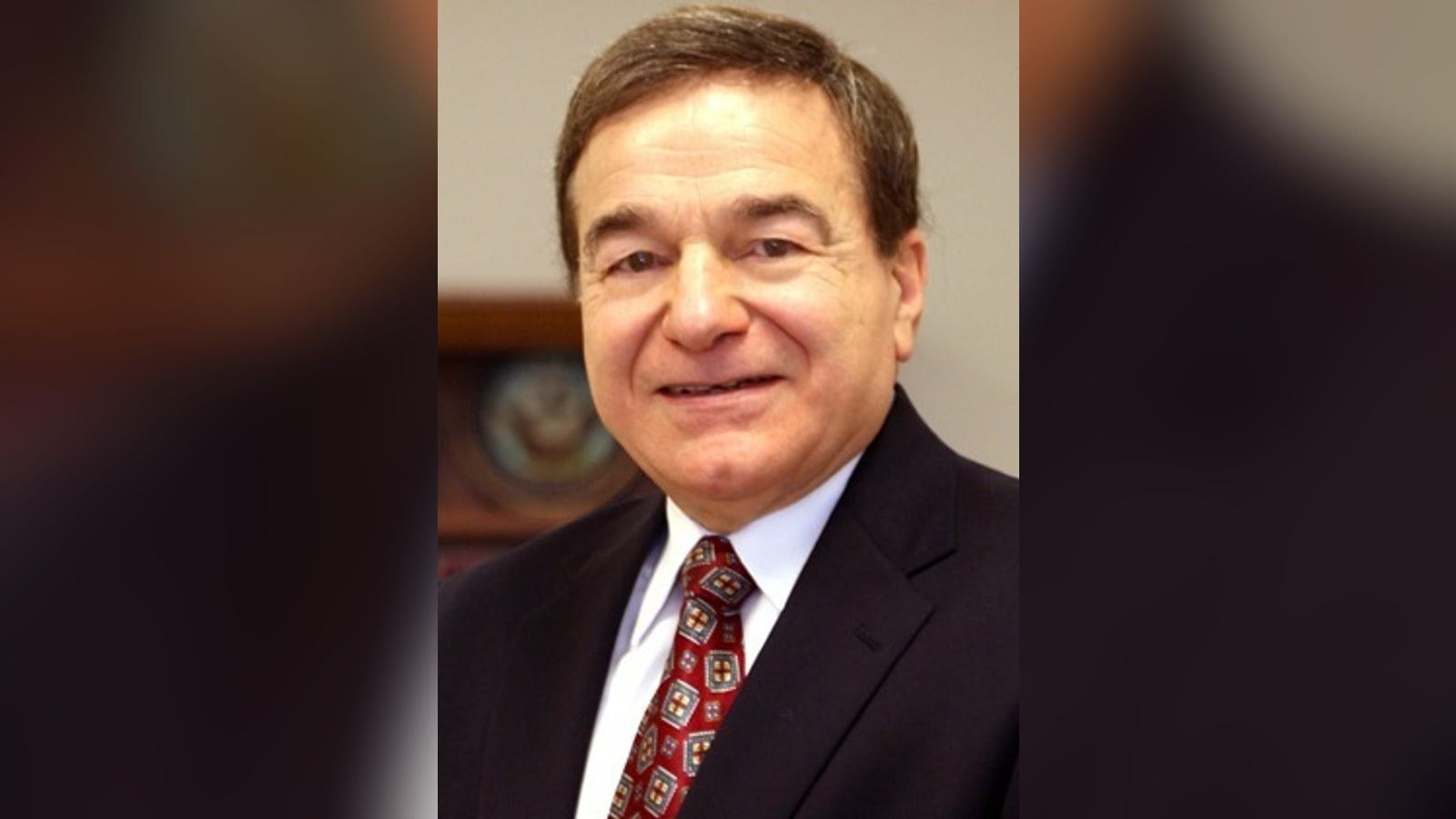
In the months before the March 1999 NATO air campaign over Kosovo, the most-quoted Albanian-American voice in Washington was not an embassy and not a federation. It was a small civic league run out of a Westchester County, New York office by a former two-term Republican Congressman and his wife.
The organization was the Albanian American Civic League — the AACL. Its president was Joseph J. DioGuardi, who had represented New York’s 20th Congressional District from 1985 to 1989 and was the first Albanian-American voting member of the US Congress. Its Balkan Affairs Adviser was Shirley Cloyes DioGuardi, a writer and foreign-policy analyst who had joined the league in 1994. Together they had spent a decade walking the corridors of the Russell, Dirksen, and Hart Senate office buildings making the case for stronger US engagement on Kosovo.
This article is the institutional reference for the AACL. What follows is what the league is, when and where it was founded, the people who built it, the work it did on Capitol Hill through the most consequential decade of modern Albanian history, how it differs from older Albanian-American organizations like Vatra, and why a Westchester advocacy group founded in 1989 still matters to today’s roughly 230,000 recorded Albanian Americans — a community whose broader heritage population runs closer to a million.
What the AACL is
The Albanian American Civic League is a US-based advocacy organization. It is not a member-based civic federation in the Vatra sense. It is not an embassy auxiliary. It is not a research institute. It is a focused foreign-policy lobby, organized to translate Albanian-American community interests into US congressional and executive-branch action.
Its mission, restated across more than three decades, has three parts. First: organize the Albanian-American community as a US foreign-policy constituency. Second: educate members of Congress, the executive branch, and the media about Albanian national questions — the Kosovo settlement above all, but also the rights of ethnic Albanians in North Macedonia and Montenegro, US-Albania bilateral relations, and the broader Balkan policy frame. Third: mobilize naturalized Albanian-American voters to participate in US elections.
The league has operated out of Ossining, New York, in Westchester County, since its founding. It is structurally a small organization — president, Balkan adviser, board, and a network of donors and volunteer activists across the Northeast, the Great Lakes, and the diaspora more broadly. It has never had the chapter footprint of Vatra or the membership rolls of regional civic groups. What it has had, consistently, is access — to senators, to House members, to staff directors, to State Department officials, and to the press.
For a 1980s immigrant-origin community whose total US population was still measured in the tens of thousands at the time of the league’s founding, building that kind of access from scratch was the organizing achievement.
The founding: Joe DioGuardi, 1989, Westchester County
The AACL was founded in January 1989. The founder was Joseph J. DioGuardi. The setting was the immediate aftermath of his November 1988 loss in New York’s 20th Congressional District race.
DioGuardi was born in the Bronx in 1940 to an Italian-American family of partial Albanian (Arbëresh) descent — the southern Italian Albanian-origin community whose ancestors fled the Ottoman conquest of the Balkans in the late 1400s. He was educated at Fordham University, became a certified public accountant, and built a long career at Arthur Andersen & Co., eventually becoming a partner. He was elected to the US House of Representatives in 1984 as a Republican, took office in January 1985, was reelected in 1986, and lost his 1988 reelection bid. He was the first Albanian-American voting member of the US Congress.
The 1985–1989 House years had already pulled DioGuardi into Albanian-diaspora politics. As an Albanian-origin member of Congress at a moment when Yugoslavia’s central government in Belgrade was tightening control over the autonomous province of Kosovo — and as the federation’s Rilindja-era Albanian-language institutions were being shut down — he had become the natural congressional point of contact for Albanian-American activists. He cosponsored early human-rights resolutions on the situation in Kosovo. In June 1986, after sustained lobbying by Albanian-American activists, the first congressional resolution on Albanian human rights in Yugoslavia — H.Con.Res. 358 — was introduced in the House. The next day, Senator Bob Dole introduced the same resolution in the Senate as S.Con.Res. 150. The Dole-DioGuardi pairing of those 1986 resolutions is the foundation of much of what the AACL would build on after 1989.
When DioGuardi lost his 1988 reelection, the choice he made was unusual for a defeated incumbent: rather than return full-time to accountancy or run for the seat again, he turned the Albanian-American organizing he had been doing as a House member into a standing institution. The AACL was incorporated in January 1989. Its base of operations was Westchester County. Its core program was Kosovo.
The 1990s on Capitol Hill
The decade from 1989 to 1999 is the period in which the AACL became, in practice, the central US advocacy voice on Kosovo. Three threads ran in parallel.
The first was legislative. Building on the 1986 Dole and DioGuardi resolutions, the AACL pressed for sustained congressional attention to Kosovo’s deteriorating human-rights situation after Slobodan Milošević stripped the province of its autonomy in 1989. The league briefed members and staff, drafted resolution language, and built a bipartisan list of allies — among them Senate Republican Leader Bob Dole of Kansas, Senate Foreign Relations Committee member Claiborne Pell of Rhode Island, Larry Pressler of South Dakota, and Alfonse D’Amato of New York; in the House, members including Bronx Democrat Eliot Engel, Representative Tom Lantos of California, and Representative Dana Rohrabacher of California.
The second thread was mass mobilization. In July 1991, the AACL organized a march in Washington that drew, by its own count, more than 10,000 Albanian-Americans from the White House to Capitol Hill. Senators Dole, Pell, Pressler, and D’Amato addressed the crowd along with several House members. For a community whose total US population was still in the tens of thousands at the time, a five-figure turnout on the National Mall was a meaningful signal — and it was the kind of signal a senator’s foreign-policy staffer registers.
The third thread was executive-branch engagement. Through the George H. W. Bush and Bill Clinton administrations, the AACL pressed the State Department, the National Security Council, and successive special envoys to treat Kosovo as a distinct policy file rather than a footnote to the larger Yugoslav wars. The league’s posture was that the Dayton Accords of November 1995 — which ended the Bosnian war — had explicitly left Kosovo unresolved, and that an unresolved Kosovo would produce its own war if Washington did not act.
That prediction was vindicated. By 1998, open conflict had broken out between Yugoslav security forces and the Kosovo Liberation Army (UÇK in Albanian — Ushtria Çlirimtare e Kosovës). The Rambouillet negotiations in France in early 1999 failed. NATO began its air campaign on March 24, 1999. The campaign continued until June 1999, when Yugoslav forces withdrew from Kosovo under the terms of UN Security Council Resolution 1244, and the province came under interim United Nations administration (UNMIK).
The AACL’s role in that decade was that of an advocacy organization, not a decision-maker — Washington decisions are made in Washington — but the league had spent ten years building the congressional and media context in which a NATO intervention on behalf of Kosovo Albanians could be politically defended at home. That context-building is what foreign-policy lobbies do. It is what the AACL did.
Shirley Cloyes DioGuardi and the policy program
The AACL’s policy program through the 1990s and 2000s was shaped substantially by Shirley Cloyes DioGuardi, who joined the league in 1994 as its Balkan Affairs Adviser and has held that role since.
Her background was not the Albanian community. She was a writer, foreign-policy analyst, and former book publisher who had previously worked in the US publishing industry on international affairs titles. She married Joe DioGuardi and brought to the league a different professional toolkit than its founder: deep familiarity with the Washington policy-writing world, an editorial sensibility, and an analyst’s posture toward the broader Yugoslav-successor-state question.
Her contribution to the AACL has been the substantive policy writing and the public-facing analytical voice. Through the late 1990s and into the 2000s she authored or co-authored a continuing stream of articles, op-eds, congressional testimony, and book chapters on Kosovo, on the broader Balkans, on the rights of ethnic Albanians in North Macedonia and Montenegro, and on US foreign policy in the region. She has spoken at academic conferences, briefed congressional staff, and represented the league in delegations to the Balkans — including a notable delegation with Representative Dana Rohrabacher to Albania, Montenegro, and Kosovo.
The institutional point is that the AACL has, since 1994, been a two-principal organization. Joe DioGuardi runs the Capitol Hill politics and the institutional shell. Shirley Cloyes DioGuardi runs the policy program and the analytical output. That division of labor is part of why a small organization with a tiny payroll has continued to produce a steady stream of substantive Balkan policy material for more than three decades.
AACL and Vatra: two ages of Albanian-American organizing
It is useful to compare the AACL with Vatra, the Pan-Albanian Federation of America, because the two organizations represent two different ages of Albanian-American civic life.
Vatra was founded in Boston in April 1912 by Faik Konitza and Fan Noli — seven months before Albania itself declared independence. It is a member-based civic federation, organized around a network of local chapters, focused on Albanian-American community life broadly. Its newspaper Dielli, founded in 1909, is one of the oldest Albanian-language papers in the US; publication paused from 2006 to 2011 and has continued since. Its institutional posture, then and now, is that of a hearth — the literal meaning of vatra — for the whole Albanian-American community.
The AACL was founded in Westchester County in January 1989 by Joe DioGuardi — a generation after Vatra’s founding had passed and a generation before today’s diaspora was born. It is a focused foreign-policy advocacy organization. It does not run chapters. It does not publish a newspaper of record. Its institutional posture is that of a Washington lobby, not a hearth.
These are not competing models. They are different tools for different jobs.
The 1912 generation built Vatra because the institutional task was community formation — gathering a scattered immigrant population around shared civic life, and making the case in Washington for an Albanian state on the post-Ottoman map. The 1989 generation built the AACL because the institutional task had shifted — the Albanian-American community now existed as a settled US population, and what was needed was a sharp instrument for moving US foreign policy on a specific set of national questions, Kosovo above all.
Both bodies are atdhetar (patriot) institutions in the Albanian sense. Both are still operating in 2026. Both have records that any serious account of twentieth-century Albanian-American civic life has to draw on. Treating them as alternatives misreads the institutional history. They are, in practice, the older and the younger sister institutions of organized Albanian-American life.
What the AACL does today
The AACL’s contemporary program is recognizable to anyone who tracked the organization in the 1990s, with adjustments for the post-2008 settlement.
Kosovo advocacy remains the league’s central file. Kosovo declared independence on February 17, 2008. The United States formally recognized Kosovo the following day. Roughly 110 of the 193 UN member states have since recognized Kosovo (Wikipedia: International recognition of Kosovo) — short of the threshold the Kosovo government has been pursuing. The AACL’s post-2008 work has focused on pressing for broader international recognition, defending the 1999 settlement against attempts to renegotiate the post-war framework, and weighing in on the Belgrade-Pristina dialogue process.
Ethnic-Albanian advocacy in the wider region is the second file. The AACL publishes regularly on the status of ethnic Albanians in North Macedonia — where the Ohrid Framework Agreement of August 2001 reshaped that country’s domestic institutions — and on the smaller ethnic-Albanian communities in Montenegro and the Preševo Valley of southern Serbia. The league does not always take positions that align with Pristina or Tirana; the consistent posture is that ethnic-Albanian populations in the wider region deserve sustained US policy attention.
Civic education and community mobilization is the third file. The league publishes articles and analysis on its website, aacl.com. It encourages naturalized Albanian-American citizens to register to vote, to engage with their members of Congress, and to participate in US civic life. For an immigrant-origin community that, depending on the count, runs from the recorded US Census figure of roughly 230,000 to a community estimate closer to a million, organized civic participation is the precondition for sustained policy influence.
Scholarship and recognition programs round out the contemporary work. The league has, across its history, supported educational and cultural programs aimed at younger Albanian-Americans and at building Albanian-American visibility in US public life. These programs are modest by foundation standards but consistent.
The AACL in the larger Albanian-American civic landscape
The contemporary Albanian-American organizational landscape is broader than it was in 1989, and the AACL is one institution in a working network rather than the sole national voice on diaspora policy questions.
Vatra remains the oldest continuously-operating Albanian-American civic federation, headquartered in Boston, with Dielli publishing online at gazetadielli.com.
The Albanian American National Organization (AANO) is a separate national civic body with a chapter network — the New York chapter is headed by Ervin Toro, who is also the founder of the National Albanian Registry. AANO’s civic program is closer in style to Vatra’s than to the AACL’s.
The Albanian American Educators Association (AAEA) organizes Albanian-American teachers and education professionals across the US.
Regional civic groups operate in the major Albanian-American population centers: New York (the home of the largest single Albanian-American population in the US, roughly 56,000 by ACS count), Michigan (roughly 27,000), Massachusetts (roughly 21,000), Pennsylvania, Connecticut, New Jersey, Illinois, and the Dallas–Fort Worth metroplex, among others.
Religious bodies — the Albanian Orthodox Archdiocese in America, Albanian Catholic communities, Sunni and Bektashi mosques — play significant civic roles in their respective communities.
Albanian-language and bilingual media outlets — Illyria newspaper, Dielli, ACTV Michigan, and a growing list of digital publications — carry the diaspora’s news.
Against this landscape, the AACL’s distinct contribution is its Capitol Hill orientation. Where Vatra is the hearth, where AANO is the chapter network, where regional groups are the local civic infrastructure, and where the religious bodies are the spiritual centers, the AACL is the Washington advocacy specialist. The community is large enough and diverse enough to support all of these institutional roles. The AACL is the one that picks up the phone when a Senate Foreign Relations Committee staffer wants an Albanian-American policy view on a draft resolution.
Why this matters to today’s diaspora reader
For a younger US-based shqiptar (the Albanian self-name) reading this in 2026, the AACL’s institutional history carries three practical lessons about how Albanian-American civic power has actually been built.
The first lesson is that policy access is built across decades, not weeks. The Dole-DioGuardi 1986 resolutions came after years of community lobbying. The 1991 Washington rally came after two years of league-building. The 1999 NATO campaign came after a decade of sustained AACL Capitol Hill work. The community institutions that get listened to in Washington are the ones that show up consistently across multiple administrations, not the ones that show up once.
The second lesson is that organizational specialization matters. The AACL did not try to be Vatra. It did not try to run chapters, publish a newspaper, organize cultural festivals, or be the central civic federation. It picked one job — US foreign-policy advocacy on Albanian national questions — and built the institution around that job. The result is that a small organization with a tiny payroll has had a real effect on the US policy conversation for more than thirty years.
The third lesson is that naturalized citizenship is the precondition for political voice. The AACL has, from the start, encouraged Albanian-American immigrants to naturalize, to register to vote, and to participate in US elections. Members of Congress respond to constituents. A foreign-policy lobby works for an immigrant-origin community when that community shows up at the polls in the districts that matter — in New York, in Michigan, in Massachusetts, in the growing Albanian-American communities of Pennsylvania, Connecticut, Illinois, and Texas. The AACL’s bet, across three decades, has been that an organized, naturalized, voting Albanian-American electorate produces sustained policy attention. The post-1999 settlement is, in part, a vindication of that bet.
For today’s reader, none of this is abstract. The institutional pattern the AACL helped establish — a community organized enough to be taken seriously in Washington — is the same pattern that any future Albanian-American civic-policy effort will be built on.
The AACL built a generation of organized Albanian-American foreign-policy advocacy. The National Albanian Registry is building the count behind it — the community-led headcount of US Albanian Americans across every state, generation, faith, and Balkan country of origin. Add your name at /register — it’s free, takes about a minute, and is the count this diaspora has needed since 1912.