
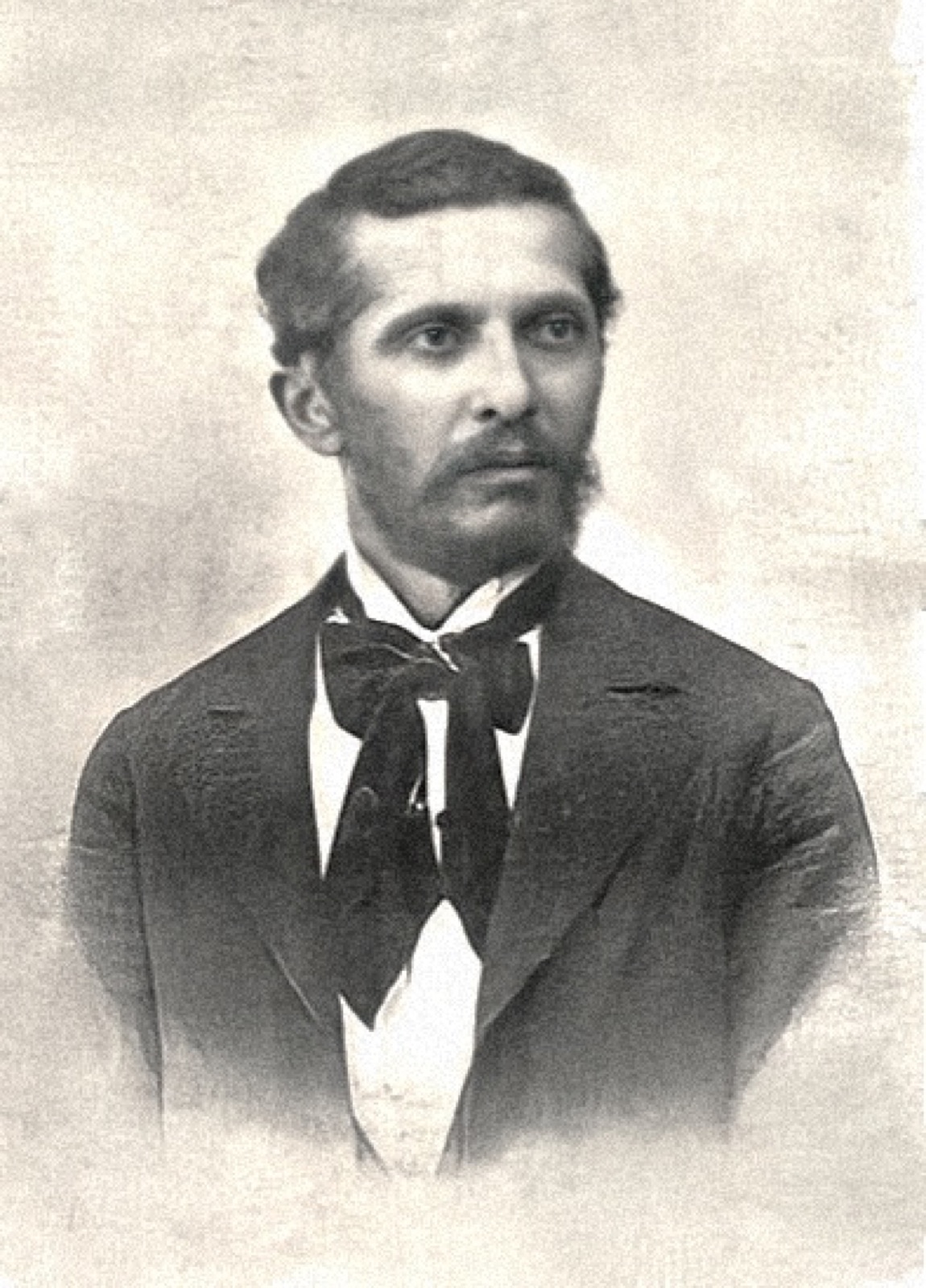
Naim Frashëri is the closest thing the Albanian language has to a Shakespeare or a Pushkin — the writer that a national literature dates itself by. He was born in 1846 in Frashër, a small mountain village in what was then the Ottoman Janina vilayet and is today southern Albania, and he died in Istanbul on 20 October 1900, twelve years before there was an Albanian state. In between, he wrote the books that taught a generation of Albanians to read in their own language.
The reason that matters for an Albanian-American family in 2026 is simple. The first organized Albanian-American communities — Boston, Worcester, the textile mill belt of New England, the Albanian colony of New York — were forming in exactly the years Naim’s books were circulating among Albanians abroad. Bagëti e Bujqësia (Cattle and Crops) was published in 1886. Histori e Skënderbeut (The History of Skanderbeg) appeared in 1898. Dielli, the Boston-based Albanian-American newspaper that is still in print, launched in 1909 as the paper of Boston’s Besa-Besën society, edited in its early years by Faik Konica and Fan Noli. Copies of Naim’s poetry reached the Albanian colonies in Massachusetts and New York and were used as primers — alongside Sami Frashëri’s grammar — for adults learning to read shqip (the Albanian language) for the first time.
If your grandparents or great-grandparents emigrated from Korçë, Përmet, Gjirokastër, or any of the southern Albanian districts that fed early American immigration, there is a real chance the first sustained Albanian text they ever read was a Naim Frashëri poem. The text below is the long version of why he matters and what he wrote.
Who Naim Frashëri was
Naim Frashëri lived from 25 May 1846 to 20 October 1900 — fifty-four years that ran from the high Tanzimat reform period of the Ottoman Empire through the League of Prizren (1878), the Berlin Congress, the founding of the Society for the Publication of Albanian Writings in Istanbul (1879), the long propaganda fight over Albanian schools and the alphabet, and almost — but not quite — to Albanian independence in 1912.
He worked across at least four languages. He published a lyric collection in Persian (Tahajjulat, 1885), a study of Islam in Greek, an early scientific primer in Turkish, and the body of Albanian poetry and prose that the rest of this article is about. The standard count of his total literary output, across all four languages, is around twenty-two titles — of which about fifteen are in Albanian, four in Turkish, two in Greek, and one in Persian (Wikipedia: Naim Frashëri).
He held a stack of identities at once: civil servant in the Ottoman Ministry of Education in Istanbul, member of the Society for the Publication of Albanian Writings, Bektashi by family and conviction, brother to two of the most consequential Albanian political figures of the period, and — by the end of his life — the writer Albanians outside Albania read first when they wanted something in their own language. He never returned to Albania after leaving it as a young man.
The scholarship on him in English is led by Robert Elsie, the Canadian-born albanologist who translated and annotated Albanian literature for an English-reading audience for forty years. Elsie’s History of Albanian Literature (1995) and his anthology Albanian Literature: A Short History (2005) are the standard references; both place Naim at the center of the nineteenth-century Albanian canon.
From Frashër village to Istanbul
The Frashëri family came from Frashër, a small village in the Përmet district of what is now southern Albania, then part of the Ottoman Janina vilayet. The village sits in the mountains north of Përmet, in the area that later became the Fir of Hotova national park. It is a real place; it is also a kind of metonym for the southern Albanian Bektashi heartland that produced an outsized share of the National Renaissance leadership.
The family was prosperous landowning Albanian, affiliated with the Bektashi tariqa of Sufi Islam. The local Frashër Tekke — the Bektashi lodge — had been founded in 1781 and was one of the order’s important southern centers; the brothers grew up steeped in its traditions.
Naim’s parents died in the mid-1860s, and the family moved south to Ioannina (Albanian Janina), the administrative capital of the vilayet. There Naim and his younger brother Sami enrolled at the Zosimaia, a Greek-language secondary school that was the most important institution of Western-style education available to the Christian and Muslim populations of the region. At the Zosimaia he learned Ancient and Modern Greek, French, and Italian; outside it he took private lessons in Ottoman Turkish, Persian, and Arabic from local Bektashi teachers. The trilingual base — Greek for Western literature, Ottoman Turkish and Persian for the Islamic literary tradition, Albanian as the family’s first language — defines him.
In the late 1860s and early 1870s he worked briefly as a customs officer in Ioannina and at Saranda on the coast, then moved to Istanbul, where he spent the rest of his life as a civil servant in the Ottoman Ministry of Education. Istanbul in those years was the largest Albanian city in the world by population. It was also where the political and literary work of the Rilindja was actually being done, by Albanian intellectuals and merchants operating in the imperial capital while the homeland was under direct Ottoman administrative control.
The Frashëri brothers as a single project
The three Frashëri brothers should be read as one project with three departments. None of them is fully legible alone.
Abdyl Frashëri (1839-1892) is the political brother. He served in the Ottoman administration, then became one of the founding leaders of the League of Prizren in 1878 — the first organized Albanian political body to demand autonomy from the Ottomans and resist the partition of Albanian-inhabited territory among the Balkan states under the Treaty of San Stefano. He led Albanian delegations across European capitals trying to get Albanian claims recognized at the Berlin Congress. He was captured when Ottoman forces crushed the League’s provisional government in 1881, imprisoned until 1886, then exiled — he died in 1892.
Naim Frashëri (1846-1900) is the poet — the cultural and spiritual brother. His job in the project was to give Albanians something to read in their own language: pastoral poems, Skanderbeg as epic, a Bektashi devotional, lyric verse. The political case Abdyl was making in cabinets needed a literary substrate to land on, and that substrate did not exist before Naim wrote it.
Sami Frashëri (1850-1904) is the polymath. He wrote the six-volume Ottoman-Turkish encyclopedia Kâmûs-ül A’lâm (1889-1898), a Turkish-French dictionary, novels in Turkish, and — most relevant here — the political pamphlet Shqipëria — ç’ka qenë, ç’është, e ç’do të bëhet? (Albania — What it Was, What it Is, and What it Will Be), published in Bucharest in 1899, which laid out the program for an autonomous and eventually independent Albania. He served on the same Istanbul Albanian Society Naim served on, and his proposed alphabet became the basis of the 1879 Stamboll (Istanbul) alphabet.
The three of them lived through the same Ottoman political settlement, the same family Bektashi tradition, and the same Istanbul intellectual milieu, and they divided the labor of the National Renaissance among themselves: politics, literature, scholarship.
The Rilindja Kombëtare context
To understand why a national poet was needed, hold the political situation of the 1870s and 1880s in mind. The Ottoman Empire was visibly contracting in the Balkans. Greece had been independent since 1830 and was actively asserting territorial claims against Albanian-inhabited southern districts on the basis of Greek-Orthodox population shares. Serbia, Montenegro, and Bulgaria gained or expanded sovereignty in 1878. The Treaty of San Stefano, signed in March 1878, would have partitioned almost all Albanian-inhabited territory among the new Slavic states; the Berlin Congress of June-July 1878 walked some of that back, but the trajectory was unmistakable.
Albanians in this period had no agreed alphabet, no schools in their own language inside the Ottoman Empire (Albanian-language schools were illegal under Ottoman law for most of the nineteenth century), no recognized political body, and a confessional split among Sunni Muslims, Bektashis, Catholics in the north, and Orthodox Christians in the south that the Greek and Slavic claimants were actively exploiting to argue that “Albanian” was not really a nationality.
The Rilindja Kombëtare — literally “the National Rebirth” or Albanian National Renaissance — was the response. Its core goals were straightforward: standardize the alphabet, build a literature in Albanian, open Albanian-language schools, push for autonomy or independence, and articulate an Albanian national identity that could bridge the four religious communities. The movement runs from roughly the founding of the League of Prizren in 1878 to the Declaration of Independence at Vlorë on 28 November 1912. Naim’s adult life is the same window. He is not a contemporary of the Rilindja; he is one of its central producers (Wikipedia: Rilindja).
The Istanbul Albanian Society and the alphabet question
In 1879, in Istanbul, a group of about thirty Albanian intellectuals founded the Society for the Publication of Albanian Writings (Albanian: Shoqëria e të Shtypuri Shkronjavet Shqip) — usually shortened in English to the Istanbul Albanian Society or Shoqëria e Stambollit. Sami Frashëri was its first president; Naim was an early and active member.
The society’s first practical task was to settle the alphabet. Albanian had been written, before this point, in at least four different scripts: Arabic for Muslim Albanians, Greek for Orthodox Albanians, Latin for Catholic Albanians (especially in the north), and a small number of original Albanian alphabets like the Elbasan script and Vellara script. The arguments were partly religious, partly geographic, and entirely consequential — without a single alphabet there could not be a single literature, a single press, or a single school system.
The committee produced what is now called the Stamboll alphabet (the Istanbul alphabet), based largely on a draft by Sami Frashëri. It used Latin characters supplemented by a small number of Greek letters and special symbols for Albanian-specific sounds. It was the dominant Albanian script in print until the Congress of Manastir in 1908 — held in present-day Bitola, North Macedonia — produced the all-Latin alphabet that is still used today (Wikipedia: Albanian alphabet).
Naim wrote in the Stamboll alphabet. The first editions of Bagëti e Bujqësia, Lulet e Verës, and Histori e Skënderbeut were printed in it. When the Manastir alphabet replaced it after his death, his texts were re-typeset — but the period in which his books circulated in their first editions, including the editions that reached the Albanian colonies in the United States, was the Stamboll-alphabet period.
The major works
Naim’s Albanian-language output divides cleanly into four buckets: the pastoral, the lyric, the historical-epic, and the religious. Robert Elsie’s translations and the editions issued by the Naim Frashëri Publishing House (the Tirana state press named for him) are the standard texts.
Bagëti e Bujqësia — Cattle and Crops, 1886, published in Bucharest. A long pastoral poem in rhymed couplets, modeled loosely on Virgil’s Georgics, that idealizes the rural Albanian landscape and the dignity of working it. It is the most cited single work in Albanian literary history; the verses on the 200 lekë banknote are taken from it. For diaspora readers in Massachusetts mill towns who had grown up in those exact southern Albanian villages, the poem’s address to the homeland — its rivers, mountains, animals, named places — landed as a kind of literary homecoming object.
Lulet e Verës — The Flowers of Summer, 1890, Bucharest. A collection of lyric poems on themes of love, faith, friendship, exile, and patriotism. The pieces are short, formally varied, and accessible. Many of them entered the Albanian school curriculum after 1912 and stayed there through the communist period and after.
Histori e Skënderbeut — The History of Skanderbeg, 1898, Bucharest. A verse epic of about 11,500 lines on Gjergj Kastrioti Skanderbeg (1405-1468), the Albanian commander who led the fifteenth-century resistance against the Ottoman conquest. Naim’s framing is explicit: Skanderbeg as the historical proof that Albanians had once been a sovereign people with a unified leader, and could be again. See our companion article on Skanderbeg for the historical figure himself.
Qerbelaja — also 1898. A religious epic in twenty-five cantos on the Battle of Karbala (680 CE) and the martyrdom of Husayn ibn Ali, central to Shia and Bektashi devotion. It is one of the longest religious poems in Albanian and the principal literary expression of Naim’s Bektashi spiritual frame.
Fletore e Bektashinjve — The Bektashi Notebook, 1895, Bucharest. A short prose-and-verse devotional outlining Bektashi belief and practice for an Albanian-language readership. It was the first sustained Bektashi devotional text in Albanian and is still cited as a foundational document of Albanian Bektashism.
He also published a substantial body of work in Persian, Turkish, and Greek that is important for specialists but less central to the Albanian-American story. The works above are the ones that crossed the Atlantic.
The Bektashi spiritual frame
Naim’s religious identity is part of the picture, and it is worth treating as a fact rather than reading it through any later confessional debate.
The Bektashi Order is a Sufi tariqa (a Sufi brotherhood) that traces its lineage to Hajji Bektash Veli, a thirteenth-century Anatolian mystic. It is heterodox by Sunni standards, draws on Shia, Christian, and pre-Islamic Anatolian elements, and has historically been tolerant in its practice. The order took deep root in Albania during the Ottoman period — the World Headquarters of the Bektashi Order has been in Tirana since the order was suppressed in Turkey in 1925 — and Albanian Bektashis make up one of the four traditional religious communities of Albania alongside Sunni Muslims, Orthodox Christians, and Catholics (Wikipedia: Bektashi Order).
For Naim, Bektashism was not just family inheritance. He saw it as a model for a workable Albanian identity that did not pit Muslim against Christian. The Fletore e Bektashinjve is structured to make exactly that case: a spiritual frame inclusive of Christian symbols, a love-of-country ethic, and an explicit call to put national fellowship above sectarian division. The Qerbelaja, a Shia-Bektashi martyrological epic, sits alongside the Histori e Skënderbeut, a poem about a Christian Albanian commander — and Naim understood the two as complementary parts of the same national project.
This is the part of Naim that translates least well into modern partisan religious discourse, and it is also one of the parts that mattered most in his own time. The Albanian Renaissance had to argue, against active Greek and Slavic counter-claims, that Albanians were a single people across confessional lines. Naim wrote that argument as poetry.
Reception in the early Albanian-American diaspora
The first organized Albanian immigration to the United States began in the 1880s and accelerated through the 1890s and 1900s. The Boston area, the Massachusetts mill belt around Worcester and Lowell, the New York metro, and the industrial Midwest absorbed most of it. Almost all of these immigrants came from the same southern Albanian Orthodox and Bektashi villages — Korçë, Përmet, Frashër, Leskovik, Kolonjë, Gjirokastër — that produced Naim and that he wrote about.
What they brought with them, materially, was very little. What they brought intellectually included Naim’s books. Albanian-language print was largely banned inside the Ottoman Empire; the first editions of Bagëti e Bujqësia, Lulet e Verës, and Histori e Skënderbeut were printed in Bucharest, where there was a long-established Albanian community and a sympathetic press, and from there they were distributed across the diaspora — to Sofia, to Cairo, to Athens, and to the Albanian colonies in the United States.
The Boston-based newspaper Dielli (The Sun), founded in 1909 as the paper of Boston’s Besa-Besën society and later published by the Vatra federation after its 1912 founding, regularly reprinted Naim’s poetry and ran articles on him through the 1910s and 1920s. Konica’s own literary review Albania, published from Brussels (1897-1909), did the same. Fan Noli — the founder of the Albanian Orthodox Church in America and later prime minister of Albania for six months in 1924 — drew on Naim’s vocabulary and imagery in his own Albanian translations of the Orthodox liturgy and his original verse.
The school primers shipped from Boston to Albanian-language schools inside Albania during and after independence often included Naim’s shorter lyrics as reading material. For Albanian-American grandparents who learned to read shqip in adulthood at a community-run literacy class in a New England mill town, or who learned it as children in a village school once Albanian-language education was finally legal, Naim’s verses are the texts they almost certainly encountered first. The body of Albanian-American folk and patriotic music drew on his lyrics throughout the twentieth century.
Legacy in modern Albania and the diaspora
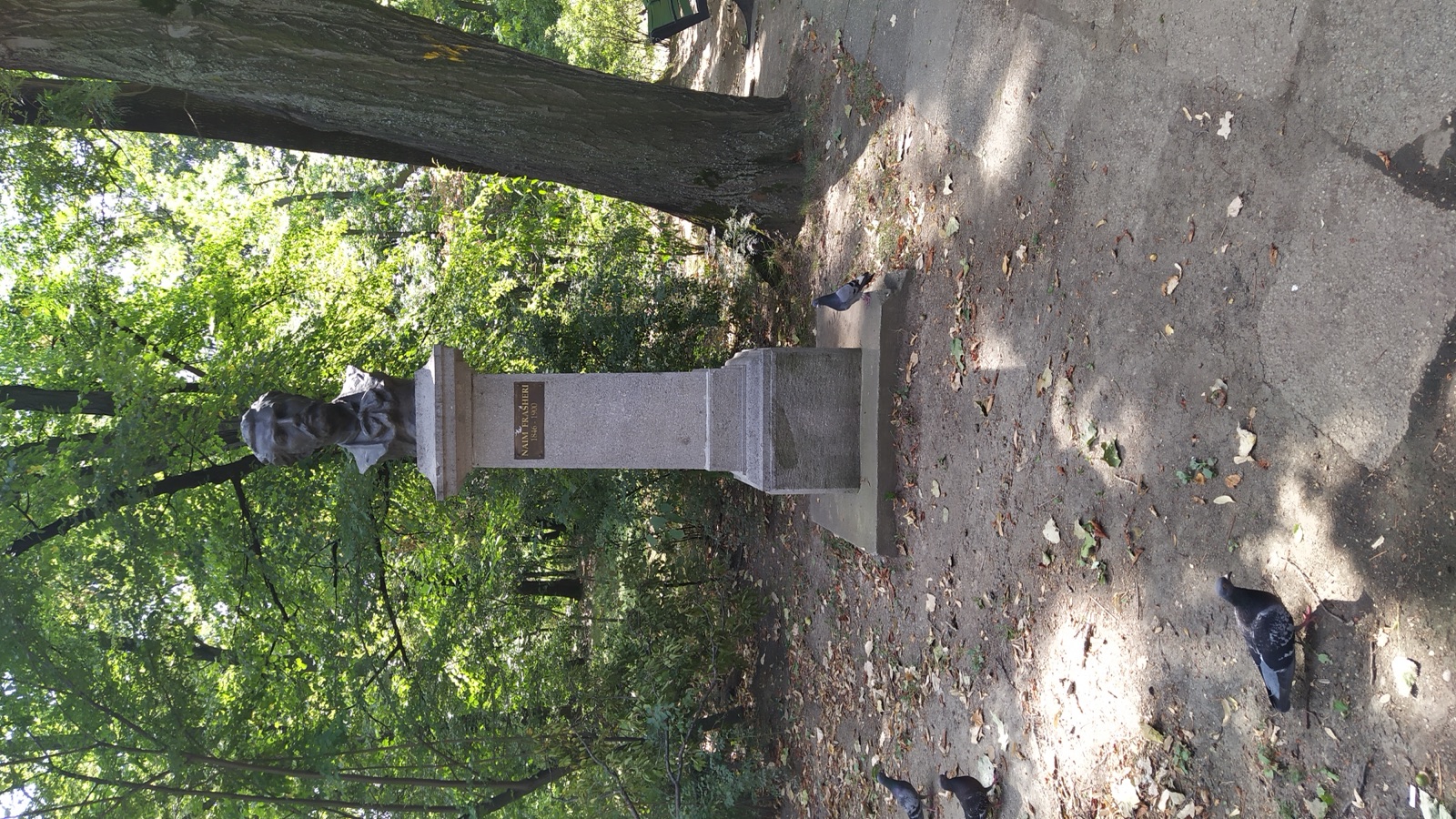
Naim died in Istanbul on 20 October 1900 at the age of fifty-four. His remains were transferred to Albania in 1937 under King Zog and reinterred at a memorial site in Tirana; the site has been moved and reorganized several times since. 25 May, his birthday, is observed as Naim Frashëri Day in Albanian schools.
His face appears on the 200 lekë banknote, with verses from Bagëti e Bujqësia on the reverse. The communist-era state publishing house in Tirana, the principal venue for Albanian-language books from 1944 to 1991, was the Naim Frashëri Publishing House (Shtëpia Botuese Naim Frashëri) — a deliberate choice that placed him above any modern political figure in the literary hierarchy of the Albanian state.
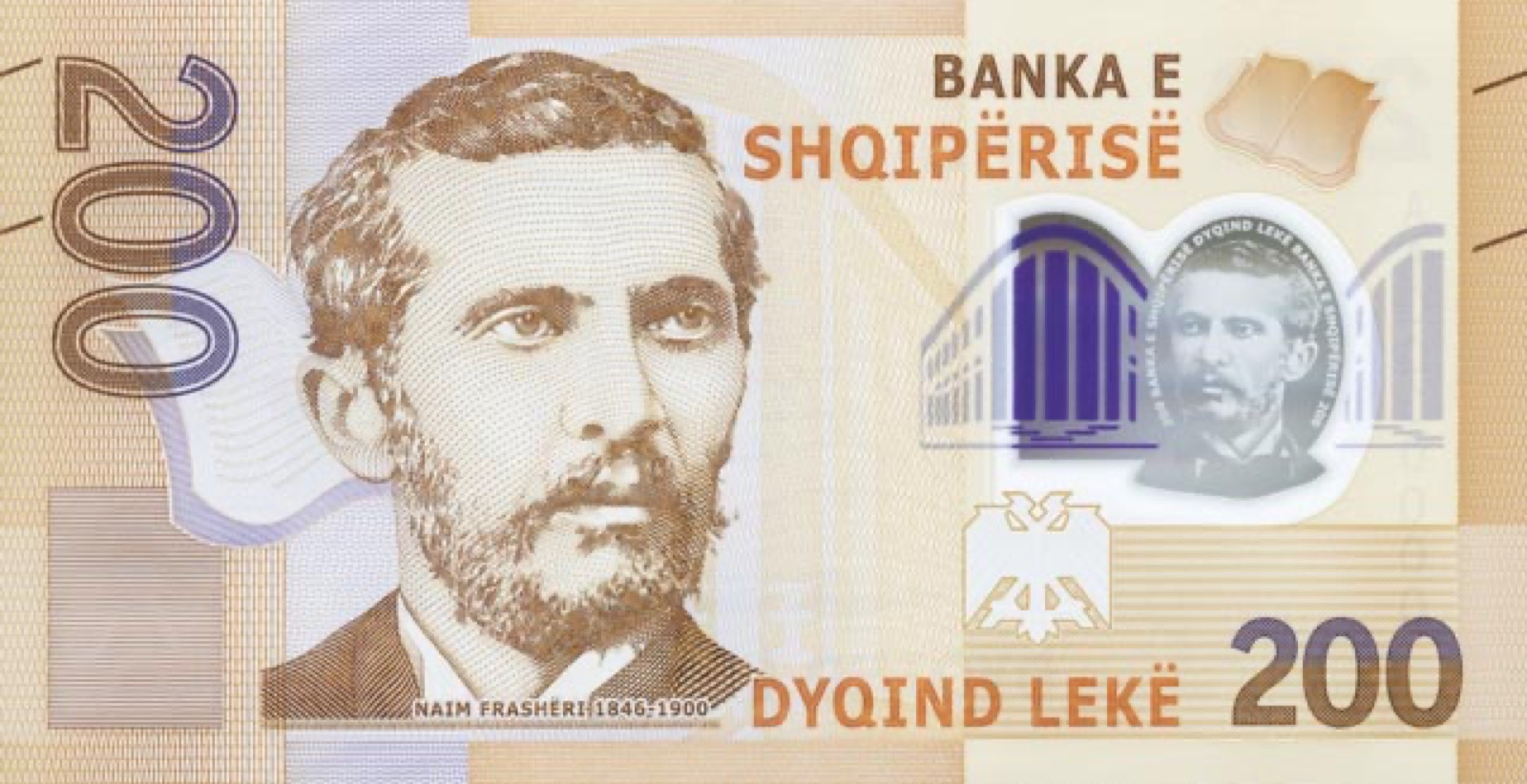
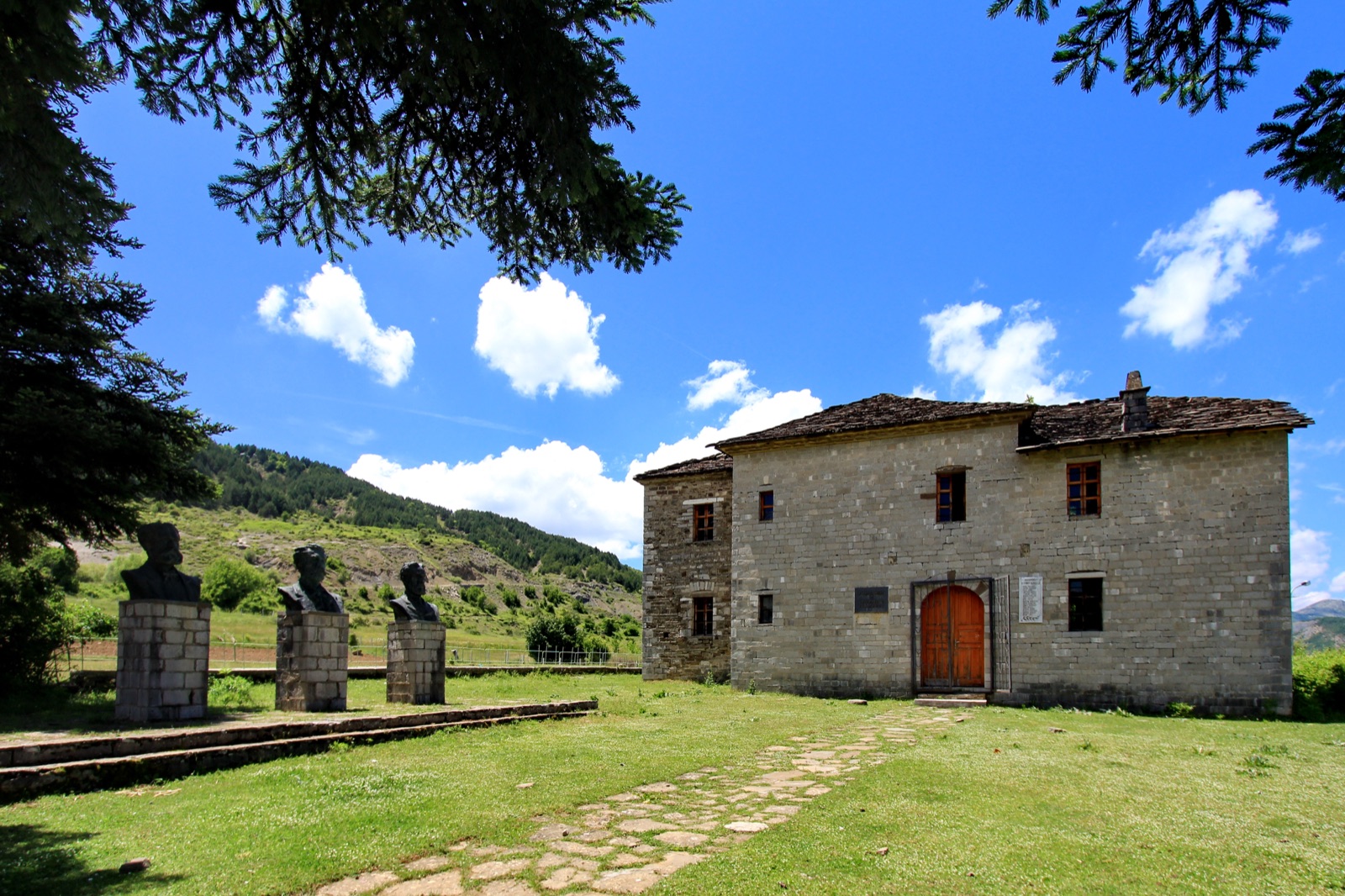
Schools, streets, and cultural centers across Albania, Kosovo, North Macedonia, and the diaspora carry his name. Frashër village itself remains a pilgrimage site for visitors interested in the National Renaissance, with the restored Frashëri family house and the Bektashi tekke as the two main points of interest. Robert Elsie’s English translations and his anthology work made the major Albanian poems available in English from the 1990s on, opening Naim to a generation of Albanian-Americans who grew up without Albanian as a first language.
He is, at this point, the writer the modern Albanian state and the Albanian diaspora both date their literature from. That is unusual. Most national literatures have a contested founder. Albanian literature has Naim, and the case is institutional rather than rhetorical: the alphabet committee, the canon, the publishing house, the currency, the school day, and the verses every Albanian schoolchild memorizes come from the same writer.
For families in the United States with Albanian roots — whether your grandparents arrived in 1905 or 1995 — Naim is the literary common ground. He is what the textbook in Tirana and the Albanian-school weekend class in Brooklyn are both teaching from. The National Albanian Registry counts the community that reads him, in English and in Albanian, across four generations of arrival. If you have not yet been counted, register here.