
An Albanian American today can read a handwritten note from a grandmother in Gjirokastër, a Facebook post from a cousin in Pristina, and a newspaper printed in Tirana — all in the same letters, without a second thought. That seems ordinary. It was not always possible.
For most of the language’s written history, Albanian had no single alphabet. The same word might appear in Latin script in the Catholic north, in Greek script in the Orthodox south, and in Arabic-Ottoman script among Muslim communities. A book printed in one region could be unreadable in another. A people who already shared a language did not share a way to write it down.
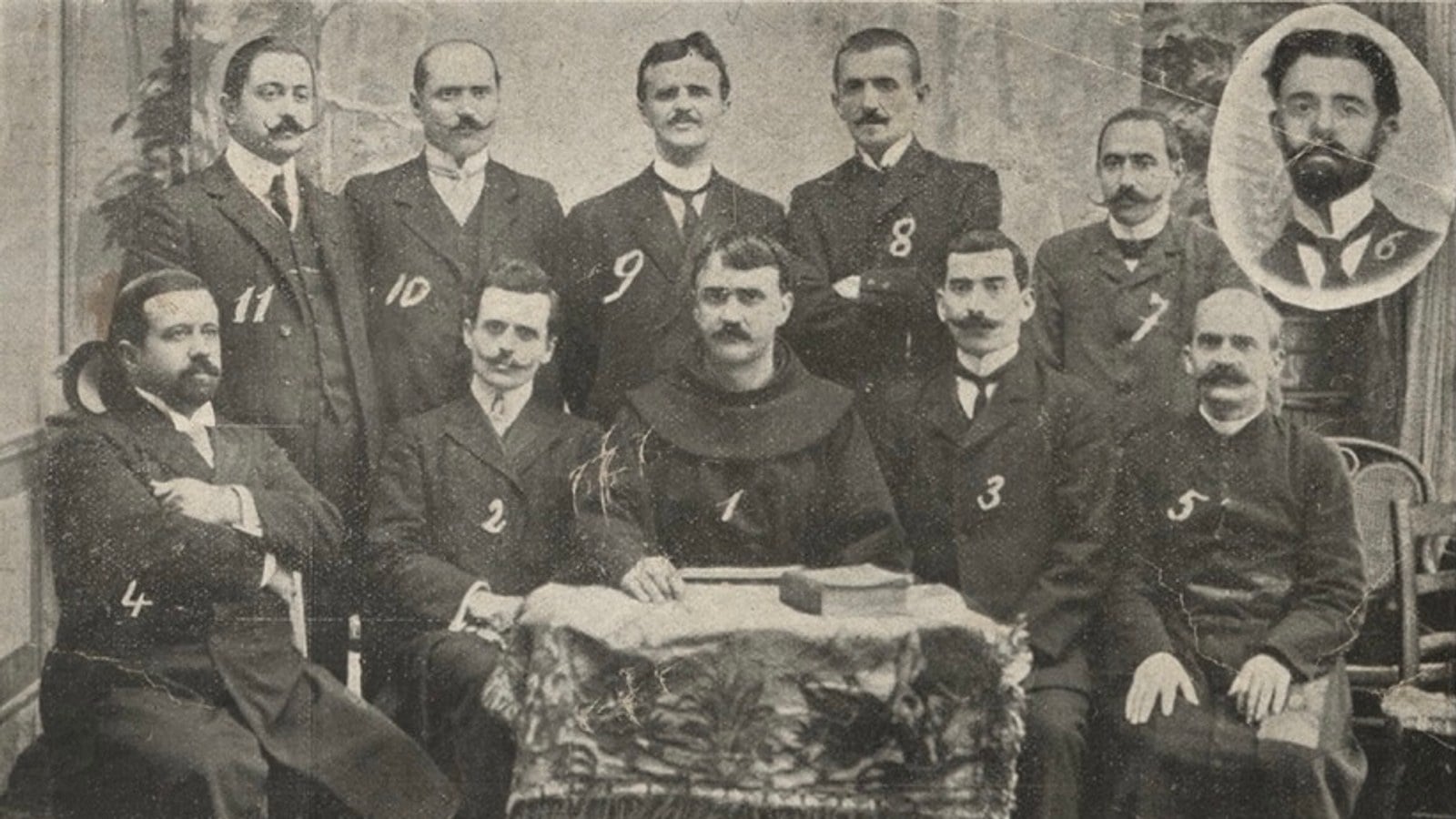
That changed in one week. From November 14 to 22, 1908, fifty delegates met in the Ottoman city of Manastir — modern Bitola, in North Macedonia — and agreed on a standard alphabet for Albanian. The decision held. The 36-letter alphabet that came out of that room is the one Albanian schoolchildren learn today, the one on every Albanian street sign, and the one a diaspora family uses to teach a child the word for “grandmother.” This is how it happened, and why it still matters.
Before 1908: one language, three alphabets
To understand the Congress of Monastir, you have to understand the problem it solved. Albanians in the late Ottoman period were divided in ways that had nothing to do with what they spoke. They were spread across several Ottoman provinces — the vilayets of Manastir, Shkodër, Janina, and Kosova. They belonged to different faiths: Sunni Muslim, Bektashi, Catholic, and Orthodox. And the way they wrote their shared language followed those divisions almost exactly.
Catholics in the north tended to write Albanian in Latin letters. Orthodox communities in the south often used Greek script. Muslim communities used the Arabic-based Ottoman script. On top of that, several scholars over the previous two centuries had invented entire original alphabets for Albanian — the Elbasan script, the Vithkuqi script, and others — none of which spread beyond a small circle.
This was not a neutral inconvenience. Both the Ottoman state and the Greek Orthodox Patriarchate actively discouraged Albanian-language schooling, each for its own reasons. A people cannot build a national press, a school system, or a common literature when its readers cannot agree on which symbols make which sounds. The alphabet question was, in practice, the literacy question and the national question wrapped together.
Eight days in Manastir
The congress was organized by the Bashkimi (“Union”) club of Manastir, one of the Albanian cultural societies that had multiplied during the Rilindja, the Albanian National Awakening. About fifty delegates came, representing cities, towns, and patriotic associations from across the Albanian lands. Some had voting rights; others attended as observers.
The delegates elected Mid’hat Frashëri — a writer and publisher from the famous Frashëri family — as chairman of the congress. But the real work of choosing letters went to a separate commission, which elected Gjergj Fishta, a Franciscan friar who was also the most celebrated Albanian poet of his generation, as its chairman, and Parashqevi Qiriazi, an educator and publisher, as chairwoman. Frashëri also served as the commission’s vice-chairman, and Luigj Gurakuqi as its secretary.
The most deliberate choice the organizers made was the makeup of that commission. They built it to cross every line that normally divided Albanians: it seated Catholic, Orthodox, Muslim, Bektashi, and Protestant members together. The point was unmistakable. The alphabet was to belong to all Albanians, not to one faith or one region. (Sources differ on the commission’s exact size and roster, listing roughly eight to eleven members; the interfaith composition is the well-attested part.)
November 22 — the day the congress closed — is now marked every year as Alphabet Day, Dita e Alfabetit.
Three alphabets, one compromise
Here is the detail most short accounts get wrong: the congress did not invent an alphabet, and it did not crown a single winner on the spot.
Three systems were already in use, and each had a constituency. The Stamboll alphabet, created by Sami Frashëri and adopted in Istanbul in 1879, was mostly Latin but used a few Greek and invented letters; it followed a strict “one letter, one sound” rule and was the most widely used. The Bashkimi alphabet was fully Latin and handled Albanian’s extra sounds with letter combinations — digraphs like sh and gj. The Agimi alphabet, also Latin, used accent marks instead.
Rather than force a single choice and risk walking out divided, the delegates compromised. They sanctioned two alphabets: a lightly modified Stamboll alphabet, and a new, fully Latin alphabet based on the Bashkimi system. Both would be taught and printed, and usage would decide.
It did. Over the following years the fully Latin alphabet pulled ahead, and the Stamboll alphabet faded out within a couple of decades. The system Albanians use now is the descendant of that Latin compromise — built, it’s worth saying, on roughly thirty years of earlier alphabet work rather than from scratch. Manastir did not start the conversation. It ended it.
Why Latin, not Arabic or Greek
The choice of a Latin base looks obvious in hindsight. In 1908 it was a statement.
Practically, Latin offered a clean phonetic fit once you added the digraphs and the two special letters, ç and ë. But the politics mattered just as much. Arabic script tied Albanian to the Ottoman Empire that governed it and to one of its faiths. Greek script tied it to the Orthodox Church hierarchy, which had its own claims on Albania’s Orthodox south. Latin letters belonged to neither. They placed Albanian alongside the languages of independent European nations.
For a people who had no state of their own, that was the message. You declare a nation in many ways. One of them is deciding, together, what your words look like on a page. The Congress of Monastir did that four years before the Albanian Declaration of Independence of 1912 — and it is hard to imagine the second event without the first.
Why a 1908 decision still matters — especially in the diaspora
The alphabet has barely changed in more than a century. Thirty-six letters, all Latin, including the nine digraphs — Dh, Gj, Ll, Nj, Rr, Sh, Th, Xh, Zh — and ç and ë. It is still the official alphabet of Albanian, taught the same way in Tirana, Pristina, and Albanian weekend schools in Detroit and the Bronx.
That permanence is the whole point for a community spread as widely as this one. An Albanian American family is connected to relatives in Albania, Kosovo, North Macedonia, Montenegro, and across the diaspora. The shared alphabet is one of the few things that crosses every one of those borders, every faith, and every generation without translation. The same letters that printed a banned primer in Ottoman Manastir print a children’s book in Michigan now.
It’s worth being honest about what the alphabet did and did not do. It did not erase the difference between the Gheg and Tosk dialects, and it did not by itself produce a single standard literary Albanian — that came later, formalized in 1972. What 1908 settled was the foundation underneath all of it: the same letters, for everyone. Everything built on top of the language assumes that agreement.
The instinct behind Manastir is, in the end, a simple one — a scattered people deciding to be counted as one, on the record, in a form that lasts. That instinct did not end in 1908. The National Albanian Registry exists for the same reason: to put the Albanian-American community on the record, together, in a way the numbers can’t ignore. The Census counts about 230,000 of us; the real figure is closer to a million. If the people in Manastir could agree on an alphabet in eight days, getting counted takes about two minutes. Add your name.