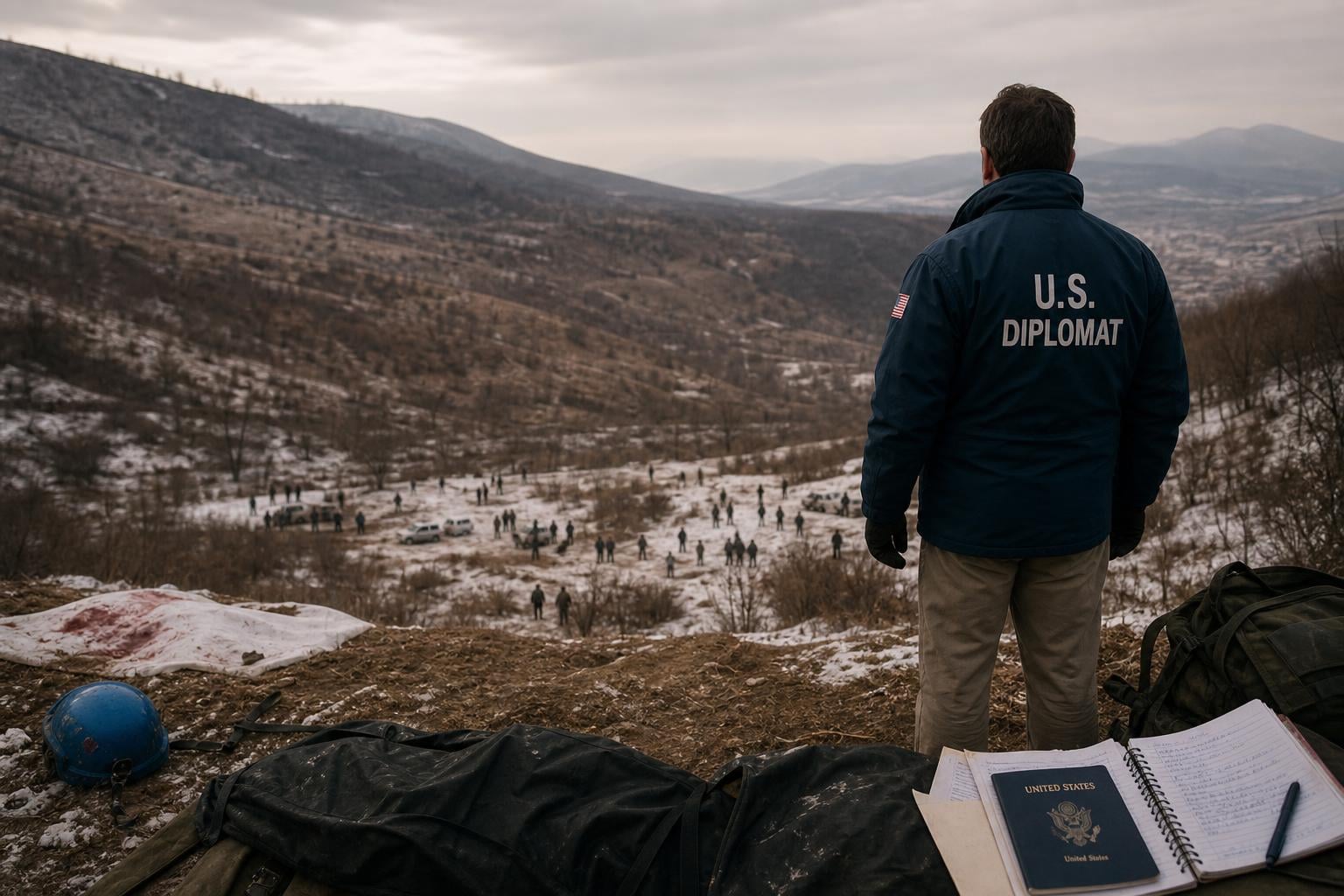
Recak — Reçak in Albanian, Račak in Serbian — sits in a shallow valley in the Shtime municipality of central Kosovo. On the morning of January 16, 1999, a small convoy of OSCE Kosovo Verification Mission (KVM) vehicles drove into the village and stopped at the lip of a wooded gully. The mission’s chief, William Walker, climbed out into snow and walked the line of bodies that lay where they had been left the previous day. He counted forty-five dead. Most had been shot at close range. Several had been mutilated. They were Kosovar Albanian civilians from Recak and the surrounding hamlets, and they had been killed by Serbian and Yugoslav security forces during a sweep operation on January 15.
A few hours later Walker stood beside the gully and held a press conference. He used two phrases on camera that had not, until that morning, been spoken at that level of authority about the events of the Kosovo war. He called what had happened a crime against humanity, and he called it a massacre. He named Yugoslav security forces as responsible.
That single statement is the reason William Walker matters to the Albanian American and Kosovar-American diaspora today. It is the moment a senior international diplomat with a verification mandate, on camera, named the violence in Kosovo for what it was. Within ten weeks NATO aircraft were over Yugoslav airspace and the war that had begun as an internal Serbian campaign against the Kosovo Liberation Army had become a transatlantic intervention. Kosovo’s path to the February 17, 2008 declaration of independence runs through many rooms in many capitals. Recak is one of them, and the American who carried the word “massacre” out of that gully is part of how the room shifted.
This is who he is, what he did before Kosovo, what happened that January, and why a Kosovar village raised a statue in his honor.
Who William Walker is
William Graham Walker is a retired American career Foreign Service officer. He was born in 1935 and joined the United States Foreign Service in 1961, the same year Frank G. Wisner Jr. joined (see Ambassador Frank G. Wisner Jr.). His thirty-five-year diplomatic career was concentrated almost entirely on Latin America — postings in Peru, Bolivia, Honduras, El Salvador, and senior policy roles at the State Department’s Bureau of Inter-American Affairs.
After El Salvador he served as Vice President of the National Defense University in Washington, D.C., from 1994 to 1997. Then, in August 1997, he was named to head a UN mission in Croatia — his first Balkans posting, and one that had nothing to do with Latin America and everything to do with a region where the United States had been struggling to find a coherent policy. A second Balkans assignment followed within the year: Kosovo.
The OSCE Kosovo Verification Mission needed an experienced American at its head. Walker took the job. The thirteen months that followed are the chapter of his life that Kosovar Albanians and Albanian Americans remember.
Foreign Service career before Kosovo
Walker’s early Foreign Service career followed the standard pattern of an American diplomat who specialized in one region. He served at posts across Latin America through the 1960s and 1970s, accumulating the country expertise and Spanish-language fluency that would make him useful to Washington in the Reagan-era Central America files.
By the mid-1980s he was a senior officer at the State Department’s Bureau of Inter-American Affairs, and from 1985 to 1988 he served as Deputy Assistant Secretary of State for Inter-American Affairs. The portfolio at that level included the contested files of the moment — Nicaragua, El Salvador, Guatemala, Honduras, and the policy architecture around what Washington called the Central America wars. The Reagan administration’s posture toward those wars was the subject of sustained domestic and international debate; Walker’s role at the bureau placed him inside the policy machine that ran them.
In 1988 President Ronald Reagan nominated him as United States Ambassador to El Salvador, a post he assumed under Reagan and held through the entire George H. W. Bush administration. He served in San Salvador until 1992.
The El Salvador tenure was consequential and controversial. The country was in the final years of a civil war between the government and the Frente Farabundo Martí para la Liberación Nacional (FMLN). On November 16, 1989, members of the Salvadoran army’s Atlacatl Battalion entered the campus of the Universidad Centroamericana José Simeón Cañas in San Salvador and killed six Jesuit priests — including the rector, Ignacio Ellacuría — along with their housekeeper Elba Ramos and her sixteen-year-old daughter Celina. The killings were carried out during a battalion-sized FMLN offensive in the capital.
The US Embassy under Walker, and the embassy’s role in the subsequent investigation and the broader American policy of military aid to the Salvadoran government, drew sharp criticism from human-rights organizations, members of the US Congress, and the Society of Jesus. A 1990 congressional task force led by Representative Joseph Moakley investigated the murders and the embassy’s handling of intelligence about them. The episode is part of the historical record of his Salvador posting and is treated here without editorializing — it shaped how some observers later read his Kosovo assignment, both critics and defenders. Walker has spoken publicly about El Salvador over the years and has defended the embassy’s record.
He left San Salvador in 1992. He served as Vice President of the National Defense University in Washington, D.C., from 1994 to 1997, then, in August 1997, was named Special Representative of the UN Secretary-General to head the United Nations Transitional Administration for Eastern Slavonia, Baranja and Western Sirmium (UNTAES) — the mission that oversaw the peaceful reintegration of Serb-held eastern Slavonia into Croatia after the Croatian War. UNTAES concluded in January 1998.
The OSCE Kosovo Verification Mission, October 1998 to June 1999
By autumn 1998 the conflict in Kosovo between Yugoslav security forces and the Kosovo Liberation Army (UÇK in Albanian) had escalated into open war. Hundreds of thousands of Kosovar Albanians had been displaced. The international response was a diplomatic agreement negotiated in October 1998 by US envoy Richard Holbrooke with Yugoslav President Slobodan Milošević — the Holbrooke-Milošević agreement — which provided for a partial Yugoslav military pullback and the deployment of an unarmed civilian verification mission under the auspices of the Organization for Security and Co-operation in Europe (OSCE).
The mission was the OSCE Kosovo Verification Mission, established by OSCE Permanent Council Decision No. 263 on October 25, 1998, with an authorized strength of up to 2,000 unarmed civilian verifiers. Its mandate was to monitor the ceasefire, verify Yugoslav and Serbian compliance with the Holbrooke-Milošević terms, and report violations. It was not a peacekeeping force. It carried no weapons. Its only weight on the ground was its visibility and the credibility of its reporting.
William Walker was named Head of Mission. Operational deployment began in late October 1998 and continued through the autumn and winter. By January 1999 the KVM had several hundred verifiers in country with field offices across Kosovo. The mission was understaffed against its mandate, the ceasefire was fraying, and field reporting through November and December 1998 documented escalating ground operations by both sides.
The KVM is the institutional context for everything that followed. When Walker spoke at Recak on January 16, 1999, he spoke as the head of an OSCE verification mission — not as an American diplomat, not as a journalist, not as an advocate. The OSCE chairmanship at the time was held by Norway, and Foreign Minister Knut Vollebæk was Walker’s direct OSCE counterpart. The mandate gave Walker a platform that no individual American voice could have carried alone.
Recak and Reçak — what happened on January 15 and 16, 1999
The Recak operation began at dawn on January 15, 1999. Yugoslav and Serbian Interior Ministry forces — the MUP (Ministarstvo unutrašnjih poslova / Ministry of Internal Affairs) supported by units of the VJ (Vojska Jugoslavije / Yugoslav Army) — moved into the village of Recak in the Shtime municipality south of Pristina. The official Serbian justification was an anti-terrorist operation against KLA fighters reported in the area. KVM verifiers in the region were aware of the operation in progress and observed parts of it from a distance during the day.
By evening the security forces had withdrawn. KVM patrols entered the village that night and found a number of bodies. The full scale was not visible until the morning of January 16, when verifiers and journalists walking through Recak and the gully above it found additional dead — most of them men, several of them elderly, at least one boy of twelve. The total identified that day reached forty-five Kosovar Albanian civilians. The bodies bore close-range gunshot wounds; some had been mutilated.
Walker drove to the village on the morning of January 16. He walked the gully with the verifiers who had found the dead. He spent time with the families gathering in the village center. Then he held the press conference for which he is remembered.
The Yugoslav and Serbian governments rejected the framing. Belgrade’s account described the dead as KLA combatants killed in a legitimate counter-terrorist engagement and accused the KVM of staging or misreading the scene. The dispute over the precise circumstances of every death continues in academic and forensic literature; the international consensus, anchored by KVM reporting and subsequent International Criminal Tribunal for the former Yugoslavia (ICTY) findings, held that the dead were unarmed civilians killed in a security-force operation rather than combatants killed in battle.
The press conference and what it broke
On the afternoon of January 16, 1999, William Walker stood near the Recak gully and spoke to a crowd of international and local journalists. He used the words crime against humanity and massacre. He named Yugoslav security forces as responsible. The footage was on every major international news network within the hour.
The statement broke a yearlong diplomatic ambiguity. Through 1998, international descriptions of violence in Kosovo had been carefully balanced — references to “incidents,” “clashes,” “alleged atrocities,” “reports requiring verification.” Walker’s institutional position as head of the OSCE Verification Mission gave him standing to abandon that vocabulary. He had a verification mandate, he had verifiers on scene, he had walked the bodies himself, and he said in plain English what he had seen.
Two days later, on January 18, 1999, the Yugoslav Ministry of Foreign Affairs declared Walker persona non grata and gave him 48 hours to leave the country. The OSCE chairmanship, the United States, the European Union, and the United Nations Secretary-General responded immediately. The expulsion order was suspended under international pressure within days. Walker remained at his post.
The question of whether his statement was forensically precise — whether every one of the forty-five dead met the legal definition of a civilian killed unlawfully — is a question that scholars and lawyers have debated since. The political question of whether his statement was correct in substance — that Kosovar Albanian civilians had been killed by Yugoslav security forces during an operation that targeted a village — was answered then and has been answered since by the documentary record assembled at the ICTY and by independent journalism.
The Finnish forensic team and Helena Ranta
A few days after the press conference, the Finnish government dispatched a team of forensic pathologists, working under European Union auspices, led by Helena Ranta, a forensic odontologist with extensive experience in international war-crimes investigations. Their mandate was to perform autopsies on the Recak dead and produce an independent forensic finding.
Ranta’s reports were more cautious than Walker’s press-conference language. The forensic team concluded that the dead were unarmed civilians, that they had not been killed in a battlefield engagement of the kind Belgrade described, and that the wound patterns were not consistent with the Yugoslav account of an anti-terrorist operation against armed combatants. In her formal published findings Ranta declined to use the legal term “crime against humanity,” noting that such determinations were the responsibility of judicial bodies rather than forensic teams. In a 2008 interview, she went further and made a direct accusation against Walker himself: she said he had pressured her to publicly blame Serbian security forces in her report, even though assigning that responsibility was not part of her forensic mandate.
Both records — Walker’s political framing and Ranta’s forensic findings — are part of the canonical history of Recak. Presenting them honestly together is the responsible way to discuss the event. Walker’s framing carried the international consensus and shaped policy; Ranta’s findings shaped the forensic record that later supported war-crimes prosecutions.
From Recak to Rambouillet to NATO
The diplomatic timeline after January 16 moved fast. On January 28, 1999, the Contact Group — the United States, United Kingdom, France, Germany, Italy, and Russia — convened in London and called for Yugoslav and Kosovo Albanian delegations to meet for negotiations at the Château de Rambouillet in France. The talks opened on February 6, 1999 under co-chairs Robin Cook of the United Kingdom and Hubert Védrine of France, with US lead Christopher Hill in the room and Madeleine Albright supervising from Washington.
The Kosovo Albanian delegation was led by Hashim Thaçi of the KLA, with Ibrahim Rugova of the LDK also present (see Ibrahim Rugova). The Yugoslav delegation refused the proposed text. After a March 15-18 follow-up at the Centre de conférences in Paris, the negotiations collapsed.
On March 24, 1999, NATO began Operation Allied Force, a 78-day air campaign against Yugoslav military and infrastructure targets that ended on June 10, 1999 with the Military-Technical Agreement at Kumanovo and the withdrawal of Yugoslav forces from Kosovo. UN Security Council Resolution 1244, adopted that same day, established the United Nations Interim Administration Mission in Kosovo (UNMIK) and the NATO-led Kosovo Force (KFOR). The KVM had been withdrawn on March 20 ahead of the air campaign; Walker’s mission ended formally with the dissolution of the verification structure that summer.
The line from Recak to Rambouillet to Operation Allied Force is not the only line that mattered. Years of Kosovar Albanian political organization, Western European pressure, Russian limits, and the Clinton administration’s appetite for action all fed into the March 24 decision. But Recak was the political accelerant. After January 16 it was no longer politically tenable in Washington, London, Berlin, or Paris to treat Kosovo as a contained internal Yugoslav matter.
How Kosovo has honored William Walker
Walker’s honors span two countries. On November 24, 2008, Albanian President Bamir Topi made him an Honorary Citizen of Albania, and in January 2023 Albanian President Bajram Begaj granted him the Knight of the Order of the Flag, one of Albania’s highest honors. Kosovo’s recognition came separately: on January 15, 2009, the tenth anniversary of the killings, Kosovo’s president and prime minister awarded Walker the Golden Medal of Freedom. In January 2017 the village of Recak/Reçak itself erected a statue of Walker.
The village’s memorial complex commemorates the forty-five who were killed. Walker has visited it on multiple anniversaries — January 15 each year — and has spoken at the commemorations. He is one of a small number of foreign nationals whom Kosovar Albanian civic life routinely names alongside its own war-era figures. Madeleine Albright, Bill Clinton, Wesley Clark, Tony Blair, and Joschka Fischer are among the others.
For Kosovar Americans visiting the country today, the statue of Walker standing in Recak is a small but specific reminder that the path to independence ran through American institutional voices as well as through Kosovar Albanian sacrifice and political organization. The relationship between Kosovo and the United States is denser than any single name can carry, but Walker’s is one of the names that carries the most weight in Kosovo itself.
What this means to Kosovar Americans today
The Albanian-American diaspora — Albanian and Kosovar — is roughly 230,000 strong by the 2024 American Community Survey count, and likely closer to one million when ethnic Albanians from across the Balkans, second- and third-generation descendants, and undercounted households are included. Within that diaspora, the Kosovar-American share is concentrated in Michigan, New York, New Jersey, Massachusetts, and Texas.
For first-generation Kosovars who came to the United States in the late 1990s, Recak is not history. It is family. Many of them were displaced during the same campaign that produced the Recak deaths, and many of them watched Walker’s January 16 press conference live on satellite television in apartments in Detroit, the Bronx, Worcester, or Yonkers, and understood — sometimes for the first time — that the West had begun to see what they had been telling it for a decade.
For their American-born children and grandchildren, Walker is one of the names that explains how Kosovo got to February 17, 2008. The path was longer than any single moment, and it included Kosovar Albanian political work that began in the Lidhja Demokratike e Kosovës under Ibrahim Rugova in 1989, ran through the parallel state of the 1990s, accelerated through the war years, and ended in a state recognized by more than 100 UN members. Walker’s piece of that story is small in the scheme of years but large in the scheme of how a single sentence at a press conference can move a policy.
He is still living. He has continued to travel to Kosovo, speak at universities, and participate in commemorations. He is one of the last senior international figures from the verification-mission era still actively engaged with the country.
Walker in the longer arc
Reading Walker’s career honestly means holding two things at once. The El Salvador chapter is part of the public record and remains contested in human-rights and academic literature. The Kosovo chapter is also part of the public record, and on it the Kosovar Albanian and broader Albanian-American assessment is overwhelmingly positive — a foreign diplomat who, at a specific moment that mattered, said the thing that needed saying and accepted the political consequences.
Both chapters are his. The diaspora is not required to flatten one into the other. What Walker did at Recak on January 16, 1999 stands on its own merit and was decisive in the timeline that produced an independent Kosovo. What happened in El Salvador between 1988 and 1992 is part of a different historical account that the United States is still writing.
For the Kosovar-American community, the relevant fact is the one preserved in the statue that stands in Recak today. An American official with a verification mandate walked into a village on a January morning, counted the dead, and used the right words on camera. That is what Kosovo remembers him for, and that is the part of his career that belongs to the diaspora’s collective memory.
The National Albanian Registry’s mission is to count the Albanian-American community accurately and to anchor its story in real names and real history. If you are Kosovar American, Albanian American, or of Albanian heritage in the United States, you can add your name to the count — a free, neutral, community-led record that helps strengthen the diaspora’s institutional memory of the people, places, and moments that made Kosovo possible.