
Albanian political history starts in Krujë. Around 1190, a local lord named Progon — the first Albanian ruler known by name — established a principality in the mountains of central Albania. It was small, hemmed in by the Byzantine Empire on every side, and it lasted less than 70 years. But it was the first time in the recorded past that an Albanian-speaking population governed itself under its own leaders, in a territory identified by the ethnic name that would eventually become the name of a country.
The principality was called Arbanon. The word is the root of Albania.
For a broader view of where Arbanon fits in the long arc from Illyria to the modern republic, see Albanian history: a timeline from Illyrians to independence. This article covers the principality itself — its founders, its rulers, how it functioned inside a crumbling empire, and why the name still matters.
The name that became a country
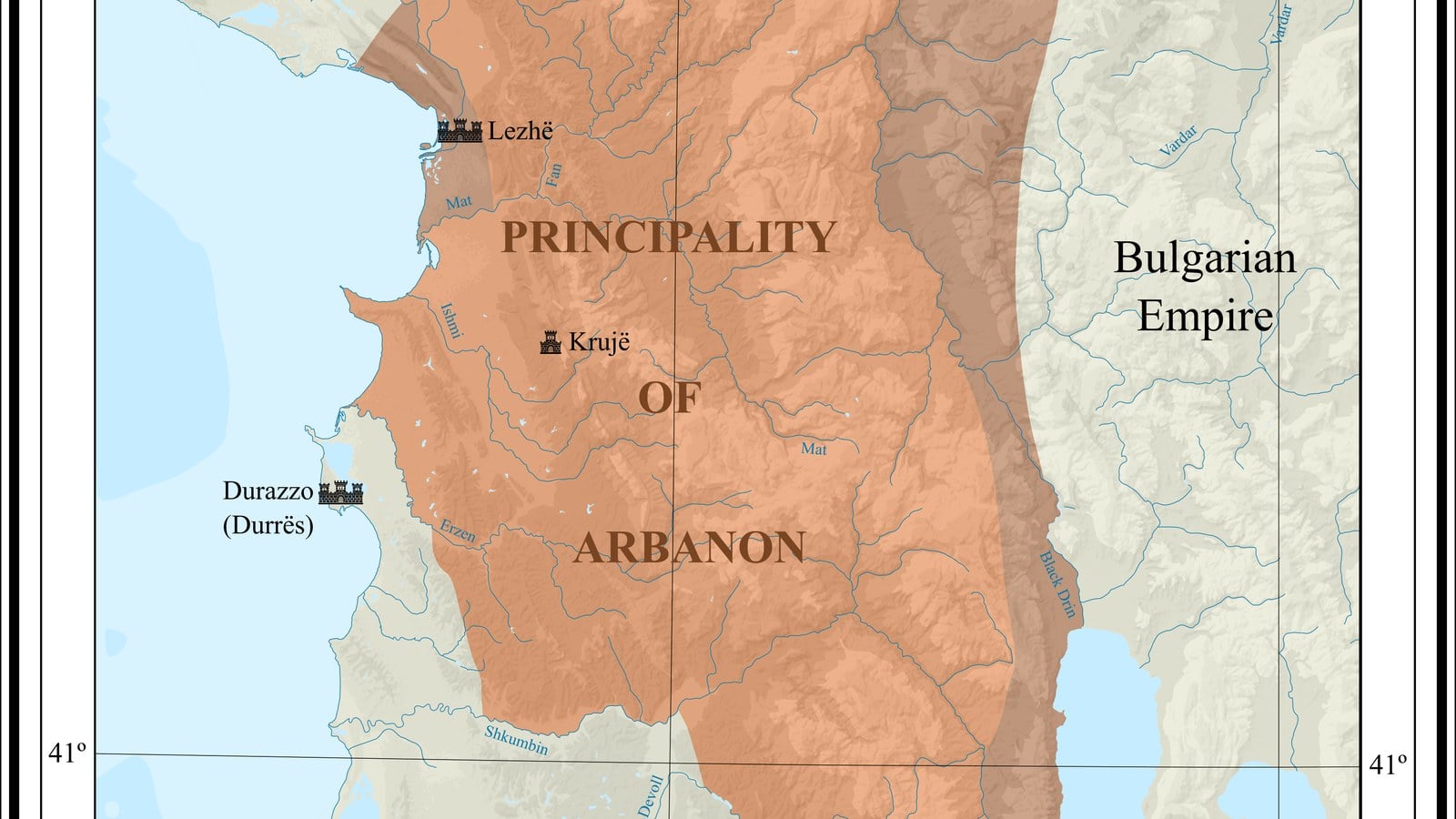
The word “Arbanon” appears in Byzantine sources as early as 1081, when the historian Anna Komnene described a region inland from the Adriatic between the Mat and Shkumbin rivers. A few years earlier, in 1078–1079, the historian Michael Attaleiates had referred to “Albanoi” and “Arbanitai” as an ethnic group in the western Balkans — the first Byzantine reference to Albanians under their own name, though the identification is debated among scholars.
The connection goes deeper. The 2nd-century geographer Ptolemy recorded an Illyrian tribe called the Albanoi and a settlement called Albanopolis in the same central Albanian highlands. Modern archaeology has identified the likely site of Albanopolis at Zgërdhesh, a hill-fort near Krujë — the same town where Progon would establish his principality over a thousand years later.
In Albanian, the country was called Arbëri and the people Arbëreshë. The shift from “Arbanon” to “Arbëri” follows a regular sound change in Albanian called rhotacism. Albanians used “Arbëreshë” as their self-designation until the 18th century, when the word Shqiptar gradually replaced it. Today, the Arbëreshë communities of southern Italy — descendants of Albanian migrants who left in the 15th century — still call themselves by the older name, preserving the medieval endonym that mainland Albanians moved past.
The name, then, is not incidental. Arbanon is where the word “Albania” comes from.
Krujë and the founding
The fortress of Krujë sits on a rocky ridge in central Albania, about 20 kilometers north of Tirana. The site was fortified in the 5th or 6th century and developed over the following centuries from a military outpost into an urban settlement. Archaeological finds from medieval graves at the site — imported ceramics, weapons, trade goods from across the Byzantine world — indicate a community of some wealth and regional standing.
Around 1190, an Albanian lord named Progon established himself as archon of Krujë and the surrounding highlands. The title archon was a Byzantine administrative rank — it placed Progon within the imperial system while acknowledging his local authority. The territory he controlled lay east and northeast of Venice’s Adriatic possessions, in the mountainous interior where Albanian-speaking populations had been concentrated since the early medieval period.
Progon’s principality was not an independent state. It was an autonomous entity within the Byzantine Empire — self-governing in practice, subordinate in theory. The arrangement was typical of how the Byzantine periphery functioned: central authority tolerated local strongmen who kept order and collected taxes, as long as they acknowledged the emperor.
Progon is the first Albanian ruler known by name in the historical record. He ruled until approximately 1198.
Three rulers, three decades
Gjin Progoni (c. 1198–1208)
When Progon died around 1198, his elder son Gjin succeeded him as archon of Krujë. Gjin’s rule was steady: the Byzantine framework held, and Arbanon continued as a mountain principality within it. He maintained diplomatic ties with both the Despotate of Epirus and Serbia and controlled additional territories around Elbasan. He died in 1208.
Dhimitër Progoni (1208–c. 1216)
Gjin’s younger brother Dhimitër (Latin: Demetrius) inherited the principality and became its most consequential ruler. The timing worked in his favor: four years earlier, in 1204, the Fourth Crusade had sacked Constantinople and shattered the Byzantine Empire into competing successor states. The central authority that had kept Arbanon subordinate no longer existed. For the first time, the principality operated as a functionally independent state.
Dhimitër used the independence. He was the first Albanian ruler to style himself princeps Arbanorum — Prince of the Albanians — a Latin title that appears in his correspondence with Pope Innocent III around 1208–1210. In those letters, he described his territory as the mountainous region between Shkodra, Durrës, Ohrid, and Prizren — a domain considerably larger than the highland core around Krujë.
He also held the Byzantine honorary title of panhypersevastos, one of the highest ranks the imperial system could confer. He acquired it through his wife: in 1208, Dhimitër married Komnena Nemanjić, daughter of the Serbian Grand Prince Stefan Nemanjić and granddaughter of Byzantine Emperor Alexios III Angelos. The marriage created a formal alliance with Serbia and gave Arbanon a place in the network of Balkan ruling families.
Dhimitër’s reign — roughly 1208 to 1215 or 1216 — was the high-water mark of Albanian political autonomy before the 15th century. An Albanian ruler bore an Albanian title, governed an Albanian-speaking population, and corresponded with the Pope as a sovereign. The state was small and hemmed in on all sides, but it existed on its own terms.
He died around 1216. The Progon family’s rule ended with him.
After the Progoni
Grigor Kamonas (c. 1216–after 1236)
After Dhimitër’s death, power passed not to a Progon heir but to Grigor Kamonas, a Greek-Albanian nobleman who held the Byzantine title of sebastos. Kamonas had married a daughter of Gjin Progoni, and after Dhimitër’s death he married the widow Komnena Nemanjić — consolidating his claim to rule through both connections.
The transition coincided with Arbanon’s loss of independence. Around 1216, Michael I Komnenos Doukas of the Despotate of Epirus expanded northward into Albania and Macedonia, bringing Arbanon under Epirote authority. Under Kamonas, the principality functioned as an autonomous dependency of Epirus — self-governing locally, but no longer sovereign. The Archbishop of Ohrid, Demetrios Chomatenos, documented Kamonas’s governance in his surviving legal case files.
Golem of Krujë (c. 1252–1257)
The historical record is thin between Kamonas and the principality’s last ruler. By the early 1250s, Golem — an Albanian nobleman who had married a daughter of Kamonas and Komnena — held power in Arbanon. The political landscape had shifted: the Despotate of Epirus and the Empire of Nicaea (the strongest Byzantine successor state) were fighting over the western Balkans, and local lords had to choose sides.
In 1252, Golem defected from Epirus to Nicaea. It did not save the principality. In the winter of 1256–1257, the Nicaean statesman George Akropolites — who was also a historian, and who recorded the events himself — formally annexed Arbanon into the reconstituting Byzantine Empire. Golem disappears from the records at that point.
The rebellion that followed
The annexation did not hold easily. In 1257, a rebellion broke out against Nicaean rule. The Nicaean governor, Constantine Chabaron, was captured at Kanina. George Akropolites himself was taken prisoner at Prilep by forces loyal to Michael II of Epirus. Reinforcements from Asia Minor finally suppressed the rebellion by 1259.
After that, Arbanon ceased to exist as a distinct political entity. Two years later, the Empire of Nicaea reconquered Constantinople and became the restored Byzantine Empire. Albanian-speaking territory was absorbed into a centralized state once again.
The principality had lasted roughly 70 years. It would be another century and a half before Albanian noble families — the Balsha, Thopia, Kastrioti, and Muzaka — carved out new principalities in the same territory. And Krujë would appear again in the 1440s, when Skanderbeg made it the stronghold of his 25-year resistance against the Ottoman Empire.
What Arbanon means for Albanian Americans
For Albanian Americans, Arbanon occupies a specific place in the national story: it is where the thread starts. Before Arbanon, Albanian-speaking people appear in the historical record as subjects of other states — Byzantine, Slavic, Roman. With Arbanon, they appear for the first time as political actors governing themselves.
The name matters, too. When Albanian Americans call themselves Albanian, they are using a word that traces back to the Arbanon principality and, before it, to the Albanoi tribe Ptolemy recorded nearly 2,000 years ago. The Arbëreshë of Italy still use the medieval form of the name. The modern form — Albania, Albanian — passed through Latin, Italian, and English, but the root is the same.
Arbanon was not a large state. It was not a powerful one. It lasted less than a human lifetime. But it established the basic political fact that Albanian history builds on: that an Albanian-speaking population could govern itself, in its own territory, under its own leaders. Dhimitër Progoni’s letters to the Pope — written in the early 13th century from a mountain fortress in central Albania — are among the earliest diplomatic documents in Albanian political history. They say, in formal Latin, something that the declaration at Vlorë would say again seven centuries later in Albanian: this people is here, and it has a state.
The fortress of Krujë still stands. The Skanderbeg Museum inside it draws visitors year-round. But before Skanderbeg held the fortress, the Progoni family built a principality around it — the first Albanian state, and the one whose name became the country’s.