
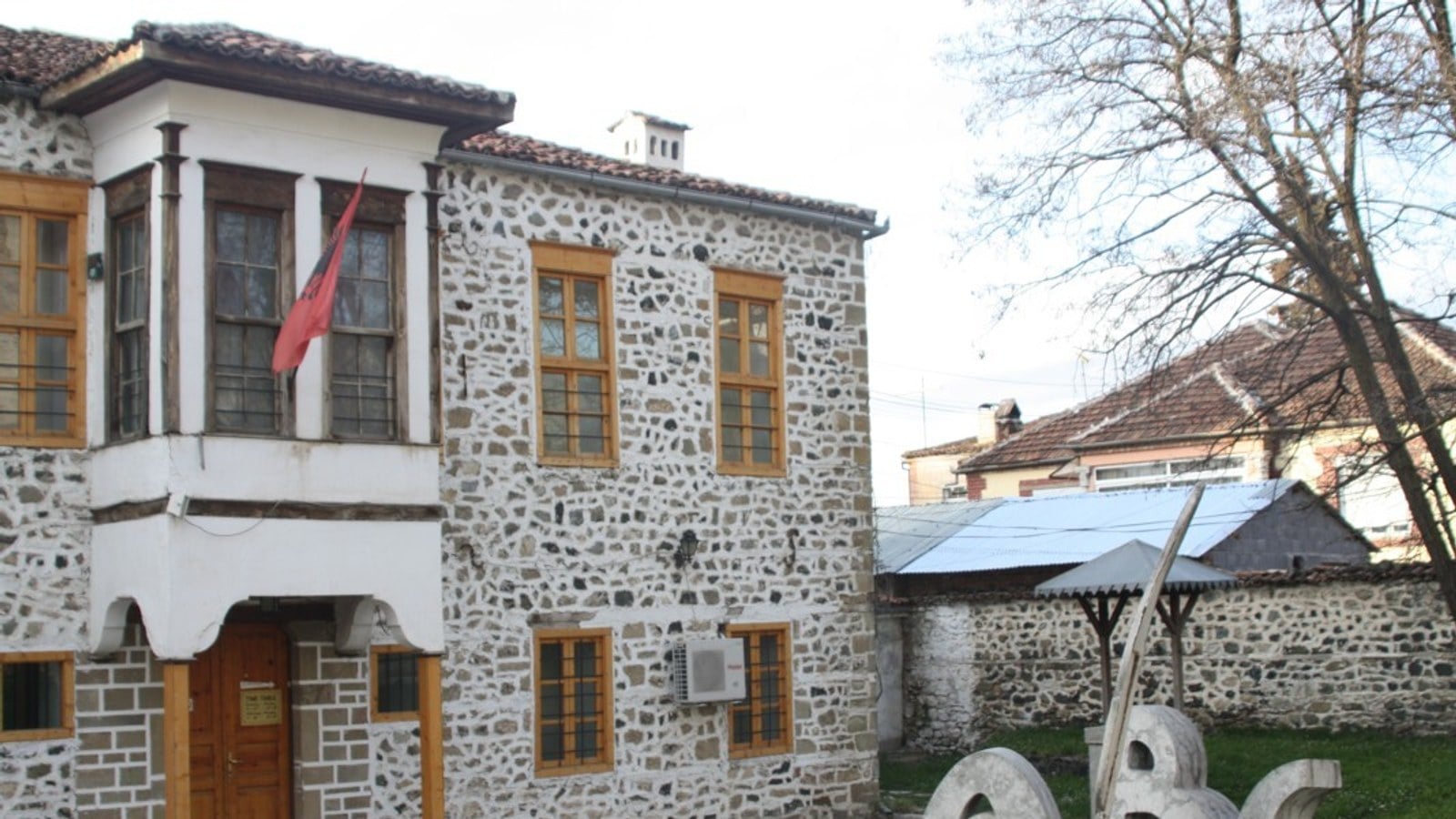
On 7 March 1887, in a two-story house on a side street in Korçë, a former Ottoman civil servant named Pandeli Sotiri opened the doors of a school called the Mësonjëtorja e parë shqipe — literally the first Albanian school. The building had been donated for the purpose by Diamanti Terpo, a Korçë merchant from a well-known local patriotic family. The school’s first cohort was small. The teachers were paid by a Bucharest-based émigré society called Drita (The Light). The textbooks had been written specifically for it by Naim and Sami Frashëri in Istanbul.
What made it new was not the building or the size of the class. It was that the lessons were in Albanian — and that the Ottoman state, for the first time in the long nineteenth century, had let it happen.
For an Albanian-American family in 2026, the date matters for two reasons. First, 7 March is observed every year as Teachers’ Day (Dita e Mësuesit) — in Albania, in Kosovo, in North Macedonia, in Albanian schools in the Bronx and in Worcester, and in the weekend Albanian classes that meet in church basements from Boston to Sterling Heights. Second, almost everyone in the first organized wave of Albanian immigration to the United States — Korçë, Përmet, Leskovik, Kolonjë, the southern Albanian villages that fed New England’s textile mills from the 1890s onward — came from the same region the Mësonjëtorja served. The literacy that made Boston’s Vatra federation, the Dielli newspaper, and the early Albanian-American church possible was, in part, the literacy that this school produced.
The article below is the long version of who opened it, why it took until 1887 to be legal, who taught in it, why a sultan eventually shut it down, and what the building is today.
Why an Albanian school had to open in secret
For most of the nineteenth century, schools in the Ottoman Empire were organized by religious community — the millet system — not by nationality. Greek-Orthodox children went to Greek-language schools run by the Patriarchate. Catholic children, mostly in the northern Albanian highlands, attended schools tied to Italian or Austrian missions. Muslim children attended mektep and medrese in Ottoman Turkish and Arabic. There was no Albanian millet, and there were no recognized Albanian-language schools.
The state position was that “Albanian” was not a nationality for educational purposes; an Albanian child’s schooling was a function of his or her confession. This was not a passive arrangement. Albanian-language printing was restricted, Albanian-language teaching outside the home was prosecutable, and the Ecumenical Patriarchate of Constantinople — which had jurisdiction over Orthodox Christian education across the empire — actively pressured Orthodox Albanians to school their children in Greek. The Greek government, after its 1830 independence, supported the same posture: a literate Orthodox population in southern Albania reading Greek strengthened later territorial claims to the region.
By the 1870s, a generation of Albanian intellectuals operating from Istanbul, Bucharest, Sofia, and Cairo had concluded that without an Albanian school system there would not be an Albanian nation in any politically meaningful sense. The League of Prizren in 1878 (Wikipedia: League of Prizren) formalized the political demand. The Society for the Publication of Albanian Writings in Istanbul in 1879 organized the alphabet. The opening of a real school inside Ottoman territory, teaching in shqip (the Albanian language), was the next step. It took another eight years to get a permit.
The 1887 founding in Korçë
The permission, when it came, was narrow. A petition filed in Istanbul in 1886 was approved on the formal grounds that Christian Orthodox Albanian children were the intended pupils — a loophole that the Patriarchate immediately contested but that the Ottoman administration accepted under pressure from the Albanian intellectuals on the imperial council, the Frashëri brothers chief among them. The school was authorized as a private religious-community institution. In practice, it admitted children regardless of confession from its first year.
Pandeli Sotiri (1843-1892), born in the village of Selckë in the Lunxhëri region, was named first headmaster. He had been educated in Greek-language schools and worked as a teacher in the Ottoman provincial system; he is the figure on the founding plaque (Wikipedia: Pandeli Sotiri). The building — a 1840s two-story Korçë town house — was offered without charge by Diamanti Terpo, whose family produced several generations of Albanian national-movement supporters. Books, primers, and salaries were paid from outside the empire: the Drita society in Bucharest, founded in 1884 by Albanian merchants and intellectuals abroad, was the principal financial backer, with additional support from the Istanbul Albanian Society.
The first day of class was 7 March 1887. Standard accounts give an initial enrollment of around thirty-five students in the opening year, growing through the early 1890s as the Korçë community and surrounding villages sent more children. Tuition was nominal or waived for poorer families. The curriculum was Albanian-language reading and writing, arithmetic, geography, basic history, and — for older pupils — French as a foreign language.
Pandeli Sotiri married a Greek woman — the niece of a Greek Orthodox archbishop — and left Korçë for Greece later in 1887; he died in 1892, allegedly thrown from a third-floor window by Greek Orthodox fanatics, though sources disagree on whether this happened in Thessaloniki or Istanbul. Administration of the school passed to Petro Nini Luarasi and Thanas Sina, and after them to a rotating set of teachers including Nuçi Naçi and Orhan Pojani.
The Rilindja context
The Mësonjëtorja did not happen in isolation. It was one institution inside a broader cultural and political movement called the Rilindja Kombëtare — the Albanian National Renaissance — that ran from roughly the League of Prizren in 1878 to the Declaration of Independence at Vlorë on 28 November 1912. Read our companion article on the Albanian Renaissance for the broader frame.
Three pieces of that movement made the 1887 opening possible. First, the Istanbul Albanian Society (Shoqëria e të Shtypuri Shkronjavet Shqip) had, by 1887, produced the Stamboll alphabet — a Latin-based Albanian writing system, drafted largely by Sami Frashëri, that the school used as its primer. See our article on the Albanian alphabet for how that script worked and what later replaced it. Without a settled alphabet there would have been no textbooks to teach from.
Second, the Drita society in Bucharest, founded 1884, gave the movement a financial base outside the Ottoman tax and police system. Albanian merchants in Romania, Bulgaria, and Egypt pooled money there and channeled it to the school project. The Bucharest printing presses ran off the Albanian-language books that the empire would not allow printed inside its own borders.
Third, the writing existed. By 1887 there was already a small body of Albanian-language pedagogical material: Naum Veqilharxhi’s 1844 primer Ëvetar (Spelling Book), Kostandin Kristoforidhi’s mid-century translations of the Bible into Albanian, and the first edition of Naim Frashëri’s Bagëti e Bujqësia (Cattle and Crops, 1886). See our article on Naim Frashëri for the literary side of this story. The Mësonjëtorja gave that body of writing its first classroom.
The teachers and the curriculum
The school’s instructional staff was small — usually four to six teachers at a time — but the names are central to Albanian educational history.
Pandeli Sotiri taught and administered from March to roughly autumn 1887. Petro Nini Luarasi (1865-1911), born in the Korçë-region village of Luaras, taught Albanian language and history; he was later excommunicated by the Greek Orthodox Patriarchate for his role and died in 1911 — community memory says by poisoning, though the case was never formally ruled. Thanas Sina managed the school after Sotiri’s departure. Nuçi Naçi (1864-1917) taught and later wrote a short Albanian history of the school. Orhan Pojani (1862-1932) and Petro Nini Luarasi’s brother Kostandin taught younger pupils.
The curriculum was deliberately broad for a primary school of the period. Pupils learned to read and write in Albanian using a primer adapted from the Stamboll alphabet. They studied arithmetic from a textbook prepared by Sami Frashëri. Geography and elementary natural science came from translations by Naim Frashëri and Jani Vreto. The older pupils studied French — the lingua franca of Ottoman secondary education — and selections from European literature.
The teachers worked under sustained pressure. Local Greek bishops issued public excommunications against parents who enrolled their children. The Ottoman police periodically interviewed staff and pupils. Several teachers, including Luarasi, were eventually forced to leave Korçë and continue their work abroad. The school nevertheless ran continuously from 1887 until the 1902 closure.
The Mësonjëtorja for girls — the Qiriazi sisters
On 15 October 1891, four and a half years after the boys’ school opened, a separate Shkolla e Vashave — Girls’ School — opened in Korçë under the same Albanian-national auspices. It was the first Albanian-language school anywhere for girls.
The founding family was the Qiriazi household. Gjerasim Qiriazi (1858-1894), a Protestant pastor and educator trained at the Collegiate and Theological Institute in Samokov, Bulgaria, organized the school and taught in its first years. His sister Sevasti Qiriazi-Dako (c. 1871-1949) — also educated at the American College for Girls at Constantinople, and the first Albanian woman to earn a Western-style higher diploma — served as headmistress from 1892. Their younger sister Parashqevi Qiriazi (1886-1970) began teaching at the school at age eleven and later became a pioneering figure in Albanian-language women’s education and publishing, in Korçë and, for a period, in Boston. The sisters are remembered together as Motrat Qiriazi — the Qiriazi sisters — and the companion article on Motrat Qiriazi tells their story in full.
Several points are worth underlining. The Qiriazi family was Albanian Orthodox by background and Protestant by conversion, an unusual confessional position that gave them connections to the American Board of Commissioners for Foreign Missions and, through it, to the American College for Girls at Constantinople — at the time one of the few Western-style higher institutions open to Ottoman Christian women. That network funded the girls’ school and protected it diplomatically for a period. Naim Frashëri personally helped secure the Istanbul authorization, and Sami Frashëri sent books.
The girls’ school operated under harsher Ottoman and Patriarchate pressure than the boys’ school. It was closed and reopened repeatedly through the 1890s and 1900s. Parashqevi Qiriazi later compiled the first Albanian-language reader specifically for women, Abetare për shkollat e para të Shqipërisë (1909). She left Korçë for Romania in 1914 after the Greek occupation of the city, then went to the United States, where she published the periodical Yll’ i Mëngjesit from Boston and represented Albanian interests at the 1919 Paris Peace Conference, before returning to Albania in 1921 to continue her educational work.
Harassment, closure, and the 1908 reopening
The 1887 school survived fifteen years of steady pressure before it was finally closed by Ottoman order. The pressure came in three forms.
The first was confessional. The Ecumenical Patriarchate issued repeated condemnations of the school and the families who sent children there. Petro Nini Luarasi was excommunicated by name in a 1892 encyclical that named other Mësonjëtorja teachers as well. The Greek consulate in Monastir (today Bitola, North Macedonia) lobbied Ottoman provincial officials to revoke the school’s permit.
The second was administrative. Ottoman inspectors visited the school regularly through the 1890s. Permits were challenged. Specific teachers were declared persona non grata in the Korçë sancak and forced to relocate. Luarasi’s eventual exile to Bucharest was one such instance.
The third was direct intimidation. The school suffered at least two serious physical incidents during its operation, including window-smashing attacks attributed to local Greek-aligned partisans. Several Mësonjëtorja teachers received anonymous death threats; Luarasi’s 1911 death is widely attributed by Albanian sources to poisoning by Patriarchate-aligned actors.
In 1902, Sultan Abdul Hamid II signed the order closing the Mësonjëtorja outright. The building was confiscated by the Ottoman administration and used as a prison.
Six years later, in July 1908, the Young Turk Revolution forced Abdul Hamid II to restore the 1876 constitution and ease the empire’s restrictions on minority-language education. Local Albanians in Korçë moved within weeks to retake the building. The school reopened in late 1908 and continued operation, with interruptions during the Balkan Wars (1912-1913) and the First World War, into the period of independent Albania after 1920.
Legacy in independent Albania and the diaspora
Once Albania declared independence at Vlorë on 28 November 1912 (see our article on 28 Nëntori), the Mësonjëtorja was no longer a clandestine institution. It became one of the founding nodes of the new state’s school system. 7 March was declared the national day of Albanian education and remains the only secular national holiday in Albania tied to a specific school.
The building itself continued to function as a working school from the 1908 reopening until 1967, when the state converted it to a museum. Generations of Korçë children went through its rooms; alumni include several twentieth-century Albanian writers, ministers of education, and academics.
The diaspora connection is the part that matters most for an Albanian-American reader. The first large wave of Albanian immigration to the United States — Boston, Worcester, the Massachusetts mill belt, the New York metro, and the early Albanian colonies in Connecticut and Michigan — drew heavily from the Korçë, Përmet, Leskovik, and Kolonjë districts that the Mësonjëtorja served. Many of the immigrants in that wave had attended the school as children, or had been taught to read by teachers it had trained.
The Boston-based Vatra federation, founded in 1912, was organized in part by Mësonjëtorja alumni. Dielli (The Sun), the Boston Albanian-language newspaper still in print today, was edited in its first decades by writers — Faik Konica, Fan Noli, Sotir Peci — who treated the Korçë school as a kind of constitutional anchor. The early Albanian-American community press returned to the date and the institution every March. Adult-literacy classes for new immigrants in Boston and Worcester through the 1910s and 1920s used the same Albanian primers — first Stamboll-alphabet, then Manastir-alphabet — that had been written for the Mësonjëtorja.
This is what people mean when they say the diaspora and the Renaissance were a single project on two sides of the Atlantic. Korçë taught the children, and Boston, twenty years later, taught their parents.
Visiting the building today — Muzeu Kombëtar i Arsimit
The original house, donated by Diamanti Terpo in 1887 and dating to the 1840s, still stands at its original site in the old quarter of Korçë. Since 1967 it has operated as the National Museum of Education (Muzeu Kombëtar i Arsimit), the only museum in Albania dedicated specifically to the history of Albanian-language education (Wikipedia: National Museum of Education). It holds the legal status of Monument of Culture.
The permanent collection includes original Mësonjëtorja school registers, attendance books, and pupil notebooks from the 1887-1902 period; Naum Veqilharxhi’s 1844 primer Ëvetar; the Kostandin Kristoforidhi alphabet; original copies of the Stamboll and Manastir alphabet drafts; first editions of Naim Frashëri’s school textbooks; and photographs and effects of Pandeli Sotiri, Petro Nini Luarasi, and the Qiriazi sisters. The classroom on the second floor is preserved with original desks and slates.
The museum is part of Korçë’s broader cultural axis — within walking distance of the National Museum of Medieval Art, the Bratko Museum, and the old bazaar. Visitors with family roots in Korçë, Përmet, or the surrounding villages often come specifically to see the school registers, which contain the names of many of the early-emigration families.
Why this matters in 2026
The Mësonjëtorja is the institution Albanians point to when they say literacy in shqip was an act of national survival, not just a school administrative milestone. It is also the institution that most directly connects the Albanian National Renaissance to the Albanian-American story: the language the first Boston immigrants brought with them, in the few cases where they brought any written Albanian at all, was the language this school taught.
That connection is still operating. Albanian weekend schools in New York, New Jersey, Michigan, Massachusetts, and Texas teach from textbooks descended in a fairly direct line from the Mësonjëtorja primers. Teachers’ Day every 7 March in Albanian-American communities marks the same date.
The National Albanian Registry is building a community-led count of the Albanian-American population — the people who, by ancestry or arrival, are part of the same story the Korçë classroom started. If you have not yet been counted, register here.