Ervin and I got on a Zoom in early August with Dr. Nevila Pahumi, the reference specialist who looks after the Albanian collections at the Library of Congress. I’ll admit something up front. I had never searched loc.gov before that call. I’ve heard the name my whole life, I build websites about Albanian heritage, and I had never once typed “Albanian American” into the largest library on earth. Nevila had us do it live. The first result was the Albanian American web archive.
That call changed how I think about what NAR is building, and it should change what you do with the boxes in your parents’ basement. Here’s what we learned.
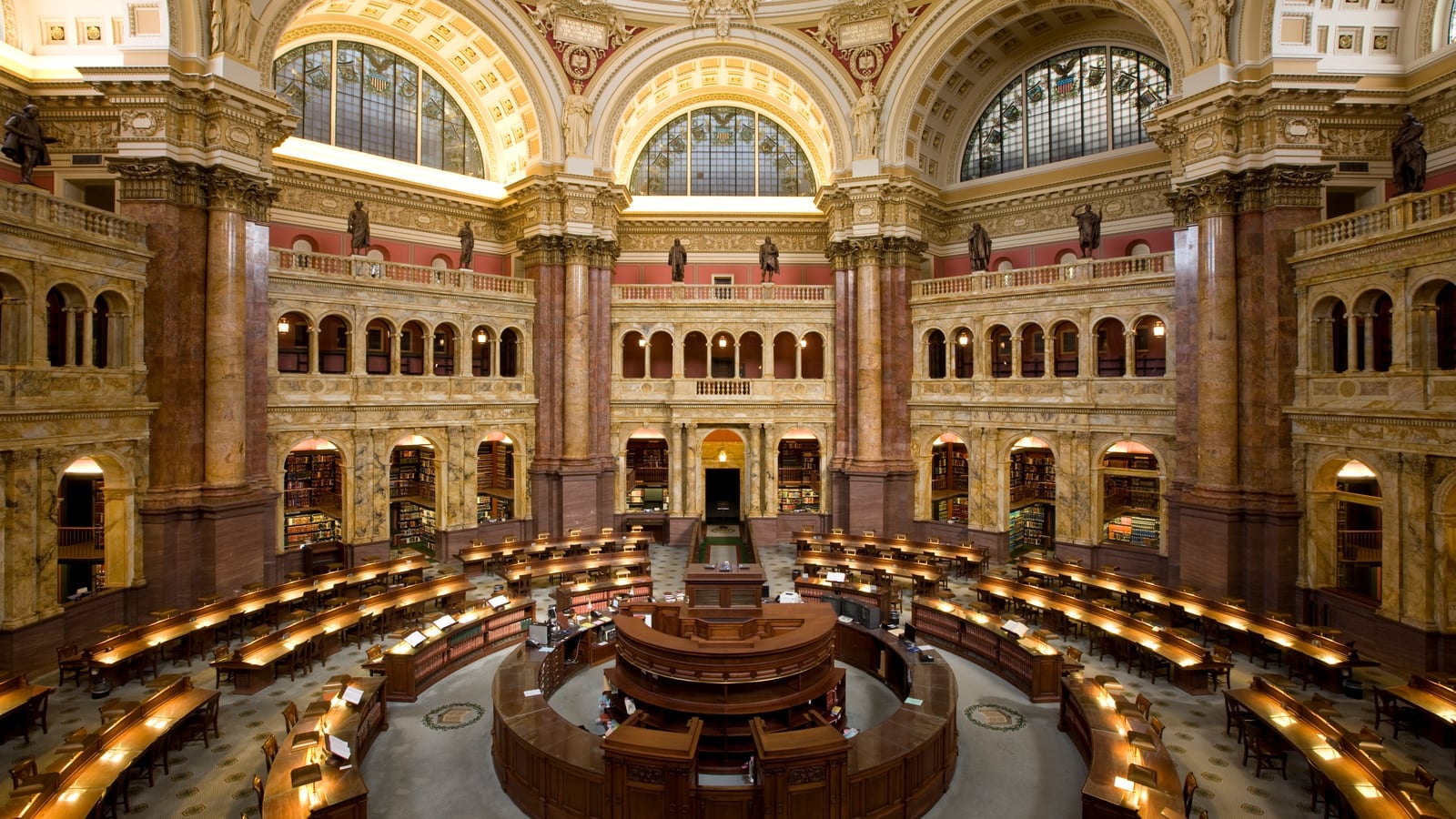
The largest Albanian collection in America sits across from the Supreme Court
The Library of Congress was established in 1800, which makes it the oldest federal cultural institution in the United States. About 3,200 people work there. Albanian materials started filtering in during the late 1800s, and today the collection runs, in Nevila’s words, “somewhere between 15,000 to 20,000 items of different format, from Albania, from all parts of Southeast Europe where Albanian is spoken or written or is a language of communication.”
That makes it the largest Albanian collection in the United States, and likely the largest outside Albania itself.
Some of what’s in there:
- Marin Barleti’s biography of Scanderbeg, printed in Rome in the early 1500s. One of the earliest biographies of our national hero, and you can view a digitized copy online.
- An illuminated manuscript, hand-painted with the American and Albanian flags, presented to President Woodrow Wilson in 1919 by Albanians pleading for support of independence. It survives because Wilson’s widow donated his papers.
- A 1939 radio recording of Faik Konica, our first minister to the United States. The Library still has it.
- Dielli, the Boston newspaper Konica and Fan Noli built, on microfilm going back to 1909. Illyria from the Bronx. Liria from Boston. Zëri i Popullit, Koha Jonë, the official gazette, even the communist-era satire magazine Hosteni.
- The world’s largest collection of physical phone books, which sounds absurd until you hear why it matters. More on that below.
“Albanian is one of 470 foreign languages we work with,” Nevila told us. Then she added, without much modesty: “We’re able to do what the British Library does. And probably much, much better, frankly.”
The person keeping it
Nevila celebrated five years at the Library the day before our call, and by the institution’s standards she’s new. “Most librarians go on to have a career of anywhere between thirty to forty-five years,” she said. “And I’m just at the very beginning.”
She didn’t set out to be a librarian. She’s a historian of Southeast Europe with a PhD from the University of Michigan, she taught Balkan history, and she works in about seven languages. She’s the first person hired to work full time on promoting the Albanian collections, but she was careful to point out the collection isn’t hers: “This has been accumulated over a century. I’m just the first person hired to promote it.”
Her collecting priorities, in her own ranking: language first, history second. “What is Albanian? Language is the feature of that kind of identity.” The Library collects Albanian material in every field except clinical medicine and technical agriculture, which belong to two other national libraries in DC.
When Ervin asked her what she ultimately wants, the answer took four words. “Grow the collections. Grow awareness.”
The internet is now a collection too
This is the part that stopped me. The Library of Congress doesn’t just archive books. It has been archiving Albanian websites, and Nevila was part of an initiative to preserve the web presence of immigrant communities from Central and Eastern Europe.
“We document community websites wherever we find them,” she said. How do they find them? “Sometimes it’s an accident, and sometimes it’s word-of-mouth.” Churches, mosques, community organizations. Active sites get crawled weekly or monthly. Sites the Library wants for the record get captured at least once, because community websites have a habit of fading off the internet, and once they’re gone, they’re gone.
The whole thing is permission based. A site owner gets a written request from the web archiving team, and if you agree, your site’s story is preserved by the national library of the United States. Permanently. Any researcher, anywhere, over the age of 16, can access it for free.
Sit with that for a second. Most Albanian organizations in this country have no archive at all. Their history lives in a filing cabinet, a Facebook page, and the memory of whoever has been treasurer the longest. The national library will preserve a community’s digital record forever, for free, and most of us don’t know the program exists.
How to use the Library
You don’t need to be a professor. You don’t even need to go to Washington, although if you do, the building sits next door to the Supreme Court, a short walk from Union Station, and Nevila hosts tours. She’s welcomed the Albanian ambassador and the minister of culture, but also regular families and student groups.
Three practical routes:
- Search from your couch. Go to loc.gov and search “Albanian American” or any topic, name, or town. The digitized items, including the Barleti Scanderbeg biography and the Wilson manuscript, are open access.
- Ask a librarian. The European Division answers questions from anyone at ask.loc.gov. And this is where those phone books come in. “I have a grandfather who lived in Bonn. I know you guys have phone books. Can you help me find his address? That is a regular question that I get,” Nevila told us. If your family passed through Italy, Greece, Germany, or anywhere else on the way to America, the Library may be able to place them at an address in a specific year. That is genealogy gold.
- Visit in person. Anyone 16 or older with a photo ID gets a free Reader Card. Pre-register online, show up, and you can request materials into the reading rooms.
Do not throw away the boxes
Here’s the story that stuck with me. Some years ago, the basement of Albania’s National Library in Tirana flooded. Newspapers going back to the early 1900s, back before the country formally existed, were in that basement. They survived as records because they had been digitized and duplicated first.
Nevila told us that story as encouragement, because digitizing archives is slow, unglamorous work. “What you’re doing is incredibly important,” she said. “It has incredible value.”
So what happens to your grandfather’s letters, your church’s fiftieth anniversary booklet, your society’s convention programs from 1962? Two answers now, not one.
First, the Library of Congress accepts donations, and it says no less often than you’d think. “It’s very rare that we reject something,” Nevila said. “If we don’t have it, we usually accept it.” The main reason for rejection is duplication. You submit an offer through the Library’s online donation form (never mail items unsolicited), a specialist like Nevila reviews it, and if it adds to the collection, your family’s materials enter the permanent record of the United States. For older items there’s a bonus: anything published in 1930 or earlier that enters the collections can be digitized outright, free of copyright complications.
Second, and this came directly out of our call: when the Library can’t take something, Nevila can now point people to us. NAR is building a digital archive for exactly the materials that fall outside a national library’s scope, and the referral runs both ways. As she put it, “That’s what libraries do. They connect people. There’s no point in hoarding it all.”
She also said something that applies to us as much as to her. “Part of collecting is servicing it as well, because there’s no point to hoarding books that are not going to get used.”
That’s the standard. Not just saving things. Making them findable. “It’s all about findability,” she said. “Promoting findability.”
Where this goes
The Library of Congress counts our books. Nobody yet counts us. Those are two halves of the same project, and after ninety minutes with the person who keeps the first half, I’m more convinced than ever the second half is worth building.
If you’ve got materials worth preserving, start with the Library’s donation form or write to us at NAR. If you’ve got a website that documents Albanian life in America, let the web archiving team know it exists. And if you’ve got two minutes, add yourself to the count at albanianregistry.org, because a community that keeps its records should also know its own size.
What’s sitting in your family’s basement?