

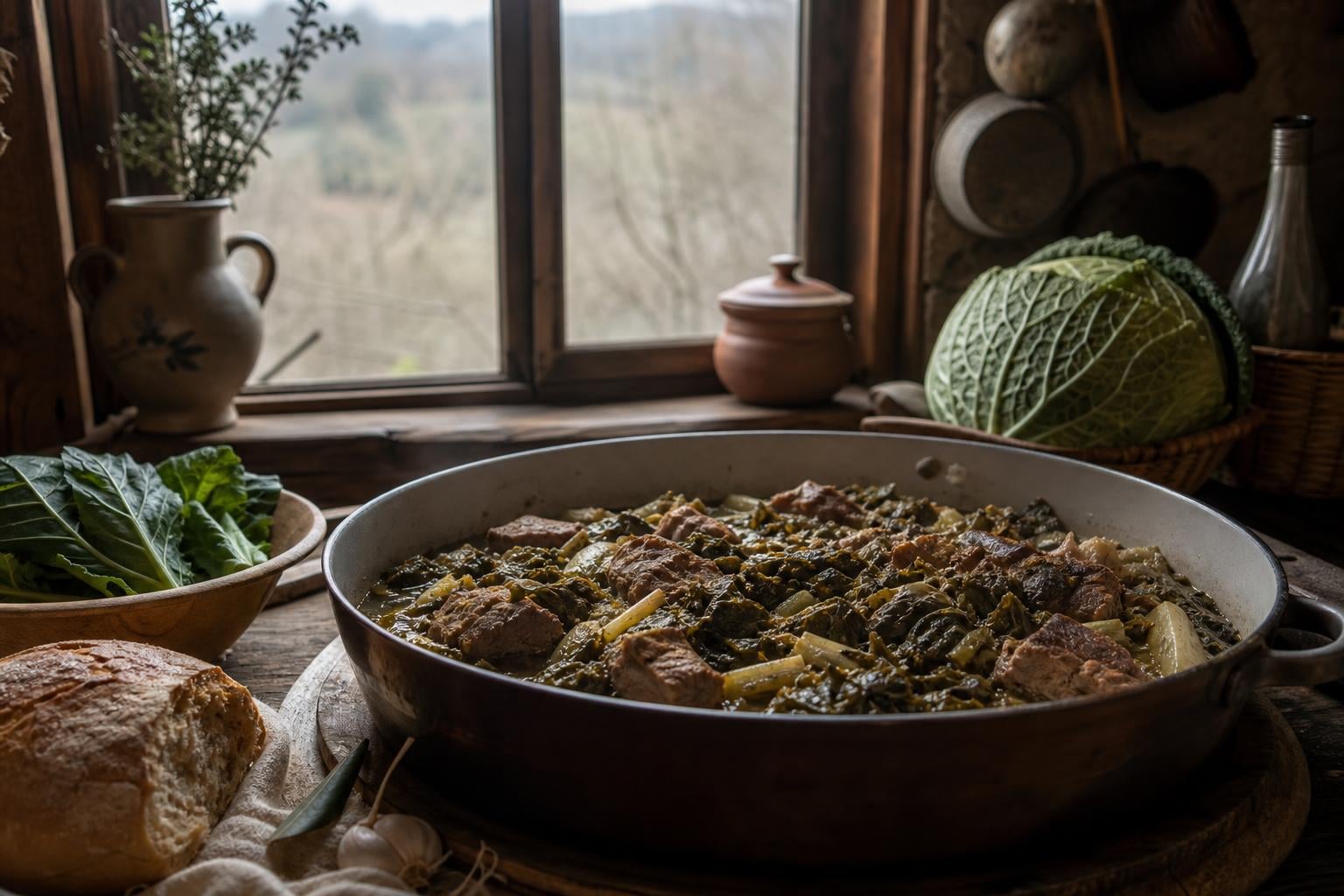
Lakra me mish (also called mish me lakra, meat with greens) is the Albanian braised dish of cooking greens slow-cooked with meat until both turn soft, savory, and deeply flavored. Lakër is the Albanian word for the cabbage family — head cabbage, collard greens, kale, and the leafy greens that grow alongside them — and mish is meat. Put them in one pot with onion, paprika, and a little fat, give them an hour and a half, and you have one of the plainest, most reliable mains in the Albanian winter kitchen.
It is a stew, not a pie. This matters, because the word lakër also names a baked pastry, lakror, the layered greens pie from the Korçë region. They are different dishes that happen to share a vegetable. Lakra me mish is eaten with a spoon from a bowl, with bread for the broth. Lakror is cut into wedges. If someone in your family says they are making lakra, the pot on the stove tells you which one.
This is the home-kitchen version, written for a US kitchen with US ingredients, with the quantities and timings nailed down. It serves six and takes about two hours, most of it hands-off once the pot is going. The recipe scales easily, freezes well, and — like most braises — tastes better on the second day.
What Lakra me Mish Is, and Where It Comes From
Lakra me mish is built on two things doing the same work: greens and meat both broken down slowly by heat and time. The meat goes in first and browns, the greens go in after and wilt down into a fraction of their raw volume, and then the whole pot simmers low until the meat is fork-tender and the greens have gone silky. A little paprika and onion carry the flavor; tomato shows up in some versions and not in others.
The dish is eaten across Albania, Kosovo, North Macedonia, Montenegro, and the diaspora. It belongs to a wide family of greens-and-meat braises found across the Balkans and the eastern Mediterranean (Albanian cuisine). Cabbage-and-meat stews, collard-and-meat pots, and their cousins turn up in Greek, Turkish, South Slavic, and other regional kitchens under their own names. Those shared roots are simply the history of a region where the same vegetables grew and the same long winters demanded the same kind of cooking. Lakra me mish is the Albanian version of that idea, with paprika, onion, and the meat the household ate.
Practically, it survives because it solves a real problem. Cabbage and collards are cheap, they store for months in a cold cellar, and a tough cut of meat that needs long cooking is exactly what a slow braise wants. A family with a head of cabbage, a few cuts of lamb or pork, and an afternoon could feed everyone and have leftovers. That math still works in a US kitchen, which is part of why the dish travels so well into Albanian-American homes.
NAR is the National Albanian Registry, a 501(c)(3) nonprofit building a community-led count of Albanian Americans. The US Census counts roughly 230,000 people of Albanian ancestry (2024 American Community Survey), while community estimates that include later generations and ethnic Albanians run closer to a million. The gap is the reason NAR exists, and food is one of the clearest threads connecting those numbers to real households. A dish like lakra me mish does not show up in many English-language cookbooks, but it shows up on a lot of Albanian-American stoves every winter. Writing it down is part of keeping it. So is being counted.
Lakër: The Greens, and What They Mean
The single word that does the most work in this dish is lakër. In standard Albanian it most often means head cabbage, but the term stretches across the broader cabbage family and the leafy cooking greens that grow with it: collard greens, kale, and the tougher field greens of the countryside. Which one a cook reaches for depends on the region, the season, and what the garden or the store had.
In much of the country, lakra me mish literally means cabbage with meat — a head of green cabbage, cored and sliced, braised down with the meat. In other regions and households, lakra leans toward collards and kale, the sturdy leaves that cook down without dissolving. The dish is the same idea either way: a hardy member of the cabbage family, given enough heat and time to go tender.
For diaspora cooks this is good news, because the US produce aisle stocks all of it year-round. Collard greens are the easiest match to the heavier cooking greens of the Balkans and hold their texture through a long braise. Lacinato kale (sold as dinosaur kale or cavolo nero) is a close second and stays a touch firmer. Plain green cabbage is the cheapest and most traditional option of all. Many Albanian-American cooks blend two of them — a head of cabbage plus a bunch of collards — for body and depth. What you skip are the delicate greens: spinach and chard collapse to nothing in an hour-long simmer and turn the pot to mush.
The Meat: Lamb, Beef, or Pork by Region and Faith
The meat in lakra me mish splits along regional and religious lines, and all of the versions are correct.
Lamb is the oldest and most widespread choice — shoulder or neck, cuts with enough connective tissue to reward a long braise. Beef chuck or shank is the everyday substitute and the diaspora default, because it is easy to find and forgiving. Lamb and beef cover most of Albania and Kosovo and most Muslim and Orthodox households.
Pork is the northern and Christian variation. In Catholic families in the north of Albania and parts of Kosovo, and in many Orthodox homes, pork shoulder or smoked pork ribs go into the pot and bring a smoky richness the leaner meats do not. Smoked pork in particular turns the dish into something closer to a Central European cabbage stew in spirit, though seasoned the Albanian way.
The faith line is real but not rigid. A Muslim Albanian family will use lamb or beef; a Catholic family in Shkodër might use pork; an Orthodox family in the south might use any of the three depending on the day and the fasting calendar. During Orthodox fasting periods the dish is sometimes made with no meat at all — just greens, onion, oil, and beans for body. The technique below works for whichever meat your household keeps.
North vs. South, and the Kosovo Versions
Like most Albanian home cooking, lakra me mish drifts a little from region to region. The differences are matters of emphasis, not separate recipes.
In the north of Albania and in the highlands, the dish runs heavier and often smokier — pork or smoked meat in Christian households, more chili heat, a thicker pot meant to stand up to hard winters. Northern cooking leans into the cabbage end of lakër, with sliced head cabbage doing most of the work.
In the south, the hand is a little lighter. Olive oil does more of the cooking, the greens skew toward collards and field greens, and a finishing squeeze of lemon or a spoon of yogurt is more common. Southern versions sometimes carry a brighter, leaner profile.
In Kosovo and among Kosovar-Albanian families, the dish often runs hotter — dried hot pepper flakes (speca djegës) stirred in — and tends toward beef. Kosovar cooks also make a closely related winter dish of cabbage stuffed and rolled rather than simply braised, which overlaps with japrak (the Albanian preparation of stuffed leaves) when the cabbage leaf is used instead of the grape leaf. The braised version on this page is the simpler, faster one — no rolling, just a pot.
None of these are competing claims to a single correct recipe. They are what happens when one practical dish gets cooked across a few hundred miles and several generations. Cook the one your family cooked.
Ingredients
Serves 6. All measurements are US standard.
For the braise:
- 2 lbs boneless lamb shoulder, beef chuck, or pork shoulder, cut into 1½-inch cubes (see the note below on smoked pork)
- 2 lbs greens: one large head of green cabbage, OR 2 large bunches collard greens, OR 2 bunches lacinato kale — or a mix totaling about 2 lbs
- 1 large yellow onion, diced
- 4 cloves garlic, finely chopped
- 2 Tbsp tomato paste (optional; see variations)
- 1 Tbsp sweet paprika
- 1 tsp hot paprika or ½ tsp red pepper flakes (optional, for a Kosovar-style heat)
- 1 tsp dried oregano
- 2 bay leaves
- 3 to 4 cups water or low-sodium stock
- 3 Tbsp olive oil (or 2 Tbsp oil plus rendered meat fat)
- 1½ tsp kosher salt, plus more to taste
- ½ tsp freshly ground black pepper
- Juice of half a lemon, to finish (optional, common in the south)
A note on the meat: shoulder cuts are the right call — lamb shoulder, beef chuck, or pork shoulder all carry the connective tissue that melts into the braise and gives the broth body. Lean cuts like leg or loin go stringy and dry over an hour and a half. If you want a smokier northern pot, use smoked pork (smoked shoulder, smoked ribs, or a smoked ham hock) for half the meat and fresh shoulder for the rest.
A note on the greens: if using cabbage, quarter it, cut out the hard core, and slice into ribbons about half an inch wide. If using collards or kale, strip the leaves off the thick center stems (the stems stay tough even after a long cook) and tear or chop the leaves into rough two-inch pieces. Wash everything well — field greens hold grit.
A note on paprika: fresh, fragrant paprika is what colors and flavors the pot. A jar that has sat open for two years gives a dull, flat result. If it has no smell when you open it, it will do nothing for the dish.
How to Make Lakra me Mish
Step 1 — Brown the meat (12 minutes)
Pat the meat cubes dry and season with half the salt and the black pepper. Heat the olive oil in a heavy 6-quart pot or Dutch oven over medium-high heat. When it shimmers, add the meat in a single layer — work in two batches if the pot is crowded, because crowded meat steams instead of browning. Sear 3 to 4 minutes per side until deeply colored. Remove the browned meat to a plate and set aside.
Step 2 — Build the base (10 minutes)
Lower the heat to medium. There should be rendered fat in the pot; if it looks dry, add a tablespoon of oil. Add the diced onion and cook 6 to 7 minutes, stirring, until soft and golden at the edges. Add the garlic and stir 30 seconds until fragrant.
Add both paprikas, the oregano, and the tomato paste if using. Stir continuously for about 60 seconds — the paste should darken and the spices should bloom in the fat. This step is where the color and depth of the broth get built. If it threatens to stick, splash in a tablespoon of water.
Step 3 — Wilt the greens (8 minutes)
Return the browned meat and its juices to the pot. Add the greens in batches — they will look like far too much, then collapse to a fraction of the volume as they wilt. Add a handful, stir until it wilts down, add the next handful. With cabbage this goes fast; with collards or kale it takes a few minutes more. Keep going until all the greens are in and reduced.
Step 4 — Braise (1 hour 20 minutes)
Add the bay leaves, the remaining salt, and 3 cups of water or stock — enough to come about two-thirds of the way up the contents, not to cover them, since the greens release more water as they cook. Bring to a gentle simmer.
Cover and cook on low for 1 hour. Stir every 20 minutes or so and check the liquid level; add a splash of water if it looks dry. After the first hour, the meat should be approaching fork-tender.
Uncover the pot and continue at a low simmer for another 20 to 30 minutes. This is the step that separates a good lakra me mish from a watery one: with the lid off, the excess liquid reduces and the flavors concentrate. The finished dish should be wet but not soupy — the greens and meat sitting in a thickened, savory broth rather than a thin one.
Step 5 — Finish and rest (10 minutes)
Pull the bay leaves. Taste and adjust the salt — wait until now, since stock and any smoked meat add sodium of their own. If you are making a southern-style version, stir in the lemon juice now. Pull the pot off the heat and let it rest 10 minutes; the broth thickens and the flavors round out as it sits.
Why This Method Works
The two long, slow steps — browning the meat and braising it low with the greens — are doing the same chemistry the dish has always relied on, just measured.
Browning the meat first builds the base flavor. The deep crust that forms in step one is the Maillard reaction, the same browning that gives roasted meat its savor, and it dissolves into the broth during the simmer. Skip the sear and dump raw meat into the pot and you get a paler, flatter stew. The thirty seconds spent on each batch pays off in the bowl.
The long braise is what turns tough, cheap cuts tender. Shoulder meat is full of collagen — connective tissue that is rubbery when undercooked and dry when cooked fast and hot. Held at a low simmer for an hour or more, that collagen slowly converts to gelatin, which makes the meat fork-tender and gives the broth its body. This is why a fast-cooked lean cut fails here and a slow-cooked shoulder succeeds.
The greens follow the same logic. Raw cabbage and collards are tough and slightly bitter. Cooked down slowly, they go silky and faintly sweet as the fibers break and the harsh edge cooks off. Crowding them in raw and rushing the heat steams them and leaves them bitter — which is the single most common complaint about a first attempt. Wilt them down properly in step three, then let time do the rest.
Variations
Tomato version. Stir 2 tablespoons of tomato paste into the base in step two, or add a 14-ounce can of crushed tomatoes with the liquid in step four. The pot turns redder, sweeter, and a little more stew-like. Common in many households; equally common to skip it entirely for a cleaner greens-and-meat flavor.
Smoked-pork northern version. Use smoked pork shoulder, smoked ribs, or a smoked ham hock for half the meat. The smoke runs through the whole pot and the dish reads heartier and more wintry. A Catholic-northern and Christian-household variation.
Kosovar hot version. Lean on beef, add a teaspoon of dried hot pepper flakes (speca djegës) with the paprika in step two, and finish with a splash of red wine vinegar. The pot runs hotter and brighter.
Lenten / meatless version. During Orthodox fasting weeks, drop the meat entirely. Add a drained can of white beans (or a cup of dried beans, soaked and pre-cooked) for body, bump the olive oil, and lean on the paprika and onion. The dish loses its richness but gains a clean greens-and-bean character — a cousin of fasule, the Albanian white bean stew.
Rice or potato addition. Some families stir a half cup of rice into the braise for the last 25 minutes, or add diced potato, to stretch the pot and soak up the broth. Both are honest home-cook moves.
Serving and What to Pour Alongside
Lakra me mish goes into shallow bowls, hot, with bread already cut and on the table. It is not a centerpiece dish that announces itself — it is a weeknight-and-Sunday dish, the kind that fills a house with the smell of braising cabbage and pulls people to the table without ceremony.
What goes around it:
- Crusty bread. A country loaf or fresh bukë for sopping the broth. Half the pleasure of the dish is the bread in the liquid.
- Kos (yogurt). A small bowl of cold, full-fat plain yogurt on the side. The tang cuts the richness of the meat and the slight sweetness of the greens. Some eaters spoon it straight into the bowl.
- Pickled peppers. Speca turshi — peppers pickled in vinegar and salt — sit on many Albanian tables and add a sharp counterpoint.
- A chopped salad. Cabbage, cucumber, or tomato with onion, dressed simply with oil and vinegar.
- Wine or raki. A young red alongside the meal, or a small glass of raki before it, in the families that keep that custom.
The dish reheats beautifully and, like most braises, improves overnight as the flavors settle. Make a big pot on Sunday and it carries through the week.
A Note Before the FAQ
Lakra me mish is one of those dishes that lives in the cooking, not in a book. The grandmothers who made it did it by feel — a head of cabbage, whatever meat was on hand, paprika by the pinch, a pot left to braise while they did something else. That version does not appear in many English-language cookbooks, and when the cook who carried it is gone, the specifics often go with her.
If you have someone in your family who makes it, call this week and ask. Watch the pot if you can. Ask what the greens should look like at the one-hour mark, and what meat her mother used, and whether tomato went in or not. Write the answer down. That is how a dish like this stays Albanian across an ocean and a few generations. For more of the everyday Albanian table, the overview of Albanian dishes is a good next stop.
Heritage food and being counted are two sides of the same act of keeping. If you have not registered yet, take two minutes and get counted with NAR — free, neutral, and part of how the diaspora’s food, names, and history get the record they deserve.