
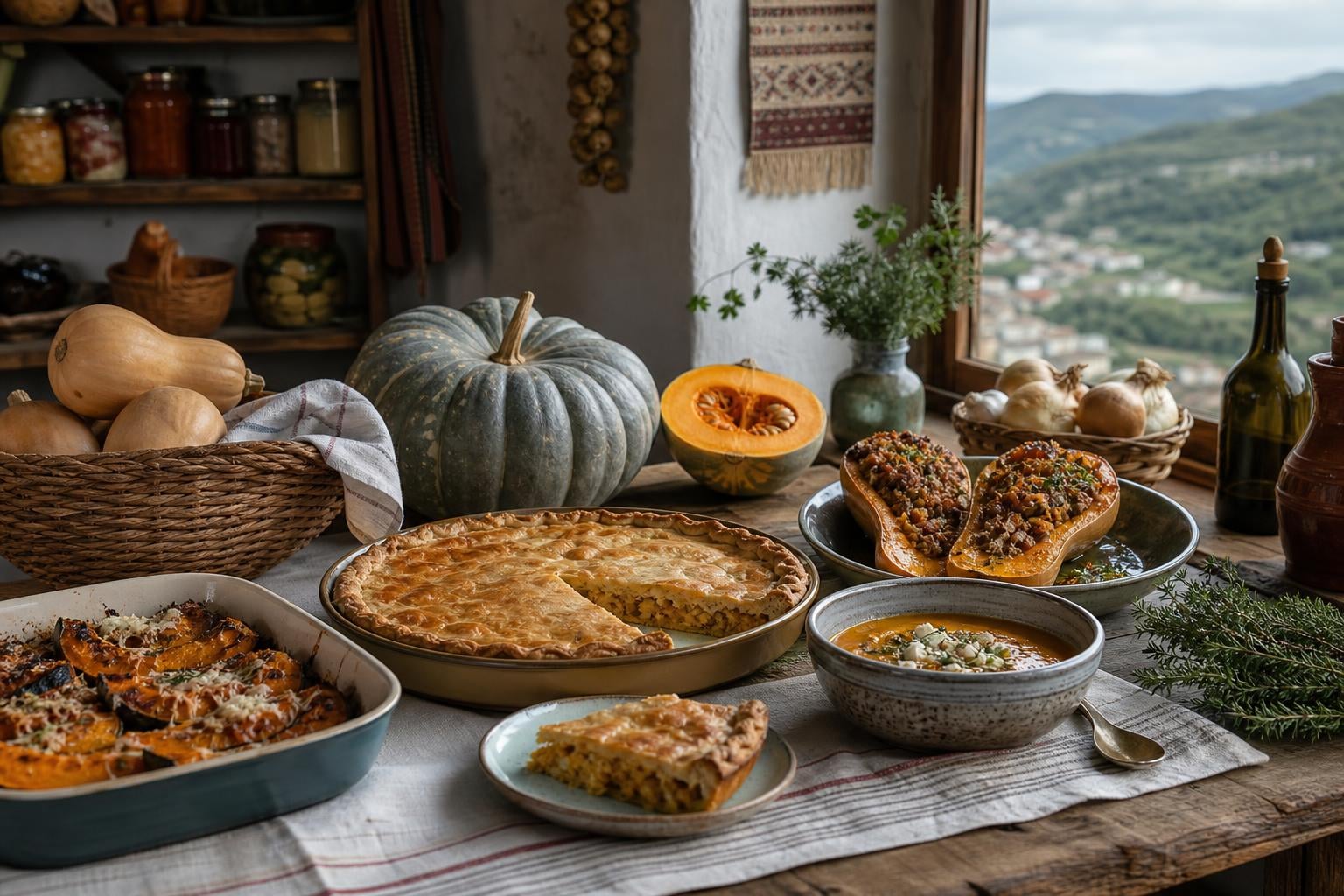
Fall in an Albanian household has a smell. Onions softening in olive oil, a sheet of filo crackling in the oven, and underneath it the unmistakable scent of grated pumpkin sweating off its water. By the time the byrek me kungull comes out of the pan, the kitchen has the warm, slightly sweet, slightly toasted air that signals the seasons have turned.
Kungull (pumpkin and squash) is one of those ingredients that does more work in Albanian cooking than its reputation suggests. It is not a holiday-only food. It is not a dessert. It is the autumn-and-winter workhorse that anchors the pie tray, the soup pot, the stuffed-vegetable platter, and, in many households, the Sunday breakfast. For Albanian Americans, kungull dishes are also the part of the diaspora cooking that translates easiest into a US kitchen — every American grocery store stocks butternut squash, and the recipes adapt almost without losses.
This guide covers what kungull is in Albanian cooking, the canonical pumpkin dishes, the regional variation between north and south, and how Albanian-American families in New York, Michigan, Massachusetts, Texas, and across the country rebuild them with the ingredients on hand. The framing throughout is diaspora-practical: which versions travel, what gets substituted, and what the family Sunday lunch looks like 5,000 miles from Korçë.
What kungull covers in Albanian kitchens
Kungull is a broad word. It covers the entire pumpkin and squash family — the orange winter pumpkin, the long pale butternut, the green-and-yellow zucchini, and the round green kabocha-style gourds sold in Albanian markets in the fall. In a recipe, the modifier does most of the work.
Kungull i ëmbël (literally “sweet pumpkin”) is the dense, orange-fleshed winter squash that goes into pies, stuffed dishes, and soups. Kungull i njomë (“young pumpkin”) is summer squash and zucchini, sliced into stews, fried as fritters, or chopped into rice dishes. Farë kunguj (pumpkin seeds) are roasted and salted as a snack — sold in every village square in Albania, and in many Albanian-American grocers in New York and Detroit.
The Mediterranean and Balkan cooking tradition that Albanian food belongs to leans on this whole gourd family. Pumpkin and squash arrived in the region after the 16th-century Columbian Exchange, traveled the Ottoman trade routes, and were absorbed into the southern Balkan repertoire alongside corn, tomatoes, and peppers (Wikipedia: Albanian cuisine). Four centuries later, kungull sits inside the canonical recipe set the way potatoes do in Ireland or rice does in Italy.
The seasonal logic is straightforward. Winter squash is what is available, cheap, and storable from October through March. In village Albania it was kept in cool storerooms through the winter, drawn on when fresh produce ran short. The dishes that built up around it — pies, soups, stuffed gourds — are the dishes that get pulled out when the days shorten and the meal has to be substantial.
The seasonal context: pumpkin as winter food
In Albania and Kosovo, kungull is autumn-and-winter food. The pie comes out of the oven when the air gets colder. The soup runs from October through early spring. The stuffed pumpkin shows up at Sunday lunch from late October through February, and on the holiday table around Christmas and Orthodox Epiphany.
Two cooking calendars overlap. The Muslim calendar, followed by the majority of Albanians, brings kungull dishes to the Ramadan and Eid tables when those holidays fall in fall and winter — Ramadan moves through the year, so the menu rotates. The Christian calendars (Orthodox in the south, Catholic in the north) put kungull on the table during the long fasting periods before Christmas and Easter, when meat is restricted and vegetable-and-grain dishes do the heavy lifting. Kungull i mbushur me oriz (pumpkin stuffed with rice) and byrek me kungull without cheese are both rooted in this fasting-day tradition.
In Albanian-American households the rhythm shifts slightly. The American Thanksgiving and Christmas calendar pull the pumpkin dishes forward a few weeks. Byrek me kungull shows up on the Thanksgiving spread next to the turkey in many diaspora kitchens — an Albanian answer to pumpkin pie that the kids actually eat. By the time the New Year rolls around, the pumpkin has cycled off and the heavier winter stews take over.
There is also the simple economics of it. A single butternut squash yields enough flesh for a 9x13 pan of byrek that feeds eight, at modest cost. Lamb tells the story of Albanian holidays; kungull tells the story of Tuesday-night dinner.
Byrek me kungull: the canonical pumpkin pie
The most common pumpkin dish in Albanian cooking, and the easiest entry point for any diaspora cook, is byrek me kungull — pumpkin byrek. The base technique is the standard Albanian filo pie: thin sheets of dough (petë) layered with butter or olive oil, wrapped around a filling, and baked in a round or rectangular pan until the top blisters and the bottom crisps (Wikipedia: Albanian cuisine).
The pumpkin filling is straightforward and forgiving. Grate raw winter squash on the large holes of a box grater. Salt it lightly and let it sit in a colander for 20 minutes so it sheds water — this is the step American cooks tend to skip and regret. Squeeze the grated squash hard in a clean towel. Sauté chopped onion in olive oil until soft, then add the squash and cook a few minutes more. Off the heat, stir in a spoonful of sugar, a pinch of salt, sometimes a handful of rice or crumbled feta, and in northern households a little ground cinnamon.
Layer the filling between sheets of filo, brushing each sheet with melted butter or olive oil. Score the top, bake at around 375°F for 35-45 minutes, and let it rest 10 minutes before cutting. The result is somewhere between savory and sweet — the sugar is restrained, the onion gives it body, and the filo turns the whole thing into something halfway between dinner and dessert.
Regional and family variations stack up from there. Some cooks add chopped walnuts. Some add raisins. Some skip the sugar entirely and lean savory with feta and fresh dill. The southern Albanian style tends toward less sugar and more herbs; the northern Albanian and Kosovar style tends toward sweeter, sometimes lightly spiced with cinnamon or nutmeg.
For the US-Albanian kitchen, the substitution math is simple. Athens-brand filo from any grocery store works. Butternut squash replaces kungull i ëmbël directly. Regular yellow onion stands in for the larger Mediterranean onion. The only ingredient that genuinely matters is the squash variety — a watery jack-o’-lantern pumpkin will not give the same dense, sweet result as a butternut, kabocha, or sugar pie pumpkin.
Lakror me kungull: the southern variation
In southern Albania — Korçë, Përmet, Berat, and the surrounding region — the pumpkin pie often takes a different form. Lakror is the southern pie family, distinct from byrek in three ways: the dough is thinner and more delicate, the filling is bound differently, and the traditional baking method uses a saç — a heavy iron lid covered with hot embers that bakes the pie from above while a fire below heats the pan (Wikipedia: Lakror).
Lakror me kungull uses the same grated-and-drained squash filling as byrek me kungull but treats the dough more like a thin tart shell. The result is crispier, smokier (when cooked the traditional way over embers), and less bread-like. Korçë is the center of the lakror tradition, and the pumpkin version is a fall and early-winter staple in Korçë households.
The distinction matters for Albanian Americans rebuilding the dish in the US. Lakror benefits from a heavier, shallower pan and a hotter oven (400°F or higher) to mimic the radiant heat of the saç. Cast iron works well. Some Albanian-American grandmothers rig versions with two stacked Dutch ovens — the bottom holding the pie, the top inverted over it with the lid heated on a separate burner.
The southern style of lakror me kungull also leans more savory. Less sugar, more dill, sometimes a little leek (presh) mixed into the squash, and feta or gjizë (Albanian fresh curd cheese — see Albanian cheeses) folded into the filling. It eats less like dessert and more like a vegetable course.
In Albanian-American food culture, the lakror tradition has held up best in Massachusetts and parts of New York — communities with strong roots in Korçë and the surrounding southern Albanian region. The byrek style dominates in Detroit, in the Bronx, and across most of the diaspora, reflecting the broader geographic mix of where Albanian Americans came from (Wikipedia: Albanian Americans).
Pite me kungull and the broader pie family
A note on terminology that confuses Albanian-Americans whose families came from different regions: byrek, lakror, and pite are all used to describe layered savory or lightly sweet pies, and the overlap depends on where you grew up.
Pite is the broader, older word for “pie” in Albanian, related to the same root as Greek pita. In some regions, pite and byrek are used interchangeably. In others, pite specifically refers to a thicker, breadier version with fewer filo layers, while byrek is reserved for the thin-filo pie (Wikipedia: Albanian cuisine). Pite me kungull in northern Albanian and Kosovar usage often describes a heavier, rustic version of the pumpkin pie — fewer dough layers, denser filling, sometimes with cornmeal added to the filling for body.
The diaspora reality is that families bring whatever vocabulary their region used. A Kosovar grandmother in the Bronx might call the same dish pite me kungull that an Albanian-American grandmother in Worcester calls byrek me kungull or lakror me kungull. The recipes are cousins, not strangers. Asking which one is “correct” misses the point — there are five or six regional versions of the pumpkin pie, all with valid claims.
For a US-based cook standing at the supermarket trying to decide what to make, the practical question is dough thickness. Standard filo (Athens, Krinos) gives the byrek result. Hand-rolled thicker dough gives the pite result. A thinner hand-rolled or stretched dough gives the lakror result. All three use roughly the same pumpkin filling, with regional tweaks.
Kungull i mbushur: stuffed pumpkin
The other canonical kungull dish is kungull i mbushur — stuffed pumpkin or stuffed squash. Where byrek is everyday food, kungull i mbushur is closer to a centerpiece dish. It shows up on Sunday lunches, at holiday meals, and on Orthodox fasting tables.
The construction is the same as the Ottoman-Balkan stuffed-vegetable tradition (dolma, sarma, yaprak). Cut the top off a small to medium winter squash, scoop out the seeds and stringy pulp, and fill the cavity with a rice-based stuffing. The standard filling: short-grain rice partially cooked, sautéed onion, chopped parsley and dill, sometimes ground lamb or beef, sometimes pine nuts and raisins, salt, pepper, a little olive oil. Replace the squash top as a lid, set the whole gourd in a baking dish with a little water, and bake covered for 60-90 minutes until the squash is tender and the rice is fully cooked.
Two regional styles dominate. The southern Albanian and Orthodox-fasting style is meatless — rice, herbs, sometimes a little grated cheese folded in, sometimes a handful of currants. The northern and Kosovar style adds ground lamb or beef, more spice (a touch of cinnamon and allspice), and sometimes a tomato-yogurt sauce served alongside.
In Albanian-American kitchens, kungull i mbushur has had a slower revival than byrek me kungull. The dish takes longer, requires a properly sized squash, and is harder to scale to weeknight cooking. But it is the showpiece pumpkin dish for the Albanian-American Thanksgiving table — a stuffed pumpkin sitting next to the turkey makes the cultural double-flag of the holiday visible. The version that travels best uses a single 4-5 pound butternut or kabocha squash and a rice-and-pine-nut filling that holds up to long baking.
Supa me kungull: pumpkin soup, Albanian style
Albanian supa me kungull (pumpkin soup) is closer to a country soup than to the silky, dairy-rich purées common in American restaurants. The base technique: sauté chopped onion and carrot in olive oil, add cubed peeled winter squash, cover with broth or water, simmer until everything is tender, and either leave it chunky or partially blend.
Regional variation runs along the same lines as the pies. In southern Albanian cooking, the soup tends to be lighter — vegetable broth, a generous handful of fresh dill or parsley stirred in at the end, sometimes a squeeze of lemon. In the north and Kosovo, the soup tends to be heavier — meat broth, sometimes a roux thickener (meljë) made from flour and butter, sometimes a yogurt swirl on top.
The defining Albanian touch on most versions is the dairy finish. A spoonful of kos (Albanian yogurt) gets stirred into each bowl at the table, not into the pot. This keeps the yogurt from breaking and gives the soup the signature tangy contrast that runs through Albanian cooking — the same logic as the yogurt topping on tavë kosi or the yogurt cup served alongside byrek. For Albanian Americans, full-fat Greek yogurt is the closest US supermarket substitute.
A second variation, common in the south, adds trahana — the dried fermented grain pellets that thicken many Albanian winter soups. Trahana turns the pumpkin soup into something closer to a porridge: heartier, slightly sour, the kind of dish that doubles as dinner. Trahana is available at Greek, Bulgarian, and Albanian grocers across diaspora neighborhoods in Yonkers, Sterling Heights, and Waterbury.
How Albanian-American families rebuild these dishes
The diaspora kitchen is a study in adaptation. Albanian Americans cook byrek me kungull, lakror, and kungull i mbushur with what is on the shelf at ShopRite, Meijer, and HEB. The recipes survived because they adapt.
The most common substitutions, drawn from how families actually cook in the largest Albanian-American communities:
Pumpkin variety: Butternut squash is the standard substitute and what most second-generation Albanian Americans grow up calling “kungull.” Kabocha is the closer match for the dense, sweet, slightly chestnut flavor of Albanian kungull i ëmbël and is increasingly used in diaspora kitchens. Sugar pie pumpkins work but require careful draining. Standard jack-o’-lantern pumpkins should be avoided — too watery, too bland.
Filo dough: Athens-brand or Krinos-brand frozen filo, available in any US supermarket, is the standard. The thin sheets are slightly more delicate than hand-rolled petë, but the difference is small. For lakror me kungull, some families switch to phyllo-style thicker dough sheets or make a quick yogurt-and-flour dough from scratch.
Fat: Albanian kungull dishes traditionally used butter (gjalpë) in the north and olive oil in the south. Both are widely available in the US. Some Albanian-American cooks use a 50/50 blend between filo layers — butter for flavor, olive oil for crispness. Margarine is not a real substitute; the flavor drops away.
Yogurt: Full-fat Greek yogurt is the closest substitute for Albanian kos. Stonyfield whole milk, Fage 5%, and Wallaby Organic are reasonable supermarket options. Avoid nonfat — the texture and tang are wrong.
Cheese: When the recipe calls for gjizë, drained ricotta works in a pinch but is sweeter. Mixing ricotta half-and-half with crumbled feta gets closer to the savory tang. Djathë i bardhë is well replaced by standard supermarket feta. See Albanian cheeses for the full breakdown.
Spices: Cinnamon and nutmeg (in northern-style sweet pumpkin pies) are pantry standard. Fresh dill and parsley (for southern and stuffed-pumpkin versions) keep at most US groceries.
The bigger pattern in diaspora cooking is that kungull dishes have proven stable across generations. The recipes are forgiving, the ingredients are in every US grocery store, and the cultural logic — fall, family, the smell of butter and pumpkin in the oven — translates without subtitles. Second-generation kids who do not speak the language still know what byrek me kungull tastes like at their grandmother’s house.
Connecting the kitchen to the community
A bowl of supa me kungull, a tray of byrek, and a stuffed pumpkin on the Sunday table are how a culture keeps itself in the room when the language fades. For Albanian Americans, the question of what to do with that — beyond cooking it once a year — runs into how diffuse the community is. New York has roughly 52,000 Albanian Americans; Michigan about 30,000; Massachusetts about 21,000 (Wikipedia: Albanian Americans). Most of those people do not know each other, do not share a grocery store, and do not run into one another at the same school pickup.
That is the gap food alone cannot close. The recipes are durable; the social fabric around them is not. A second-generation kid who eats kungull i mbushur at Thanksgiving still benefits enormously from a third-generation neighbor down the street who also eats it. Identity holds up better in groups than in isolation, and the diaspora map of who is where, what their kids speak at home, and which families are still cooking the old dishes has never been written down.
NAR’s count and registry exists to fill that gap. The first step in any community-building effort is knowing who is in it. If pumpkin pie at Thanksgiving and kungull i mbushur at Christmas are how a family stays Albanian, the NAR registry is how the family becomes visible to every other Albanian household within fifty miles.