
On the morning of September 16, 2026, at 10:00 in The Hague, a court reads out a verdict that a large part of the Albanian world has waited years to hear. The defendants are Hashim Thaçi, Kadri Veseli, Rexhep Selimi and Jakup Krasniqi: four former leaders of the Kosovo Liberation Army, the guerrilla force that fought Serbia in 1998 and 1999 and that many Kosovo Albanians credit with winning their independence. The charges are crimes against humanity and war crimes. All four have pleaded not guilty.
For Albanian Americans, this is not a distant foreign headline. It reaches into family history, community identity, and a long argument about how the story of Kosovo’s independence gets told. This piece is a plain-language explainer, written to be accurate whichever way the verdict goes. It does not take a side on guilt or innocence, and it is not a call to any particular action. It is here so that a reader who has heard the case discussed at a dinner table, in a WhatsApp group, or at a community event can understand what is actually being decided.
What happens on September 16
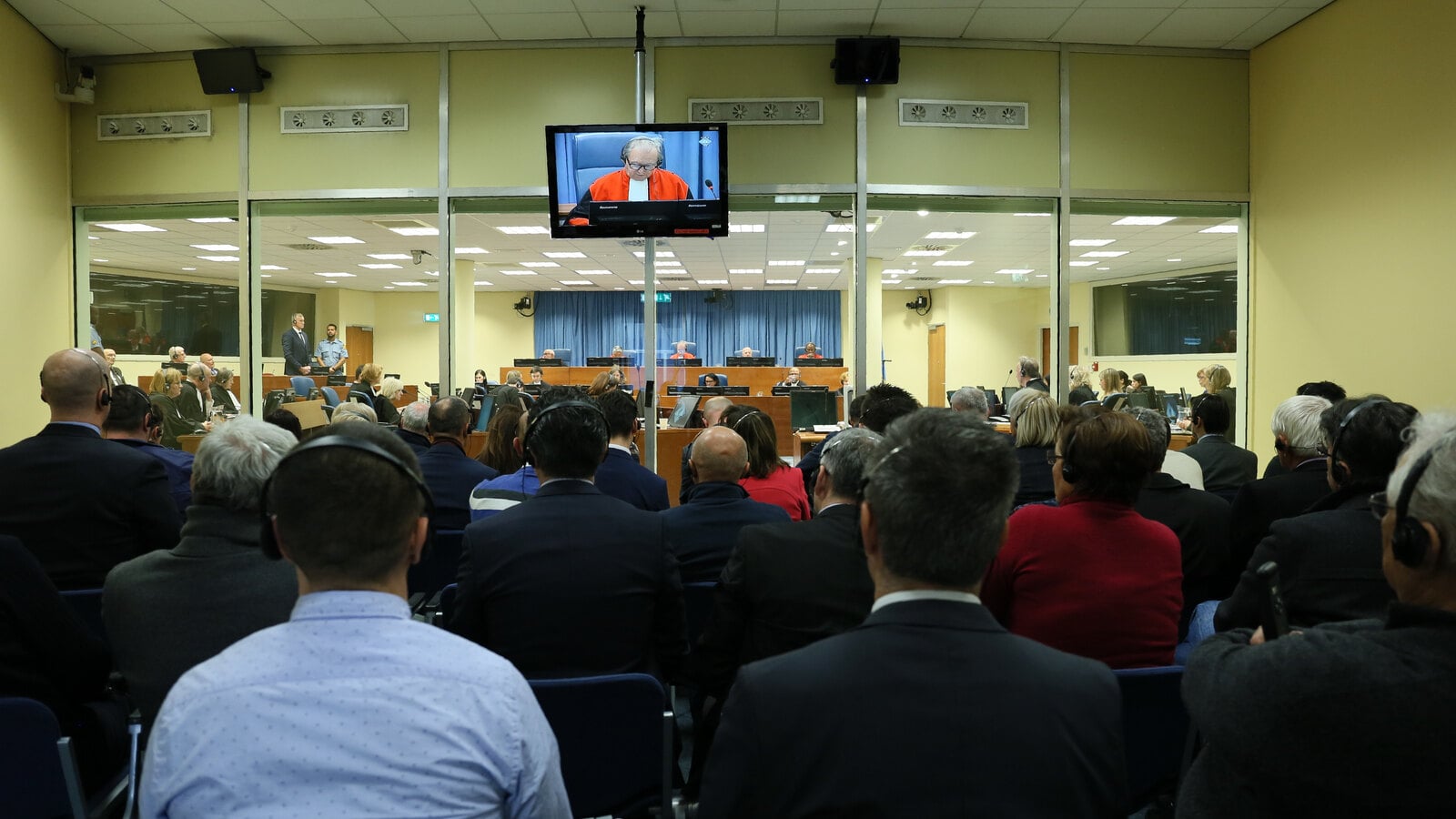
The Kosovo Specialist Chambers has scheduled the pronouncement of its trial judgment for 16 September 2026 at 10:00 CET. That is 4:00 a.m. in New York and mid-morning in The Hague. The hearing is public. It is streamed on the court’s website in Albanian, English and Serbian, and it can be followed from the public gallery at the court.
What the panel reads out is a first-instance judgment. In plain terms, it is the trial court’s decision, and it can be appealed by either the prosecution or the defense to the court’s appeals panel. So September 16 is a decisive day, but it is a milestone rather than a guaranteed final chapter. The full process, including any appeal, can run longer.
The four defendants
Each of the four was a senior figure in the Kosovo Liberation Army, known in Albanian as the Ushtria Çlirimtare e Kosovës or UÇK, during the 1998–99 war, and each went on to a leading role in independent Kosovo.
Hashim Thaçi is the best known. A KLA political leader during the war, he became Kosovo’s prime minister in 2008, the year Kosovo declared independence, and later its president. In November 2020, after a pre-trial judge confirmed the indictment against him, he resigned the presidency and traveled to The Hague, saying he did not want to face the charges while in office.
Kadri Veseli is a former speaker of Kosovo’s parliament and the former head of the KLA’s intelligence structure, later a leading figure in one of Kosovo’s main political parties.
Rexhep Selimi and Jakup Krasniqi were both senior KLA figures who continued into Kosovo’s political leadership after the war, Krasniqi as a former parliamentary speaker and the KLA’s wartime spokesman.
These are not obscure names in Kosovo. They are among the people most associated with the independence era, which is a large part of why the case carries the weight it does.
The charges
The Specialist Prosecutor charges the four with crimes against humanity and war crimes allegedly committed by the KLA between 1998 and 2000, during and just after the war with Serbia.
According to the indictment, the men bear individual and command responsibility for a campaign against people the KLA regarded as opponents. The prosecution alleges more than one hundred murders, along with enforced disappearances, torture, and persecution, much of it connected to KLA-run detention sites in Kosovo and in northern Albania. The people said to have been targeted include Serbs, Roma, and ethnic Albanians suspected of collaborating with Serbian authorities or of opposing the KLA. The court has recognized 156 participating victims in the case.
Two points matter for an accurate reading. First, these are allegations that the defendants deny; all four pleaded not guilty, and Thaçi has publicly said he expects an acquittal. Nothing here is a finding of guilt. Second, the case is about alleged conduct in Kosovo and Albania, not, as it is sometimes described in casual conversation, about “war crimes in Serbia.” That distinction is worth holding onto, because the identity of the alleged victims is central to what the court is weighing.
Why this court exists, and why it is contested
The Kosovo Specialist Chambers is an unusual institution, and understanding its shape explains most of the argument around it.
It began with a 2011 report by the Council of Europe, prepared by the Swiss investigator Dick Marty, which alleged serious crimes by KLA figures against Serbs, Roma, and Albanians considered traitors. To investigate those allegations, Kosovo’s own parliament voted in 2015, under heavy pressure from the United States and the European Union, to create a specialist court. It is legally part of Kosovo’s justice system and applies Kosovo law, but it sits in The Hague and is staffed by international judges and prosecutors. It was placed abroad because earlier war-crimes trials of KLA figures, both at the older Yugoslavia tribunal and under the EU mission in Kosovo, had been marred by witness intimidation.
Here is the fault line. The court’s mandate covers only crimes connected to the KLA. It does not weigh crimes committed by Serbian forces during the same war, which were prosecuted, if at all, in other venues. To many Kosovo Albanians, that one-sided design feels like putting the independence movement itself on trial while its adversary goes unexamined. When the chambers were created in 2015, war veterans and ordinary citizens protested in the streets. Supporters of the court answer that accountability does not cancel the justice of Kosovo’s cause, that alleged crimes against civilians deserve a hearing regardless of who committed them, and that a protected-witness court abroad was the only realistic way to hold one. Both of those positions are sincerely and widely held across the diaspora. A reader does not have to resolve them to follow the case.
What it means for Albanian Americans
For many Albanian American families, the events of 1998 and 1999 are not history from a textbook. They are the years relatives fled, the years phone calls home carried news of the missing, the years that produced the independent Kosovo a lot of American-born Albanians have visited since. The people in the dock are tied, in the community’s memory, to that period of survival and self-determination. That is why a verdict in a courtroom an ocean away can feel personal at a kitchen table in the Bronx, in Sterling Heights, or in Worcester.
It is also why the community is not of one mind. Some Albanian Americans will experience the day as an attack on figures they regard as founders. Others will hold that accountability and independence are not in conflict, and that a mature nation can face hard questions about its own past. Many will feel both at once. The National Albanian Registry does not adjudicate that argument, and it does not endorse a position on the verdict or on any of the defendants. What is true regardless of where a reader stands is that Albanian Americans are living through a heavy collective moment together, and that the community will process it the way it processes most things, in person, in parishes and cafés and community halls, and online.
If you see a gathering announced in your city around the verdict, understand it for what it is: a community reacting to a moment it did not choose the timing of. Whether that reaction reads as solidarity, as grief, or as protest will depend in part on what the panel decides on the morning of the 16th.
Being counted, whatever the verdict
Moments like this one are when a diaspora becomes visible to itself. Thousands of Albanian Americans who rarely think of themselves as a single community suddenly are one, watching the same feed at the same hour.
That visibility is worth making durable. The U.S. Census counts about 230,000 Albanian Americans. The community’s own estimate is close to a million. The gap is the difference between being seen as a rounding error and being seen as a constituency, and it is the reason the National Albanian Registry exists: to produce an honest, community-led count of how many of us are actually here. It is free, it takes about two minutes, and it does not ask you to hold any particular view of Kosovo, the KLA, or the verdict. It asks only whether you want to be counted.
If a day like September 16 makes you feel part of something larger, you can get counted here. The court in The Hague will decide what it decides. How large and how visible the Albanian American community is, is something we decide ourselves.
Sources
- Kosovo Specialist Chambers, “Thaçi et al. Trial Judgment Scheduled for 16 September 2026,” scp-ks.org
- Kosovo Specialist Chambers, case page, Hashim Thaçi et al., scp-ks.org
- Balkan Insight, “After Delays and Controversies, End in Sight For Thaçi’s Kosovo War Crimes Trial,” September 10, 2026, balkaninsight.com
- Al Jazeera, “Kosovo president resigns to face war crimes charges,” November 5, 2020, aljazeera.com
- Kosovo Specialist Chambers, “Council of Europe Parliamentary Assembly Report” (the Dick Marty report), scp-ks.org