

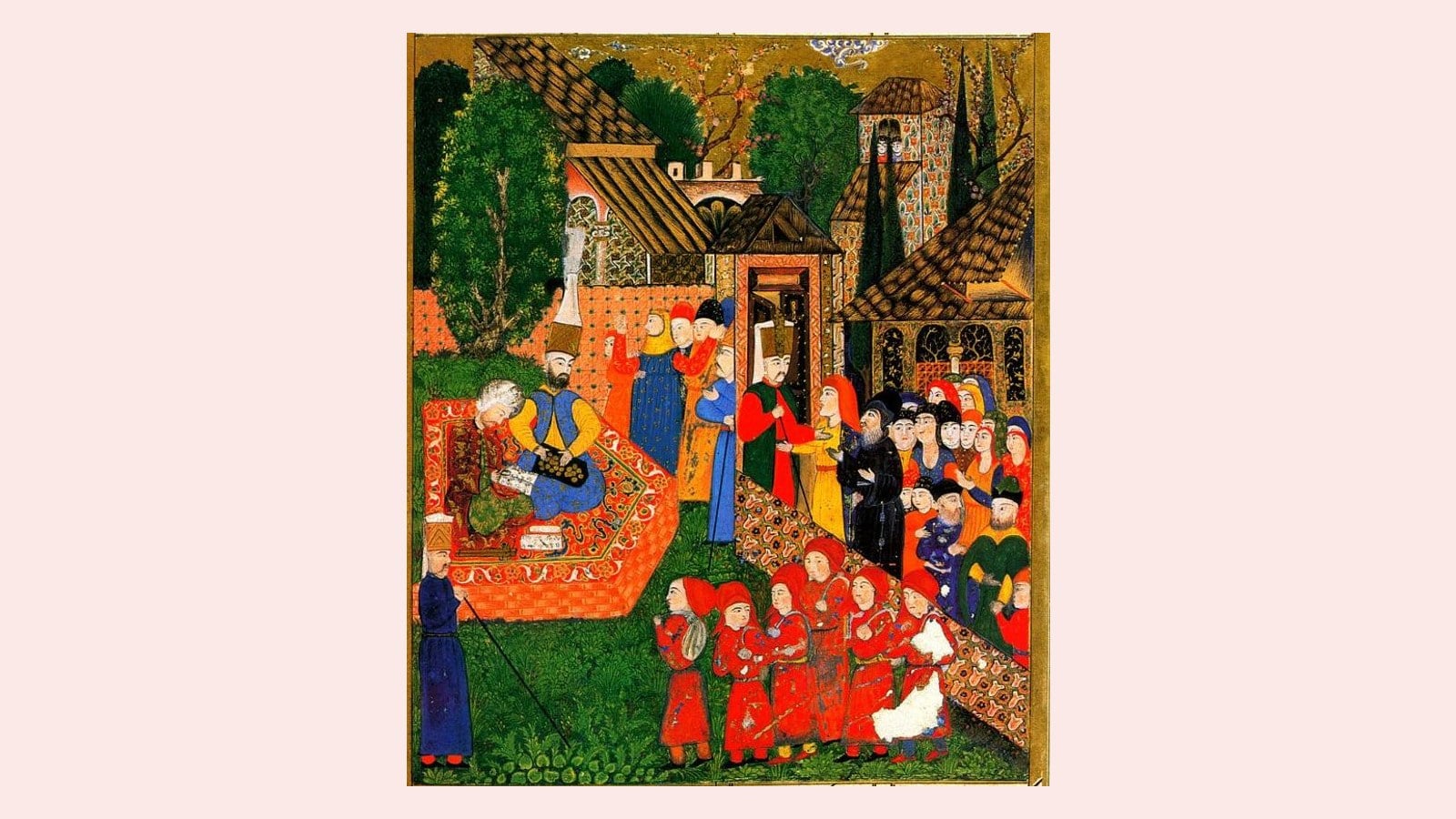
Every few years, the collectors came.
Ottoman officials — accompanied by a local kadi and a janissary escort — rode into the Christian villages of Albania, Greece, Serbia, and Bosnia with a register and a quota. They lined up the boys. They checked teeth, limbs, height. They picked the ones they wanted — roughly one boy for every forty households, aged 8 to 18 — and wrote the names in the register. Then they took them.
The boys walked east to Istanbul. Most never saw their families again. They were circumcised, converted to Islam, and trained. The best went to the Enderun palace school to become administrators, governors, and grand viziers. The rest entered the Acemi Oğlan cadet corps and graduated into the janissary infantry — the Ottoman Empire’s most feared fighting force. The system that produced them was called the devshirme, and it ran for roughly 250 years.
For Albanian families, the devshirme was both a wound and, paradoxically, a ladder. It took sons. It also created some of the most powerful men in the Ottoman world — including Skanderbeg, who turned what the empire taught him against the empire itself, and the Köprülü grand viziers, who ran the empire from the top for more than half a century.
How the system worked
The devshirme (Turkish: devşirme, literally “collecting”) began under Sultan Murad I around 1380. Written records first mention it in 1438, but the practice likely predated the documentation. It was a form of human taxation — the Ottomans called it a tribute in kind in place of the cash head-tax (cizye) that Christian subjects owed.
The levy operated on a cycle, recurring every 3 to 7 years depending on the empire’s military needs. Each cycle collected between 1,000 and 3,000 boys from across the Balkans. The targeted populations were rural Christians — Albanian, Bulgarian, Greek, Serbian, Macedonian — and the selection criteria were specific:
- Age: 8 to 18 (some sources say 7 to 20)
- Health: physically strong, no visible defects
- Exemptions: only sons, orphans, and married boys were technically exempt
- Quota: approximately one boy per 40 households, rising to one per 20 in times of high military demand
The boys were registered in a document called the eşkâl defteri — a physical-description ledger that recorded each boy’s name, father’s name, village, and distinguishing features. A surviving register from the Bursa region during the levy of 1603-04 documents thousands of boys collected from that area alone.
Once selected, boys were marched to Istanbul in groups, handed over to Turkish farming families in Anatolia for several years to learn Turkish and adjust to Muslim life, and then sorted. The most promising — the tallest, the sharpest, the most physically imposing — went to the Enderun, the palace school inside Topkapı. The Enderun was one of the most sophisticated schools of government in the early modern world: its graduates administered provinces, commanded armies, and governed the empire. The rest entered the Acemi Oğlan (cadet corps), where they trained with weapons, drilled in formation, and learned the janissary code. After years of training, they graduated into the janissary ranks.
The janissary corps
The janissaries (yeniçeri, “new soldiers”) were the Ottoman Empire’s elite standing infantry. Founded in the 1360s, they were the first professional army in Europe since Rome’s legions — a permanent, salaried force that answered to the sultan alone.
By the 1500s, the corps numbered between 10,000 and 40,000 men. They were organized into orta (companies), each with its own barracks, mess hall, and officer hierarchy. They fought with composite bows, then matchlock muskets, then flintlocks — adopting firearms earlier and more systematically than most European armies. Their discipline in volley fire and coordinated movement made them the most effective infantry in the Mediterranean world for over a century.
The janissaries had a spiritual dimension that was unusual for a military unit. The corps was closely affiliated with the Bektashi Sufi order, a mystical Islamic brotherhood founded in the 13th century that blended Sufi practices with Shia elements. The Bektashis provided chaplains to the janissary barracks; a Bektashi representative was permanently attached to the corps. The janissaries were sometimes called the Tâife-i Bektâşiye — “the Bektashi tribe.”
The Bektashi connection matters for Albanian history specifically. After the janissary corps was dissolved in 1826 and all Sufi orders banned in Turkey in 1925, the Bektashi world headquarters relocated to Tirana, Albania, in 1930. The order remains headquartered there today — a living institutional link between the janissary world and modern Albania.
Albania as a recruiting ground
Albanian lands were among the most heavily targeted by the devshirme. Ottoman records list Albanians alongside Bulgarians, Greeks, and Serbs as the primary source populations. The preference was not random: Albanian boys had a reputation for physical hardiness and adaptability that Ottoman recruiters valued.
The demographic toll was real. Albania’s population in the 15th and 16th centuries was small — perhaps 200,000 to 400,000 — and losing even a few hundred boys per levy cycle, compounded over generations, cut into the reproductive and labor base of entire communities. The removal of young males disrupted family structures in ways that contemporary Christian accounts documented with grief.
Resistance was not passive. Albanian families developed strategies to protect their sons:
- Child marriage — only married boys were technically exempt, so families married sons as young as possible
- Physical disfigurement — some accounts describe families knocking out a son’s front teeth or cutting off a finger to make him fail the physical inspection
- Flight to the mountains — families moved to highland villages where Ottoman administrative reach was thinnest
- Conversion — the most consequential strategy: families who converted to Islam removed their sons from the levy entirely, since only Christian boys were taken
The conversion strategy had a structural logic. Converting also eliminated the jizya (non-Muslim head tax) and excused families from corvée obligations like road and bridge maintenance. For Albanian noble families, conversion opened access to hereditary timars (military land grants) that Christian lords could not hold. Elite Albanian clans — branches of the Dukagjini and Muzaka — began converting as early as the mid-1400s.
But resistance also turned violent. In 1565-66, a revolt against the devshirme erupted in the Dukagjin highlands of northern Albania — the same region governed a century earlier by Lekë Dukagjini, whose legal code became the customary law of the Albanian mountains. Further uprisings broke out in Himara in 1566 and again in 1568, triggered by new Ottoman taxation and devshirme attempts. These revolts were suppressed, but they demonstrated that acceptance of the child levy was never universal.
Albanians the system produced
The devshirme was designed to sever boys from their families and reshape them as servants of the sultan. It often succeeded. But some of the men it produced used their Ottoman training in ways the system did not intend — and several reached the highest levels of the empire.
Gjergj Kastrioti — Skanderbeg (c. 1405-1468). The most famous Albanian in history was sent to the Ottoman court as a child hostage around age 9 or 10 (circa 1415). Converted to Islam and given the name Iskender (Alexander), he spent roughly 20 years in Ottoman service and rose to command Ottoman forces. In 1443, during the Battle of Niš, he defected, returned to Albania, raised his family’s double-headed eagle banner over Krujë, and fought the empire for 25 years. Skanderbeg’s story is told fully elsewhere on this site — what matters here is that the man who became the symbol of Albanian resistance was himself a product of the Ottoman military machine.
The Köprülü dynasty. Köprülü Mehmed Pasha was born around 1575 in Roshnik, near Berat in southern Albania. He entered Ottoman service through the palace kitchens and rose through the imperial household over decades. He became Grand Vizier in 1656 and founded a dynasty that produced six grand viziers between 1656 and 1710 — a stretch of more than half a century during which an Albanian family from a village near Berat effectively governed the Ottoman Empire. The Köprülü era is covered in the Albanian grand viziers article; in context here, it demonstrates that the same pipeline that extracted Albanian boys also funneled them into the empire’s highest office.
Muhammad Ali Pasha (1769-1849). Born in Kavala (in modern Greece) to an Albanian family from the Korçë region, Muhammad Ali was not a devshirme recruit — he joined the military voluntarily at 18. But he is a product of the broader Albanian military tradition that the devshirme helped create. He became the Ottoman viceroy (wāli) of Egypt in 1805, modernized its military and economy, and founded a dynasty that governed Egypt until the republic was declared in 1953. He is often called the founder of modern Egypt.
These are the names that survived in the historical record. For every Skanderbeg or Köprülü, thousands of Albanian boys entered the system, served, and died without leaving a trace in the archives — their names in the eşkâl defteri the only evidence they existed.
The devshirme and Albanian Islamization
The devshirme was not the sole cause of Albanian conversion to Islam, but it was one of the system’s most powerful accelerants.
The arithmetic was straightforward: Christian families paid the jizya, faced the devshirme, and bore corvée obligations. Muslim families paid none of these. For Albanian peasant households operating at the margin of subsistence, conversion was an economic calculation as much as a religious one. For noble families, it was a political survival strategy — Muslim Albanian lords could hold timars, command local militias, and rise within the Ottoman provincial administration. Christian lords could not.
The conversion happened gradually, not overnight. Through the 1500s, much of Albania remained Christian. By the late 1600s, roughly 70 percent of Albanians had converted — the highest Islamization rate in the Balkans. Scholars who have studied the process — including the historian Noel Malcolm and the demographer Machiel Kiel — generally characterize it as driven by fiscal incentive and elite integration rather than forced mass conversion. The devshirme was the stick; tax relief was the carrot; and over 250 years, the combination reshaped the confessional map of Albania.
The Bektashi order played a role here too. Its syncretic, tolerant approach to Islam — incorporating elements familiar to converts from Christian practice — made conversion less of a cultural rupture than it might have been under a stricter interpretation. The Bektashi tekke (lodges) that spread across Albania from the 1600s onward served as bridges between the old faith and the new.
The end of the devshirme
The devshirme’s end was gradual, not a single event. Scholars have traditionally placed an early abolition order around 1638, though no surviving decree confirms the exact date. Ottoman records document sporadic levies as late as 1666 and 1674. By the early 1700s the practice had effectively ceased.
The system ended for practical, not humanitarian, reasons. By the 1600s, the Ottoman Empire’s own population had grown large enough that it no longer needed a slave-recruitment mechanism to staff its army. Inflation had weakened the feudal timar structures that the devshirme supported. And military technology was shifting: the era of the disciplined, close-formation infantry that the janissaries represented was giving way to larger, cheaper armies equipped with mass-produced firearms.
The janissary corps itself survived the devshirme by over a century. By the 1700s, janissary ranks were increasingly filled by volunteers and hereditary members rather than devshirme recruits. The corps grew corrupt, politically powerful, and militarily ineffective. In 1826, Sultan Mahmud II ordered the janissaries dissolved — the “Auspicious Incident” — killing thousands in their barracks in Istanbul. The institution that had begun with Albanian and Balkan boys taken from their families ended in a massacre ordered by the sultan those boys had been trained to serve.
What the devshirme left behind
For Albanian Americans, the devshirme is not an abstraction from a textbook. It is part of the family story — the deep background behind why Albania is majority Muslim, why Albanian names appear in Ottoman palace records, why a boy from the highlands could end up commanding an empire’s army or governing its provinces.
The system was coercive. Boys were taken by force, converted without consent, and remade in the image of a state that had conquered their homeland. But the people who passed through it were not passive objects. Skanderbeg turned his training against the empire. The Köprülü dynasty governed the empire from within. Albanian janissaries and administrators carried their language, their networks, and — often — their loyalties into the Ottoman world and sometimes back out again.
The devshirme ended over 300 years ago. Its consequences did not. The religious composition of modern Albania — majority Muslim, with Catholic and Orthodox minorities — is, in part, the long shadow of a system that made conversion the rational choice for families trying to keep their sons. The Bektashi order, which the janissary corps nurtured, is still headquartered in Tirana. And the pattern of Albanians rising within the structures of larger states — Ottoman, Venetian, Egyptian, American — is older than any of them. The devshirme did not start that pattern, but it industrialized it.