

By some scholarly estimates, as many as 49 of the roughly 290 men who held the office of Ottoman grand vizier were Albanian — other counts are lower, depending on how Albanian origin is defined. By any measure, no other non-Turkish ethnic group supplied the empire’s highest office at a comparable rate.
The Albanian grand viziers came from towns and villages that sit on the modern map of Albania: Berat, Vlora, Delvina, Elbasan. They entered Ottoman service through the devshirme system, through military merit, or through clan networks that funneled Albanian talent toward Istanbul. Several rose to run the empire at its peak. One family from a hillside village near Berat held the grand vizierate for nearly half a century.
This article covers the Albanian grand viziers in approximate chronological order: the early figures who served under Suleiman the Magnificent, the Köprülü dynasty that dominated the late 17th century, and the provincial governors who built autonomous power bases from Cairo to Ioannina. For the pashaliks themselves, a separate article covers their territorial reach and local governance.
The Suleiman era: three Albanian grand viziers in succession
Between 1523 and 1541, all three men who served as Ottoman grand vizier were Albanian. This is the most concentrated run of Albanian leadership in Ottoman history, and it happened under Suleiman the Magnificent, the empire’s most powerful sultan.
Pargalı Ibrahim Pasha (grand vizier 1523 to 1536) was born in Parga on the Epirote coast. He was taken into the sultan’s household as a boy, became Suleiman’s close companion and closest confidant, and rose to grand vizier at roughly age 30. Ibrahim wielded extraordinary power. He commanded Ottoman armies in Hungary, negotiated with European ambassadors as an equal, and accumulated titles that no grand vizier before him had held simultaneously. He governed for thirteen years before Suleiman ordered his execution in 1536.
Ayas Mehmed Pasha (grand vizier 1536 to 1539) succeeded Ibrahim. He came from Delvina in what is now southern Albania, near the Himarë coast. Ayas had served as governor of several provinces and led Ottoman naval forces in the eastern Mediterranean. His term was competent but overshadowed by his predecessor’s dramatic career.
Lütfi Pasha (grand vizier 1539 to 1541) came from Vlora. He was a scholar and administrator who married Suleiman’s half-sister Shah Sultan. After his dismissal from office, he wrote the Asafname, a manual of statecraft that described the ideal qualities of a grand vizier and the proper administration of Ottoman government. The Asafname remains a primary source for Ottoman political thought. It is one of the few cases where an Albanian grand vizier left behind a written record of how he believed the office should function.
Later Albanian grand viziers
Koca Sinan Pasha served five separate terms as grand vizier between 1580 and 1596, under sultans Murad III and Mehmed III. He came from what is now Albania, of Albanian origin according to Ottoman sources. Sinan was a career military commander who fought in Persia, Yemen, Hungary, and across the Mediterranean. His five appointments and four dismissals reflect the volatile politics of the late 16th-century Ottoman court. The fact that the sultan kept reappointing him says something about the scarcity of qualified alternatives.
The Köprülü dynasty: one family, six grand viziers
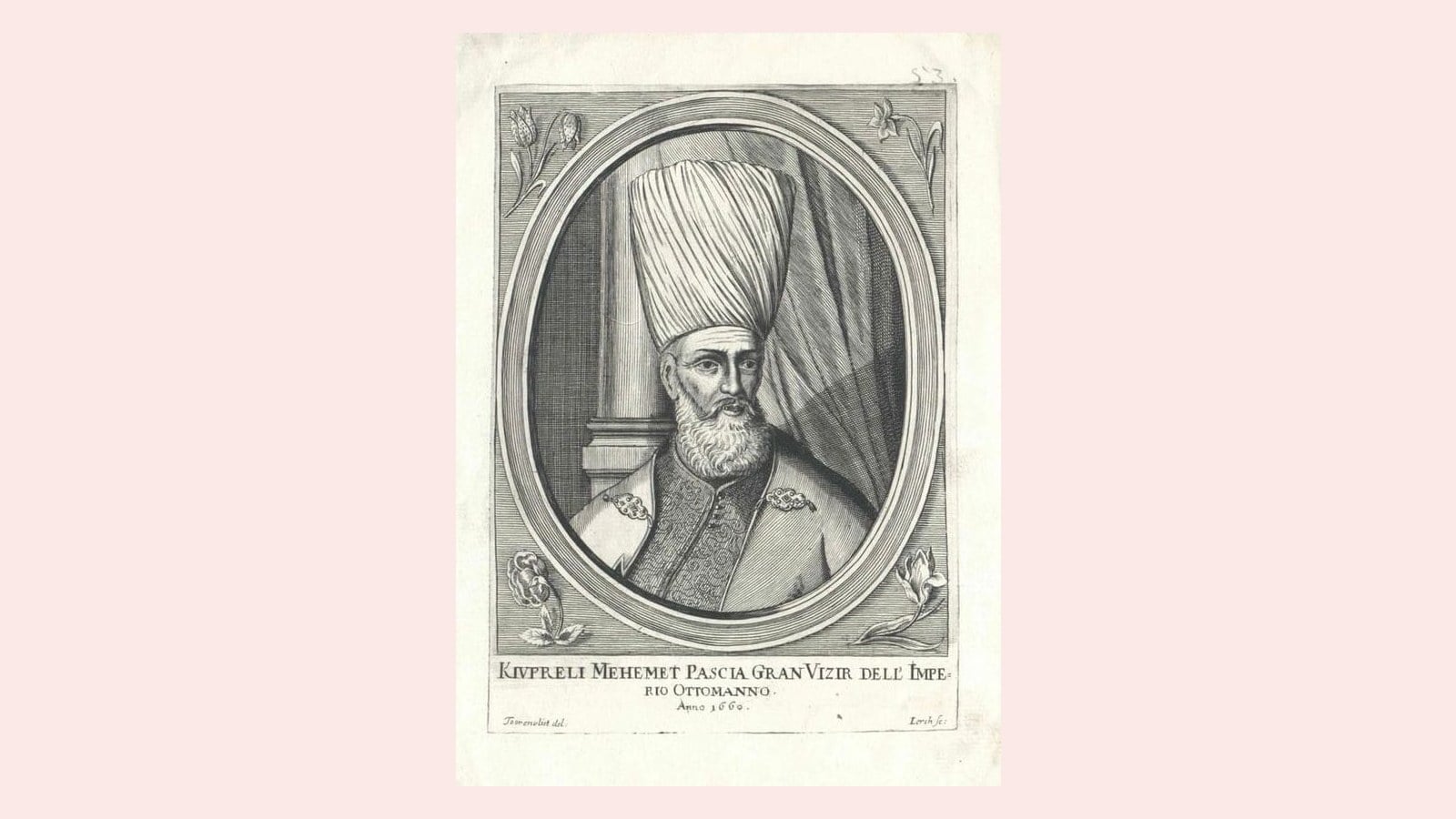
The Köprülü family came from Roshnik, a village on the hillside above Berat in central Albania. Between 1656 and 1710, six members of the family served as grand vizier, including Kara Mustafa Pasha, who was adopted into the household. They governed the Ottoman Empire during one of its most critical periods, when military defeats, fiscal crisis, and provincial rebellion threatened the state’s survival.
Köprülü Mehmed Pasha (grand vizier 1656 to 1661) accepted the office at roughly 80 years old, after a career as a provincial administrator. The empire was in crisis. A series of weak or short-lived grand viziers had allowed corruption and military indiscipline to spread. Mehmed was given near-absolute authority by Sultan Mehmed IV and used it decisively. He purged disloyal janissary commanders, restored treasury collections, and suppressed provincial revolts. He died in office after five years.
Fazıl Ahmed Pasha (grand vizier 1661 to 1676) was Mehmed’s son. He was 26 when he took office. His fifteen-year tenure was the longest grand vizierate of the 17th century. Fazıl Ahmed’s major achievement was the conquest of Crete from Venice in 1669, ending a war that had lasted more than twenty years. He also led campaigns in Poland and oversaw a period of relative internal stability. He died at 41, still in office.
Merzifonlu Kara Mustafa Pasha (grand vizier 1676 to 1683) was adopted into the Köprülü family and continued their dominance. He launched the siege of Vienna in 1683. When the siege failed, he was executed by the sultan’s order. The defeat at Vienna is often cited as the beginning of Ottoman territorial retreat in Europe.
Fazıl Mustafa Pasha (grand vizier 1689 to 1691) was another son of Köprülü Mehmed. He attempted reforms to reverse the military losses that followed Vienna. He was killed at the Battle of Slankamen in 1691, fighting against the Habsburgs.
Amcazade Hüseyin Pasha (grand vizier 1697 to 1702) was a nephew of Köprülü Mehmed. He negotiated the Treaty of Karlowitz in 1699, the first major Ottoman territorial concession in Europe. Under its terms, the empire ceded Hungary and Transylvania to the Habsburgs, the Peloponnese to Venice, and parts of Ukraine to Poland.
The Köprülü era illustrates a pattern. When the Ottoman system reached crisis, it turned to Albanian administrators who could impose order through a combination of personal authority and clan loyalty. The family’s durability across six grand viziers and half a century was not coincidence. Each Köprülü promoted relatives, protégés, and fellow Albanians into key positions, creating institutional continuity that outlasted any individual appointment.
Beyond Istanbul: the Albanian pashas
Not every Albanian who governed at the imperial level served in Istanbul. Some built autonomous power bases in the provinces. Their stories overlap with the broader history of Albanian pashaliks, but two figures deserve mention here for the scale of their reach.
Muhammad Ali of Egypt (1769 to 1849) was born in Kavala, in what is now northeastern Greece, to a family with roots in the Korça region of Albania. He arrived in Egypt as part of an Ottoman Albanian military contingent sent to fight Napoleon’s forces. By 1805 he had seized power in Cairo. Muhammad Ali modernized Egypt’s army, built its first industrial base, and established a dynasty that ruled until 1953. His descendants included King Farouk, who abdicated in 1952 in favor of his infant son Fuad II, the last king of Egypt. Muhammad Ali’s Egypt was technically an Ottoman province. In practice it operated as an independent state and twice went to war against the sultan.
Ali Pasha of Tepelena (1743 to 1822) governed a semi-autonomous domain centered on Ioannina (now in northwestern Greece) that stretched from southern Albania to the Gulf of Corinth. His court attracted European diplomats, travelers, and writers. Lord Byron visited in 1809 and described him in Childe Harold’s Pilgrimage. Ali Pasha maintained his own army, conducted independent foreign policy, and at his peak controlled more territory than some European states.
The Bushati family governed the Pashalik of Shkodra in northern Albania for much of the 18th century, operating with similar autonomy. These provincial power centers share a common thread: Albanian military talent that the Ottoman system had cultivated eventually exceeded what the system could control.
How Albanians reached the grand vizierate
Three mechanisms explain the concentration.
The first is the devshirme system. From the 14th through 17th centuries, the Ottoman state periodically collected boys from Christian Balkan villages, converted them to Islam, and trained them for military or administrative service. Albanian villages were a regular source. The boys who entered this pipeline lost their family ties and owed their entire career to the sultan, which made them reliable instruments of central authority in a way that Turkish nobles with existing clan loyalties were not.
The second is geography. Albania’s mountainous terrain produced fighters. Ottoman administrators valued the martial culture of the Albanian highlands for the same reason they valued similar cultures in the Caucasus: communities that had spent generations in armed clan feuds produced soldiers and commanders who required minimal additional training.
The third is voluntary conversion. Unlike the devshirme, which operated through forced collection, many Albanian families converted to Islam and entered Ottoman service voluntarily, especially from the 17th century onward. This was not a spiritual choice in most cases. It was a career decision. A Muslim Albanian could hold any office in the empire. A Christian Albanian could not.
The combination of these three paths created a steady pipeline of Albanian talent into the highest levels of Ottoman government. Scholarly estimates of the Albanian share vary — some count as many as 49 grand viziers of Albanian origin, others fewer — but by any measure, Albanians were the most represented non-Turkish group in the office.
What this means for Albanian-American families
The Albanian grand viziers are not household names in most American Albanian communities the way Skanderbeg is. They should be.
These were not minor functionaries. They were the executives of the most powerful state in the Mediterranean world for two centuries. When Fazıl Ahmed conquered Crete, he ran a military operation larger than anything any European state had attempted in a generation. When Muhammad Ali industrialized Egypt, he built a modern state from Ottoman raw material. When Köprülü Mehmed took office at 80, he pulled an empire back from collapse through administrative competence.
The scale of Albanian representation in Ottoman government is a historical fact that most people outside Balkan studies have never encountered. It is a pattern that lasted for centuries and shaped an empire that stretched from Budapest to Baghdad.
For Albanian Americans who hear “where is Albania?” more often than they would like, the answer includes this: Albanian administrators ran the Ottoman Empire during periods when it was the most powerful state on earth. The evidence is in the Ottoman records.