
Ask an Albanian where the family comes from and, somewhere in the answer, you will usually hear about fighting — not as a hobby, but as a fact of survival. The phrasing varies. A grandmother in Worcester might say we never bent the knee. A father in Detroit might point to a portrait of a helmeted man with a goat’s-head crest. The teenager translating for both of them might just shrug and say we’re known for not backing down.
That reputation is real, and it is older than any one story. Classical Greek and Roman writers described the Illyrian tribes of the western Balkans as warlike. Ottoman sultans spent two and a half decades trying to subdue a single Albanian commander and failed for most of it. Renaissance popes called that commander a defender of Christendom. None of these writers compared notes. They reached for the same description independently, across roughly two thousand years.
This article is not a full account of any one of those eras — the National Albanian Registry has detailed pieces on the Illyrians, on Skanderbeg, on besa, and on Albanian history as a whole. The job here is the through-line that connects them. Why does the phrase “Albanians have a warrior reputation” keep coming up, and what is the sourced pattern beneath it?
We walk that pattern in order: the reputation itself, the Illyrian antiquity it starts in, Skanderbeg’s resistance, the cultural code that made all of it possible, the symbols that carry it, and what the whole inheritance means to Albanian-American families now. The frame throughout is honor and the defense of home — heritage and identity, not a celebration of violence.
A people described as martial
The first thing to understand is that “martial people” is a description applied to Albanians from the outside, repeatedly, by observers who had no reason to flatter them.
Byzantine officials, Venetian envoys, Ottoman administrators, and 19th-century European travel writers all left some version of the same note: these highlanders are hard to govern, quick to defend their own, and dangerous to corner. The observation was not always meant kindly. Empires that want to tax and conscript a population do not enjoy a population that organizes itself to resist taxation and conscription.
What makes this more than a stereotype is its consistency across sources that never coordinated. A Roman historian writing about Illyrian raiders, an Ottoman scribe logging a failed siege, and a British traveler describing a northern clan in the 1800s were not passing along a single rumor. They were each recording, in their own century, an encounter with a culture built around defense.
It helps to separate two ideas that get tangled together. One is the romantic notion of a people who simply love to fight. The other — the accurate one — is a people who lived for centuries in hard mountain terrain, often without a state they recognized as their own, and who therefore had to make defense of family, land, and given word the organizing principle of daily life. The reputation is a byproduct of that arrangement, not a personality trait.
Frame it as identity rather than boast and it reads differently. The “warrior” in the Albanian sense is closer to the one who holds the line for the household than to a conqueror. That distinction runs through every era that follows.
Illyrian antiquity: the oldest layer
The deepest layer of the story sits in antiquity, among the Illyrian tribes of the western Balkans — the Paleo-Balkan peoples that most mainstream scholarship places at the root of the Albanian line, even as it flags the specifics as still partly debated.
The Illyrians were never a single nation. They were a family of related peoples — Dardanians, Taulantii, Ardiaeans, Labeates, and dozens more — spread across the territory of modern Albania, Kosovo, Montenegro, and the Dalmatian coast. Classical Greek and Roman authors described them, collectively, as formidable: hilltop fortresses above narrow valleys, a coastal kingdom that lived partly on Adriatic raiding, and tribal kings who fielded armies against Macedon and Rome.
The most quoted episode is Queen Teuta. After King Agron of the Ardiaeans died around 231 BCE, his widow Teuta took the regency and pushed Illyrian raiders as far south as the Peloponnese and west toward the Italian shore. Roman shipping suffered, Rome demanded restraint, and — according to the historian Polybius — one of Rome’s envoys was killed on the way home. The First Illyrian War followed in 229-228 BCE. The Registry’s profile of Queen Teuta tells that story in full.
Rome fought three Illyrian Wars between 229 and 168 BCE. The last ended with King Gentius defeated and captured at his capital of Scodra (modern Shkodër) in 168 BCE, and the independent Illyrian kingdom folded into Roman control. What matters for our through-line is not the defeat but the arc before it: a small Balkan power that resisted the largest empire of its age across three wars before going down.
That is the oldest version of the pattern — a people in this exact geography, organized around fortress and clan, who fought above their weight. Albanian families who teach their children we are descended from the Illyrians are teaching the first chapter of the warrior story without always naming it as such.
Skanderbeg: the canonical resistance
If antiquity is the oldest layer, Skanderbeg is the layer everyone knows. He is the single most documented figure in pre-modern Albanian history, and his life is the canonical heritage story the whole reputation now hangs on.
Gjergj Kastrioti — given the Ottoman title Skanderbeg, İskender bey, “Lord Alexander” — was an Albanian noble taken to the Ottoman court as a young hostage and trained in its military. In November 1443 he defected, returned to the Albanian highlands, raised his family’s double-headed eagle banner over the fortress of Krujë, and in March 1444 unified the rival Albanian principalities at the League of Lezhë.
What followed is the part that built the reputation in Europe. From 1443 until his death in 1468 — almost exactly 25 years — Skanderbeg held the central Albanian highlands against successive Ottoman campaigns. He faced two sultans, Murad II and Mehmed II, the second of whom had conquered Constantinople in 1453. Sieges of Krujë broke against his defense more than once. Pope Calixtus III named him Athleta Christi, “Athlete of Christ,” in 1457, and Pope Pius II planned to make him a captain-general of a pan-European crusade in 1463 (Wikipedia: Skanderbeg).
Two details make Skanderbeg the load-bearing story rather than just a famous one. First, the documentation: Byzantine historians wrote about him, Venetian and Neapolitan archives logged his treaties, two popes corresponded with him, and his biographer Marin Barleti published a Latin life of him in Rome around 1508-1510. Most pre-modern Albanian leaders survive only in fragments; Skanderbeg survives in a paper trail.
Second, the through-line is unmistakable. He raised a double-headed eagle, organized scattered clans into a single resistance, and held a homeland in mountain country against an empire — the same shape as the Illyrian story a millennium and a half earlier, now with names and dates an entire continent recorded. His banner became the modern Albanian flag, which is why every diaspora gathering still flies the eagle that he flew.
The cultural engine: besa, the Kanun, and the kullë
The reputation did not run on famous individuals. It ran on a culture that made resistance the default setting of ordinary life. Three things powered that engine: besa, the Kanun, and the highland tower house, the kullë.
Start with besa (the Albanian code of honor — your word is your bond). Besa is a given word treated as binding to the death, and binding not just on you but on your family and your descendants. To break a besa is to mark your whole house as dishonored for generations. The Ottoman-Albanian Grand Vizier Mehmed Ferid Pasha put it plainly in 1903: an Albanian who gives besa once cannot break it. Crucially, besa is the reason behind the fighting, not the love of fighting itself. A man held the line because he had sworn to — for a guest under his roof, for a relative’s safety, for a truce between clans.
Besa is the load-bearing concept inside the Kanun (the centuries-old body of Albanian customary law), best known in the version attributed to the 15th-century nobleman Lekë Dukagjini. The Kanun governed family, marriage, property, hospitality, debt, and conflict across the northern highlands. It was transmitted orally for centuries and finally written down in full by the Catholic priest Shtjefën Gjeçovi, published posthumously in Shkodër in 1933 — 1,262 articles organized by topic (Wikipedia: Kanun). The Kanun is notorious abroad for its blood-feud provisions, but those provisions exist to contain vengeance, not to celebrate it. The code’s deeper purpose was order in a place where the state’s writ did not run.
Then there is the kullë (a fortified stone tower house). Across the northern highlands, families built tall stone towers with thick walls, small high windows, and a defensible ground floor — homes designed to double as fortresses during a feud or a raid. The kullë is the architecture of the Kanun made physical: a building that assumes the household may have to defend itself and that honors the obligation to shelter a guest. Surviving towers like the Kulla e Mic Sokolit in Tropojë still stand as monuments to that defensive culture.
Put together, the three explain the reputation better than any battle does. A people who swear unbreakable oaths, govern themselves by a code of honor when no state will, and build their houses to withstand attack will, predictably, be described by outsiders as warlike. The warrior reputation is the visible edge of a culture organized around honor and defense.
The eagle and the Land of the Eagles
Every warrior tradition needs a symbol, and the Albanian symbol is the eagle — specifically the black double-headed eagle on a red field.
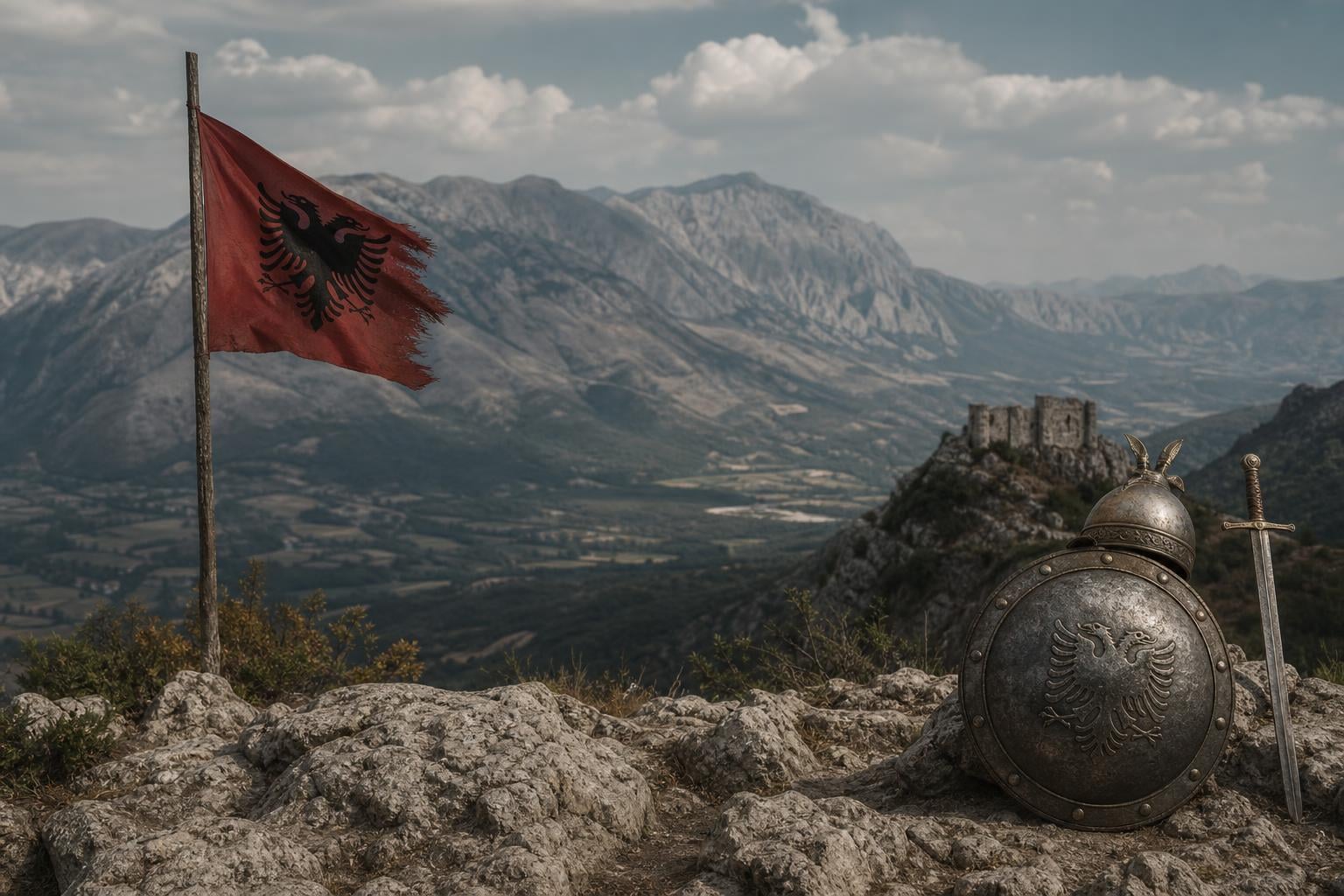
The double-headed eagle predated Skanderbeg as a Byzantine and broader Balkan motif, but it was the personal heraldic device of his Kastrioti family, and he flew it from Krujë’s walls beginning in 1443. When the Albanian national movement took shape in the 19th century, that banner was the natural rallying symbol — a documented Albanian commander who had stood against an empire. The modern flag of Albania, adopted at the declaration of independence in Vlorë on 28 November 1912, is a direct descendant of his eagle.
The eagle is woven into the name of the country itself. Shqipëria (the Albanian name for Albania, “Land of the Eagles”) is popularly tied to shqipe, the Albanian word for eagle, and Albanians have long called themselves children of the eagle. It is worth being precise here: most linguists actually trace the self-name shqiptar and the country name Shqipëria to a verb root meaning “to speak clearly,” with the eagle reading being a beloved folk etymology rather than the scholarly consensus (shqiptar meaning).
But the folk meaning is the one that stuck culturally, and for a reason. The eagle is a fitting emblem for the warrior identity: a predator that nests in high mountains, defends its territory, and does not flock. It captures how the community has long pictured itself — proud, highland, and unbowed.
For the diaspora, the eagle does heavy symbolic work. It appears on flags at the New York parade, on rings and pendants, on the wall of the Bronx restaurant with Skënderbeu over the door, and in the hashtag-era shorthand of a people keeping the symbol alive far from the mountains it came from. The eagle is how the warrior heritage travels — compact enough to wear, old enough to mean something.
How the diaspora carries the heritage
Here is the turn that matters most for an Albanian-American reader: in the diaspora, the warrior heritage survives mostly as teaching and identity, not as the battlefield.
Albanian-American families pass it down deliberately. Children learn the Skanderbeg story before they can place him on a timeline. They learn the word besa and what it costs to break one. They absorb, often without it being spelled out, that standing firm for family and community is what the name is supposed to mean. The “warrior” in a third-generation kitchen in Worcester is a grandparent insisting that your word is your bond, that a guest is sacred, that you do not abandon your own. That is the Kanun, translated into American life without the towers and the feuds.
The heritage also shows up in service. Albanian Americans have served in the US military across generations — in the wars of the 20th century and the deployments of the 21st — and the community treats that service as continuous with the older ethic of defending home. The frame is pride, plainly. Families point to a son or daughter in uniform the way an earlier generation pointed to the man who held the line for the household, because in the community’s own telling it is the same impulse pointed at a new home.
It is worth naming what the heritage is not, because the warrior frame can be misread. It is not a claim that Albanians are more violent than anyone else, and it is not nostalgia for vengeance. The blood-feud machinery of the old Kanun is rare today and broadly condemned; what endured into diaspora life is the honor side — the given word, the open door, the loyalty — not the killing side. Albanian-American community life carries the warrior story the way most peoples carry their hardest history: as example, as identity, and as a standard to live up to rather than a weapon to pick up.
That inheritance reaches across every branch of the community — Albania, Kosovo, North Macedonia, Montenegro, and the Arbëresh of southern Italy who left the Balkans centuries ago and still kept the language and the eagle. Wherever the diaspora landed, the through-line came with it.