
Ishulli i Sazanit (Sazan Island) is a small place that has held a disproportionate amount of 20th-century history. The island covers roughly 5.7 square kilometers — about 2.2 square miles — at the mouth of the Gjiri i Vlores (Bay of Vlore), where the Albanian coastline turns the corner from the Adriatic into the Ionian. It is the largest island in Albania, and on most maps of the Balkans it is a single dot (Wikipedia: Sazan Island).
The dot has been Ottoman, then Italian, then Albanian, then a Soviet forward base, then Albanian again. It has been a coaling station, a fleet anchorage, a submarine pen, a closed military zone, and, in the last few years, a tightly chaperoned tourist destination. Most of the buildings on the island today were built by foreign militaries. Most of the underground was dug by Albanian conscripts during the Cold War. The island has more bunkers than residents, and that ratio has been true for sixty years.
This article is a heritage history of Sazan, written for an Albanian-American readership. The aim is not a tour guide. It is a single-page reading of why one rock in the Adriatic ended up carrying so much modern Albanian history, and why the diaspora should know it. For broader context, see albanian-history, the Cold War backdrop in operation-valuable, and the long arc of albania-us-relations.
Geography and the Bay of Vlore
Sazan sits about five kilometers off the tip of the Karaburun Peninsula, the long arm of mainland Albania that curves south from the city of Vlore and shelters the Bay of Vlore from the open Adriatic. From the air, the bay reads as a deep, almost enclosed harbor with one narrow opening to the sea. Sazan is the cork in the bottle.
The island itself is roughly 4.8 kilometers long and 2 kilometers across at its widest, oriented broadly north-south. The terrain is hilly, with the highest point reaching about 340 meters above sea level. Vegetation is Mediterranean scrub. There is no permanent civilian population. Fresh water is limited; for most of its modern history, water has been brought in by ship or collected in cisterns.
What makes Sazan strategically important is not its size but its position. The Strait of Otranto, the narrow stretch of sea between Albania and southern Italy, is the gateway between the Adriatic and the Ionian. Any navy that controls Sazan controls the southern entrance to the Adriatic, and by extension the sea lanes to Venice, Trieste, Bari, Brindisi, and the Italian east coast. From Sazan, a coastal artillery battery can range across the strait. From the bay behind it, a submarine fleet can sortie into the Mediterranean unobserved. That is the single fact that has driven every owner of the island since the late 19th century.
The Karaburun-Sazan National Marine Park, established in 2010, includes the waters around the island and gives the area a layer of legal environmental protection. The marine park designation will become important again later in this article when we get to the 2024-2025 development controversy.
From Ottoman Sazeno to Italian Saseno, 1914
Sazan entered the modern era as Ottoman territory. Across the long Ottoman period the island had a small fishing presence, occasional grazing, and intermittent military use, but no permanent settlement of consequence. Ottoman maps record it under a romanization close to Sazeno or Saseno.
When Albania declared independence in 1912, Sazan was part of the new state’s claimed territory. That status did not last. The Great Powers convened on the question of Albania’s borders and its place in the European balance, and the Treaty of London (1915) — the secret pact that brought Italy into the First World War on the Allied side — promised Italy sovereignty over Sazan. Italian forces had already landed on the island in 1914, citing strategic necessity; the treaty formalized what was effectively a fait accompli.
Italy administered Sazan as Saseno from 1914 onward, later folding it into the Italian colonial structure that also briefly held Vlore on the mainland. Albanian sovereignty over the bulk of the country was eventually restored, and Italian forces were pushed off the mainland in 1920 after the Vlora War of that year, when Albanian fighters and a regional uprising forced an Italian withdrawal from Vlore. But Sazan stayed Italian. The mainland concession was traded, in effect, for retention of the island. By 1920, the political boundary in the Bay of Vlore ran between an Albanian shore and an Italian island five kilometers offshore.
That arrangement held for the next 27 years.
The Italian period, 1914-1947
Under Italian sovereignty, Saseno became one of the most heavily fortified small islands in the Mediterranean. The Italian Royal Navy — the Regia Marina — used it as a coaling station, a signals post, and a forward observation point on the Strait of Otranto. The First World War saw the Otranto Barrage, an Allied naval blockade across the strait designed to bottle up Austro-Hungarian submarines inside the Adriatic. Saseno sat on the southern shoulder of that operation. Italian destroyers, submarine chasers, and observation aircraft used the island and the bay behind it as a base of operations.
Between the wars, Italy invested heavily in the island’s infrastructure. Concrete batteries, ammunition magazines, barracks, signal towers, and a small power plant went in. By the 1930s, Saseno was a permanent military installation with several hundred personnel and a steady rotation of warships. The island is mentioned in Italian naval doctrine of the period as the southernmost permanent base of the Regia Marina and the anchor of the Italian position in the lower Adriatic.
The Second World War deepened the fortification. After Italy’s invasion and occupation of Albania in April 1939, Saseno and the mainland fell under a single command. Coastal artillery was expanded, anti-aircraft batteries were added, and tunnel works were started in the island’s interior. Italian forces operated submarines and motor torpedo boats from the bay against Allied shipping in the Adriatic and Ionian. After the Italian armistice with the Allies in September 1943, German forces took over Albania and parts of the Italian fortifications, including positions on Sazan.
The legal disposition of the island was settled at the Paris Peace Conference of 1946 and the Treaty of Peace with Italy signed in February 1947. Under that treaty, Italy renounced sovereignty over Sazan and the island was returned to Albania. The Italian garrison departed. The fortifications stayed. Most of the bunker plans, gun mounts, and tunnel layouts that any visitor sees on Sazan today were laid down in the Italian period and inherited intact by the new Albanian government.
The Soviet submarine base, 1950s-1961
Albania emerged from the Second World War as a small communist state under Enver Hoxha, aligned at first with both Yugoslavia and the Bashkim Sovjetik (Soviet Union). The Yugoslav alignment broke with the Tito-Stalin split of June 1948. After 1948, Albania bound itself tightly to Moscow, and Moscow noticed the geography.
What Moscow saw was a Mediterranean naval position. The Soviet Navy in the late 1940s and 1950s had no permanent forward base on the Mediterranean. The Black Sea Fleet was bottled up behind the Turkish Straits, which Turkey controlled and which NATO would soon dominate after Turkey’s accession in 1952. Sazan, paired with the deep-water anchorage at Pasha Liman on the inside of the Karaburun Peninsula, gave Moscow a forward Mediterranean port for the first time in Russian or Soviet naval history.
By the mid-1950s, the Soviet Navy had stationed a submarine flotilla in the Bay of Vlore. Sources vary on the precise composition over time, but the standing force at the peak of the deployment included roughly twelve diesel-electric submarines of the Whiskey class — Project 613 in Soviet designation — plus tenders, support ships, and supply vessels. The flotilla was crewed by Soviet personnel and operated under Soviet command, with Albanian liaison officers attached. The base at Pasha Liman handled the surface support and maintenance; Sazan handled the seaward defense, the coastal artillery, and the harbor approaches.
For roughly a decade, that base was the southernmost piece of the Warsaw Pact. The submarines patrolled the central and eastern Mediterranean and were, in NATO intelligence terms, a permanent feature of the regional threat picture. From the Albanian side, the arrangement brought hard-currency contracts, Soviet engineers, and a steady flow of military aid. From the Soviet side, it was the only Mediterranean base the navy had.
The 1961 split: the day Hoxha kept the boats
The Albanian-Soviet alliance broke in stages between 1958 and 1961, driven by the wider Sino-Soviet split and Hoxha’s decision to side with Mao Zedong against Nikita Khrushchev. The break became formal in 1961. Diplomatic relations were downgraded, Soviet aid was withdrawn, and the Pasha Liman and Sazan bases were ordered evacuated (Wikipedia: Albanian-Soviet split).
The naval handover did not go smoothly. According to the standard accounts, the Pasha Liman base held twelve Whiskey-class submarines at the time of the split. When the evacuation order came, Albanian forces blocked the base, and Hoxha’s government held onto four of the submarines — along with smaller craft, weapons, and equipment — on the grounds that they had been transferred to Albania or paid for by Albania. The Soviet crews departed without them. The four retained submarines were incorporated into the Albanian Navy, where they served for years afterward as the core of the country’s underwater fleet.
The political symbolism was as important as the hardware. A small communist state had told a superpower to leave its territory and had kept the equipment. Khrushchev was furious, but the geography worked against any Soviet response: Albania did not border any Soviet ally after Yugoslavia broke in 1948, and any military move on the Adriatic would have crossed NATO waters. Moscow swallowed the loss. Sazan and Pasha Liman became Albanian bases again, this time without Russian crews, without Russian supply lines, and without any allied navy at all.
For the diaspora, the 1961 episode is one of the cleaner stories of Albanian sovereignty in the 20th century. A country of two and a half million people removed a superpower from its territory by administrative order and kept the submarines on the way out.
The bunker landscape: Cold War fortification
The decades after 1961 were the high period of Albanian isolation. The country broke with the Soviet bloc, briefly aligned with the People’s Republic of China, broke with China in 1978, and entered a period of near-total geopolitical solitude that lasted until the collapse of the regime in 1991. Throughout that period, Sazan was a frontline military installation, treated by Tirana as the most likely target of any seaborne attack from NATO, Yugoslavia, or any other adversary.
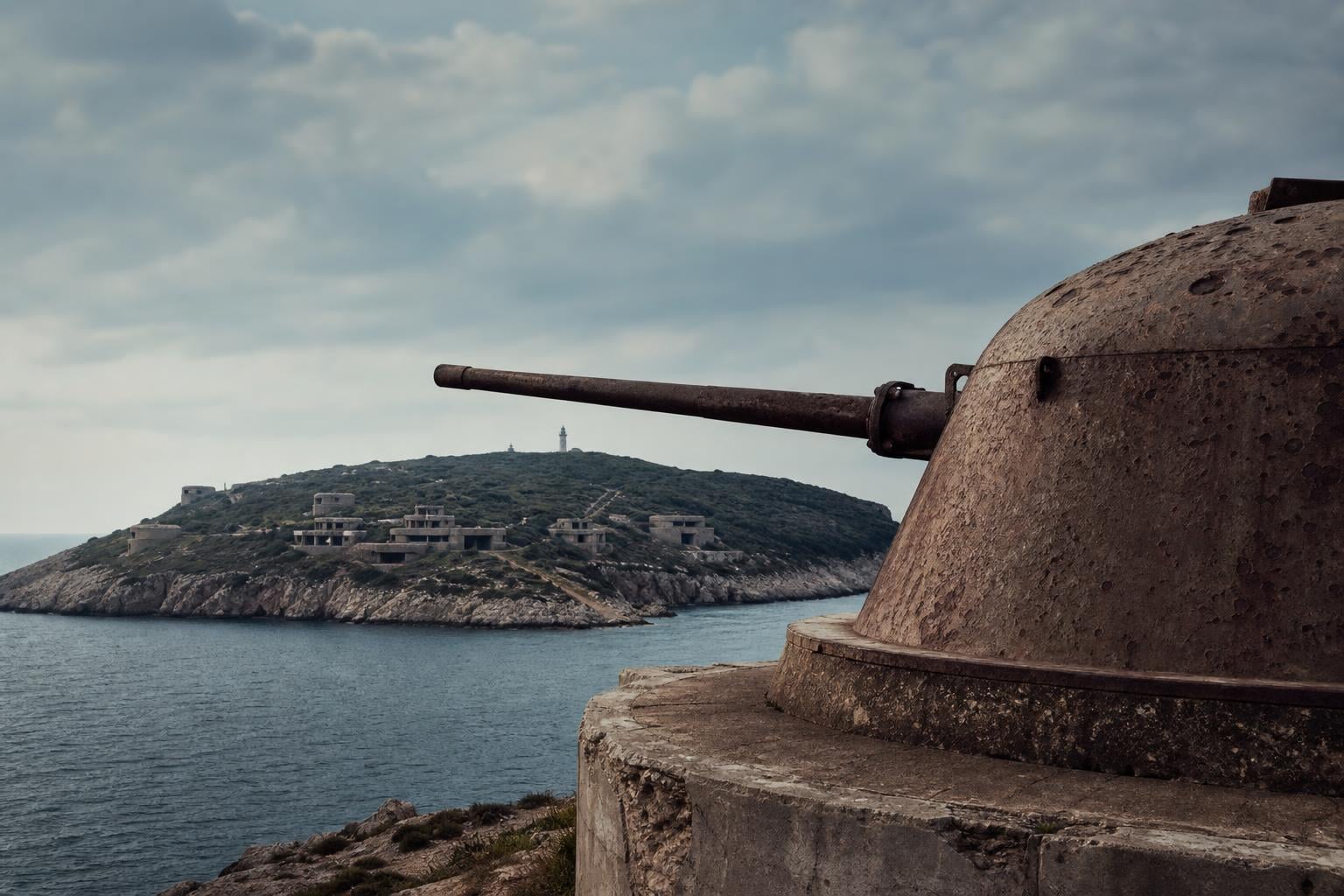
The most visible legacy of that period is the bunker landscape. Across Albania, the Hoxha government built an estimated 170,000 bunkers between the early 1970s and the late 1980s — a national defense doctrine that combined paranoia, ideological mobilization, and Chinese-influenced concrete construction. On Sazan alone, the figure widely reported in Albanian and international press is over 3,600 bunkers, plus a network of tunnels, ammunition stores, command posts, and connecting trenches dug into the island’s volcanic rock and limestone.
The structures vary in type. Single-soldier “mushroom” bunkers — the small concrete domes that became the international visual shorthand for Hoxha’s Albania — are scattered across the island in defensive arcs facing the seaward approaches. Larger pillboxes for crew-served weapons sit at higher elevations. Coastal artillery emplacements were built or refurbished from the Italian-era foundations. Underground tunnels connect command posts and ammunition magazines, in some cases running for hundreds of meters through the island’s interior. The total volume of concrete poured on Sazan has never been precisely quantified, but the island is, by mass, one of the most heavily fortified pieces of land per square kilometer anywhere in Europe.
The scale was disproportionate to any realistic threat. A NATO landing on Sazan was never seriously planned. The fortifications served as much for internal political mobilization as for actual defense. But the structures are real, and they are still on the ground.
From closed military zone to limited public access
For the entire communist period, Sazan was a closed military zone. Civilians did not visit. Photography was prohibited. Even fishermen had to keep a documented distance. After the regime change in 1991-1992, the island remained under Albanian military jurisdiction, although the strategic importance steadily declined. Through the 1990s and 2000s, the garrison shrank. Many of the bunkers fell into disrepair. The naval facilities at Pasha Liman were partly modernized under NATO cooperation programs after Albania joined the alliance in 2009, but Sazan itself stayed off-limits.
The opening came in stages. Limited day visits by special permit began in 2015. Regular guided boat tours from Vlore expanded from 2019 onward, paused during the COVID-19 period, and resumed at greater scale by 2023. Today, the standard visit is a guided boat trip from Vlore harbor, with a docking at the small Italian-era pier on the island’s eastern side, a guided walk through a few of the bunker zones and the abandoned village near the pier, and a return to the mainland the same day. Overnight stays remain restricted. Significant areas of the island, including the still-active military zones, are off-limits to civilians.
The island has no permanent civilian population. The visitor infrastructure is minimal. From a heritage perspective, the limited access is in tension with the depth of history on the ground: most of the Italian fortifications, Soviet-era buildings, and Albanian bunker network can be observed only from a marked path, and very little is interpretively presented in any language.
Sazan today: the Kushner agreement controversy
In 2024-2025, the Albanian government announced a development agreement with Affinity Partners, the private investment firm founded by Jared Kushner, for a project on Sazan and the adjacent Karaburun coast. The reported value of the agreement is approximately $1.4 billion. The announced concept involves a luxury hospitality and resort development, with a long-term lease structure rather than transfer of sovereignty.
The agreement is contested on several lines.
The Albanian government, led by Prime Minister Edi Rama, presents the project as foreign direct investment of unusual scale, framed as a vehicle for tourism revenue, employment, and infrastructure improvements in a region that has historically had limited economic activity outside of fishing and seasonal coastal tourism. Government statements have emphasized the long-term lease structure, the conservation provisions written into the agreement, and the precedent of large-scale private investment in Albanian coastal tourism elsewhere.
Opposition parties, including the Democratic Party of Albania, have raised objections on questions of process, transparency, environmental review, and the scale of land allocated to a single foreign investor. Environmental groups, including organizations active in the Karaburun-Sazan National Marine Park, have raised concerns about the impact of resort construction on the marine ecosystem, on archaeological remains both Italian-era and earlier, and on the legal status of land inside a protected national park. International press coverage has noted the unusual political profile of the investor — Kushner is the son-in-law of U.S. President Donald Trump — and the questions that profile raises about the U.S.-Albania relationship.
As of 2025, permits, environmental reviews, and political handover steps were still in process, and the project had not broken ground. The agreement remains controversial in Albanian public debate, and reasonable observers on both sides disagree on its merits. The diaspora-relevant point is that, for the first time in eighty years, the question of who controls Sazan is back in active political dispute — this time as a commercial question rather than a military one.
What an Albanian-American sees on Sazan
For an Albanian American visiting Sazan today — or reading about it from the United States — the value of the island is mostly historical. The Italian period left the architecture. The Soviet period left the submarine pens and the deep-water anchorages. The Hoxha period left the bunkers. The post-1991 period left the abandonment, and the next period, whatever it turns out to be, will leave whatever the current political process produces.
Diaspora readers tend to have one of three relationships to Sazan. The first is family memory: parents or grandparents who served in the Albanian military during the Cold War sometimes rotated through Pasha Liman or had relatives who did, and the island shows up in family stories about the 1961 split or the bunker construction years. The second is geopolitical: Sazan is the cleanest single place to point to when explaining to non-Albanian friends why a small Adriatic country mattered to three different superpowers in the same century. The third is contemporary: the Kushner agreement has put Albania on the front pages of American business press in a way that is unfamiliar, and Sazan is at the center of that coverage.
Whichever relationship is closest, the underlying fact is the same. The island is small, militarized, and strategically placed. It is part of the Albanian story, it is part of the diaspora’s story, and it is now part of an international story whose ending is not yet written. For the connection to the wider Albanian-American experience, see albanians and albania-in-america.
The National Albanian Registry’s role here is not to take a position on the Kushner deal. It is to make sure the Albanian-American community knows the history well enough to follow what happens next.
If you want to be counted as part of the diaspora that follows this story — and the wider work of recording Albanian heritage in America — register with the National Albanian Registry. The count is community-led, free, and ongoing.