

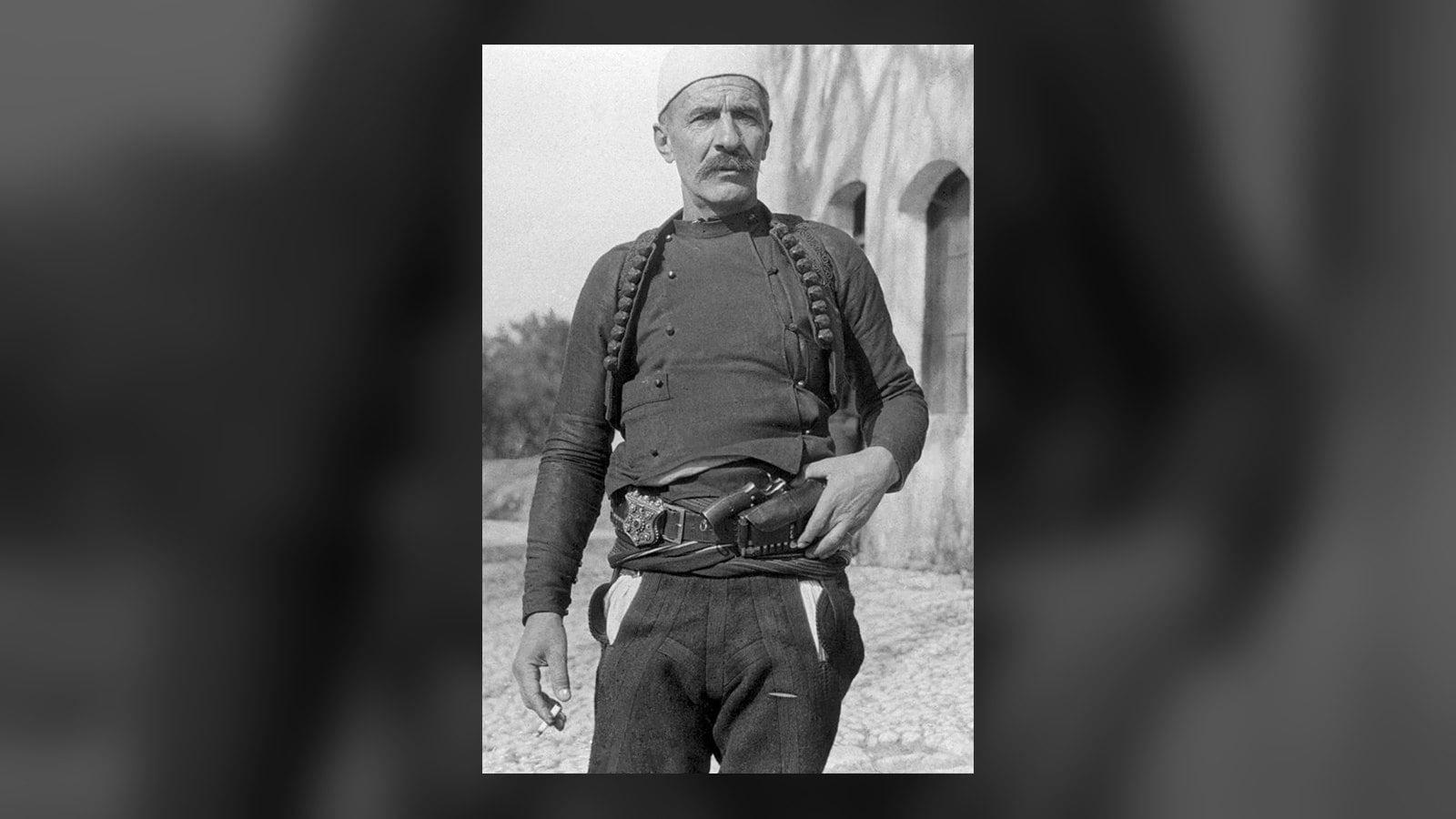
In November 1912, while delegates gathered in the port city of Vlorë to declare Albania an independent state, a guerrilla commander from the mountains of Kosovo arrived with a company of armed men. He did not come to give speeches. He came to stand guard. The commander was Isa Boletini, a man who had spent most of his adult life fighting Ottoman authorities in the highlands above Mitrovica, and his presence at the assembly connected the new state’s founding moment to the armed resistance that had helped make it possible.
This is the story of a fighter whose life ran from the Battle of Slivova to the Albanian declaration of independence to an ambush on a mountain road in Montenegro — and whose name still marks streets, schools, and community halls wherever Albanians have settled.
Born into resistance
Isa Boletini was born on 15 January 1864 in the village of Boletin, near Mitrovica in what is now northern Kosovo. The region was Ottoman territory, and the Albanian clans of the highlands had a long, complicated relationship with Constantinople — paying taxes intermittently, supplying soldiers when it suited them, and resisting centralized control when it did not. Boletini grew up in that world. His family held local standing, and he was drawn into armed resistance while still a teenager.
The first major episode in his fighting career came in 1881 at the Battle of Slivova, fought near Ferizaj in central Kosovo. Ottoman forces attempted to disarm the Albanian clans of the region — a recurring source of conflict, since the right to bear arms was bound up with clan honor and local autonomy. Boletini, then seventeen, fought alongside a contingent of Albanian fighters against the Ottoman troops. The battle did not end Ottoman control of Kosovo, but it marked the beginning of Boletini’s decades-long career as a commander willing to take the field against regular forces, not just conduct raids.
Between rebellion and the sultan’s court
Boletini’s relationship with the Ottoman state was not a simple story of permanent rebellion. Like many Albanian leaders of the period, he moved between resistance and accommodation depending on the political moment. After Slivova, there were periods when he was received in Constantinople and even served, by some accounts, in the entourage of Sultan Abdul Hamid II. The Ottoman system often worked this way with frontier leaders: bring them to the capital, give them honors, and hope their loyalty would hold when they returned home.
It did not hold for long. The Young Turk Revolution of 1908, which promised constitutional reform, initially raised Albanian hopes for greater autonomy. When those hopes were disappointed — the new government in Constantinople proved as centralizing as the old one, and in some ways more aggressive about disarmament and taxation — Albanian resistance flared again. Boletini was at the center of the revolts that broke out in 1910 and 1912. The 1912 uprising, concentrated in Kosovo, was large enough to extract concessions from the Ottoman government, including promises of administrative autonomy and Albanian-language schooling. Those concessions arrived just as the First Balkan War made them irrelevant.
The guard at Vlorë
When the Balkan War began in October 1912 and Serbian, Greek, and Montenegrin armies advanced into Albanian-populated territory, the urgency of an Albanian declaration of independence became acute. Ismail Qemali, the Ottoman-era diplomat who organized the assembly, sent word across the Albanian lands calling for delegates. Boletini answered.
He traveled from Kosovo to Vlorë — a journey of several hundred kilometers through territory that was being fought over — and arrived with a group of armed men. At the Assembly of Vlorë on 28 November 1912, Boletini and his fighters provided security. Contemporary accounts describe them standing guard at the building where Qemali read the declaration and raised the flag with the black double-headed eagle. Boletini was not a delegate in the parliamentary sense. He was the armed force that gave the assembly something more than words.
His presence mattered for another reason. The assembly needed to show that the declaration spoke for Albanians across the entire territory, not just the south. Boletini, coming from Kosovo with fighters at his back, was living proof that the northern highlands — the region most immediately threatened by Serbian advances — stood behind the new state. The League of Prizren, which had organized Albanian resistance in Kosovo decades earlier, had laid the groundwork for exactly this kind of cross-regional solidarity.
After the declaration, Boletini remained in Vlorë as part of the provisional government’s security arrangements. He was among the figures who gave the early Albanian state whatever physical authority it had, which was not much — the government controlled little territory beyond the town itself.
A prince’s bodyguard
The provisional government did not last long. The Great Powers, meeting in London, recognized Albanian independence in principle but imposed their own arrangements. In 1914 they installed Prince Wilhelm of Wied, a German aristocrat, as the ruler of the new Principality of Albania. Wilhelm arrived in Durrës in March 1914 and found a country that barely functioned as a state. Revolts broke out almost immediately, and the prince’s authority rarely extended beyond the capital.
Boletini served as part of Wilhelm’s personal guard during this period. The image is striking: a highland guerrilla commander from Kosovo protecting a European prince who had been parachuted into a country he did not know. It did not last. Wilhelm fled Albania in September 1914, barely six months after arriving, as World War I engulfed the region and his position became untenable.
The road to Podgorica
With the collapse of Wilhelm’s government and the advance of Serbian and Montenegrin forces into Albanian territory during World War I, Boletini’s situation became desperate. He retreated northward into Montenegro, moving through a landscape that was hostile in every sense — the terrain was mountainous, the winter was harsh, and the Montenegrin authorities regarded Albanian fighters as enemies.
On 23 January 1916, Boletini’s group was intercepted near Podgorica by Montenegrin forces. The details of the encounter vary across sources, but the outcome is consistent: Boletini was shot and killed in the ambush, along with several of his companions. He was 52 — he had turned 52 just eight days earlier, on 15 January.
Milovan Djilas, the Yugoslav dissident and writer who grew up in Montenegro, later described the killing of Boletini in his memoir, noting the way the event was remembered in Montenegrin oral tradition — a sign of how deeply the Albanian-Montenegrin conflict of that period cut into both communities.
After death
Boletini’s body was buried near Podgorica. For nearly a century, his grave remained in Montenegro, a point of quiet contention between Albanian and Montenegrin narratives about the wars of the early 20th century.
His remains were exhumed from Podgorica and brought to Mitrovica in 1998, where they were kept in a mosque before being moved to a temporary memorial. In 2015, a formal reburial ceremony was held near his birthplace of Boletin in the Mitrovica district. Hundreds of people attended, alongside Kosovo government officials. The event carried the weight of a national act — a fighter who had died in exile was finally laid to rest at home, almost exactly a century after his death.
Why he matters to the diaspora
A large share of Albanian Americans trace their family lines to Kosovo, and Boletini occupies a specific place in that community’s historical memory. He is the figure who connects the independence movement of 1912 to the Kosovo question that defined Albanian politics for the rest of the century — the question of why half the Albanian-speaking population ended up outside the borders of the Albanian state.
The borders drawn by the Great Powers in 1913 left Kosovo under Serbian control, a fact that Boletini had fought against and that his death underscored. When Kosovo Albanians experienced repression under Yugoslav rule, when the 1998-99 war forced hundreds of thousands to flee, and when Kosovo declared independence in 2008, the thread ran back to the same unresolved partition that Boletini had resisted with a rifle.
Streets, schools, and community organizations across the Albanian diaspora carry his name. In cities with significant Kosovo Albanian populations — New York, Detroit, Houston — Boletini is not a distant historical figure but a family reference, the kind of name that comes up when grandparents explain why the family left and what they were part of before they did.
The National Albanian Registry exists to count and connect that community — the people whose family stories include figures like Boletini, whether they know his name or not. If your family’s roots run through Kosovo, through the independence movement, through the long resistance that preceded it, you can add your name to the count. It takes about two minutes.