

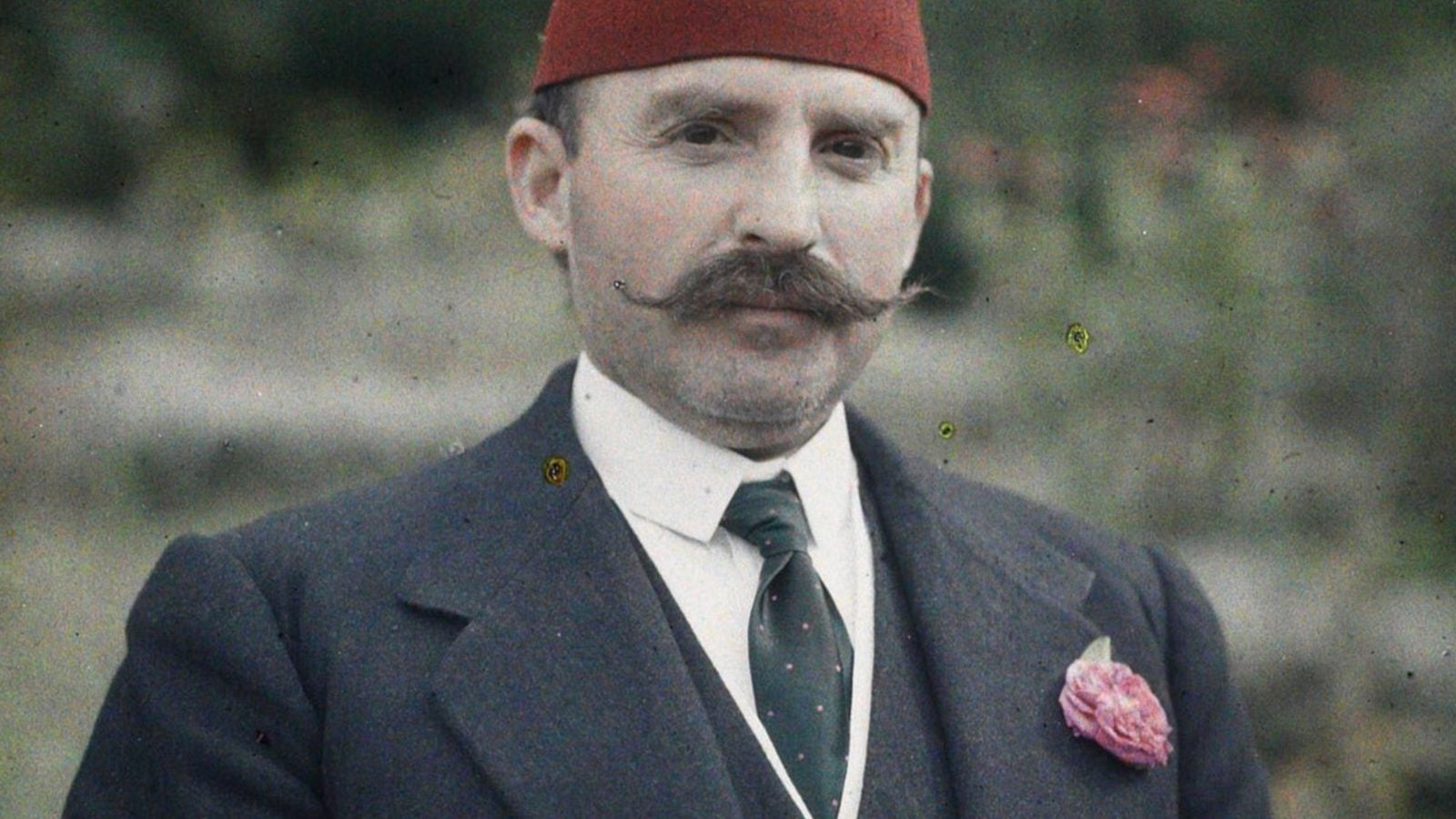
Essad Pasha Toptani is the most argued-about figure of the Albanian independence era. He commanded the defense of Shkodër during the longest siege of the Balkan Wars. He set up a rival government in Durrës to compete with Ismail Qemali’s provisional government in Vlorë. He served as Albania’s third prime minister. He signed a secret treaty with Serbia. He declared war on Austria-Hungary. And on a June afternoon in 1920, a 24-year-old Albanian student walked up to him outside a Paris hotel and shot him dead.
His story can be told as tragedy or treason — and Albanians have told it both ways for over a century. The neutral version, insofar as one exists, is that Essad Pasha operated in the same impossible environment as every other Albanian leader of the period: an empire collapsing, neighboring states carving up Albanian-speaking territory, and Great Powers deciding the outcome regardless of what any Albanian wanted. Within that environment, he made choices that served his own power first. Whether those choices also served Albania is the question that makes him divisive.
The Toptani family and Ottoman career
Essad Pasha was born in 1863 in Tirana, then part of the Ottoman Empire. His father was Ali Toptani; his mother, Vasfije, came from the Alizoti family. Through his mother he was a first cousin of Aqif Pasha Biçakçiu, who would play his own role in the independence era. The Toptani were one of the most prominent landowning clans in central Albania, with substantial holdings near Tirana and Durrës and roots reaching back to the founding of modern Tirana. The family’s reach into Albanian politics extended beyond Essad: a Toptani woman, Sadije, later became the mother of King Zog I.
Under the Ottoman system, Essad held a series of administrative and military positions. He served as kaymakam (sub-governor) and commanded the gendarmerie in Tirana. When the Young Turk Revolution restored the Ottoman constitution in 1908, he joined the movement and was elected to the Ottoman parliament. He participated in organizing the Albanian revolts of 1912 that preceded the declaration of independence.
The Siege of Shkodër (1912–1913)
When the First Balkan War broke out in October 1912, Essad Pasha was one of two Ottoman commanders defending the northern Albanian city of Shkodër (Scutari) against Montenegrin and Serbian forces. The other commander was Hasan Riza Pasha, who held the senior position.
The siege lasted six months, from October 1912 through April 1913. The defending Ottoman and Albanian forces numbered some 20,000 to 25,000. Montenegrin losses ran to about 3,000 killed; Ottoman losses were far lighter, in the low hundreds. The city held through the winter of 1912–13, and the defense earned both commanders international attention.
On 30 January 1913, Hasan Riza Pasha was shot and killed. The circumstances have never been definitively established. Multiple contemporary accounts attribute the killing to Essad’s men, alleging that Essad wanted sole command so he could negotiate a surrender on terms that would advance his political ambitions. Other sources treat the killing as unresolved. What is not disputed is that with Hasan Riza dead, Essad became the sole commander.
On 23 April 1913, he surrendered the city. The terms were notably generous to the losing side: Essad and his troops were allowed to leave with full military honors, their personal weapons, and their equipment — everything except the heavy artillery. Multiple contemporary accounts report that Essad received a substantial sum of money from Montenegro’s King Nikola — some sources specifying £10,000 sterling.
The arrangement had a political dimension. Montenegro had reportedly promised to support Essad’s ambitions to become ruler of Albania. With his army intact and a treasury that most Albanian leaders could not match, Essad headed south.
A rival government in Durrës (1913)
While Ismail Qemali’s provisional government struggled to maintain its hold on Vlorë and win international recognition, Essad set up his own power base. On 16 October 1913, he established the Republic of Central Albania in Durrës — a rival government that directly undermined the fragile unity the Vlorë assembly had tried to create.
The timing was not accidental. The Great Powers in London were in the process of deciding Albania’s borders and form of government. By presenting himself as an alternative center of authority, Essad was positioning himself as the man the Powers should deal with — or at least as someone who could not be ignored. His base in Durrës, the country’s largest port at the time, gave him a logistical advantage that the Vlorë government lacked.
The republic lasted until 7 March 1914, when Prince William of Wied arrived to take the throne of the Principality of Albania — the state that the Great Powers had designed to replace both competing Albanian governments.
Cabinet minister under Prince Wied, then arrest and exile (1914)
When Wied arrived in Durrës, Essad was named minister of war and internal affairs in the new government, formed under Prime Minister Turhan Përmeti. Essad became, in effect, the most powerful Albanian in the principality’s cabinet, controlling much of the country’s armed force.
The arrangement did not hold. In May 1914, Wied’s government accused Essad of plotting a coup and conspiring with Serbia and Italy. On 19 May, when Essad refused to lay down his weapons, armed forces under the Dutch gendarmerie officer Johan Sluys surrounded and shelled his house in Durrës. Essad surrendered, was arrested, and was deported to Italy aboard an Italian warship. The evidence for the coup plot was contested at the time and remains so.
With or without a coup, Essad’s removal did not stabilize Wied’s government. The principality was already collapsing under the weight of internal revolts and external pressures. Wied himself left Albania in September 1914, and the state the Great Powers had designed lasted barely six months as a functioning government.
The Serbian alliance and World War I
From Italy, Essad moved to reinsert himself into Albanian politics with foreign backing. In September 1914, he signed a secret treaty with Serbian Prime Minister Nikola Pašić — the Treaty of Niš — formalizing the cooperation between them. With Italian and Serbian financial support, he built armed forces and recaptured territory in central Albania. On 5 October 1914, with Wied gone and Përmeti’s term over, Essad took the post of prime minister — Albania’s third, after Ismail Qemali and Turhan Përmeti — a title whose legitimacy outside his Serbian- and Italian-backed territory remained contested.
By mid-1915, Serbian forces had occupied much of eastern Albania — Pogradec, Elbasan, Tirana, and Kavajë. Essad operated from Durrës as the ruler of central Albania with foreign sponsorship. His power base weakened in November 1914 when Muslim rebels in central Albania turned against him, but with Italian backing he held the port city.
In December 1915, he declared war on Austria-Hungary to align himself with the Entente powers. He also profited from the arrangement by taxing all Allied supplies that passed through Albanian territory on their way to the Serbian army — a revenue stream that made him one of the wealthiest Albanian figures of the war years.
When Austria-Hungary swept through central and northern Albania in the spring of 1916, Essad’s position collapsed. He fled to Thessaloniki and then to France.
Paris and the assassination (1916–1920)
In France, Essad won recognition from French authorities as the head of an Albanian government-in-exile. He spent two years in Paris attempting to organize international support for Albania and to position himself for a role in the postwar settlement. When the Paris Peace Conference opened in 1919, he represented Albanian interests — or his version of them.
The effort stalled. Italy, which had its own plans for Albania under the secret Treaty of London, worked against Essad’s recognition. The conference did not seat him as Albania’s official representative.
Back in Albania, the Congress of Lushnjë in January 1920 had established a new government that rejected any claim Essad had to authority. Albanian political sentiment had turned against him. His secret treaty with Serbia, his profiteering during the war, and his record of working with foreign powers to install himself over Albanian opposition had accumulated into a broad consensus: he was working for himself, not for Albania.
On 13 June 1920, Avni Rustemi, a 24-year-old student from Libohovë in southern Albania, waited outside the Hotel Continental in Paris. When Essad Pasha emerged, Rustemi shot him twice with a Smith & Wesson revolver — once in the neck, near the spinal column, and once in the left chest. Essad died from his wounds. He was 57 years old.
The trial and its aftermath
Rustemi was arrested immediately and tried by a French court. The defense argued that Essad Pasha had betrayed Albanian national interests through his dealings with Serbia and Montenegro, and that Rustemi had acted to protect Albanian sovereignty. On 20 December 1920, the French jury acquitted him.
The acquittal was received as a national vindication in Albania. Rustemi returned home and entered politics, serving in the Albanian parliament. He was himself assassinated in Tirana in April 1924 — his death became one of the triggers for the political crisis that brought Fan Noli briefly to power before Ahmet Zogu took control.
Why he still divides opinion
Essad Pasha Toptani is not forgotten. He is argued about. In Albanian political memory, he occupies the space of the figure who had the resources and connections to serve the national cause but chose personal ambition instead — or, depending on whom you read, the figure who understood that Albanian independence required dealing with the powers as they were, not as Albanian nationalists wished them to be.
The first reading dominates. For most Albanians, the secret treaty with Serbia, the surrender of Shkodër under suspect terms, and the rival government in Durrës form a pattern of self-serving betrayal. The second reading — that Essad was a pragmatist operating in a theater where every Albanian leader made compromises with foreign powers — has its historians, but it has never won a popular audience.
For Albanian Americans, Essad’s story is part of the same independence-era history that includes Ismail Qemali and 28 November 1912. The difference is that Qemali is remembered for creating something — a declaration, a government, a national act. Essad is remembered for fracturing it. Both operated in the same impossible decade. Both dealt with the same foreign powers. One became Babai i Kombit. The other became the cautionary example of what happens when personal ambition and national interest come apart.