Enver Hoxha ruled Albania for 41 years — from November 1944 to his death on 11 April 1985. In that time he banned every religion, built 173,000 concrete bunkers, executed roughly 5,500 people, imprisoned tens of thousands more, sealed the borders so completely that leaving was a felony, and broke alliances with Yugoslavia, the Soviet Union, and China in succession until Albania had no allies at all. He ran the most isolated state in Europe for longer than any other communist leader on the continent.
He also came from Gjirokastër, studied in France, spoke fluent French and Italian, and quoted Voltaire. The gap between the cosmopolitan biography and the paranoid dictatorship is part of what makes the story hard to reduce to a single frame. This article does not try to. It walks the life chronologically: where he came from, how he took power, what he did with it, and why the regime he built is the reason so many Albanian-American families are in the United States today.
For the end of communist rule — the 1990 protests, the 1991 elections, the statue toppling in Skanderbeg Square — see that article. For the 1967 atheism decree and the 23-year ban on religion, see that one. For the 1997 pyramid-scheme collapse that followed the regime’s economic aftermath, see that. This piece is about the man.
Gjirokastër
Enver Hoxha was born on 16 October 1908 in Gjirokastër, a stone-built Ottoman town in southern Albania. His father, Halil Hoxha, was a Muslim cloth merchant who traveled internationally for trade — to Istanbul, Cairo, and Western Europe. His mother was Gjylihan Hoxha. The family was comfortably middle-class by local standards, Sunni Muslim, and connected to the regional merchant networks that ran through the Albanian south.
Gjirokastër in 1908 was still part of the Ottoman Empire. Albania did not yet exist as a state — the declaration of independence came four years after Hoxha’s birth. He grew up in a town that would pass through Greek occupation during the Balkan Wars, come under Italian influence between the world wars, and be occupied by Italy and Germany during World War II. By the time he took power at 36, the country he inherited had existed for only 32 years, had never had a stable government, and had been occupied or partitioned by its neighbors in almost every decade of its existence.
Education: Korçë, Montpellier, Brussels
Hoxha attended the French-language secondary school in Korçë — the Lycée Français, one of the best schools in interwar Albania — and then the American Technical School in Tirana. In 1930, he won a state scholarship to study natural sciences at the University of Montpellier in France. He did not complete a degree. He attended classes at the Sorbonne in Paris and, by his own later account, began frequenting French Communist Party meetings.
From 1934 to 1936, he worked as secretary at the Albanian consulate in Brussels. He was dismissed after communist literature was found in his possession. He returned to Albania and taught French at his former school in Korçë.
The education matters because it gave him something most Albanian political figures of his generation did not have: fluency in the language of European communism. He read Marx and Lenin in French before Albanian translations existed. He attended party meetings in Paris during the same years the French Communist Party was one of the strongest in Western Europe. When the Albanian Communist Party was founded in 1941, its leader was not a factory worker or a peasant. He was a French-educated schoolteacher who had spent years in the European cities where communist theory was produced.
The partisan war (1941–1944)
In November 1941, the Albanian Communist Party was founded with Yugoslav guidance, and Hoxha became its leader. He was 33 years old. Albania was under Italian occupation, which had begun in April 1939 when Mussolini invaded and forced King Zog into exile.
In September 1942, Hoxha helped organize the National Liberation Front at the Conference of Peza, which brought together communist and non-communist resistance groups. In July 1943, the partisan forces were organized into the Albanian National Liberation Army, with Hoxha as political commissar and later supreme commander.
The war was fought on two fronts. Against the Axis occupiers — first Italy, then Germany after Italy’s 1943 capitulation — the partisans waged a guerrilla campaign from the southern and central mountains. Against rival Albanian factions — particularly the nationalist Balli Kombëtar and the royalist Legaliteti movement — the communists fought a parallel civil war for control of post-occupation Albania. By the end of 1944, the partisans had won both fights.
On 29 November 1944, Albanian partisan forces liberated Shkodër, the last major city under German control. This is the official liberation date. Albania was one of the few European countries liberated from Axis occupation without direct Allied army intervention — a fact the regime would cite for the next 41 years as proof of Albanian self-sufficiency.
Consolidation: purges and the one-party state (1944–1948)
Hoxha moved quickly. Between 1944 and 1947, the new government executed political opponents, arrested landowners and aristocrats, banned opposition parties, nationalized property, and established a Stalinist single-party state. The Party of Labour (renamed from the Communist Party) became the only legal political organization.
The first major purge came from within. Koçi Xoxe, the deputy prime minister and interior minister, had been the strongest pro-Yugoslav voice in the party leadership. When Hoxha broke with Yugoslavia in 1948 — aligning with Stalin in the Tito-Stalin split — Xoxe was arrested, tried in a show trial, and hanged on 11 June 1949. His execution established the pattern that would run for the next 36 years: anyone who aligned with a foreign patron that Hoxha later abandoned became a traitor, and traitors were killed.
In the early 1950s, Hoxha’s regime executed a group of Albanian intellectuals in reprisal — a signal that no segment of society was exempt from the security apparatus.
The alliance cycle
Hoxha’s foreign policy followed a pattern with no parallel among other communist states. He allied with a major power, extracted economic and military aid, then broke with that power on ideological grounds — and in each case, the break was preceded by a domestic purge of anyone associated with the former ally.
Yugoslavia (1944–1948). The Albanian Communist Party was founded with Yugoslav guidance, and post-liberation Albania was deeply dependent on Yugoslav economic support. When Tito broke with Stalin in 1948, Hoxha sided with Moscow. Pro-Yugoslav officials, led by Koçi Xoxe, were arrested and executed. Yugoslav advisers were expelled.
The Soviet Union (1948–1961). For the next 13 years, Albania received Soviet economic aid, military equipment, and technical assistance. The break came over de-Stalinization. When Khrushchev denounced Stalin’s personality cult at the 1956 Party Congress, Hoxha — whose own regime was modeled on Stalinist lines — saw the denunciation as a direct threat. By 1961, the split was complete. Soviet submarines left the Albanian naval base at Vlorë. Soviet advisers went home. Pro-Soviet officials in Tirana were purged.
China (1961–1978). Hoxha aligned with Mao Zedong in the Sino-Soviet split. Chinese economic aid replaced Soviet aid. Chinese engineers helped build factories and infrastructure. The relationship survived the Cultural Revolution — Hoxha’s own 1967 religion ban was partly modeled on it. But after Mao’s death in 1976, Deng Xiaoping’s reforms horrified Hoxha. In 1978, China cut all aid. Chinese specialists were expelled.
Isolation (1978–1985). After the break with China, Albania had no major ally. Hoxha’s Albania spent its last seven years as the most diplomatically isolated state in Europe — no NATO, no Warsaw Pact, no Non-Aligned Movement, no meaningful bilateral relationships. The economy, deprived of all external aid, entered a long decline that the regime could suppress but not reverse.
The instruments of control
Three systems kept the population in line.
The Sigurimi. The Drejtoria e Sigurimit të Shtetit — the Directorate of State Security — was Albania’s secret police. It employed an estimated 10,000 officers within the Ministry of Internal Affairs, backed by a much larger and undocumented network of secret collaborators, party activists, local officials, and ordinary citizens recruited to report on neighbors, coworkers, and family members. Homes, offices, and public spaces were monitored. The Sigurimi was formally dissolved in July 1991 after the regime fell.
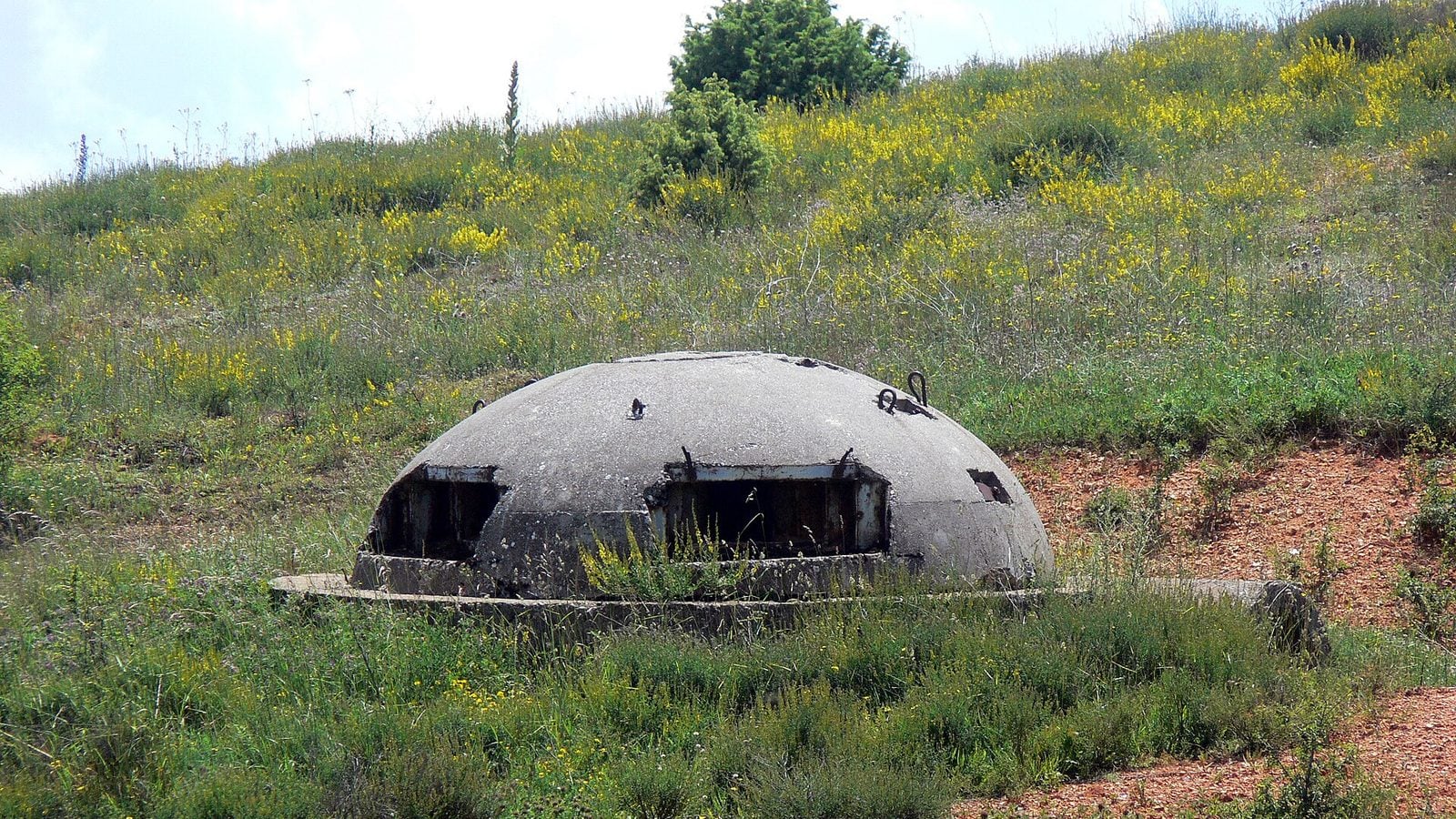
The bunkers. Between 1967 and 1986, the regime built approximately 173,000 concrete military bunkers across Albania — roughly 5.7 per square kilometer of national territory. They were designed to defend against a foreign invasion from NATO, the Warsaw Pact, or both. The invasion never came. The bunkers were never used in combat. They consumed an estimated 2% of GDP during the peak construction years and remain scattered across Albanian farmland, hillsides, and beaches today — the most visible physical legacy of the Hoxha period.
The camps. Political prisoners — real and accused — were sent to forced-labor camps at Spaç, Burrel, Qafë-Bari, and other facilities. Albania held thousands of political prisoners across a network of prison institutions and labor camps; no reliable cumulative total exists for the full life of the regime. Conditions were harsh: copper mining, canal construction, and swamp drainage in facilities with minimal food and medical care. The camp system was wound down between 1990 and 1992 as the regime collapsed.
The religion ban
In February 1967, Hoxha launched a campaign to eliminate all religious practice in Albania. By the end of the year, the country’s mosques, churches, and Bektashi teqes had been closed, repurposed, or demolished. The ban was formalized in Article 37 of the 1976 constitution, making Albania the world’s first officially atheist state. Clergy of every faith — Sunni Muslim, Bektashi, Catholic, and Orthodox — were imprisoned, sent to labor camps, or executed.
The ban held for 23 years. Our companion article on Albania as the first atheist state covers the decree, the persecution of clergy, and the post-1990 restoration in full. What matters here, in the context of Hoxha’s biography, is the ambition. Other communist states persecuted believers. Hoxha outlawed belief. The distinction reflects the nature of the regime: comprehensive, ideologically total, and willing to pursue a policy to its logical end even when no other state on earth had done so.
Mehmet Shehu and the final purge
The most consequential domestic event of Hoxha’s final years was the death of Mehmet Shehu, who had served as Albania’s prime minister since 1954 — 27 years in office, one of the longest premierships in modern European history.
On 17 December 1981, Shehu was found dead. The official announcement said suicide. The circumstances have never been fully explained. What followed was clear: Hoxha declared Shehu a foreign agent — simultaneously working for the CIA, MI6, KGB, and Yugoslav intelligence, a charge that stretched credibility — and launched a final purge (1981–1983) that swept through the government. The ministers of interior, health, foreign affairs, and defense were arrested. Several were tried and executed; their burial sites remained secret for decades.
The Shehu affair demonstrated that even the highest-ranking official in the country was not safe — that three decades of loyal service did not protect anyone from being retroactively declared a traitor. It was the last large-scale purge. Hoxha’s own health was failing. He had suffered from diabetes since 1948, and the disease had caused progressive vascular, cardiac, and kidney damage.
Death
Enver Hoxha died on 11 April 1985, at the age of 76. The cause was cardiac and renal failure following ventricular fibrillation on 9 April. He was succeeded as First Secretary of the Party of Labour by Ramiz Alia, who had been prepared for the role for years.
Hoxha was buried in a public cemetery in Tirana. In 1988, a pyramid-shaped building opened in central Tirana as the Enver Hoxha Museum, dedicated to his political legacy — it was never a tomb and never held his remains, despite being sardonically nicknamed the “Enver Hoxha Mausoleum” after the regime fell. The museum closed after 1991 and the building was repurposed over the years as a conference and exhibition venue, a NATO staging post during the 1999 Kosovo War, and a broadcasting center, standing increasingly derelict before a 2021–2023 renovation. It remains one of Tirana’s most recognizable and contested structures.
The end of communist rule came five years after his death — student protests in December 1990, the first multi-party elections in March 1991, and the final dissolution of the People’s Socialist Republic in April 1992. The economic wreckage left behind contributed directly to the 1997 pyramid-scheme collapse that produced a second crisis and a second wave of emigration.
The regime diaspora families fled
For Albanian Americans, Enver Hoxha is not a historical curiosity. He is the reason.
Emigration from Albania was a felony under the Hoxha regime. Leaving the country required Politburo approval. Foreign radio was jammed. Foreign travel did not exist for ordinary citizens. The border was patrolled, mined in some sections, and backed by a shoot-to-kill policy. For 41 years, Albania was a closed country in a way that even other communist states were not — East Germans could at least receive West German television signals; Albanians could not leave, could not communicate out, and in many cases did not know what was happening beyond the border.
When the regime fell in 1990–1992, the emigration was immediate and enormous. Roughly 5,000 Albanians climbed embassy walls in Tirana in July 1990. In August 1991, the cargo ship Vlora arrived in Bari, Italy, carrying approximately 20,000 people. Total emigration in the early 1990s ran into the hundreds of thousands. A significant share of the roughly 230,000 Albanian Americans counted by the 2024 American Community Survey trace their family arrival to the years immediately after the Hoxha regime ended.
The question that runs through Albanian-American family history — why did we leave? — leads, for a large share of the community, to this man and the 41 years he spent building a system that made staying impossible. The bunkers are still in the ground. The camp sites are still on the hillsides. The families are in New York, Michigan, Massachusetts, Connecticut, and Texas. The connection between the two facts is Enver Hoxha.